By: Violet Hirman



By: Violet Hirman
By: Evie Beaumaster
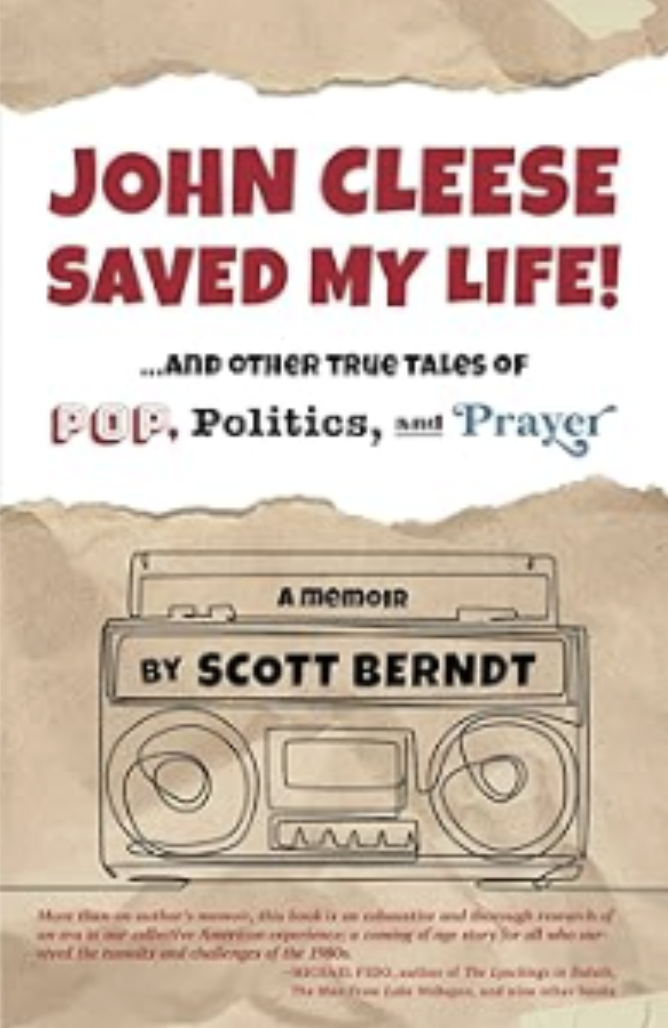
In the book ‘John Cleese Saved My Life… and Other True Tales of Pop, Politics and Prayer’, Berndt combines memories with past global events and songs, to teach not only his personal experience but the experiences of countless people. The book follows Berndt through many different times in his life and the spiritual and mental journeys that led him there.
I haven’t ever read a memoir quite like it. I believe that there are two types of memoirs, ones that share just experiences and ones that share experiences and wisdom. This book definitely shares wisdom more than just life experiences. All of the experiences that are shared here are shared in insightful ways that lead to us learning more about the bigger picture of the time period and the world. Berndt shares memories followed by quotes and song lyrics to help the reader grasp the bigger picture of the memory or the point that he is trying to share.
This book also gives insightful opinions about religion and religious beliefs, it also questions religion at its core. This book combines memory with facts about the time period and impacts of certain events, locally and globally. I think that Berndt successfully captured part of himself in the book.
This book was great, it was quick paced and cut up into short memories, and facts. This book took me approximately 3 hours to read and I finished it the same day I got my hands on the copy of the book that is available in the school library. This book is hard to put down and I only found myself stopping to eat, before I sat down and finished the entire book in one night. It was such an attention grabbing book and was an easy read.
Overall, I would recommend this book and in terms of memoirs, it is a great one. Berndt’s unique writing style helps capture the reader’s attention. I was skeptical at first, but I found myself captivated by the mix of songs, quotes and memories. Unlike some other memoirs, Berndt included research for timely events that relate to the book and this helps the reader think more deeply about the time period. I would recommend this book to older, less sensitive readers, as there are descriptions of violence and racism, as well as religious content and profanities that some readers might find offensive.
Overall, it is an excellent book that you should totally read!
For more information, please visit these websites:
| ATHLETIC EVENTS SCHEDULE: MARCH 17 – MARCH 22 | |||
| MONDAY | MARCH 17 | ||
| TIME | BUS TIMES | EVENT | LOCATION |
| 4:00pm | Badminton vs. Harding | HOME | |
| TUESDAY | MARCH 18 | ||
| TIME | BUS TIMES | EVENT | LOCATION |
| WEDNESDAY | MARCH 19 | ||
| TIME | BUS TIMES | EVENT | LOCATION |
| 4:00pm | Badminton vs. Washington | HOME | |
| THURSDAY | MARCH 20 | ||
| TIME | BUS TIMES | EVENT | LOCATION |
| FRIDAY | MARCH 21 | ||
| TIME | BUS TIMES | EVENT | LOCATION |
| 4:00pm | Badminton vs. Humboldt and North St. Paul | HOME | |
| SATURDAY | MARCH 22 | ||
| TIME | BUS TIMES | EVENT | LOCATION |
| 9:00am | 7:30am | 1:00pm | Track and Field Indoor Time Trial | U of M Fieldhouse |
By: Maya Song

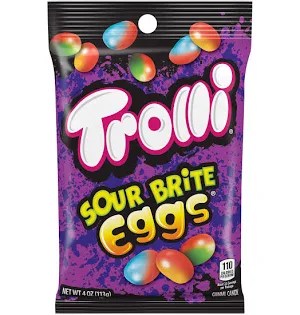
Trolli is a long standing candy manufacturing company known all across the world. It was founded in Germany in 1948 by Willy Menderer, which was then passed down to his son, Herbert Mederer in 1981. The company is now operated by the Mederer group which acquired the company in 1998.
The company expanded its reach to the United States in 1982, which introduced their product to a whole new population. Places such as Asia, North America, and Europe all saw the potential of this brand and invested in helping it grow. The fact that Trolli was given the opportunity to sell its products internationally really helped the company reach the status that it holds today, as one of the world’s biggest candy manufacturing companies ever.
They reached their highest accolade in 1993 when their famous sour glow worm won the Candy Kettle Award, a highly prestigious award that other famous companies like Ferrero, Lindt, Nestlé, and Haribo have won.
Some of their bestsellers include the sour brite crawlers, peach rings, and my personal favorite, egg gummies. Trolli is well known for having very creative flavors and designs as well as experimenting with sour flavors. The company does not sit on their laurels but constantly comes out with new things for consumers to try. They provide a variety of different gummy candies and have become a very successful and popular company due to their innovation.
While there are a plethora of other candy manufacturing companies around the world that compete with Trolli, Trolli will always be one of the originals. Trolli has remained one of the most successful ones out there for nearly 75 years, while it continues to grow its brand and followers.
In my personal opinion, I truly love Trolli gummies, especially the gummy eggs. I think that they are definitely worthy of their status, and it is always a guarantee to fulfill a sweet craving.
By: Maya Vossen-Nelson

In 2024, crime podcasts consistently occupied spots in both Apple Podcasts and Spotify’s Top Charts and IMDb announced that over 58 new TV documentary series were released in 2024.
On the surface, individuals who enjoy crime podcasts, crime TV and crime novels seem like sadists; they seek out media recalling the pain and suffering of others. But there is actually a deeper psychological component.
Individuals are attracted to tragedy because it is human nature to be highly attuned to threatening behavior. Humans want to discover the patterns, causes and outcomes of harmful situations to protect themselves and loved ones. This is a survival instinct ingrained in the human psyche since before homo sapiens emerged.
This draw is similar to the desire to know what is happening when an ambulance goes by or being unable to look away from a highway crash. Most people don’t wish harm on others, so why has an entire industry been built on this fascination?
Although the TV is relatively new, this question has puzzled philosophers for centuries. Aristotle first explored this topic and observed that “[W]e enjoy looking at the most exact portrayals of things whose actual sight is painful to us”. A Stanford Philosophy article reflects on Aristotle’s quote and reasons that there is “pleasure as arising from the knowledge acquired in viewing such representations”.
This can be further explained by brain research that shows human brains experience danger and passion in strikingly similar ways: both causing arousal, both releasing dopamine. Dopamine is often described as the brain’s ”pleasure chemical” and is responsible for actions relating to cognition and reward. Dopamine can be released during pleasurable activities (such as eating and social interaction), during the anticipation of rewards, foreseeing favorable outcomes and while achieving goals. The dopamine released while watching crime TV is produced from anticipation and from experiencing intense emotions regardless of if it is repulsion or fascination.
Studies show that women are more likely than men to seek out content that analyzes the killer’s motive, contains information on how victims escaped and what actions increase the risk of becoming a target for killers.
Female fascination with crimes is not because they are more likely to become murderers, it is actually quite the opposite. Women make up fewer than 20% of murders, are approximately 60% more likely to be victims of kidnapping and 90% more likely than men to be victims of rape.
So, the next time you see someone watching a crime documentary don’t be so quick to judge.
By: Sylvia Yannsdottir

It’s really easy to get caught up in the constant changes of life, and one way to help navigate through that is by journaling. Journaling is a productive way to sort your thoughts, and emotions, and can help you grow as a person. By taking just a few minutes of your day to write down anything that you’re thinking of, it can really help you find peace and clarity within your life.
One way that journaling has personally benefited me is by forcing me to reflect on my experiences and lessons I’ve learned. Oftentimes when I journal it leads me to re-analyze the things that I’ve experienced from a different perspective, and that leads me to look for improvement and growth within my actions.
Aside from that, journaling can strengthen many things, like memory, creativity, critical thinking, focus, and problem solving skills. There are truly no downsides to journaling, so why not start sooner rather than later?
In the past few years, it has become more popularized by society, especially social media, to establish healthy habits in your life, and one of those healthy habits is journaling. Oftentimes you’ll see more people sharing different kinds of interesting prompts, or ideas for what you can write about.
While writing isn’t for everyone, that doesn’t take away from the fact that it can be really beneficial to start journaling. Although it can be hard to maintain habits, there are plenty of ways to start small, like establishing a routine and over time gradually improving it.
I strongly believe that I’ve gained a lot in my life since I started journaling consistently, and I strongly urge others to try it out. Whether you’re a writer or not it’s something that is at least worth trying, and could really be helpful throughout your life.
By: Hermekay Dehaney
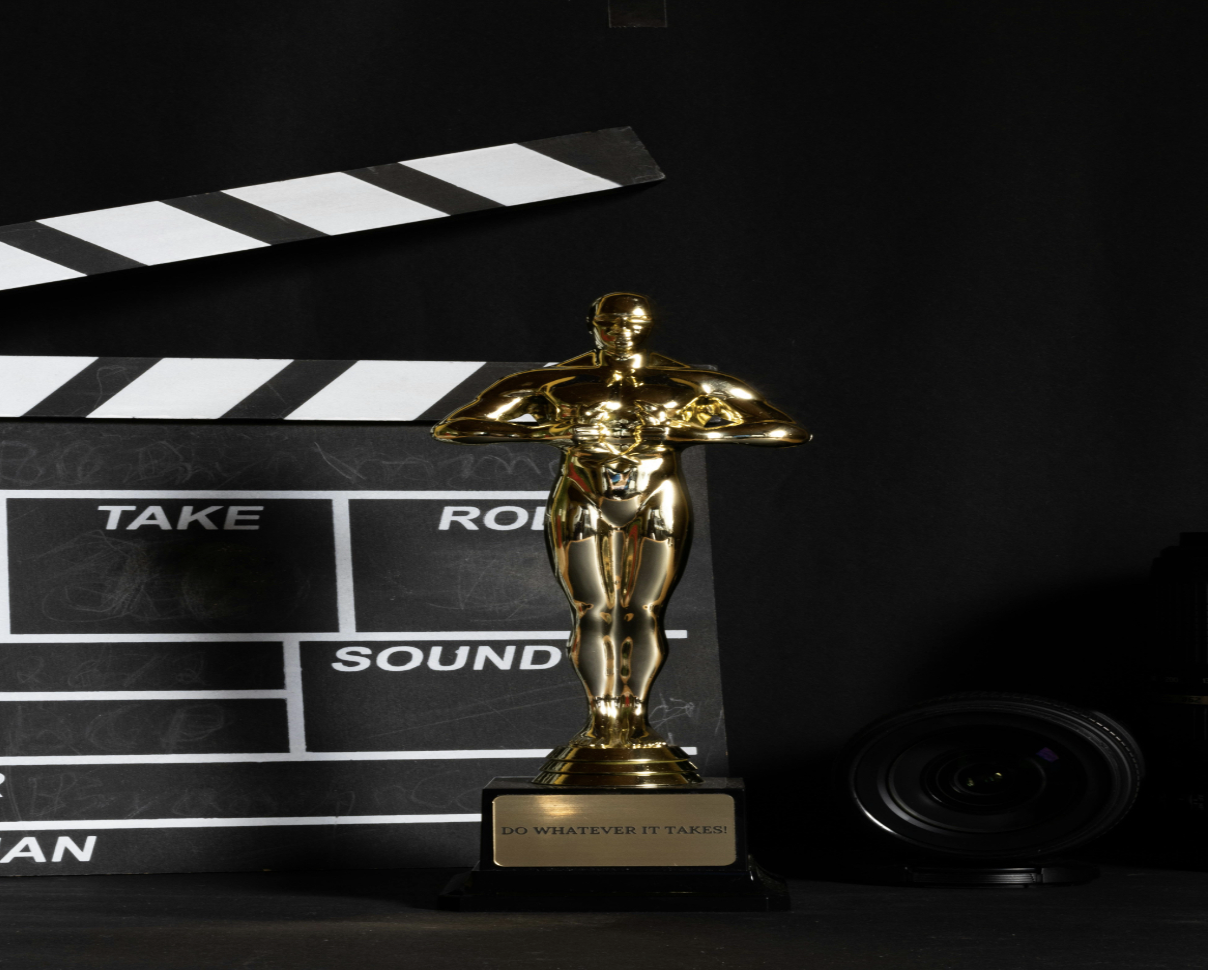
Over the years, the Oscar ceremony has delivered everything from heartfelt wins to shocking surprises, giving the audience a lot to talk about afterward. In honor of the annual Oscar awards taking place on March 2, here is a look back at some of the most memorable Oscar moments from over the years — the good, the bad, and one of the most unforgettable.
The Good:
‘Parasite’ groundbreaking win (2020)
‘Parasite’ was the first non-English language film to win Best Picture. Created by Bong Joon-ho, the South Korean film won Best Director, Best Original Screenplay, and Best International Feature Film. This win marked a turning point for the Academy because it showed that there is a potential shift to embrace international films rather than just sticking to Hollywood movies.
Leonardo DiCaprio wins first Oscar (2016)
Leonardo DiCaprio is arguably one of the most well known actors in the world. He has acted since the late 1980s, best known for movies such as ‘Titanic,’ ‘The Great Gatsby,’ and ‘The Wolf of Wall Street.’ Even after so many famous movies, and 7 Oscar nominations, Leonardo DiCaprio finally won his first Oscar for his role in ‘The Revenant,’ in 2016. He was received with a well-deserved standing ovation from the audience. He took time out of his speech to raise awareness of climate change, he said, “Climate change is real, it is happening right now, it is the most urgent threat facing our entire species, and we need to work collectively together and stop procrastinating.”
Halle Berry’s Historic Win (2002)
Halle became the first Black woman to win Best Actress for her role in, ‘Monster’s Ball.’ In her heartfelt acceptance speech, she says, “This moment is so much bigger than me. This moment is for Dorothy Dandridge, Lena Horne, and Diahann Carroll. It’s for the women who stand beside me: Jada Pinkett, Angela Bassett, and Vivica Fox. And it’s for every nameless, faceless woman of color that now has a chance because this door tonight has been opened.” Her speech remains one of the most powerful moments in Oscar history.
The Bad:
‘Moonlight’/’LaLa La’ mix-up (2017)
The 2017 Oscar ceremony is remembered for the most infamous line in Academy Awards history. 2 ½ minutes into ‘LaLa Land’s’ Best Picture win, announced by Faye Dunaway and Warren Beatty, ‘LaLa Land’ producer Jordan Horowitz informed the audience that, “There’s been a mistake. ‘Moonlight’, you guys won Best Picture. This is not a joke.” That shocking reveal overshadowed what should have been a celebratory win for ‘Moonlight.’
Adrien Brody’s Awkward Speech (2025)
Adrien Brody broke the record for the longest Oscar-winning acceptance speech, beating the record set in 1943 by Greer Garson. The speech was 5 minutes and 40 seconds of pure awkwardness. While walking on stage to accept his award, Adrien Brody spit out his gum and threw it to his wife, Georgina Chapman who then proceeded to catch it. Towards the end of his lengthy speech of thanking anyone he could think of, the Academy began to play music which is a signal that your time is up. Instead of taking that as a sign, he proceeded to say, “I’m wrapping up, please turn the music off. I’ve done this before. Thank you. It’s not my first rodeo, but I will be brief.” This is not his first time doing something like this. When he accepted his award for Best Actor for the ‘Pianist’ in 2003, his speech went over time and he responded to the music cutoff by saying, “One second, please. One second. Cut it out. I got one shot at this. I didn’t say more than five names, I don’t think.”
The Unforgettable:
Will Smith slaps Chris Rock (2022)
Often referred to as “The Slap heard around the world,” due to the video becoming a viral sensation, not just in the United States, Will Smith slapping Chris Rock is still remembered to this day, which is why I placed it as the most unforgettable Oscar moment. This moment shocked audience members and people watching at home. It was caused by an uncomfortable moment when Will Smith walked onstage and slapped Chris Rock after Rock made a joke about his wife, Jada Pinkett Smith’s bald head. The incident immediately went viral and similar to the ‘Moonlight’ mix-up, this incident cast a shadow over Will Smith’s award win for Best Actor for the movie ‘King Richard’ which he won later that night.
Whether good, bad, or unforgettable, these Oscar moments shape the legacy of The Academy and also remind us of the unpredictability of live television on one of Hollywood’s biggest nights.
By: Maeve Brady
Chemistry, and just science in general, correlates with everything in our lives. Now, something that directly relates to the water we drink, the air we breathe, and the DNA we contain is covalent bonds or also known as covalent bonding. Now, after hearing about this, you may be wondering, what exactly is covalent bonding? Well, after the further analysis I will provide in this article, I hope you gain a better understanding about its properties and how it appears in our everyday lives.
A covalent bond is a common occurrence in our lives. In simpler terms, according to the distinguished researchers at the University of Hawai’i at Mānoa, “The puppies represent atoms. The bones represent one of their electrons. Both puppies share both bones” Covalent bonding is a phenomenon where elements may share electrons in order to fill their valence electrons to get a full set. This is unlike ionic bonding, where elements steal electrons instead of sharing electrons. Covalent bonds have the goal of sharing their valence electrons to completion.
For context, in the periodic table, all of the elements have valence electrons who are located in the outermost electron shell of an atom. According to its properties, every element wants to become more stable by gaining a full set of eight valence electrons, this minimizes their energy usage and with this full set, or close to full set, of valence electrons, the element becomes less reactive. In certain circumstances, depending on the group in the periodic table, we may see different results in how reactive they are. You can check what group they are in.
If an element is in group five, then it has five electrons existing in it. And if it is in group sixteen, then it has six electrons, not sixteen. So, in the case of group eighteen, these elements are known as “noble gases”, and they have a complete set of eight valence electrons, meaning they have a full set and are not reactive; they don’t have a reason to bond with different groups in the periodic table besides themselves.
But there are a couple exceptions to this principle. One example is Helium. Helium is a noble gas with only two valence electrons instead of eight. This is because helium’s single electron shell is already completely filled. Therefore, it still demonstrates this stable and sparse reactivity.
The aspect of covalent bonding is the formation of a complete set of valence electrons after two elements share the adequate amount of electrons with one another. And with this type of bonding there are subcategories of polar and nonpolar covalent bonding.
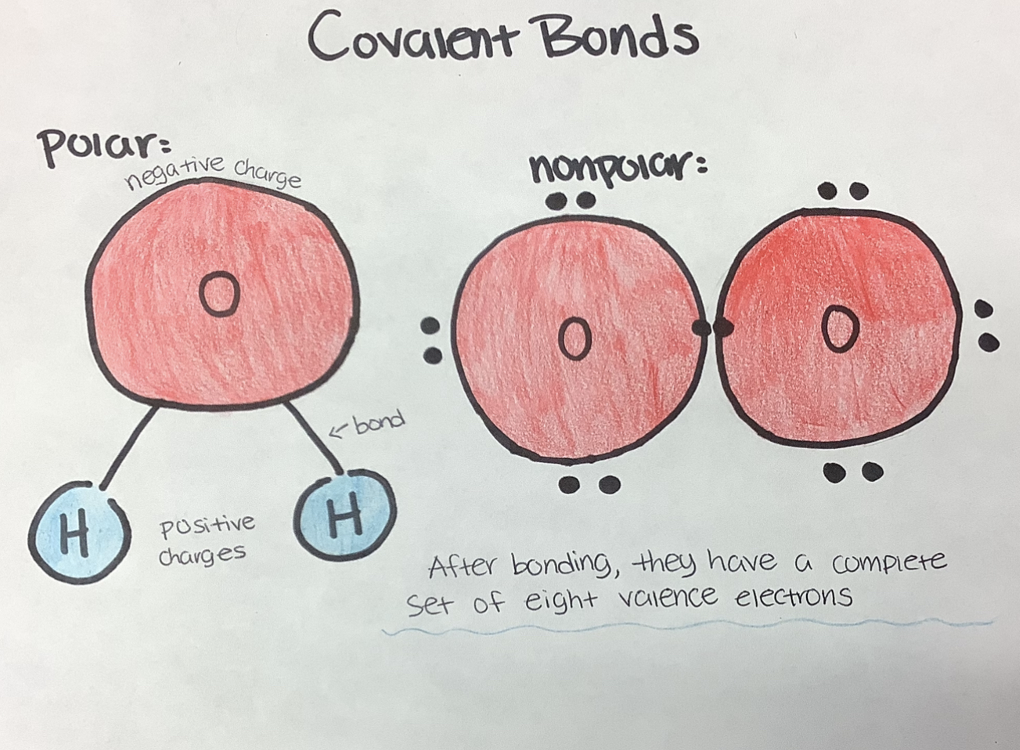
An example of polar covalent bonding would be the bonding of two hydrogen atoms and an oxygen molecule, the chemical structure of water. Oxygen has six valence electrons while each hydrogen molecule has one. This means that oxygen is almost stable and only needs two more electrons for full completion. And this is where the word “polar” comes in. “Polar” is essentially this sense of having polarity, and in the context of covalent bonding, it means a non-uniformed and unequal way of bonding. So, in the case of the chemical formation of the water molecule, oxygen and the hydrogen atoms both share their electrons, which gives them both a full set of valence electrons. But because oxygen has a higher electronegativity-oxygen has the tendency to attract electrons towards itself-so it tends to “hog” the valence electrons, hence, creating this negative charge to the originally neutral element. And with this, it creates these positive charges to the two hydrogen atoms.
Now, on the other hand, there is nonpolar bonding. Nonpolar bonding is described as the more uniformed way of bonding and in the context of covalent bonding, it is when two elements equally share valence electrons. Now, in general, you may come across more nonpolar bonds between the same elements, but that is not always the case. In fact, nonpolar bonding can be executed between two different elements as long as they share valence electrons relatively equally. The most prominent example of nonpolar covalent bonding is when two oxygen atoms can each contribute two valence electrons to complete the others’ set.
Now for the big question. How can we find Covalent Bonding in our everyday lives? Well, that is simple to answer. If we truly analyze it, we can tell that covalent bonds are in more than we may have initially thought. For example, one of the most popular examples is the properties H2O. According to the distinguished researchers at the University of Hawai’i at Mānoa, “The unequal sharing of electrons between the atoms and the unsymmetrical shape of the molecule means that a water molecule has two poles-a positive charge on the hydrogen pole (side) and a negative charge on the oxygen pole (side). We say that the water molecule is electrically polar.” This demonstrates that a polar covalent bond is how H20 comes about. And we use water in our everyday lives. It is the basis of everything, and something we rely on so heavily. Besides water, covalent bonds also may be found in our air and more, as mentioned in the first paragraph.
Thank you so much for following me along as I explain the basics on covalent bonding! I hope you now have a better understanding of this process and how it appears in our everyday lives.
By: Austin Bailey-Zimmerman

Ingredients:
Instructions:
Review:
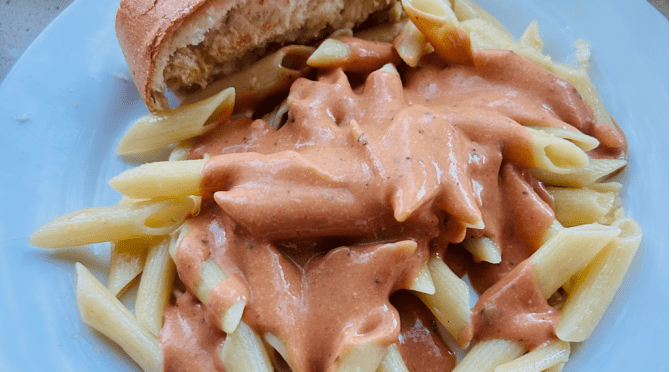
This recipe was absolutely delicious. I made it for my family for dinner, and they all loved it! We all went back for seconds because we enjoyed it so much.
The sauce is altogether so creamy and enjoyable to eat. The sauce also has a lot of flavor to it from the warm tomato flavor to the savory onion and sweet cream. I like how you can also make this recipe your own by using whatever base sauce you want and adding things to your specific taste.
I got this recipe from https://midwestfoodieblog.com/penne-rosa by Kylie. She has created this recipe to be so easy and affordable, and it doesn’t take a lot of time to have a full dinner for your family!
The sauce has the perfect ratio of flavor and paired with the noodles, it is an amazing, filling and healthy dinner!
Try this recipe out for a great dinner! I know I will for sure be making this again! Enjoy!
By: Nereida Dominguez Remedios
“Latin American music, musical traditions of Mexico, Central America, and the portions of South America and the Caribbean colonized by the Spanish and the Portuguese.” –britannica.com
“The origin of Latin music in the United States dates back to the 1930s with Rhumba. Rhumba was prominent with Cuban-style ballroom dancing in the 1930s, but was not mainstream. It was not until the 1950s and 1960s that Latin music started to become intertwined with American culture.” –wikipedia.org

Nowadays, Latin music has become one of the most listened to music genres. Now, there are different styles of music like reggaeton, norteñas, corridos, salsa’s, cumbias and many more.
In the past decades there have been many artists that have sadly died. Even though they have died they still have a big impact in music today, like Selena, Vicente Fernández, and Chálanos Sanchez, and many more. These artists have had the biggest influence on today’s Latin music.
In the last couple of years some of the biggest artists have been Bad Bunny, Feid, Raul Alejandro, J Balvin, Daddy Yankee, and Don Omar. These artists have been the most successful throughout the years. Most of these artists have upbeat songs, but they also have some music for you to get into your feelings. Like Bad Bunny, his old music is more sad where he would call it trap music.
The biggest style I know people listen to is corridos. “Corridos is a ballad in a traditional Mexican style, typically having lyrics that narrate a historical event.” -Oxford Languages
Some of the biggest artists that are known for corridos are Peso Pluma, Fuerza Regida, Nathanael Cano, Junior H, and Tito Double P and many more. These artists have helped define new regional Latin music.