
By. Selena Thao
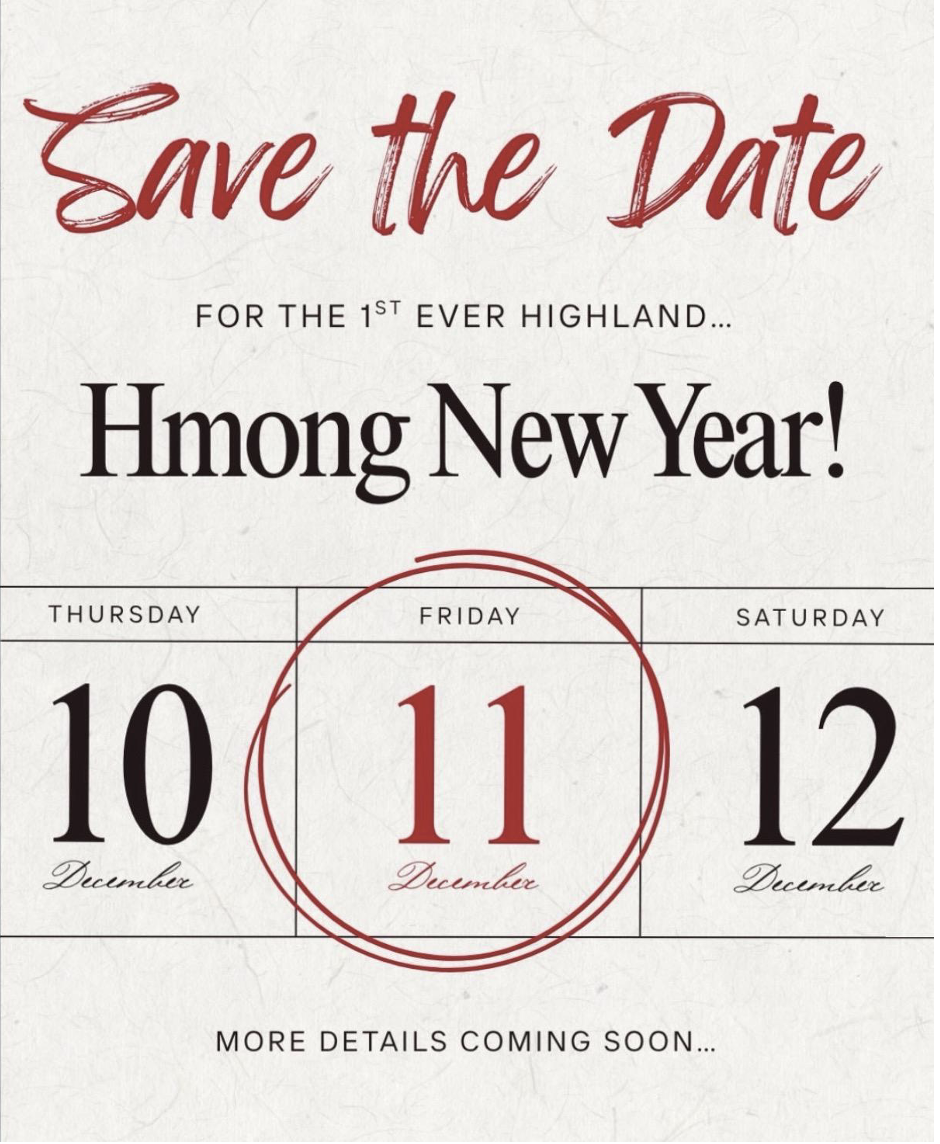
This year is going to be Highland Park’s first ever Hmong New Year! If you’re looking forward to it, don’t forget to mark it down on your calendar on December 11th.
As it is Highland’s first HNY, I’m sure you guys are unfamiliar with what it is. Hmong New Year is a celebration for the end of harvest season and to give thanks to our ancestors/ask for blessings. Although the New Year is celebrated differently overseas versus in the states, both sides love to eat.
The Hmong translation of Hmong New Year is “Nog Peb Caug” which means “eat thirty” and within 3-10 days, 30 dishes are to be prepared and eaten.
Since this is Highland Park’s first Hmong New Year, we would like all culture groups to show up and show out. We mainly want to focus on Hmong culture but we wouldn’t mind if other culture groups came to join in all the fun!
We would like for Highland Park students and teachers to be educated in our culture due to how small our community is here at Highland.
During our preparation meetings every Wednesday after school, we always discuss food. Food is how we express our love for others; for example, I would be at my cousin’s house and their grandma would say, “Ntxhais, los noj mov.” Or “Tub, los noj mov.” Which means, “Daughter, come eat.” And “Son, come eat.” Hmong people are always willing to feed one another to show respect and love. Even when food isn’t prepared or is being prepared, aunties/wives will ask, “Tus ntxhais/Tub, koj tshaib plab noj mov?” Meaning, “Daughter/son, are you hungry to eat food?”
Another thing about our culture is that elders call their sons, daughters, grandchildren or other young people “son/Tub” , “daughter/Ntxhais” in respect.
Let’s hop back onto Highland’s HNY. During our performances, we hope that students and teachers learn from our culture other than our bright colors and performances; we hope that everyone sees our passion, pride and love from the Hmong Community here at Highland. Our culture is more than our powerful performances. Our songs write stories about love, sadness and religion; finding the beauty in every emotion and past tragedies or stories. In Hmong culture, we believe that everything happens for a reason, whether it’s a mistake or a purpose. All of it is a lesson.
We want people to walk into the auditorium with questions about the Hmong culture, and leave while taking our stories out with them. All our lives we worked hard to make a place here in the U.S. and now that most of us settled down here in Minnesota, Wisconsin, and California, we’d like everyone to hear our stories.

