
Tag Archives: culture

Highlands 1st Hmong New Year ‘26 – ‘27

By. Selena Thao

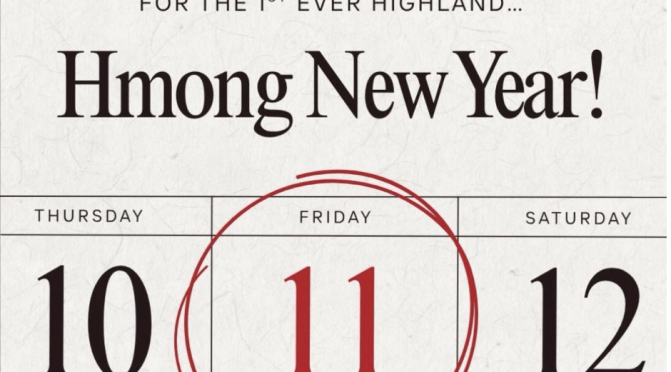
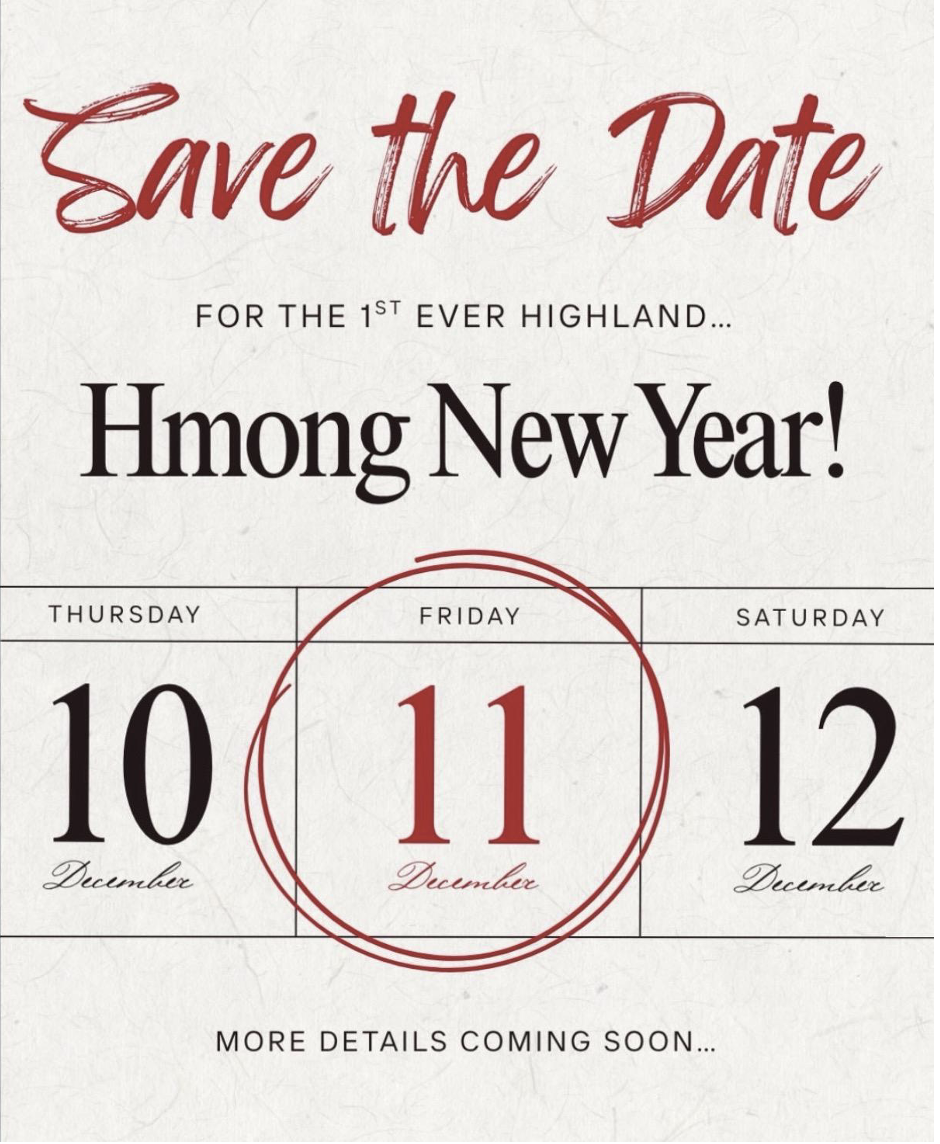
This year is going to be Highland Park’s first ever Hmong New Year! If you’re looking forward to it, don’t forget to mark it down on your calendar on December 11th.

As it is Highland’s first HNY, I’m sure you guys are unfamiliar with what it is. Hmong New Year is a celebration for the end of harvest season and to give thanks to our ancestors/ask for blessings. Although the New Year is celebrated differently overseas versus in the states, both sides love to eat.

The Hmong translation of Hmong New Year is “Nog Peb Caug” which means “eat thirty” and within 3-10 days, 30 dishes are to be prepared and eaten.

Since this is Highland Park’s first Hmong New Year, we would like all culture groups to show up and show out. We mainly want to focus on Hmong culture but we wouldn’t mind if other culture groups came to join in all the fun!

We would like for Highland Park students and teachers to be educated in our culture due to how small our community is here at Highland.

During our preparation meetings every Wednesday after school, we always discuss food. Food is how we express our love for others; for example, I would be at my cousin’s house and their grandma would say, “Ntxhais, los noj mov.” Or “Tub, los noj mov.” Which means, “Daughter, come eat.” And “Son, come eat.” Hmong people are always willing to feed one another to show respect and love. Even when food isn’t prepared or is being prepared, aunties/wives will ask, “Tus ntxhais/Tub, koj tshaib plab noj mov?” Meaning, “Daughter/son, are you hungry to eat food?”

Another thing about our culture is that elders call their sons, daughters, grandchildren or other young people “son/Tub” , “daughter/Ntxhais” in respect.

Let’s hop back onto Highland’s HNY. During our performances, we hope that students and teachers learn from our culture other than our bright colors and performances; we hope that everyone sees our passion, pride and love from the Hmong Community here at Highland. Our culture is more than our powerful performances. Our songs write stories about love, sadness and religion; finding the beauty in every emotion and past tragedies or stories. In Hmong culture, we believe that everything happens for a reason, whether it’s a mistake or a purpose. All of it is a lesson.

We want people to walk into the auditorium with questions about the Hmong culture, and leave while taking our stories out with them. All our lives we worked hard to make a place here in the U.S. and now that most of us settled down here in Minnesota, Wisconsin, and California, we’d like everyone to hear our stories.

Ballet Folklorico

Ballet Folklórico is one of the many ways to express Mexican culture. Ballet Folklórico is a dance that represents all of the regions in Mexico; therefore, it has many different types of dances, clothing, and music within the category. 

These dances were practiced and performed as early as the 17th century and started to become more popular in the 18th century, after the War of Independence. 

The most popular and widely known type of Folklorico is the Folklorico dances of Jalisco. A traditional Folklorico Jalisco dress is made of a fabric called poplin. The colors of the dresses are strong such as red, Mexican pink, and yellow. The shirt part of the dress has sleeves that go up to the elbow. Both the skirt and the dress are decorated with ribbons that match the dress. 

The men wear a typical charro suit which is made up of long tight pants with decorations on the sides. Along with the pants there is a matching jacket and silk tie. They also wear a wide-brimmed hat, or sombrero, with the outfit. 

All Folklorico dances consist of a lot of movement of the whole body. There is a lot of footwork, legwork, use of the torso, and armwork. In many dances the ladies use their skirts with coordination and elegance to produce beautiful waves of color emanating from their dresses.

There are many groups all around the world that teach the wonders of Ballet Folklorico that usually focus on all the different types of dances from all the regions in Mexico. Joining a group allows one to connect with their Mexican culture or learn of Mexican culture, and this makes learning Ballet Folklorico all the more fun. 

Chinese New Year at Highland

Free on Friday? Well, here’s something. On February 5th, 2016, Highland will be hosting a 2016 Chinese New Year celebration organized by the Jie Ming Mandarin Immersion Academy and the Highland Park Middle. Taking place at the Highland Park Sr auditorium, this event will last between 6pm-8pm. The celebration will include a performance and a carnival. Worried that the late night event will leave you feeling hungry? They’ve got that covered as desserts will be served after the performance. However, the actual date of the Lunar new year is on Monday February 8th, 2016. This will mark the first day of the year of the Red Monkey which is the ninth animal in the Chinese Zodiac.

The “red” part of the year represent fire which originates from the Five Elements incorporated into the Chinese calendar. Red is also considered to be a very lucky color in the Chinese culture. Chinese New Year will last for a total of 15 days

People born in the year of the Monkey includes the years: 1920, 1932, 1944, 1956, 1968, 1980, 1992, 2004, 2016, and 2028.

According to SunSigns.org, people born in the year of the Monkey are ambitious (and competitive), smart, yet mischievous, and are associated with activity and adventure. With the year of the Red Monkey, people will be dealing with more financial problems. It is also advised that this year people should be more aware of their actions before making any abrupt changes with anything contributing to money, careers, and relationships.

Location of the event? Highland Park Senior HS: 1015 South Snelling Ave, St Paul, MN 55116