What is Securly?

By: Tasha Cudinsky

What is Securly? Securly is the tool that the Saint Paul Public School System uses to restrict internet access. For years this system has just been used to restrict what things students can search and what websites we can visit. This year SPPS has changed how they use Securly.

Starting in fall of 2022, all parents and guardians of SPPS students started receiving weekly updates that showed them what their students had searched that week. Additionally, if parents download the Securly app they can view their students search history at any time that they want.

All parents or guardians of SPPS students were automatically signed up for the weekly Securly emails. According to the SPPS tech department, this system was implemented because of the requests of some parents, though it is not clear how many parents requested this.

When this system was implemented, all parents were sent an email explaining what Securly is, and encouraging parents to download their app to be able to view the search history at any time.

Students were not informed about the implementation of this system despite the fact that it is their search history that was being given to parents or guardians.

While parents and guardians having the ability to see their students search history may seem harmless, some groups have raised concerns about this new system. The concerns about this system are that not all students come from a safe and accepting home and may end up being harmed by this new system.

Abuse is not an easy topic to talk about, but it is something that happens, and we need to remember to watch out for those who are going through it. The concern with Securly is that an abusive parent or guardian might catch their student searching something along the lines of, “How do I escape an abusive situation?” Or looking into an abuse victim shelter. If a student ended up in this position, they could end up being put in danger because of a system that was put in place by their school, which was supposed to help them.

Despite the fact that concerns have been raised about how this new system may actually harm the students more than help them, little to nothing has been done to either inform the students, or protect those who are at risk. So far, there has been one announcement about Securly during advisory, and only in Highland Park Senior High, not the other SPPS schools. Other than this, there have been no notable changes with the Securly issue.

For more information, please visit:

HBCU Colleges

By: Maya Breininger

As a junior, it is time to invest in possible colleges that will allow me to carry out my career.

As a black student, one thing hindering my educational experience has been the constant surrounding of students who don’t look like me. By the deduction that being immersed in similar cultures to my own would improve my academics, the colleges that I now apply to are mainly HBCU colleges.

First, in order to understand what HBCUs are, you must understand their history. People of color constantly deal with oppression and acts of judgment. Their communities, which are supposed to be uplifting and accepting, are cruel and derogatory. Their work environments, which are supposed to be creative and inclusive, barely meet the bare minimum of kindness, and the stigma still exists. HBCUs, or Historically Black Colleges and Universities, are safe harbors and communities where its members uplift and support each other.

HBCU colleges are forgiving with their grade acceptance, and turn those with low GPA scores into succeeding students of the world; ready to take hold of their education. They have many different categories of HBCUs, and they are spread all throughout the United States. The schools all offer different programs, they have multi-meaningful backgrounds, and they are built on the belief that everyone deserves a fair shot at genuine education.

After the deaths of both George Floyd and Breonna Taylor, the application of African American students in HBCUs spiked. As the world seemed a divided place full of harm towards African Americans, they found peace of mind in HBCU colleges. There are many successful graduates from HBCUs, such as Kamala Harris, Oprah Winfrey, Wendy Robinson and many more.

HBCUs offer a kind space with a loving community of high-paced, go-getter students who know how to support each other. For this reason, I have chosen that the college I apply to will be a Historically Black College or University. And hopefully, this will inspire many other teens to do the same.

For more information, please visit these websites:

https://www.essence.com/celebrity/celebs-who-graduated-hbcus-2/
https://www.usnews.com/education/best-colleges/articles/a-guide-to-hbcus

Pizza Hut decline

By: Joseph Nelson

We all know that building with the weird roof on the top of it. The same roof that draws thousands of customers into the building to order the now well known pizzas that Pizza Hut offers.

But there’s a problem, the yearly sales for the franchise have only gone down in the years! What does this mean? How has this happened? Has someone finally out pizza’d the hut?

In 1990 Pizza Hut had the reputation of having some of the craziest pizza ideas like the Bigfoot, that was a 2 foot wide and 1 foot long pizza, where at one point made a total of 18% of Pizza Huts total revenue. But that wasn’t even close to the sales of their stuffed crust pizza that totaled around 1 billion dollars worth of sales in its first year.

Along with all these ideas, Pizza Hut served as a more modern and fancy pizza restaurant where families and friends could come together to dine in instead of the now very popular delivery service that Dominos has pioneered. But, like all good things, they must come to an end.

Pizza Hut had finally started to cut down on quality and started raising prices with many critics calling out the change in Pizza Hut sauce as the start of its downward spiral. With this new sauce came new pricing with now a large pizza costing $8.49 instead of $6.49.

With the new pricing came new problems with the teen audience (who was their main audience they attempted to appeal to) being in outrage that their after school hangout spot just got a little more expensive.

The competition didn’t help either, with places like Dominos and Papa Johns making compelling and appealing prices to old Hut customers, with more bang for their buck, with a small Domino’s pizza almost costing only half of a small Pizza Hut pizza.

Now, finally Pizza Hut is seeing the downsides like in 2019 when they were forced to close more than 500 restaurants due to underperformance and lack of finances.

Pizza Hut has been a staple to many with the iconic saying “You can’t out-pizza the hut” but it truly seems like the hut has been out-pizza’d for a long time.

For more information, please visit:

How COVID-19 still has an affect on us three years later

By: Calla Fragrassi & Mackenzie Malek

After three years of constant change in our school system, we wanted to ask Highland Park students how they were affected personally, then and now, by COVID-19.

We asked the same questions to students in grades 9-12 on their experiences.

Academics- How did the pandemic affect you academically in school? Was the transition between virtual to in-person learning challenging for you? If so, explain.

Freshman: “I thought the transition was really hard because on top of having to adjust to a whole new lifestyle where I couldn’t see people and couldn’t do so many things, my workload was still similar and so it was harder to do than before because I had so much more going on.”

Sophomore: “I felt like I fell behind in my classes and that school felt optional. Yes, I would say it was challenging because everything was constantly changing and it felt like there was no routine.”

Junior: “I believed everything would be easier coming out but my ideas changed. Also, I mentally struggled after the pandemic which took a toll on school. The actual transition wasn’t the hard part.”

Senior: “It made things easier and I got all As. The transition wasn’t that hard but it was fun to see other people again.”

Activities- Did COVID stop you from participating in any sports or activities you were involved in at the time? If so, how did that affect you personally?

Freshman: “COVID restrained me from all my sports and from seeing people I loved and it was really challenging because I relied on those practices to be good at my sports, so I felt set back and also felt set back from social activities since I wasn’t allowed to see people.”

Sophomore: “I stopped playing volleyball during COVID and when I went back for the season it was harder getting back into it because of the long break off, so I ended up quitting because I didn’t enjoy it as much anymore.”

Junior: “It took away club gymnastics, which was hard for me since it was the last year, and made the sports I eventually joined challenging in the fact everyone knew it wasn’t normal.”

Senior: “It prevented our football season in 2021 from going its full length because we had a shorter season due to COVID.”

Socially- Do you think the way you interacted with others changed after COVID? If so, explain.

Freshman: “ I think it did because so many people relied on social media to interact during quarantine and social media was the base of a lot of people’s senses of humor and things like that, so it kind of became something that defined your personality which I hadn’t really noticed before quarantine.”

Sophomore: “It was weird seeing my teachers and classmates in person after so long, and it felt weird being able to interact with other people besides just my family.”

Junior: “Yes, how I interacted changed in the way I grew, how I wanted to be as a person when I was in lock down. So, I figured out who and how I’d interact.”

Senior: “No, because I still interacted with people during COVID.”

All in all, these responses show that no matter the age, all these students had somewhat similar experiences throughout the pandemic. As you can see, for academics and activities, everyone had similar answers such as falling behind in classes and having to take a break from sports.

For the social questions, the responses varied a bit because this depended on how everyone interacted with others before COVID-19 prevented them from socializing. Some students were still able to talk to their friends and classmates, but others not so much.

What happened during the pandemic still has an affect on everyone today in some way and will in the future.

Pepsi vs. Coke

By: Rose Ramadan and Thea Berg

In this article, we will be reviewing the difference in pop flavors. We chose to compare Pepsi and Coke flavors, due to the big controversy surrounding them. We tested regular Pepsi, regular Coke, Cherry Pepsi, and Cherry Coke. We also tested the different pop brands they own. For Pepsi, we tested Sierra Mist and for Coke, we tested Sprite.

Our outcomes were as anticipated. More so than Pepsi, we preferred most Coke products. On a scale of 1 to 10, we assigned each pop a flavor rating. Then a bubble scale from 1 to 10. The aftertaste on a scale of 1 to 10.

The majority of Coke products scored an 8 on the flavor rating. They scored a 6 on the bubbling scale, primarily due to our distaste for bubbly beverages. On the aftertaste, they scored an average of 9.

Pepsi, on the other hand, scored an average of 6 on the flavor scale. On the scale of bubbling, they scored a 5. Finally, they scored an average of 7 for aftertaste.

To dive deeper, let’s review each comparison. To start with regular Coke versus Pepsi; the Coke had more of a refreshing taste. It was more pleasing to our taste buds and overall it had a better lasting flavor. In addition, it didn’t have much of an aftertaste compared to Pepsi, where the aftertaste had more of an unhealthy taste. Because of this, Coke had way more of a higher rating in our books.

To compare Cherry Coke versus Cherry Pepsi, we could hardly taste a difference between the two of them. As stated before, the Coke had more of a refreshing taste. We probably couldn’t tell the difference between them if it came down to it, though. The comparison between these two was hard.

Last, we compared Sierra Mist to Sprite. Sierra Mist, being a Pepsi product, and Sprite, being a Coke product. Though both are on the top of the list for our favorite pop drinks, we prefer Sierra Mist by a lot more. It has a sweeter taste and is more pleasing to our taste buds. It also has less bubbles which makes it more of an appealing option to the two of us.

The differences between the flavors of the regular Coke and Pepsi were subtle, but noticeable. Regular Pepsi tends to be sweeter, but it also has 2 more grams of sugar than Coke does, so the sweetness level makes sense. Coke is a little less sweet and has a more flavorful taste than Pepsi does. Pepsi also has more of a slightly citrusy tang, but Coke has more of a raisiny-vanilla flavor, although both Coke and Pepsi have very similar recipes that both contain carbonated water, high fructose corn syrup, caramel color, phosphoric acid, and caffeine.

One main difference between these two drink recipes is that Pepsi has the ingredient of citric acid in their drink, and Coke does not. The citric acid is what sets the flavors apart between the drinks and makes Pepsi have the citrus flavor over the vanilla raisin flavor.

Coke also had more carbonation and bubbles than Pepsi did, we thought that Pepsi seemed a little more flat and less bubbly.

Between the 2 of us we both agreed that we liked the flavor that Coke had better than the flavor of Pepsi. We both preferred the less sweet flavor and the less tangy flavor because we thought it tasted more authentic with the raisiny-vanilla flavor.

We also liked the carbonation level that Coke had better than the carbonation level of Pepsi.

Overall, we both agreed that the Coke products were better than the Pepsi products based on a lot of factors. Pepsi had many good flavors, and it had the upper hand with Sierra Mist, but most of the other flavors of drinks were in favor of Coke products.

The Boston Strangler

By: Ren King & Violet Hirman

*Warning: This article contains descriptions of murder and rape.

He who strikes in broad daylight.

It was a seemingly normal day, a woman after having just stepped out of the shower heard a knock on her apartment door. The plumber, though a bit early, she let him in quickly with a smile saying:

“I do hope you forgive my appearance, wait here and I’ll change quickly.”

She closed the front door, turning her back to the man in a heedless ignorance to his dangers. Her neighbors heard nothing of what came next, not of the screams, the terror in her voice as she pleaded for mercy, nor the strangled sounds of a woman dying.

In a few minutes, she was dead.

In a few hours, she was found with her bathrobe tied around her neck in a bow. So tight, that when they touched her head, it fell off.

Anna Slesers, 55 years old. The first victim of the Boston Strangler.

From June 14, 1962 to January 4, 1964, this serial killer plagued the streets of Boston. It was like a curse had been cast over the city, people lived in fear. The streets were silent, eyes turning to every stranger one would see on the street. Women locked their doors, hid their children.

Yet, this didn’t stop the murders from happening.

13 women of the police’s knowledge, many more that were unconfirmed to have been the Boston Strangler’s victims. Most were sexually assaulted, some had been stabbed or shot before they were strangled. Nonetheless, they all had one feature in common. They were found with a meticulously done bow wrapped around their neck.

Always so tight that if not handled properly, the head would fall off.

Over ten years later, a man of the name Albert DeSalvo was arrested for charges of sexual assault and breaking and entering. While he was in custody, another inmate, George Nasser recalled their conversations.

“He’s mad is what he is, sick and twisted beyond my own belief. Which is hard to believe since I shot a man, but true all the more. He says that he wishes to be as famous as the Boston Strangler himself, but a lot of the time I’m afraid that he actually is.” The exact words, according to the locals of Boston.

DeSalvo was taken into questioning about the crimes of the Boston Strangler. At first, he denied having any ties with the serial killer other than adoring remarks about his good work.

F. Lee Bailey, after two full days of interrogation, emerged with a tape of recordings from DeSalvo. Words that the police insisted were those only the Boston Strangler would know.

So, they had finally caught the Boston Strangler.

Or so they thought.

Dr. Robey was skeptical of DeSalvo’s complete guilt. He knew that the man had photographic memory, and had a track record for breaking and entering. He suspected that DeSalvo had come to the crime scenes days after the events occured to study them. That he confessed to the crimes of the Strangler in order to be sentenced to a mental hospital instead of a prison.

Alas, the evidence was too strong in DeSalvo’s favor and all investigations of the Boston Strangler were shut down.

Not before they discovered, from an eyewitness, from one of the murders, that she did not recognize DeSalvo, but instead George Nasser. Along with this, testimony that several people were seen coming out of the apartment.

Though they studied the scenes thoroughly, there was no other sign that it was a case involving multiple people other than the witness statement. Therefore, they had to believe that DeSalvo truly was the Boston Strangler.

DeSalvo was sentenced to life in prison, but not for the crimes of the Strangler. He was never actually tried for the serial killer’s crimes, only named it.

On November 26, 1973, DeSalvo told his psychiatrist that it was finally time to reveal the true crimes of the Boston Strangler.

The same day, he was found stabbed to death in his prison cell before he could say a word.

Through more recent DNA testing and closer scrutiny into the case, it was shown that unidentified DNA was found at several of the crime scenes. None of it matching to DeSalvo’s. Along with that, a painting crew was seen at the site of the first victim’s house. Two weeks later, the same crew was seen at the third victim’s.

Was it a coincidence? Or was it a clue?

To this day, no one knows the true story of the Boston Strangler. Despite countless reasons that the real killer, or killers, are still out there, further investigation cannot be taken due to DeSalvo’s confession.

So, if you’re home alone and you hear a small clicking sound. You turn around, but nothing is behind you. It may very well be…the sound of the Strangler’s walker because if they were still alive right now they would be well into old age.

For more information, please visit:

The affects of climate change

By: Ellie Moore

Global warming is impacting our environment in many ways. Climate change is caused by an increase in carbon dioxide in the atmosphere because humans are burning fossil fuels and destroying the forest.

The effects of global warming are occurring throughout the whole world, and although climate change is bad everywhere, it is worst in Japan with the Climate Risk Index being 5.5 (you want a higher Climate Risk Index). The Philippines is the next worst with 11.17, and Germany is third with 13.83.

Rising temperatures have led to the melting of polar ice caps and glaciers, causing sea levels to rise and putting coastal cities at risk of flooding. Extreme weather events such as heatwaves, hurricanes, and droughts have become more frequent and intense, leading to loss of life and property damage.

The impacts of global warming affect our economy, health, and social well-being. It is estimated that by the end of the century, global warming could cause the loss of trillions of dollars in economic output and displace millions of people from their homes.

The latest report by the Intergovernmental Panel on Climate Change warns that the world is running out of time to limit global warming to safe levels.

By the year 2035 it is said that the effects of climate change will be irreversible. The main “tipping” point being sometime between 2026 and 2042. This means we only have a few years to change our habits.

Since we only have around 20 years to take action we need to drive less and carpool if we can. Some other ways to slow down climate change is to eat less meat or use less electricity in your house.

With the population growing, it is harder to get everyone to take action, but if everyone took one small action it could make the difference of 1 million more years of our planet’s existence.

However, despite these efforts, global warming continues to worsen.

Global warming is not just a problem for the future, but one that we are already facing today. We must act now to protect our planet and secure a sustainable future for ourselves and future generations.

For more information, please visit:

Caribou Coffee bakery items

By: Toby Martin-Kohls

Caribou Coffee is a worldwide coffee chain headquartered in Brooklyn Park, Minnesota. It was also founded here in-state, in Edina, in 1992. As of May 2015, the company operates 603 locations worldwide.

Caribou is your typical American brand coffee chain, similar to Starbucks, Dunkin, Dutch Bros, and Peet’s coffee chains. They offer coffee and an array of snacks and bakery items.

On a Saturday morning, I decided to go venture out and try some of their bakery items, which I’d never tried before. This article was a good excuse for me to go buy some coffee, muffins, croissants, and scones.

The service I received was pretty good. I felt the price for the items was reasonable and each of the three items I tried, were all offered to be warmed up for me.

The first item I tried was their Blueberry Muffin. I received the muffin in a typical brown to-go bag. I’m going to be honest, looking at the muffin out of the bag was uninspiring. You could see a couple of blueberries from the top but not as much as you would like to see.

I was pleasantly surprised when I bit into the muffin, as it was warm and not dry. You could taste the blueberries but they didn’t overpower the muffin. It was sweet, but not overly sweet (like some of the other items!). The texture was wonderful, making it easy to enjoy.

The next item I sampled was their Raspberry White Chocolate Scone. It took me two locations to find them, so this may be a popular item. I opted to not have this one warmed up and was satisfied with my choice.

The white chocolate was the best part of the item, as it was nice to differentiate from just regular chocolate.

Fun fact: did you know that white chocolate is not actually chocolate and is actually made of just sugar, cocoa butter, and milk?

I was surprised by the sweetness of the chocolate complimenting the raspberry taste, but it worked pretty well. I thought the scone was soft and almost buttery-like, which made it enjoyable to eat without feeling too heavy or dense.

The sweetness was pretty good and balanced, but the coarse sugar sprinkled on the top might be a little much for some.

The last item I tried was their Lemon Poppy Seed Bread. As an avid lover of poppy seed muffins, I was excited to try this item. It is an old-fashioned pound cake with lemon zest, black poppy seeds, and icing.

I also got this item warmed up, which I think greatly improved the niceness of this item. Having your pastry warm just adds another level of comfort. The balance of flavors stood out to me, as the lemon flavor was there without being too overpowering of the bread. I got a little tired of the icing, but most will not notice the sweetness as much as I did.

Overall, Caribou has a solid selection of pastry items, perfect for when you want a little snack with your coffee on your way to work, school, or whatever!

Garbo, the greatest spy in World War 2

By: Hoaseng Thao

If there was ever a comedic spy movie to be made in the future, then it must be about Juan Pujol García, or known by the British Intelligence Agency known as MI5, as “Agent Garbo.” Juan Pujol García is credited with not only deceiving the Germans, but also receiving medals from both sides of the Second World War, an Iron Cross from the German Dictator Adolf Hitler himself, and the Most Excellent Order of the British Empire from Security Service’s Director General, Sir David Petrie.

Juan Pujol García was born in the year 1912, in Barcelona, Spain. He was a veteran of the Spanish Civil War where surprisingly, he found himself fighting on both sides of the Civil War but never firing a single bullet. After the Civil War ended, Juan Pujol García grew a hatred for totalitarianism and nazism due to Nazi Germany supporting the Fascist Spanish Leader Francisco Franco.

In 1939, when the Second World War was just beginning, Juan Pujol García decided that he needed to help stop the German war machine by offering to be a double agent to British authorities in Spain, to which they refused. Despite not being accepted by British authorities on multiple occasions, Juan Pujol García decided it was best to contact German officials in Madrid, where he posed as a Spanish Official who was willing to go to Britain as a spy on their behalf. The Germans, wanting to build a spy network in Britain, happily agreed to his offer and made him an official spy for the Third Reich.

Juan Pujol García was expected to go to London and collect intelligence about the British, but in reality Juan Pujol García moved to Lisbon where he fed the Germans information gathered from magazines, guide books, and travel brochures from a local library. Surprisingly, his information from his local library was able to fool the Germans.

In April of 1942, Juan Pujol García was finally accepted by British officials because they too were fooled as they had received reports about a spy from Spain who kept on giving information to Germany. Brought to London to work for the MI5, where Juan Pujol García, now known as “Garbo”, would work with an intelligence officer, Tomás Harris. The two would create fictional agents and stories to fool the Germans.

In 1944, Garbo participated in Operation FORTITUDE, an operation that would help deceive the Germans while the Allies prepared for the D-Day landings. On June 5th, 1944, Garbo sent his usual scheduled message to a German Radio Operator where he would send information about the D-Day landings as requested by his superiors in MI5.

Despite being on his scheduled radio message to the German Radio Operator, the latter would not even show up and would fail to receive the information Garbo had given to them, so when the D-Day landings did occur, it gave Garbo an opportunity to show how reliable he was to the German High Command.

“I cannot accept excuses or negligence. Were it not for my ideals I would abandon the work,” Garbo said to his German contacts to give the impression that he was serious about being a spy for the Germans.

On July 29th, 1944, Garbo would receive news that the Führer himself was awarding him the Iron Cross for his service in the German Intelligence against the British. Garbo had fooled Adolf Hitler, an achievement that many had wished to have during that time period.

Due to his efforts in deceiving the Germans, Garbo would then receive the Most Excellent Order of the British Empire in December of 1944, from Security Service’s Director General, Sir David Petrie.

After the war ended, Garbo contacted his handler and friend Tomás Harris about his plan of faking his own death, to which Harris would then spread this news about his “death” within MI5. Garbo would move to Venezuela and would live under a different name until 1988, when he was discovered by a British writer, Nigel West, who had tracked him down and asked him to come back to Europe to which he accepted.

On the 40th anniversary of the D-Day landings, 1984, Garbo would return to Europe to visit Normandy, France, to tour the beaches in which the allies landed to liberate France before paying his respects to the fallen.

In 1988, Garbo passed away in Caracas, Venezuela, forever known as the greatest spy to participate in the second world war.

For more information, please visit:

African Night

By: Ajmal Abdirahman & Mushtaq Yonis

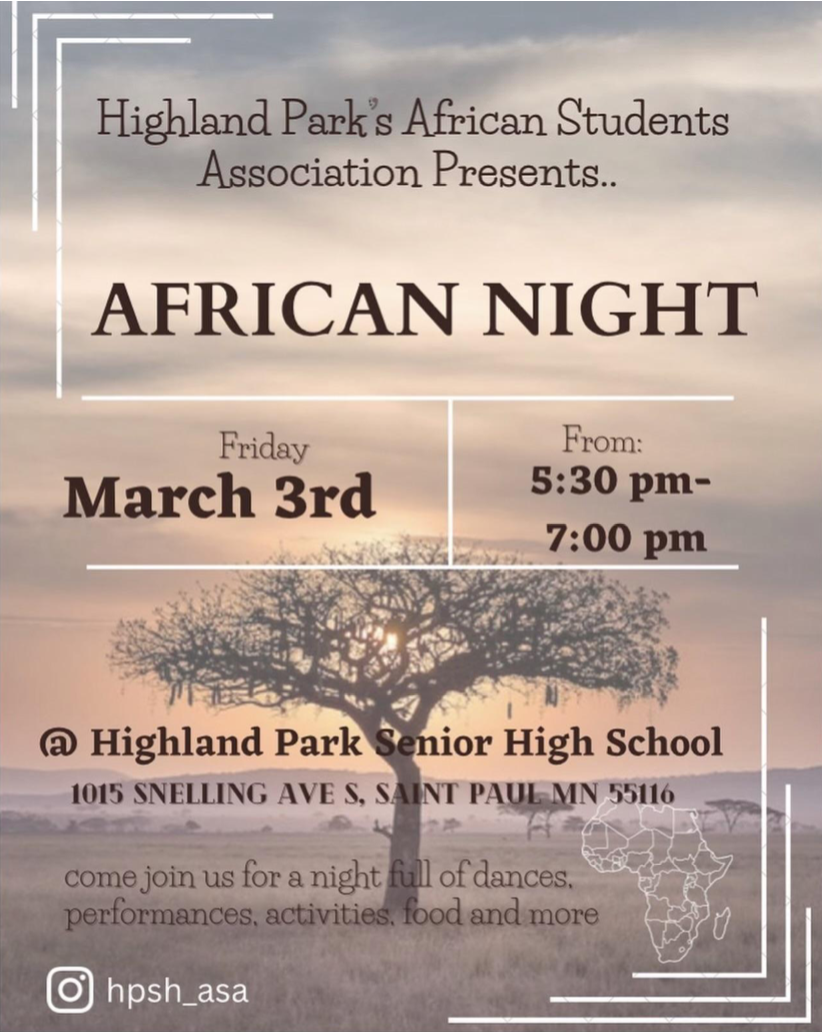
Image taken from: Instagram-@hpsh_asa

On March 3rd, Highland Park Senior High hosted the second annual African Night! African Night showcased a variety of different cultures, dances, poems, clothing, and food. Students who are a part of Highland’s African Student Association (ASA) put in a lot of time and effort to make it an enjoyable and fun filled night. The turnout was huge with lots of people coming from all over St. Paul!

The opening act was by Ayane Kabeto. She sang and danced for the audience. She beautifully sang “Blame It on the Boogie”, by The Jackson 5, and started the show off with a bang!

Followed by Ayane’s wonderful singing was a showcase of Oromo dances. The amazing dancers were, Fadela Yussuf, Nuhamin Melese, Zubeyda Kedir, Saba Getahun, Liya Lantyderu, Nardos Ashenafi, Samera Adam and Beti Negash. Oromos are the largest ethnic group in Ethiopia, which numbers around 40 million people.

Fun fact! The Oromo language is one of the youngest languages in the world to become a written language. Before that, the Oromos had a rich oral literature tradition including songs, proverbs, poems, and stories.

After that amazing performance…It was followed by a traditional Somali dance called Dhaanto. The dancers who showed off their dance skills were, Hana Elmi, Salmaan Mohamud, Nasro Osman, Subeir Said, Lena Ahmed, Sahil Ali, Sohail Ali and Iman Abdi. The performers did an amazing job showcasing their culture!

Dhaanto is a style of traditional Somali music and folk dance. The Dhaanto was inspired by the camel and mimics the actions of the camel. Fun fact, the world’s largest population of camels is found in Somalia.

Next was the lively Tanzanian duo. The two dancers were Jamila Dauda and Maaka Nyembo. They showed us a few Tanzanian dances with some really nice songs. The duo showed us our first taste of West Africa! They danced to the songs “Inama” by Diamond Platnumz Ft Fally Ipupa and “Kelebe” by Rayvanny Ft Inoss’B.

Tanzania is a country in East Africa. Tanzania is known for its vast wilderness areas. It is regarded as one of the most beautiful aspects of East Africa. It is renowned for its exotic wildlife and rich cultural heritage. Here is a picture of the duo!

Then the crowd got to enjoy some Ethiopian and Eritrean dances. The dancers were Liya Lantyderu, Sonya Hussein, Ayane Jarso, Samera Adam, De’ Shaun Booker and Mahlet Dagne. Some of the dances they performed were, Gurage, Wyleta and Tirgey.

There’s a lot to love about Ethiopia, including its coffee and culture! And also Eritrea, for its delicious food, beautiful culture and its amazing architecture from Eritrea’s capital city Asmara.

Next was a beautiful spoken poem by Iman Abdi. Her poem was beautifully written. Black beauty was the theme of her poem. She spoke clearly and confidently and did so well!

After the poem, we got another taste of West Africa! The dancers were Qamar Amode, De’Shaun Andrea-Booker and Jamila Dauda. The songs they danced to were from Nigeria and Ghana. They were very vibrant and enthusiastic!

Nigeria is the most populous country in the whole of Africa with around 210 million people. Nigeria is one of the most diverse countries in the world with more than 500 spoken languages.

Ghana is also a very diverse country with over 70 ethnic groups residing in Ghana. Ghana is known for its dynamic culture and its food!

Next, the crowd got to enjoy an intermission with a video. The video was made by Asia Mohamed and Asma Sedik.

We talked to Asma Sedik about her experience as one of the video makers:

“The process of making the video was a bit stressful since we had to film it during school. It was hard to find times that would work for everyone and we often would have to miss class to film. But otherwise it was so much fun filming and we had a blast with our friends. Editing was also fun but also stressful because we didn’t have access to a professional camera or editing software, but we made due with what we had and learned a lot. Overall, a great experience!”

Back to more dancing, the crowd got to enjoy more Somali dances with Somali Part 2. The dancers were Zubeyda Kedir, Qamar Amode, Lena Ahmed, Sohail Ali, Sahaam Ahmed, Subeir Said, Muna Mohamed and Salmaan Mohamud. They did a performance of Shirib dance. The Shirib dance is very common in the southern region of Somalia.

A break from all the dancing; next up was a game show. The crowd was asked questions about Africa and if answered correctly they were given candy!

Then we got to enjoy a solo Congolese dance! By Jamila Dauda. She danced to the songs, “Call Me Baby” by CDG, “Moto” by Fabregas and “Ntaba Mood” by Ntaba2. She did a wonderful job!

There is a lot to be admired about the country of Congo with its rich natural resources and the world’s second-largest rainforest, in addition to, its unique culture and its delicious dishes.

Then we got to enjoy more Oromo dancing with Oromo Part 2! The dancers were Samera Adam, Muna Mohamed, Eddie Reynosa, Obama Ahmed, Sahil Ali and Zubeyda Kedir. They performed dances such as, Wollo, Wallega, Shagoyee and Sodoo!

Muna Mohamed, the president of ASA shared her African night experience:

“We would practice almost 4 times a week and spend a lot of time together, working on perfecting our dances and making sure we were showcasing our cultures in a positive light.”

The final thing was the Fashion show where many students participated and showcased their cultural clothing! We saw many different flags and ended the African Night with everyone singing to “Last Last” by Burna Boy! Overall, the night was a huge success and was filled with so much fun.

Ms. Baheriy was the advisor for the African Student Association, (ASA), we spoke to her about how it went this year:

“It was amazing, I’m so proud of all the students who participated, they put in a lot of work and it definitely paid off. Students started planning and practicing for dances in the early fall, and it was exciting to see it all come together last Friday!”

For more information please visit: