What type of guitar should you buy?

By: Domingo Basso

Okay, so you might be planning to buy a guitar at some point in the future but you have no idea what to buy because of the sheer variety of them. Well, hopefully after reading this you’ll at least have a little bit of a better Idea of what you might buy. 

First things first, we gotta start from the beginning, that being: what type of guitar you even want. Whether that is an acoustic, electric, bass, there’s a bit to unpack here. So, let’s go over what each of these different types of guitars even are and what separates them from each other.

The main types of guitar are: Classical guitar, Acoustic guitar, Electric guitar, and Bass guitar.

A quick disclaimer beforehand: all of these instruments can be modified and can vastly vary in sound and shape due to the sheer variety of them, but I’ll tell you what each instrument ‘typically’ is like.

The Acoustic guitar is a guitar that typically has 6 metal strings. It is known for being unlike most other guitars in the sense that it requires no electricity or power of any sort to play properly. This also makes it one of the cheapest and least maintenance options for a guitar due to you not needing to worry about as many parts to keep the guitar functioning properly.

The Classical guitar is very similar to the acoustic guitar in many ways including the fact that it too requires no external power in order to operate properly. But, what separates this from the acoustic guitar is the fact that the strings are generally made of nylon (a type of plastic) giving it its own unique sound from the acoustic.

Right from the get go, you’ll probably be able to tell that the bass guitar is the oddest out of the bunch, even from just its appearance alone. Bass guitars typically have only 4 thick strings and are noticeably lengthier than other guitars. But, what truly differentiates them from the other guitars is the type of sound that they produce and how you typically play them. Bass guitars are known for having a lower end sound like a WAY lower pitched sound, hence why the strings are so much thicker than those of other guitars. You also play bass guitars a little differently from other guitars in the sense that you usually play individual notes rather than multiple at once. This allows the bass to be a pretty solid instrument to start off with from a difficulty standpoint, but trust me when I say that mastering this instrument will still be just as challenging as the others.

Finally, the electric guitar. The electric guitar is the guitar with the most reputation and it deserves most of the credit that it gets. The electric guitar is one of the most versatile instruments on the planet due to the fact that it is built similarly to the acoustic but because of its electronic properties, it can create a much more assertive sound. It also has the ability to play mellower sounds giving it a very dynamic range. The only drawback really, for this instrument, is the monetary cost of maintaining it and purchasing the necessary parts.

I hope that my insight on each of these instruments will help you at least a little bit in deciding what to buy (and as a bass player I’m not telling you to buy the bass guitar buuuut I totally am telling you to do that so go buy a bass ASAP).

For more information, please visit:

Date places in St. Paul and Minneapolis

By: Ayamei Her

Here in Minnesota, I always find it hard to find places to go for dates that would be fun, affordable, and a good place to take good photos. Here are a couple of great places to take someone out on a date that are not only fun, but affordable and accessible. 

The first place is Walker Art Center in Minneapolis, yes the art center with the giant spoon and cherry. Not only is it perfect to look at beautiful art with the person you like, but they also have an interactive room which they change every now and then.

The art center also has a 360 experience where a quartet plays that you can also watch along with films including music, sensory mini golf, short film showings, and so much more.

The prices for tickets are affordable ranging from $0-$15. Adults being $15, seniors (62+) being $13, students being $10, active military being $7.50, and EBT cardholders being $2.

The statues outside are beautiful to look at and a good walk near the center to talk and take pictures. The price to go to look at the statues are free! You get to walk around to look at the unique structures and read about who made them and what they symbolize.

If you want to take great pictures and still have a good time, I would recommend going to the Como Conservatory and Zoo. Not only is it free but the conservatory has beautiful plants to see and it has beautiful scenery for photos.

During the summer the conservatory has a beautiful and amazing Japanese garden where you can walk through and read all about the plants and their origins. The zoo has many animals with interactive activities to do while you’re there.

The zoo also holds events like animal shows or showing off their famous sloth which people love to see with other animals as the sloth sometimes gets moved around to peacefully hangout with other animals in their exhibits.

The center itself has held many events like Gardener Talks, The Spire Sparky show, Adventure Day, Bonfires, Winter carnivals and so much more.

At the Como Conservatory and Zoo, they also have a Como Town which includes rides and games kind of like a county fair, which unfortunately, like the conservatory and zoo, is not free. Ticket prices are as follows: Unlimited Ride Wristband (Includes one Soaring Eagle Zip Ride) — $27.95

Little Tykes Unlimited Ride Wristband (under 42 inches tall) (does not include Soaring Eagle Zip Ride) – $21.95

Star Light Saver Wristband (after 4 p.m.) — $19.95

Adult Unlimited Ride Wristband (18 yrs+) — $13.95

Season Pass (Includes two Soaring Eagle Zip Rides) —  Unlimited $82.95

Season Pass (under 40 inches tall) — Unlimited $69.95

Individual Points

 Point  $0.50

Tiger: 40 Points $19.98

Sparky: 55 Points  $25

Giraffe: 80 Points $35

Polar Bear: 115 Points $50

‘Until They Bring the Streetcars Back’

By: Leticia Buggs-Sam

‘Until They Bring the Streetcars Back’ serves up a nostalgic journey through the streets of post war, 1949, Saint Paul, those wistful days of sodas, big band music, and burning leaves.

A harmless prank, a chance conversation, and Cal Gant stumbles onto cruelty, incest, and murder when he attempts to save a girl, named Gretchen, from her abusive home.

‘Until They Bring the Streetcars Back’ is about teenagers and how their lives are in and out of school, and what they go through on a daily basis.

Gretchen is one of the characters where she’s so not social with people at school or anywhere, and where she has a very abusive home and a strict dad. Her dad does not let her talk to boys. And when she met Cal, she was afraid that she would get in trouble from her dad.

Gretchen also had a crush on Cal but Cal had a crush on somebody else at the time. Gretchen and Cal talk to each other everyday. At first it was hard because Cal was popular and Gretchen wasn’t. People started to say that Cal and Gretchen were together and they started to make fun of their relationship/friendship. The people in school are like that because they know that Cal can do better and find a better girl, and they just think that Gretchen is weird.

While I was reading this book, I had the following questions:

I thought she was not allowed to talk to boys?
Yes, she’s not allowed to, that’s what made their friendship/relationship so secret from her dad because she was afraid of what her dad would do to her. So, Gretchen and Cal started to make a plan to meet in secret on when to do it, how, and where. And from there, friendship started.

Who was the girl he liked if not Gretchen?
He liked a girl named Lola. In the book you can see that for homecoming he did not take Gretchen out to homecoming but instead he took someone else. And in the begging of the book he claims that he does not like Gretchen, he likes Lola and that’a what he told his friends.

Cal is another character that struggles with things from home and school, his parents fight but they’re still together. Cal is an athlete that plays football and basketball. He was having some difficult times because he got caught up in Gretchen’s problems at home.

Another difficult time is where he tries to get his dad to come to his games. His dad always says “Yes” or “I don’t know” or “Just no, I’m too busy with work”. He never ends up going, and it shows that how much Cal wants to hang out with his dad more and make memories with his him.

And another difficult time is when his mom said stay out of people’a business it’a not your problem and their’s. Well, he had a difficult time with that when he met Gretchen and got sucked into her problems at home.

In the end, it was a good book and I would give it 4/5.

‘Scream Queens’ season 2 review

By: Semaj Carter

‘Scream Queens’ is a show about sorority girls named Chanel Oberlin, Chanel #3, and Chanel #5 They were named this because Chanel couldn’t remember their names. I also think it’s a sense of ownership and an example of how Chanel sees the world.

*Warning: spoilers ahead*

Season 2 opens up as a recap of season 1. The season was about the “Red Devil Killer”, who chased down the sorority girls and killed their “friends”. One of them, was Hester Ulrich, who was behind the Red Devil Killings, and framed the Chanel’s, who then were sent to a mental hospital.

I think the first season shows the privilege of the Channels as white women because Chanel murdered the housemaid for the sorority house and got bailed out immediately without questions or punishments. The Chanel’s get a job as doctors and get to have their TV show even though they’ve never studied or majored in a medical university. A quote from one of the characters named Wes Gardner, kind of explains it all “Even if they fail they succeed”.

One thing I would like to address is that they treat Chanel #5 like she is not logical or she’s so weird and crazy, which I know is just for comedic relief, but I just find it so entertaining how she’s the only person that’s the closest to normal and everyone treats her like she’s not.

A mystery about this show that has been bothering me for a while is that Chanel #3 hides her ears with earmuffs and I have always wondered what is so bad about her ears that she has to hide them.

I think this show should’ve gotten a season 3. I might be wrong, but I heard many people say that it got canceled yet when I research it online it says a season 3 is coming out. I can agree with people when they say that Chanel is a very horrible person, she’s racist, ableist, and very self-centered, the only reason I like her as a character is that she’s the most authentic and interesting one besides Kathy Munch, A.K.A Dean Munch, one very underrated character. I also think another character that deserved a lot more screen time is Zayday Williams, played by Keke Palmer. I fell in love with her character ever since she first appeared on the show.

You could tell the writers didn’t care much about Zayday and when they got tired of writing for her character they just kidnapped her. In the first season, she was kidnapped by the Red Devil Killer, and in the second season, she is kidnapped by the Green Meanie who was just a copycat of the iconic Red Devil.

Anyways, this is my quick opinion the ‘Scream Queen’ characters in season 2. I hope this article made sense and helped you form your own opinion of the characters and such. Overall, I would give it a 6/10. If you want to watch ‘Scream Queens’ it is available on Hulu.

The pen is mightier: How the Third Reich was fought with words

By: Jocelyn Knorr

When most people think of white roses, they think of things like love, romance, and beauty. However, in Germany, most people’s minds come to rest on an anti-Nazi organization that sprung up around the early forties; “Die Wiesse Rose”.

One of the group’s two founders, Hans Scholl, was born in Ulm, Germany in 1918. He was the eldest son of a large, forward-thinking family; his father, the city mayor, would eventually be imprisoned for speaking out. The Scholl’s father kept his house well-supplied with banned literature and encouraged his children to think for themselves; despite this, Hans joined the Hitler Youth along with his sister Sophie. He was elected as his group’s leader and standard-bearer, witnessing the most fanatical parts of the National Socialism movement. This is when his loyalties began to waver. He formed an illegal youth group called the Deutsche Jungenschaft 1.11. (d. j. 1.11), in 1934, and stopped going to Hitler Youth meetings altogether. He also fell in love—with a young man named Rolf Futterknecht, a member of d. j. 1.11.

For a while, things seemed to be going well. Hans spent a summer in the company of his illicit friends, leading young men on hikes and camping out in the forest. He passed his final high school examinations, said goodbye to his family, and headed off to his mandatory two years of Reich labor service. Then, midway through 1938, the unthinkable happened—Rolf reported on him.

Hans was arrested and swiftly sent back to Ulm. Though his family begged him not to, he rejected legal counsel and defended himself. He spoke eloquently, managing to convince the judge to dismiss the group as a youthful flight of fancy, and the relationship between Hans and Rolf as a moment of lapsed judgment. He served out the last of his time in the labor force in relative peace, and nobody mentioned the trial ever again.

However, this incident changed him irreversibly—what had once been a distaste for National Socialism had become a boiling hatred.

In March 1939, Hans was released from the Reich Labor Service to aid in the invasion of France as a medical sergeant. The atrocities he witnessed only served to reinforce his distaste.

Finally, he was sent home to Germany, to attend medical school at the University of Munich. This is where he met the other half of the founding duo, Alexander Schmorell. Alexander, or Shurik as he was known to his friends, was born in Russia in 1917, to a German father and Russian mother. After fleeing Russia at four—seeking refuge from the Revolution—he grew up in relative luxury. However, the Nazis continually harassed his father for refusing to renounce his Orthodox Christianity. He and Hans were assigned to the same dorm room; on occasion, they would have conversations, late at night, about the state of Germany, politics, and the war. The two decided something had to be done, before it was too late—this is when the resistance began to take shape.

They wrote the first leaflet together in late 1941, although Hans had the final say on edits. Attempting to appeal to intellectuals, they filled its pages with philosophy and prose, quotations from some of Germany’s best poets. Then, they sent them out, placing them in phone booths and on public benches. Time marched on, and four more members were added to the group—Christoph Probst, a lifelong friend of Alexander’s; Willi Graf, who was recruited from the university choir; and Jurgen Wittenstien, who refused to participate in the pamphlet writing but was eager to help pass them out. He was advantageous in the fact that he was a full-fledged soldier in the Wehrmacht; the uniform lended him legitimacy, and he was less likely to be stopped as he was distributing pamphlets.

That winter and spring was significant for two other reasons; the publication of the second leaflet, and the arrival of Sophie Scholl at the university. As women weren’t allowed into the university’s medical program, she studied philosophy, as well as anything else allowed to her.

Shortly after the second pamphlet was published, Sophie found a copy of it on the campus grounds. Opening it, she was fascinated by the words—she had never seen written material denouncing Nazism before. She ran to show her brother, but found his dorm empty. Instead, she began shifting around the papers on his desk, and when she moved a copy of the Tao Te Ching, a draft of the first leaflet fell out.

Sophie was astonished. When her brother returned home, she demanded answers. Ultimately, she was given all the information and even a spot in the inner circle. She was not the only woman, but she would be the first; Hans’ friends Traute and Gisela joined in late 1942. In addition, they gained an ally in a professor named Kurt Huber, who had been mistreated by the university’s administration because of his disability.

The White Rose now turned their attention to upping the scale of their efforts. They purchased paper, stamps, and envelopes in quantities that made the authorities suspicious, and even acquired a couple of duplicating machines on the black market. All of this equipment was stored in the basement of an architect—another friend of Hans’.

The next two leaflets were much of the same—appealing to the intelligentsia of Germany, who were thought more likely to be persuaded by the arguments the Rose posited. This time, about 1,500 were made. They were distributed not only in Munich, but in Berlin and Hamburg as well, mailed to random addresses picked out of the phone book. 65% of these were turned into the Gestapo, the Reich secret police.

In July of 1942, writing had to be put on hold as Alex, Hans, and Willi were sent to the Russian front as student medics. There, they witnessed the horrors of the Stalingrad fight, and the awful treatment of Jewish prisoners. However, they also spent the time with average, everyday Russians—courtesy of Alex and his Russian fluency—and found that not even Bolshevism and an invasion could break their spirit.

When they got back to Munich, they began writing their fifth pamphlet. This one took on a much more accusatory tone, referring to the Nazis as cowards and drunks and doing away with the flowery prose—this was the first leaflet not to bear the name, instead entitled “An Appeal to All Germans.” They also declared that the downfall of the Reich must start with the loss of Stalingrad, calling upon the people of the Third Reich to renounce the Wehrmacht. This caused tension within the group; Huber actually broke with them because of it, calling the notion Bolshevik. This distancing would not save him in the end—he was to die alongside Alexander Schmorell, who wrote most of the pamphlet that drove him away.

This pamphlet was distributed widely across Germany, with members sometimes traveling across the country to spread the message. But now, they were no longer alone; back in Hamburg, some family friends of the Scholls had gotten their hands on some pamphlets and their own duplicating machine. The result was the Hamburg branch of the White Rose, who would circulate the pamphlets long after the group’s demise. They were also working on linking up with a Germany-wide resistance dubbed “the Red Orchestra,” that had clued them in on Wehrmacht contacts and even an attempted coup.

By the time the sixth pamphlet was published, the tide was turning for Germany—Hitler’s approval ratings were at an all-time low, and people were restless. This pamphlet had even less pretensions, calling upon the men and women of Munich to start sabotaging the war effort; it was duplicated, distributed, and duplicated again, eventually making it into the hands of Adolf Hitler himself. To say he was enraged would be an understatement. He directed the full force of the Gestapo into finding the authors.

He did not have to wait long. On February 18, 1943, Hans and Sophie went early into the medical sciences building to pass out leaflets. They left stacks in every lecture hall, on every bench, but found that they still had about a hundred left. Then, Sophie had an idea; she raced up the stairs and dropped the entire stack from three stories up. They scattered, like snowflakes onto the floor below. Unfortunately, a janitor came in at that precise moment. He took it all in—girl, empty suitcase, anti-Nazi propaganda hanging suspended in the air of the stairwell—and decided then and there to make a citizen’s arrest.

Hans, Sophie, and their friend, and collaborator, Christoph Probst were executed on the 22nd of February 1943, after a hasty show trial. The group rapidly disassembled after that—Hans’ apartment was searched, and many members of the Rose were traced back via their handwriting. The entire inner circle was executed; the only member alive today is Traute Lafrenz, although Jurgen Wittenstein died in 2015.

The White Rose’s death only amplified their message; in July of 1943, Allied forces dropped thousands of copies of the White Rose’s final leaflet over Nazi-occupied areas, re-titled “The Manifesto of the Students of Munich”. These were also passed out by the Hamburg branch.

Nowadays, the group are heroes across Germany and beyond; two movies and a stage play have been made out of their story, and high schools, streets, train stations, and more have been named after them. In 2015, Alexander Schmorell was even sainted by the Russian Orthodox Church outside Russia. The story of these students and their determination goes to show that even in the darkest of circumstances, hope can, and will, prevail, and if not conquer the darkness entirely, aid in its toppling.

For more information, please visit:

Also, for further reading, I’d recommend:

  • ‘Sophie Scholl and the White Rose’ by Jud Newborn and Annette Dumbach
  • ‘Memories of the White Rose’ by Jurgen Wittenstein (available in PDF form).

What is Topgolf?

By: Toby Martin-Kohls

Topgolf is an entertainment venue for golfers and non-golfers alike. The facility is a driving range with colorful targets, and guests can play various golf games from their bay. They serve food and drinks to your climate-controlled bay, and have TVs and golf ball tracking screens. They provide a variety of complimentary clubs, so no need to go buy expensive clubs. They also have spots in each bay for your golf bag if you do decide to bring your own clubs. They make a welcoming environment for people who want to try golf, or just want to have a fun night out with friends.

So, you’ve decided you want to go? Excellent. First, I would recommend you or someone you are going with download the Topgolf app. Once you play for the first time and make an account, you’ll be able to see all your visit and game history right in the app. If you go at a popular time, you can join book a bay in advance on the app, or join the waitlist. This is really helpful and I would recommend you do this every time so you spend less time waiting and more time at Topgolf!

Game play can be expensive. Prices are less on weekdays and more on weekends, and prices rise again for the evening and are cheaper earlier in the day. For first-time visitors, you’ll be required to buy a one-time lifetime $5 membership.

On weekdays, depending on what time you go prices range from $35/hr bay to $55/hr bay. This is also why I would recommend going with a group of friends. You can have up to six people in one bay and it makes the price much more affordable if you spread the bill around. I would also recommend going on Tuesdays, as their Tuesday promotion is half-price. 

Once you’ve arrived, if you’ve reserved in advance or gotten on the waiting list, a bay number will be texted to you. The Brooklyn Center location has three levels. My personal favorite is the 3rd level because it’s the highest, however, they will just assign whatever bay is open. They have right-handed clubs in the bay, so it’s important to remember that if you need lefty clubs, to ask at the front desk. There is no additional charge for these clubs. 

Once you get to your bay, you will all sign in with your phone numbers and select the amount of time you would like to play. Then it’s up to you to choose from the wide variety of games they offer. They have three HD TVs in your bay, one you can choose a channel and the other two are for a scoreboard and ball tracking technology. Your bay host/server will explain all the details if you haven’t been there before, and get you started with drinks. They do ask to put a card on file at the beginning, but you’ll be able to split the tab and pay separately at the end.

There are a couple of games Topgolf recommends, specifically for beginners. The first is the signature game “Topgolf”. In this game, the objective is to score the most points by hitting balls into any one of the colored targets. The more accurate your shot is to the middle of the targets, and the farther your shot goes, the more points you earn. Another one recommended for beginners is the Angry Birds mode. It is exactly what it sounds like, virtual Angry Birds come up on the screen and you try and hit targets with your golf balls. 

Topgolf offers a variety of food and drink options. My personal favorite appetizer is the cheesy macaroni bites, especially on a cold winter day. The burgers and chicken sandwiches are decent, and my friends and I really enjoy their Chicken Caesar salad. You can finish it all off with a dessert, they offer a huge cookie crumble sundae that is pretty good (but also has 2,040 cal!) or their more unique injectable donut holes. Syringes come filled with chocolate, vanilla, and strawberry filling which you can inject into your donut holes. 

Even if you have never golfed before, Topgolf is a fun way to have fun with friends. I’ve noticed that most people who go there aren’t even great golfers, they are just there for fun. Hopefully, this review has encouraged you to go try it out!

A review of ‘Hocus Pocus 2’

By: Julia Sikorski Roehsner

Warning – spoilers

Fans of the original ‘Hocus Pocus’ movie, which was released in 1993, to great success, were likely excited by the announcement of a sequel. ‘Hocus Pocus 2’ was confirmed as in production in December of 2020, and was released to Disney+ on September 30th of this year.

‘Hocus Pocus 2’ runs about an hour and 45 minutes long. Its story line picks up three decades after the events of the first movie and is set in the present day—with a quick visit to Winifred Sanderson’s past in 1653 Salem.

The viewer learns that she was banished from the town after she refused to consent to a marriage arranged by the despicable Reverend Traske. To avoid separation, Winifred and her sisters, Mary, and Sarah, venture into the nearby forest, into which the people of Salem are too scared to pursue them.

There, the sisters encounter Mother Witch. At first wanting to eat the girls to preserve her youth and beauty, she stops when she senses Winifred’s witchly power.

Mother Witch gifts Winifred a magic spellbook—recognizable as Book from the first movie—as it is Winifred’s sixteenth birthday, but warns her to never cast the power-gaining spell of Magicae Maxima. She also makes the mysterious comment that a witch is nothing without her coven.

The flashback ends, and the viewer is soon introduced to a new cast of characters. First and foremost is a teenager named Becca. Not only is it Halloween, but it is also the day of Becca’s sixteenth birthday. She and her friend Izzy are preparing for their customary night of fun celebration, though without the company of their third friend, Cassie Traske, who has become distant in the wake of her new relationship.

The two girls pay a visit to their favorite magic shop, located in the former home of the Sanderson sisters, and Becca receives a candle as a birthday gift from the store owner, Gilbert. Per tradition, the pair then venture into the forest.

Upon lighting the candle, Becca and Izzy discover that the 1993 banishment of the witches—now a local legend—was not so permanent after all; the candle turns out to be another Black Flame Candle.

Winifred, Mary, and Sarah are back once more.

Thus begins an evening full of adventure and twists and turns as Becca and Izzy do their best to escape the Sandersons and get rid of them once and for all.

Pulled into the mix are Gilbert, who turns out to have tricked the friends and is now facing the consequences, and Cassie, whose father is the spitting image of his ancestor—Reverend Traske. There is also an appearance by the familiar corpse, Billy Butcherson. And, of course, what is Winifred Sanderson without her beloved Book?

It’s only one night, but a lot can happen in one night when there’s magic involved.

Perhaps controversially, I found ‘Hocus Pocus 2’ pretty enjoyable. Common complaints that I’ve heard about it are that it’s not up to the standards of the original ‘Hocus Pocus,’ that it lacks that same feeling of Halloween spookiness, that it’s disappointing that more of the original cast didn’t return, and that the plot itself was boring.

I can understand these complaints, but they were things that didn’t bother me personally. I am not a longtime fan of ‘Hocus Pocus,’ so nostalgia was less of a factor for me when watching ‘Hocus Pocus 2.’ I also didn’t mind that it was aimed at a wider, and potentially younger, audience.

I particularly liked the cinematography and editing. The scenes were crisp and clean, and the coloring followed a consistently pleasing color scheme.

Overall, it was a light and comedic watch.

However, there were a few moments where I found myself frustrated at the characters for not realizing the obvious, and some of the scenes felt a bit forced, both in storyline and in acting.

Therefore, I give ‘Hocus Pocus 2’ a three and a half out of five star rating. As mentioned earlier, you can watch this movie on Disney+

The Artemis Program: A multi billion dollar pipe dream

By: Reed Morris

Once again, we find ourselves revisiting an old topic. Much like my James Webb articles, this covers space exploration. The difference between the two is the successfulness. 

The Artemis Program is NASA’s newest project, hoping to get humans back on the moon. Conceived in 2010, the Artemis Program had a lot of support and dreamers behind it. It was initially scheduled for its first test flight in 2017, but here we are in 2022 with still no launch. The failures of Artemis and its SLS launch system have created an environment of high costs, short budgets, and many sad space fans like me. 

Where we run into problems

There are multiple issues with NASA’s current dream for lunar inhabitants. First off, we’ll have to cover the issues that are seen on paper. The rocket is NOT cheap. The SLS is a new launch system that is supposed to be able to carry the crew and supplies needed to start a lunar surface base, and a lunar orbital station. While it IS capable of such feats, flying it comes at a sizable cost. It runs off of several RS-25 rocket engines, which cost nearly 150 million dollars to make, for a SINGLE USE engine, in a time when private companies have cheaper multi-use engines. While the SLS is one of the heaviest lifting rockets in existence, its 4.1 billion dollar-per-launch price tag is something that cannot be ignored. 

The second and more severe problem is that Artemis 1 has been delayed over and over again due to malfunctions in the SLS’s overpriced engines. On August 29th, 2022, the Artemis 1 launch was supposed to take place. Before it was sent into space, leaks sprung up in the hydrogen fuel lines. Additionally, sensores stated that one of the four main engines was not cold enough to support fuel injection for launch. These problems were non-ignorable, delaying the launch for another week. When the problem was deemed fixed, it was set to launch once again on September 3rd. Surprise, surprise, it never left the launch pad. 

Similarly to the first failed launch, a hydrogen leak occurred, but this time it was much larger and much more dangerous. Cold liquid hydrogen is relatively stable, but when liquid hydrogen begins to mix with warm Florida air, it becomes gaseous, and VERY dangerous. This explosive hazard was deemed non-ignorable once again and the launch was postponed “to a later date”. 

That “later date” has been announced! Just recently, NASA announced that the new launch date for Artemis 1 is November 14th, 2022.

Hope for the future

While the Artemis program is over budget, riddled with problems, and yet to actually start, there is still hope. After dumping more than 23 billion dollars into a project, there is little chance that NASA will scrap the project. Even if there are more issues on the 14th, there will always be hope for future endeavors.

This can’t be promised, and can’t be stated as a fact, but I will anyway. Man will make it back to the moon whether it’s in the next several years, or the next several decades, the younger generations WILL see humans return to the moon. 

Dia de los Muertos: What is it, who celebrates it, and how can you be a part of it?

By: Alexa Ramirez

Over 345,000 people all over the state of Minnesota identify as Hispanic or Latino, and within that community, many people are preparing for the holiday, Día de los Muertos. Here at Highland Park High School, the Union Latina club hosted an event to celebrate and educate students about the holiday, in the gym, where students of any class could come down (with teachers’ permission), learn about Día de los Muertos and immerse themselves in some of the typical activities that people take part in during this holiday. But let’s talk about some key information first: What is it? Where does it come from? Who celebrates it? Let’s see!

Día de los Muertos (Day of the Dead) is a holiday that takes place from October 31 through November 2. The belief around the holiday is that on those days you welcome back deceased relatives to be reunited with them and celebrate their lives with food, drink and celebration. According to tradition, the gates of heaven are opened on October 31 for the spirits of deceased children to rejoin their families for 24 hours.

This works the same way for the spirits of deceased adults on November 1 and 2. The holiday is a blend of Mesoamerican ritual, European religion and Spanish culture and goes back some 3,000 years, originally being celebrated in Mexico by Aztecs, Nahuatl people and many other indigenous tribes who lived by the belief that death is an integral, and present part of life, that is meant to be acknowledged and not feared. It’s still celebrated in Mexico today and in other countries like Spain, Brazil, Guatemala, and many more. It is a way we show our deceased family that they are still with us and that they are not forgotten.

Contrary to popular belief, Día de los Muertos is not another form of Halloween. Though they share a date and people dress up and celebrate for both, they are very different holidays. On the Day of the Dead, it is believed that the border between the spiritual and living world dissolves, and during that period, the souls of the dead return to the living world to visit the living. When they do, they’re greeted with feasts, drinks, dances and music that they enjoy with their loved ones. They are treated as guests and are met with their favorite foods, things that cater to their interests, and other offerings all laid out on an ofrenda. Ofrendas are typically built at gravesites or in people’s homes and are decorated with candles, flowers called cempasúchil, food, photos of their deceased loved ones and any other items they deem fitting to add.

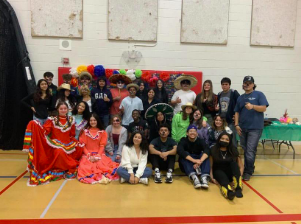
At Highland, many students (myself included) celebrate this holiday and want to share it with those at the school, which we did through the Union Latina club, where we put on an event in the field house, at the school, where students could come and learn about Día de los Muertos.

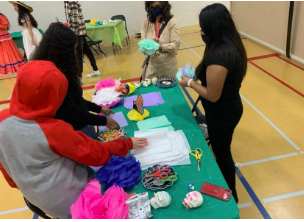
We had many different stations with activities for visitors to do. There was a coloring station where students could color in drawings from famous movies that feature Day of the Dead; a photo booth where they could try on traditional Mexican dresses, hats and decorated skeleton masks and take photos in them; and a face paint table where students got their faces painted with skeleton features in black and white or in colorful and decorative styles (whichever they preferred), which is something very common in Day of the Dead festivals and other celebrations.

Students could also visit the ofrenda that the club put together with decorative flowers, candles, and a bread that’s commonly used to decorate or to consume during Día de los Muertos called Pan de Muertos. The ofrenda had photos to celebrate those who have passed and have been important to the community here in our Saint Paul Public Schools, like Paul Wellstone and Philando Castile, as well as some passed Hispanic historical figures like Selena.

Along with these activities, we had some interactive activities like musical chairs and a group dance called el Caballo Dorado (the Golden Horse) which is a common Mexican line dance that we taught to the students and all danced together. This event was a huge success! Many classes showed up to learn, celebrate and enjoy this holiday together.

Aztec dance being performed by members of the Union Latina
The Ofrenda set up by members of the Unión Latina
Paper flower making during the Dia de los Muertos celebration
Unión Latina club during the Dia de los Muertos celebration

This event is an annual one that ULA puts on along with many others, and is an excellent way to immerse yourself in Latino culture by learning about one of its most cherished holidays right here at Highland.

More ways you can learn about Dia de los Muertos are by reading about it in books like ‘Ghosts’ by Raina Telgemaier or ‘Day of the Dead in the USA’ by Regina M. Marchi, it’s also featured in popular movies like ‘Coco’ and celebrated locally at events like the Dia de los Muertos festival in Minneapolis on November 5, and the Dia de los Muertos Fiesta at the Midtown market, also in Minneapolis.

Dia de los Muertos is one of the many Hispanic holidays that surround us here in MN with so many Hispanic and Latino people all around, and getting involved in it is an excellent way to learn and experience a new culture and enrich your life.

For more information, please visit:

Ocean pollution and how to prevent it

By: Addison Strack

Ocean pollution is a major problem that is greatly affecting the world’s oceans, and this article will give information about how to prevent the issue.

There are two main types of ocean pollution that damage ecosystems in the ocean, and are harmful to the health of organisms in the ocean.

The first type of pollution is called chemical pollution. Chemical pollution is a result of runoff from the use of fertilizer and pesticides on farms, sewage, and more. An increased use of nitrogen and phosphorus in chemicals that end up in the ocean have promoted the growth of algal blooms, which can be toxic to wildlife and humans. These chemicals are also very harmful to ecosystems in the ocean.

The second type of pollution is trash pollution. The main type of trash that ends up in oceans is plastic items, such as shopping bags, beverage bottles and caps, food wrappers, and more. Plastics are the main type of trash pollution in the ocean, because plastic can take 100s of years to decompose, resulting in buildup of these items in the ocean.

Trash pollution is very dangerous to marine life, because they can get tangled in, and digest the trash. When small organisms eat micro plastics, which are very small pieces of plastics, they absorb the chemicals from the plastics into their tissues. When larger organisms consume these smaller organisms, the toxic chemicals then become a part of their tissues. Eventually, micro plastics will then reach part of the food that humans eat.

If we don’t do anything about ocean pollution, there will be multiple negative impacts. One of the most notable impacts would be that if ocean pollution continues, it will accelerate climate change. Mangroves, reefs, and other underwater ecosystems store large amounts of carbon, and because of this, the ocean contains the most amount of carbon in the world. Pollution can destroy these ecosystems, resulting in the carbon being released into the atmosphere, which contributes to climate change.

Ocean pollution also puts marine life in danger, and can lead to extinction and endangerment of underwater species.

There are multiple things that you can do to help prevent and reduce ocean pollution.

Reducing your waste is a major change that you can make in your everyday life, to help prevent ocean pollution. Avoiding singles use plastics, such as plastic bags, plastic bottles, plastic straws, and more will help to reduce the amount of waste ending up in landfills, which could eventually make their way into the ocean.

Respecting the ocean is another thing that you can do. You can do this by fishing responsibly, making sure you don’t litter, and following rules when you are on the water.

Volunteering for beach and ocean cleanups in your community also helps immensely. You could participate in international events as well, such as Global Ocean Cleanup or The International Coastal Cleanup.

As seen above, protecting the world’s oceans is critical if we want to do anything to avoid worsening climate change, and ensure that the ocean will be accessible for generations to come.

If you would like to read more about ocean pollution and cleanups, feel free to visit the websites below: