Category Archives: Tech/Games

JOYSTiCK Reviews Ep. 20B: ‘Pokémon Legends: Z-A’ – Putting the “FUN” in Hypothermia

By: Daniel Kendle

2 logs remain.

Oh…hello again. It’s me, *cough* M-Mr. Whatshisname. Surprised I made it through last night? No need to fret: even th-this French, uh, tundra has no match against this old d-dog.

But that’s enough about me. This is a review about ‘Pokémon Legends: Z-A,’ remember? Not surprised if you didn’t: my tapes from the first part of this article were mixed with other tapes, ones centered around my plights with hypothermic bone cancer. Don’t worry, I fixed that whole mess. Today’s review will be much more “focused.” *cough*

With that aside, we’ve got 2 more sections to dive into. So without further ado, let’s dive in!

PART 3: GRAPHICS

As I can attest to as a resident of this icy, radiative hellscape, France is very pretty! The countryside is, at least; the jury’s still out on Paris itself. You see, the first line in this paragraph was a device called irony.

Jokes aside, Paris is – or at least used to be – a very pretty town. And since ‘Z-A’ decides to base its entire story in Lumiose City (a direct translation of Paris), that obviously gave the game’s developers, Gamefreak, a tricky situation. 3-D ‘Pokemon’ games on the Switch have never been lookers per say, but with this smaller, more restrictive environment, this could be the opportunity for polish that this team has been waiting for. So: did it deliver?

Uh…yeah. Kind of.

I played this game on the Switch 2, which supports 60 FPS and improved texture resolutions. Of course, this means that the game was also built for the Switch 1, which definitely hindered possible graphical fidelity here. Foliage, while populous in both versions, is still used sparingly in grassy areas, like parks. The same goes for models with high polygon counts, like humans: the Switch 1 can’t handle too many on screen at once, meaning the Switch 2 experience is hindered subsequently.

Thankfully, the game doesn’t look terrible overall. In fact, bare your teeth, but I think it looks pretty good! Sorry to all IGN reviewers out there, but the frostbite in my brain must’ve given me something you lack: a controversially-positive opinion! While nothing exceptional visuals-wise, this game is easily the best-looking mainline ‘Pokémon’ game on either console mentioned. You can definitely sense a strong level of polish here, likely a result of skipping a major game release in 2024.

The Pokémon themselves look nice, as do the humans. Gamefreak ditched the realistic textures of ‘Scarlet’ and ‘Violet’ and gave entities a more basic palette, which I wholeheartedly prefer. The choice comes across very intentionally, though, and complements the Pokémon’s natural rim-lighting.

Textures are also much more polished. Again: the Switch 1 version is likely worse in this regard, but going purely off of the sequel console’s specs, I’d call it a massive improvement over past titles.

Buildings are a misfire for me, though. They’re basically just big textured boxes, with little physical depth. Balconies are squashed and flat, being just a part of the mapped image of the building face itself. The same is true for most columns and parapets, and it brings their beauty down a bunch.

While ‘Pokémon Legends: Z-A’ doesn’t turn the wheel on its head graphically, it does well in pushing the wheel forward. For the flack recent games have received for their visuals, it’s good to see a modern title be given some more polish and time in the oven – and its due flowers.

PART 4: MUSIC

1 log remains.

The fire, it’s…i-it’s…

…l-let’s talk about the music, yeah! *cough* This is another source of praise for me, like with most ‘Pokémon’ games. If there’s anything, anything consistent about this series at all, it’d be this area. So how’s about we rapid-fire through my thoughts on some in particular, like with the Mega Evolution section. That way, I can say more about the soundtrack other than, “it’s good.”

  • To start a bit negative, the game only has 1 day and 1 night theme. Both of them are great, but after so many hours in the game, they gradually become repetitive to hear. The night them especially; the jazzy instrumentals, while nice at first, become grading over time.
  • The trainer battle theme during the Z-A Royale is really cool in an almost psychedelic way. Even though you hear this pretty often too, it never succumbed to the repetition of the day and night tracks.
  • Canari’s battle theme is peppy and upbeat, which is fun. Fits a Twitch streamer well, I suppose.
  • Corbeau’s battle music is easily my favorite in the game. It’s sinister and dire, yet the modern synthesizers give it a slick energy that I really love. A highlight of the soundtrack overall.
  • I’m not the biggest fan of electro swing, but even I quite like Jacinthe’s battle music. The overwhelming instrumentals at the beginning were befitting for her cheery, albeit psychopathic tendencies in the story.
  • Finally, the battle music for Team Flare Nouveau is among the best of the remixes here. It carries the manic energy of the original forward strongly, and is also among the soundtrack’s highs.

To conclude, the soundtrack for ‘Pokémon Legends: Z-A’ is another slam dunk for the team overall. It’s funky, weird, and alluring in all the right ways. I can’t deny the mastery at work here with this albu-!

0 logs remain.

…w-what? But…I wasn’t ready! I still needed to conclude my article and give the game an 8/10! I needed to say that the game was far-and-away the best mainline ‘Pokémon’ game on the Switch!

Death befits the ignorant, not the ready.

No…no! I-I can’t give up now. My body, my mind…we still have so much life left to live! My saga can’t end here!

This is not your will.

This is not your choice.

This is not your life.

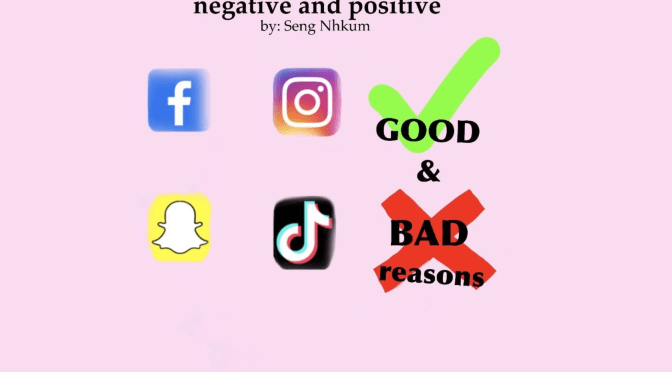
How social media can be negative & positive

By: Seng Nhkum

Today many people use social media, and approximately 5.66 billion people globally use social media, representing about 68.7% of the world’s population. Some examples of social media are TikTok, Instagram, SnapChat, Facebook, and X. I think social media can be negative and positive and these are my reasons why.

First, a reason why I think social media can be negative is harassment and cyberbullying. Cyberbullying is when someone is repeatedly creating harmful behavior using technology to threaten, harass, embarrass, or target another person. This can be negative for social media because although it’s easy to just block them they can still continue making accounts to harass you. Also, cyberbullying and harassment can lead up to damaging the person’s mental health and well being.

Another reason why I think social media can be negative is stranger danger. There are tons of people on social media which means lots of people you don’t know. Strangers can try to take advantage of you and manipulate you especially if you are still young. Strangers can take advantage of you like if the stranger knows about what you’re struggling with they could try to take advantage of that and try to manipulate you into doing something. Like what happens a lot is when a minor runs away from home to secretly meet with the stranger, which leads to a negative outcome because they don’t even personally know the person but still chooses to meet up with a stranger.

Then a reason why I think social media can also be positive is communication and awareness. Social media can spread news quickly and this leads to faster communication making communication more efficient. Also, social media can spread a lot of awareness about many things, for example like any social issues that are happening in the world, and this is positive because it shows people what things are happening in the world changing their perspectives on anything.

Lastly, another reason why I think social media can be positive is you can make a career off it making lots of money. Like many people called influencers, who post videos on social media, have made a career out of social media and being really famous while making tons and tons of money.

Overall, social media is negative and positive because it can put you in dangerous situations, but could also provide for you, or help you. Always use social media safety and use it wisely.

JOYSTiCK Reviews Ep. 20A: ‘Pokémon Legends: Z-A’ – Nuclear Winter and You

By: Daniel Kendle

(Wind blows).

Oh, hello there. It’s me: Mr. Whatshisname. Come sit; my fire’s got enough kindling for another few hours.

You may be wondering why I’m currently sitting in an abandoned Tim Horton’s, holding my hands out to a campfire as green-tinted snow falls around us. Me too! It’s honestly funny how the government tried to hide incoming nuclear fallout from us until the very moment of its conception. Or at least it would be, except for the fact that my cutting knives are made from melted squirrel teeth.

Still not convinced of the nuclear apocalypse’s existence, huh? You recognize that tall, warped monument off in the distance? Eiffel Tower. Boom. Yeah, things have gotten kind of out of hand since the Super Weapon went off. I mean, how did I even get to France in the first place? I live in Minnesota.

Actually, the Super Weapon itself actually was the Eiffel Tower. The monument was secretly designed akin to a giant energy ray, one that shot up into the sky and then down again. This blast caused all this: the snow, the wreckage, the biped horses, everything.

Y’know, this whole thing’s a bit of a coincidence. Just over a month ago the newest mainline game in the ‘Pokémon’ franchise was released, also taking place in a region inspired by France. It’s all I’ve been playing since the apocalypse began. Oh, you’re wondering Why I’ve been playing on my Switch 2 in the midst of a fallout zone? Well now, (chuckles) it’s not like I can lug my Xbox around with me, now can’t I?

But that’s enough preamble. As the embers in front of us slowly wither and die, I thought it’d be fitting to log one last game for this serial before, uh, dying. So without further ado, it’s time to answer this: is ‘Pokémon Legends: Z-A’ a maverick title in the franchise, or does it succumb to the plights of gameplay reinvention and flop as a result? As always, let’s find out.

. . .

4 logs remain.

Let’s begin with an overview of the game as a whole. ‘Z-A’ is a real-time action RPG taking place entirely within a single city in the ‘Pokémon’ world, known as Lumiose City. You play as a tourist who recently moved there, taking up residence in a hotel as you compete in the nocturnal Z-A Royale to prove your strength. Alongside this venture is a quest to solve a mystery plaguing the town involving the ephemeral Mega Energy.

For this review we’ll have multiple chapters: Gameplay, New Pokémon Designs, Graphics, and Music. Hopefully this’ll help keep things on task; the cold’s been numbing my brain, weakening it as a result.

PART 1: GAMEPLAY

This is easily the most extensive section to discuss. The main differentiator between ‘Z-A’ and past ‘Pokémon’ games comes down to its new real-time battling system. The first for the mainline series, this change comes with a bevy of new adjustments to past features from the turn-based system of old.

Battles, whether with wild Pokémon, NPC trainers or other players, function the same: you start by throwing out your selected Pokémon, then use a mix of 4 moves assigned to the A, B, X and Y buttons. Every move in the game has a cooldown period dictating when you can use it. Already here we have a big difference from past combat: PP (Power Points) used to show how many times you could use a move. Now you can use a move indefinitely, with the cooldown balancing PP’s removal.

Your companions aren’t the only ones fighting, though: YOU do too! At all times you and your current Pokémon can run around the battlefield, allowing you to dodge attacks. This is another example of the real-time effect in action: now, dodging attacks doesn’t rely on moves’ accuracy percentages, but your physical maneuvering.

In fact, most past battling components have had their functionality factored. Status ailments don’t whittle down your team members per term, instead over a period of time. For example, poison doesn’t deplete health at the end of each turn, but instead every few seconds your Pokémon’s on the field. “Trap” moves, like Fire Spin and Whirlpool are similar, where instead of dealing damage each turn, they now occupy a space on the floor temporarily, lowering health of any who step inside them. The list goes on, but one thing remains certain: this new battling system is foreign to past entries of the series, and it’s highly-commendable in that regard.

While you could easily zone out in prior titles, ‘Z-A’ instead keeps your focus constantly, a mark of praise that shouldn’t go without overlooking. This reimagined system is among this game’s biggest strengths, and a reason why this game is so replayable. We’ll discuss that latter point a bit later, though.

But what can you do with this new system? Well, aside from ranked online matches, an in-game use for battling is the Z-A Royale, another staple of playthroughs. In universe, these are nighttime tournaments held in Battle Zones where trainers defeat other trainers, gaining points for promotion matches to raise their rank. The overall objective is to climb from rank Z to rank A, becoming the best of the best.

In action, these are simple, but well-designed events. Upon entering one, you’re forced to skulk around, locating other trainers and – hopefully – surprise-attacking one with your Pokémon. Doing so catches them off guard, giving you an advantage. This rule goes both ways, however – if an NPC catches you unawares first, you’ll be stunned momentarily. After engaging each other, a battle commences, with the winner gaining medals (collectibles that translate to in-game currency at night’s end), and points. Gain enough, and you’ll be given a ticket for your promotion match.

Dotted throughout Battle Zones are also cards with varying objectives to complete, such as catching opponents unawares or using a super effective move. Upon doing so an X amount of times, you’ll be given more points and medals, potentially speeding up your time in zones.

Overall, Battle Zones are wildly-fun to mess around in. Levels of your enemies scale per rank, giving you fair fights no matter your place in the main story. They facilitate the short, snappy battles well, and continue being fun both during the campaign and in post-game. A highlight of the game for sure.

The other type of zone, as well as the last main part of gameplay are Wild Zones. In the story, an influx of wild Pokémon into Lumiose City has caused their creation, allowing trainers to catch them within “natural” habitats (at least, as natural as the Parisian skyline allows). Progressing through the campaign opens more Wild Zones to players, allowing them new Pokémon as a result.

These are a much more controversial aspect of ‘Z-A,’ from what I’ve gathered. While most offer a decent amount of vertical depth, the majority of zones are pretty small and inconsequential compared to the routes of past games. You’ll usually only find a handful of monsters in each zone, making them quick to clear out. Some also have stout layouts, stout enough to where you can explore them pretty fast. There’s 20 overall, so while I can’t expect everyone to hit right, I wish they wouldn’t range in quality so frequently. Also, the fact that they all take place in the city makes them blend together quickly. Sewers, architecture and weather can sometimes help, but there’s not a zone in the game that forgoes containing buildings and streets. A missed opportunity for variance, in my opinion.

I like Wild Zones in concept, but their execution leaves a lot to be desired. They don’t hinder gameplay, but their linearity leaves me longing for the larger landscapes of old. They’re far from bad, but calling them good still leaves a bad taste in my mouth. That, and this squirrel meat.

Forgot about me freezing to death already? Hope not; that kind of leaves the serial’s past 20 episodes a bit of a waste. Anyways, one of my logs is soon to burn out, so let’s wrap this section up soonish with some smaller features.

  • Cafés are common sights around the city, acting as optional locales for taking photos with your party members. While not super impactful in my playthrough, their inclusion is justified and respected. Not everything’s black-and-white, of course.
  • I seldom change my appearance in games when given the option, so buying outfits also wasn’t of much interest. Again: they’re cool. Just not my cup of tea.
  • The same catching mechanic from ‘Pokémon Legends: Arceus’ returns, giving you 360º control of throwing Pokéballs. Since that was a big feature of that game, I’ll ignore diving into it for the sake of time, considering it was translated about the same here. Still super fun, though!
    • Alpha Pokémon and Pokémon attacking you in general were also carried over, but for the same reasons as above I’ll leave it at that.
  • Lastly, there’s another large part of battling that we need to discuss, one which initially made its debut over a decade ago. That’s right, I’m talking about…

PART 2: SKY BATTLES MEGA EVOLUTION

3 logs remain.

As a mechanic, Mega Evolution doesn’t stray far from its namesake: in battle, a select handful of Pokémon can Mega Evolve, changing their physical form, stats, and giving a boost in strength. While there were many before, ‘Z-A’ has introduced a batch of new evolutions – 26, in fact!

Mega Evolution has also changed to abide by real-time battling. Mega Evolving is restricted to a set time limit, only able to be paused by retreating your Pokémon. A buff to the mechanic comes in the form of “C+” moves, though. All Pokémon are able to use their normal moves as C+ moves, giving them more power in exchange for some of your Mega meter. All Megas have their moves changed to C+ moves by default, staying that way until the time limit runs out.

Mega Evolution is a well-balanced mechanic, but who cares?! I’m an art student, so all I care about is whether their designs look like they can kill me or not. If you want to skip ahead of this chapter, go ahead: I’ll be bulletpointing my opinions on a handful of Pokémon designs here. If so, then let’s go.

  • I chose Totodile as my starter Pokémon, giving me later access to Feraligatr and – even later – Mega Ferligatr. This new design is controversial in how it changes the least from its original form, aside from a fin on its back turning into a giant fake jaw. When it chomps down, it gives Feraligatr the appearance of a giant Totodile, which is both really cute and sick. Some may hate it, calling it akin to Skibidi Toilet, but I honestly think it’s rad.
  • Mega Starmie is another debated-upon design, which I think is much more understandable. It’s the quintessential joke form, with the sole change being making the starfish’s legs longer. I’m usually not a fan of dumb designs made just for the sake of being dumb, but I won’t lie and say I don’t get a kick out of it. A textbook guilty pleasure design, in my book.
  • Mega Dragalge’s Pokédex entry (the franchise-wide catalog of every Pokémon species) states the following:

“It spits a liquid that causes the regenerative power of cells to run wild. The liquid is deadly poison to everything other than itself.”

See that first sentence? Well, for the uninitiated, you know what else causes the same?

Yup.

  • My favorite new Mega Evolution is easily Mega Malamar. The concept remains similar – a psychedelic, malevolent, upside-down squid – but turns them into a colossal squid mixed with a mad scientist/disco hybrid. It’s as raw as ever and among the best designs introduced; my favorite, definitely. Glad they revealed this guy pre-launch for marketing.

That’s about all the designs I specifically wanted to highlight, but obviously not the extent of my thoughts on this new batch. I’d say I generally enjoy the majority of new designs in this game, more so than most. That’s not to say there aren’t any stinkers, but still: a fine batch of new creatures.

. . .

Wow. What a thrilling couple of sections. You can tell I’m excited because of the monotone nature of my voice. It’s also how you can tell I’m slowly freezing to death, funnily-enough.

I think I need to rest. While only a couple sections in, I feel the need to rest my voice. I’ve been talking for so long, long enough to where I’m beginning to attract…predators.

(Wolves howl in the distance).

That’ll be all for today’s episode of JOYSTiCK Reviews. For now I need to figure out how to end these articles better…and how to survive this night.

“Will Mr. Whatshisname survive the frigid Paris night? Will he manage to enkindle a fire long enough to finish this review? And will scientists ever figure out how a Minnesotan high-school student managed to magically end up in France? Find out all of this and MORE in the next episode of “JOYSTiCK Ball Z.”

JOYSTiCK Reviews Ep. 19: ‘DOOM: The Dark Ages’ – My Life as a Teenage Jester

By: Daniel Kendle

Hey everyone, welcome back to JOYSTiCK Reviews, the world’s finest video game series for anyone uninterested in actually learning about the topic efficiently. ‘DOOM: The Dark Ages’ is the anticipated 3rd game in the modern ‘DOOM’ trilogy, which from a bystander’s perspective likely revolves around kittens collecting balls of colorful yarn. In actuality, you play as the Doom Slayer, an inhumanly-powerful juggernaut set on both conquering all of Hell and maybe even raising some too, who knows.

But how effectively doth the player raiseth Hell? Haveth the franchise runneth dry after all these years? And how many of these “th” suffixes can I inserteth into this review before my editor yells at me? Well, this is JOYSTiCK Reviews, I am Mr. Whatshisname, and I can confidently answer 2 of those questions in due time, with the third pending. So without further ado, let’s taketh a look.

‘DOOM: The Dark Ages’ is the third entry in the recent ‘DOOM’ trilogy of games, seceding ‘DOOM’ and ‘DOOM: Eternal.’ The 3 games are interesting in that they all have fairly-distinct gameplay from one another, despite all being first-person shooters.

The minute-to-minute gameplay in ‘Dark Ages’ is what’ll be the main focus of this review, due to it also being the game’s main focus. Like past titles, the game is split into many different levels. They’re unlocked one-by-one, with a total of 19 to complete by the end of the campaign. The main difference between this new batch of levels from older ones is ‘Dark Ages’s’ focus on more open area design for its different chapters, delineating from older, more linear levels like in ‘Eternal.’

While the main moniker for the latter’s combat was “Rip and Tear,” the former instead relies on the mantra of ‘Stand and Fight.’ These more open areas, while maybe less tightly-packed with collectibles and enemies, propagate ‘Dark Ages’s’ new tagline for its combat. Demons are usually found in spread-out hordes, like troops in some medieval battle. Collectibles, like health and stamina packs, gold, and ammo pickups follow suit, though often remain solitary from each other. These choices promote the player to intricately-explore each level, probing it for loot instead of marching straight to the end flag.

With spaced-out enemies also comes new ways to bash their brains in, of course. The main addition is the Shield Saw, with which you can not only block incoming attacks, but also throw to cut through foes or activate grappling systems. This is a great addition to the flow of combat. If you think of shooting guns as your “A” method of attacking, the Shield works elegantly as a “B” option to close in on opponents. Since you’re able to both shoot and throw the Shield at the same time, you’re able to effectively multi-task killing demons, which always feels awesome. A truly great feature indeed.

The shield introduced another staple of the game: parrying. Upon attacking, most enemies will briefly display a bright green light, meaning they can be parried. Unrealistic, sure (my uncle’s never glowed green when pouncing me for not mowing the lawn) but it gives some depth to combat outside of gunning down foes. The caveat to this is that parrying eventually becomes a bit dull, the player usually being able to confidently-master punishing every enemy’s attack. It’s a mixed bag of a system for sure, but a fun one still.

Guns are still great to shoot; their damage combined with the game’s sound design makes them all feel wonderful to wield. My favorite is the Ravager, personally: you grind up human skulls to fire out in a concentrated spread, with its speed increasing the longer you hold down the trigger. In addition, weapons can also be given unique effects that alter gameplay, though from my experience, not that much. Usually they require gold to unlock, but some “stronger” effects cost unique currency like Rubies and Wraithstones. That being said, these stronger modifiers still never broke past being cute novelties for me, so the grind to pay for them never felt super rewarding.

Aside from straight-up first-person shooting, there are 2 other central modes of combat: Atlan and Dragon segments. These are easily the most controversial of this game’s new additions, with some liking them and some not. Then, of course, there’s those who land somewhere in the middle – like me.

The dragon segments are the better of the pair. They usually take up an entire level’s space, unlike the Atlan segments who take up to only around half. You’re basically just given control of a draconian steed: you can fly, ascend up and down, and even shoot projectiles. They also come with their own parrying system, where you dodge green attacks by flicking the stick a certain direction, which increases your projectile damage for a short time.

These sections are pretty fun, in my opinion. What makes these segments more fun than Atlan ones are how the game’s enemies and objectives alter around it. To account for your new freedom in the air, enemy ships will appear that you have to chase down and shoot. The aforementioned dodging mechanic is another change. Finally, missions (level-exclusive objectives to be completed for rewards) vary when you’re flying. All these and more make the Dragon levels more distinct from regular shooting, and therefore more worthwhile.

Atlan segments I have less to say about, since there’s less to really examine. You take control of a giant mech, and fill up a meter by using different attacks. Then, you can unleash these more powerful moves for…more damage. I’m not really sure what the idea here was; it comes across as half-baked as a result of its simplicity. They’re fine, but take up space that I think could’ve been used for a more complex new system, or even just more FPS levels.

Overall, the gameplay in ‘Dark Ages’ is worthwhile in experimentation with the genre. That’s not to say every new idea works (it’s fallacious, honestly), but what does soars. While faulty in areas, it’s definitely a game whose systems you ought to try out for yourself.

Gameplay is easily the most extensive area to cover, so let’s rapid-fire through these next departments!

The graphics have taken a solid jump in polish since ‘Eternal’ in 2020. The move to the next generation of consoles likely aided in this, and I’ve seen a fair amount of character design comparisons between games subsequently. That’s not to say that newer hardware automatically improves art direction, but hey – it’s always a factor. The only true problem I have with the graphics is the lack of variety in environments: the game seems to have the term “Dark Ages” locked-in, as most landscapes primarily-consist of grays and browns. They’re still pretty to look at, but besides some late-game levels they’re all pretty homogenous.

The sound direction is an immediate hit, however. I mentioned it briefly before, but the punch of gunshots, tearing of flesh and impacts of melee attacks all combine to have the game drip with satisfying audio. It may seem simple, but that’s just because ‘Dark Age’s’ sound effects are so smoothly-implemented. This – and the rest of the modern ‘DOOM’ trilogy, really – are masterclasses in sound design and mixing in games.

The music’s more of a mixed bag. The composer for ‘DOOM’ (2016) and ‘Eternal,’ Mick Gordon, left after the last entry due to mistreatment by Bethesda. Their replacement, Finishing Move Inc., did the best they could but simply can’t compare to Gordon’s work on the last games. What we do have is still good, but c’mon: you can’t beat synthesized chainsaws as instruments. You just can’t.

I think that’s enough for today. We’ve covered a decent bit of ground, though this game’s intricate shooting left me wanting to leave some for you to find out about. Oh, what’s that? You thought I forgot about the game’s bosses? My apologies, but you must be mistaken; ‘DOOM: The Dark Ages’ took another creative liberty: replacing all but the final boss with planks of wood.

I do actually like the final boss quite a bit, despite being a bit underwhelming. The other bosses you fight throughout the campaign I found pretty dull, though, nothing worth discussing in depth. It’s here where parrying became its least compelling, truthfully.

Nonetheless, ‘DOOM: The Dark Ages’ is still a great time. Perfect? No, and there’s certainly objective problems to critique, but what I can praise is how the game delineates from what came before. It truly feels separate from the others, carving out its own identity through new gameplay ideas. I’m therefore giving the game an 8/10.

That’s all for today’s review, however. ‘DOOM: The Dark Ages’ is available now for PlayStation 5, Xbox Series X|S, and PC.

JOYSTiCK Reviews Ep. 18: ‘Fatal Fury’ (1991) – I Couldn’t Think of a Subtitle for This One

By: Daniel Kendle

Hey guys, welcome back to JOYSTiCK Reviews, the leading choice in video game serials for those seeking writing comparable to the Infinite Monkey Theorem’s. It’s been a long summer away, but at last we’ve returned to my boiling vat of video games (yay!) and opinions (boo!).

‘Fatal Fury’ is an arcade fighting game released by SNK in 1991, later being brought to home consoles like the SNES and Sega Genesis by Tamara LTD. W!WALOZA!(‘Wow! What A Load Of Zany Acronyms!’) The game is the first in the franchise of the same name, one cemented alongside ‘Street Fighter,’ ‘Mortal Kombat,’ ‘Tekken,’ and ‘Super Smash Bros.’ as a cornerstone part of its genre.  

Overall, a legacy title whose influence on future generations of games is prevalent all these years later. It’s a shame it was released the same year as ‘Street Fighter 2,’ arguably the most predominant fighting game out there for its introduction of genre staples. It’s ALSO a shame that ‘Fatal Fury’ kinda sucks!

Yeah, I didn’t really love this game, despite its importance. But why is that, and what could’ve been improved? As always, let’s find out.

‘Fatal Fury’ is a 2D fighting game, like I said before. Upon booting it up you get the choice of 3 playable characters: Terry Bogard, Andy Bogard, and Joe Higashi. The story remains mostly similar for all 3, as each character instead gets completely different movesets. I solely used Terry for my playthrough, so he’s the only one I can really speak on.

To begin, the game’s combat is similar to other fighting games from its time: 1v1 matches with health bars to denote hits taken. Combos and multi-button inputs are here in spades as well, along with a unique feature to the series: unlike its contemporaries, ‘Fatal Fury’ lets fighters switch between the foreground and background, or as I’ll call them: planes. The 2 planes act the same, but switching between them lets you attack, opening up new opportunities for combos and the like.

This distinction is neat, and I think is a lot cooler in a PVP setting. For the campaign mode it becomes less of a core facet of combat, however. From my playthrough the lane-switching mechanic acted more like a rudimentary parry. By mashing the attack button you’re able to attack as you switch lanes, so as you and the opponent hop back and forth, it culminates in the 2 of you waiting to see who’d eventually mistime an input and be hit first. An alright addition in theory, but the AI on display here doesn’t make the most of it.

On the topic of AI, here comes the primary issue with the game: its difficulty. Critiquing a game’s level of challenge is always a risky venture, but I think public scrutiny has to step aside for a second because yeah, this game is disturbingly-annoying to play.

It’s common knowledge that older games often made up for their short runtime by amping up their difficulty, thus making them artificially-longer. ‘Fatal Fury’ is a prime example of this: the story can be beaten in about an hour if you know what you’re doing. If not? Well, welcome to the trenches, kiddo!

For the few fights there are in this game, each’s respective challenge fluctuates wildly. Raiden, this luchador guy, sucks! Every move in his kit combos into one another flawlessly, so even poking him is enough for him to play ‘Operation’ with your dead, flailing body. Meanwhile, the subsequent fight against Billy Kane features a brain-dead easy infinite combo you can perform against him. By repeatedly breaking his staff, you turn what should be a tricky fight into a cakewalk.

Then there’s Geese Howard, the final boss. Going in, I knew he was notoriously-tough, but brushed any trepidation aside. So how did the fight against him go? Well, let me put this lightly:

I would rather rip my fingers apart than rematch Geese Howard.

I would rather eat a bag of nickels than rematch Geese Howard.

I would rather hot-glue rusty nails into my leg than rematch Geese Howard.

I would rather guzzle gasoline than rematch Geese Howard.

I would rather coat myself in tar and feathers, tie myself to a log, and plummet over the Niagara Falls 11 TIMES than fight Geese Howard.

This fight is horrible, truly. He spams a ground-based projectile the size of a small island nation, making blocking a constant. Couple that with his various close-range grabs and pummels, and I can confidently say that this is the only boss fight in any video game where I think the programmer responsible genuinely had some sort of malice for the player. I’m joking, of course…kinda.

Geese Howard is the worst of this rollercoaster of difficulty, though make no mistake: playing through ‘Fatal Fury’ in 2025 isn’t a walk in the park. I’ll die on this hill – though hopefully not with my credibility.

The pixel art is pretty good, albeit a bit “shiny.” The backgrounds are lavishly-decorated, and while animations for moves rely on key poses a lot, said poses look really nice in motion! Any indoor spaces especially look nice; I’m a big sucker for pixel art of rooms with interesting perspective-points.

The music’s also nice. Nothing stand-out, except for maybe, er… (inhales) ‘Haremar Faith Capoeira School – Song of the Fight [Believers Will Be Saved] (Richard Meyer’s Theme).’ It’s kinda catchy, which surprised me. Richard Meyers’ fight in-game blew, but hey-what a nice song!

Anyways, I think that’s about it. ‘Fatal Fury’ is a short arcade title that strives for combat depth almost as much as it strives for your quarters. The result? A tough-as-nails fighting game that will do 1 of 2 things: make you a lifelong fan of the franchise, or make you want to jump off a cliff. Fortunately for me, it did both!

While the various challenges presented to me irked my opinion of the game, I can’t say I don’t look back with pride on my accomplishment of finishing. It’s not for everyone and doesn’t hold up the best, but there’s an eternal charm here that some will love. I’m giving it a 5/10.

That concludes today’s JOYSTiCK Review. Thanks for reading, and have a good day!

The role of back propagation in a machine learning algorithm

By: Ivy Dahl

Photo by Google DeepMind on Pexels.com

An algorithm is a series of steps to complete a task.

A machine learning algorithm is a computer program composed of many individual, yet interconnected parts that perform a series of steps involving numbers and the guided transformations of them to achieve a specific goal, without being given an explicit direction. Back propagation is one of those parts. It’s a journey from one number to another, calculating the error of a specific guess.

Imagine a bunch of data points on a graph, given to the back propagation algorithm by some previous part of the general machine learning algorithm, all spaced apart so that a line would have to be placed along them to connect them. Approximating a line that would fit all those points evenly, finding the medium, is a difficult task. An objective numerical way is the squared distance between a given curve and the data points. This is called a loss. The fitted curve with a high loss suggests the data points are far from the currently generated curve indicating a bad approximation. Low losses indicate a better fit as the currently generated curve closely aligns with the data points, making it a more accurate approximation.

A function could represent a line.

But a constant function wouldn’t fit this line by itself. Neither would an exponential function. But what if you put them together? And added another? You can think of this collection of functions like a toolbox that is already equipped with these functions, but still in need of a perfect coefficient to bend it to fit the line as close as possible. The goal is to find the combination of coefficients that outputs the best fitting line. The best fitting line is defined as the line with the combination of k’s that yield the lowest loss. Each k represents a random number.

Y(x) =k(0) + k1x + k2x + k3x + k4x

X constructs a curve, Y calculates the loss function of it and outputs one number, the loss, then plugs these numbers back into the general equation for the curve. Now it can start going through the numbers in order to find the minimum loss. This will lead to finding the distance between data points and the current generated curve repeatedly.

But can we make this prediction without going through countless trial and errors? Differentiability is good for fast finding of optimal number combinations. We do this by focusing on one random k coefficient on a coordinate graph. We are trying to find which value of k results in the lowest loss individually.

Knowing the local behavior of a function only, we are blind to all other points. Adjust x. This new adjusted input of x will result in a new value for y which will retain the same amount of change as x was changed. There will be a line connecting x and y and when you take smaller steps it will continue to more accurately align with the optimal line configuration, creating a tangent line between the x point and y point.The steepness of this tangent line is its rate of change, indicating a change in the curve that it’s aligning with.

Now let’s say you do this for every one of the coefficients individually. This gives multiple sets of these slopes that can be compared to the larger set of complex slopes coming together to form a line. These two sets of slopes will coincide. You might not be able to recreate a complex line like this, but if you break it into smaller slopes, it’s easier to approximate the individual slopes to the original, and put them all together once done to recreate the line with the lowest loss.

This is a brief description of how back propagation is an integral part of a machine learning algorithm by taking a specific set of inputs from somewhere else in the algorithm and creating the best fitting curve for it, so that curve can be passed forward to another part of the machine learning algorithm.

JOYSTiCK Reviews Ep. 17 (Season Finale): ‘Psycho Soldier’ – Path of the Psycho

By: Daniel Kendle

…a psycho-path, if you will.

Hey gang, it’s me – Mr. Whatshisname, and welcome back to JOYSTiCK Reviews. After another year of writing for this serial, we’ve reached another milestone: the end of season 2! It’s been fun, but alas, the road’s end has come upon us. As customary, at the end of today’s review we’ll be taking a look at a brief ranking of all of the game’s I’ve reviewed thus far, with both season 1 and 2 titles included. This is so we can not only look back on the series as of yet, but doing so also lets me update scores as I see fit.

Of course, any review to be included alongside the aforementioned ranking ought to be short and sweet. Thus, I’ve dove into my “archive” (fat closet) of video game personals and have chosen the title ‘Psycho Soldier,’ released by SNK for arcades in 1987. The game is yet another retro title, the first I’ve reviewed since ‘Tetris.’

‘Psycho Soldier’ is a side-scrolling “shmup” (shoot-em’-up) game following Athena Asamiya and Sie Kensou, a pair of soldiers who, believe it or not, possess psychic powers used to fight back against an alien invasion of Japan. The game follows whichever one the player picks – though Athena is often seen as more of the game’s main main character between the two – as they descend into the Earth’s crust while fighting monsters and aliens.

Combat involves a handful of Psycho abilities, with a gauge in the bottom-left of the screen dictating the amount you have left. Attacks have you shoot out exploding orbs, lasers, and even let you transform into a different beast form depending on which character you choose, despite both functioning similarly.

I played through the game on a console, so it wasn’t required that I insert coins or tokens to continue playing after dying. This is the case for a lot of arcade-to-console ports, and I think that’s part of the reason the gameplay overall really didn’t click for me. It also goes that I’m not really a person who frequents high-score games often; I just don’t find them all that compelling compared to games with a definitive end point. These factors combined led to my experience with the game culminating in me dying, respawning, and continuing the level without worrying about my loss of points. I’m willing to admit that this is less so the game’s fault as it is my own, so I can’t really degrade it for my own personal values.

What I can degrade, however, are the controls. It’s not rare for older arcade titles to be fairly limited in movement when ported over to console controls, especially modern ones. ‘Psycho Soldier’ is no different: Athena’s movements are particularly stiff and slow, creating a bevy of problems when precise aiming is required for certain enemies. The issue is found with bosses too; some have attacks that involve them quickly darting out and striking you, which can become difficult to avoid if you aren’t in an ample spot for dodging. Since they usually take up the right half of the screen when encountered, your limited space to maneuver, er, limits the practicality of dodging these attacks.

Other than that, powerups and enemies are pretty forgettable, nothing to run home about. I suppose there’s a sort of brainless fun to be had when mowing down aliens and destructible blockades, but that feels like a lame “positive” for a video game.

“B-but Mr. Whatshisname! What about the game’s theme song, the first ever recorded for a video game character? You couldn’t possibly leave out that,” you wail, somehow ignorant to the raised cudgel being aimed at your head. I tolerate mindless whining about as much as I tolerate insubordination – I suppose you can connect the dots from there.

You’re correct in your nagging, though: ‘Psycho Soldier’ was the first-ever video game to feature a song with vocals included for one of its characters, creatively-dubbed as the “Psycho Soldier Theme”. After listening to the VHS version, ‘Super Smash Bros. Ultimate’ remix, and various instrumental versions of the song, I honestly think it’s a solid song, despite its age. Nothing crazy, really: given the technical restraints present during the 80’s, I could never expect the most radical of melodies, but it’s still aged decently-well. It’s my favorite part of the game, truthfully!

That’s about it, honestly. ‘Psycho Soldier’ is a simple little package, though one that I ultimately never found myself very interested in during my playthrough. It’s around 40-ish minutes in length, so it thankfully never felt like a waste of time. Still, I give it a 5/10.

But now that that’s done with, let’s move onto my ranking of all games reviewed so far – ‘Psycho Soldier’ included! Like any YouTube personality who doesn’t know what “personality” even means, my opinions are pretty, uh, quirky OwO.


#17: ‘Cocomelon: Play with JJ’ (2/10)

#16: ‘A Minecraft Movie’ (4/10)

#15: ‘Minecraft Story Mode’ (4/10)

#14: ‘Psycho Soldier’ (5/10)

#13: ‘Reigns: Three Kingdoms’ (6/10)

#12: ‘Pokemon TCG Pocket’ (6/10)

#11: ‘Splatoon 3’ (6/10)

#10: ‘Kirby and the Forgotten Land’ (7/10)

#9: ‘Pokemon Scarlet’ and ‘Pokemon Violet’ (7/10)

#8: ‘Wingspan’ (8/10)

#7: ‘Minecraft Dungeons’ (8/10)

#6: ‘Portal’ (8/10)

#5: ‘Super Smash Bros. Ultimate’ (9/10)

#4: ‘Pokemon Legends Arceus’ (9/10)

#3: ‘Cuphead’ (9/10)

#2: ‘Tetris’ (10/10)

#1(!): ‘Metroid Dread’ (10/10)

And with that out of the way, the season’s officially done with! A shame that the very first game I reviewed is still the best, but it’s whatever. Hopefully next year we can see some tough competition, but until then, thanks for reading, and see you for season 3!

JOYSTiCK Ep. 16: ‘A Minecraft Movie’ – Jock’ the Block

By: Daniel Kendle

The ‘Minecraft’ movie, formally known as ‘A Minecraft Movie’, is a 2025 film released by Warner Bros. Pictures, Legendary Pictures, and Mojang Studios. Directed by Jared Hess (‘Napoleon Dynamite,’ ‘Ninety-Five Senses’), the movie is based off of the popular video game ‘Minecraft.’ 

‘Minecraft’ is my personal favorite video game ever, so I’ve been…curious about its silver-screen adaptation ever since it was announced, boosted by its initial trailer’s release last year. I’m also (straightens tie) a bit of a film buff myself, so that helps a lot. So, on opening night of this year, I showed up to an AMC screening of the movie, clad in a suit and my dad’s sunglasses, ready to enter the pits and emerge back alive.

The film’s plot is pretty basic, all things considered; if you’ve seen the modern ‘Jumanji’ films, then you get the idea: people are sucked into a video game, and have to find their way back home to the “real” world. This comparison isn’t necessarily a bad one per say, but I think it’s the beginning of an all-encompassing problem this film has: identity.

When adapting a piece of media into a feature film, one must decide how faithful the adaptation must be. This is a sliding scale, with past video game movies falling all over the spectrum. For me, the sweet spot is around the middle: the film encapsulates and faithfully translates the source material thoroughly, but brings forth its own ideas as to not feel like just a 1-to-1 replica of its predecessor.

This is where ‘A Minecraft Movie’ confuses me. The film seems to strive to land on both opposite ends of the line: it wants to be incredibly-faithful, yet also be a standalone product. The movie features countless references and Easter eggs to ‘Minecraft’ and its spin-off franchises – hell, the main villain is a character from one of those spin-offs. And yet, seemingly to spite this, the plot chosen for the film seems barely interested in telling a story reminiscent of ‘Minecraft’s’ emotions, atmosphere, and world building, instead using locations and creatures from the game on a surface level.

Throughout the movie, I was having a good time – a GREAT time, even -, but never really processed the experience as an adaptation of the game I love. I’ve heard how people couldn’t believe that they were finally watching the ‘Minecraft’ movie upon initial viewing. While this likely isn’t their opinion on that matter, I felt the same, though in a negative way. This movie doesn’t feel reminiscent of its source material in any way other than literally. Throwing all of these references and characters is one thing, but capturing the spirit and vibe of the game you’re adapting is another.

For me, ‘Minecraft’ is a game that relies heavily on its unique atmosphere for its magic. In a vacuum, I’ve always described it as tender, yet haunting – the world, despite its scenic vistas and cute mobs, has always had a looming sense of isolation that prevents it from joining ‘Stardew Valley’ and ‘Animal Crossing’ in the cozy game genre. But then again, its loose structure separates it from a game like ‘Terraria,’ another sandbox game that employs a more strict and linear progression system.

It’s so unique, and is among the game’s most beguiling offerings.

This movie reminds me of a quote by Max Brooks, author of the book ‘World War Z’ (and, like, 3 ‘Minecraft’ novels; go figure). When asked about his thoughts on the book’s screen translation, he said:

“I was expecting to hate, it and I wanted to hate it because it was so different from my book, and yet the fact that it was so different from my book made it easier to watch because I didn’t watch my characters and my story get mangled…So I was just watching somebody else’s zombie movie, which was fun and intense.” – Max Brooks, USA Today

This quote is about how I feel about ‘A Minecraft Movie:’ it’s a fun ride and I’m able to put aside the original title and enjoy it separately, yet when compared to its adapted game in retrospect, it pales in comparison. I was able to enjoy my time in the theatre, but I’ve largely filtered out my memories with it. It’s over, and I’ve gained little in the process.

If you haven’t seen the clips online by now (a near-impossible task, I know), this film has some memes going around about it. Since the initial teaser, lines like “I…am Steve,” “Flint and steel!,” and most-popular of all, “Chicken Jockey!,” have gained immense notoriety since their inception. These are only a few of the movie’s impressive array of joke-quotes. The film rattles them out at nauseum, as if it’s a 9-5 for it. I can certainly see their appeal, and do find them funny – to an extent. Their inclusions have left me in the opinion that they make the film feel…hollow.

This movie, in my opinion, is set to become dated with time. Not because it has any specific pop culture references or whatever, but because of what it stands for. This is the ‘Minecraft’ movie. Forever. There’s no going back. And when you have a film whose main appeal is ironic, topical humor, there’s little chance that we’ll be as kind to it then as some of us are now.

There’s nothing wrong with liking ‘A Minecraft Movie,’ of course. Everyone has their own opinions, and as long as you aren’t hurting anyone else with your’s it’s perfectly-valid. But nonetheless, I’d like to see a strong argument for the film’s portrayal of this universe as one reminiscent of the power the original one holds.

Actually, there is 1 I should mention. Hess has stated in multiple interviews how the film’s title using “A” at the beginning is intentional, highlighting how this adaptation is only 1 of many, the others being fan creations and the like. Using “A” defines it as not the definitive ‘Minecraft’ translation, but only a single story in an amorphous narrative, one able to be shaped by anyone. I greatly-respect this decision, and believe it to be a strong counter to my thoughts on the movie’s tonal dissonance.

Still, I can’t call this a perfect bandage. Even if Mojang claims to view ‘A Minecraft Movie’ as only a fragment in a sea of ‘Minecraft’-related stories, its nature eludes this idea. Having the creators of the game supporting and developing this feature ultimately undermines this mentality. If the people who made the game, a movie’s adaptation, and also helped aid the movie’s development, that action leaves it impossible for the game studio to not be partial to this retelling of their original game. Their commitment to ‘A Minecraft Movie’ doesn’t cement it as the definitive adaptation of the game for all, but rather Mojang’s definitive adaptation of the game.

This partiality strains the director and companies’ efforts in underplaying the product’s pinnicality, causing the final result to attempt to stray from the original material’s theming and world as much as possible without becoming something new. And when that result personally feels like a poor representation of the material…my time with it is ruined.

. . .

This is likely my most controversial review yet, and I’m aware of that. I’ve mainly focused on the movie’s – and my – relationship with the game, which makes this review ripe with some of that yum-yum bias that politicians always drool over.

You’ve also possibly noticed how I’ve never even mentioned the story, characters, or VFX once! It’s a surface-level complaint, see – this whole time, I HAVE been talking about those, just in a manner less-literal than you may have expected. Yeah (grunts while flexing), back in elementary school, they called me Mr. Whatshisname the Foreshadow-er, for what it’s worth.

In conclusion, I’m giving ‘A Minecraft Movie’ a 4/10. As of April 2025, the film is playing in theatres globally.

JOYSTiCK Non-Review: Top 5 most-wanted characters for ‘Super Smash Bros.’ 6

By: Daniel Kendle

Hey guys, it’s me, Daniel Scientist, here with the boys in the lab for another bumpin’ day at work. Since both business and my monkey breeding study’s been slow for the past few weeks, I’ve been hard at work whipping up hypotheticals for the next ‘Super Smash Bros.’ game.

With the Switch 2 direct and eventual release on the horizon, a new release for the series is near-inevitable. With the last entry, ‘Ultimate,’ becoming the best-selling fighting game ever, a follow-up is poised to release relatively-soon, as the conspiracy theorists want you to believe. It just so happens, however, that I’m extremely gullible!

‘Ultimate’ brought back every past fighter along with 24 newcomers, leading to a grand total of 89 playable characters. This total is gargantuan, and has led speculation for the next title to various areas of varying quality. Reboots, upgraded ports, and regular-old successors have all been thrown out, and each is an interesting concept.

For today’s report, I’ll be examining the latter-most option, as to simplify and streamline my ideas. Specifically, I’ll be sharing my top 5 most-wanted new fighters. Treat this article like a bingo board: if I get any right, I’m gospel; any wrong, I’m just stupid.

Without further ado, I hope you enjoy this research essay (please; I don’t want to go back to the monkey ranch), and let’s dive in.

. . .

#5: Chell (‘Portal’ series)

I reviewed ‘Portal’ earlier this year, and have since fallen in love with the series. I think everything from the humor, writing, gameplay, and all that stuff in-between is rich with polish, and I’m surprised at the little fanfare for representation in ‘Smash.’

Despite having only a Portal Gun to her name, I think the protagonist, Chell, has some cool moveset ideas. Obviously, portals would be the focal point: her up and down Specials could be tied to spawning the blue and orange portals respectively, with her being able to fast-travel around the stage when necessary. Her side special could be something like spawning a box, being able to pass through the portals and potentially setting up combos. A fighter mostly focused on physic systems sounds REALLY cool, but balancing would be necessary.

#4: The Knight (‘Hollow Knight’)

While I’ve never fully finished ‘Hollow Knight,’ I’ve liked what I’ve seen of it so far, even if I’m not as into it as others. Still, the titular Knight would be a great addition to the next ‘Smash’ game.

Being a “Metroidvania,” ‘Hollow Knight’ has a wide array of abilities for the Knight to obtain and use. Vengeful Spirit, Desolate Dive, and Howling Wraiths are slick Special moves that come to mind. Also, these attacks are accessible by harnessing Soul, a meter that’s raised from hitting and killing enemies. So, bringing that mechanic into ‘Smash’ would fit perfectly, in my opinion! It also helps that ‘Hollow Knight’s’ a 2D game, features a double-jump power up (which could be a cool animation to transfer over), and has many stage possibilities with its vast underground world. In particular, the Radiance’s boss arena would be rad.

#3: Paper Mario (‘Paper Mario’ series)

Public outcry has deemed Waluigi the most-wanted ‘Mario’ character, and while he’s definitely in my top 20, I’ve always preferred this spin-off series’ lead role. It’s weird; I’ve never liked characters like Dr. Mario, Toon Link, and Young Link due to being strange, unnecessary inclusions, yet love this idea.

I’m not super keen on the ‘Paper Mario’ series, but after doing some research I think there’s a strong variety of avenues to take this fighter down. Hammers, confetti, and assisting support characters could all be featured, referencing both the 2D and ring combat in different games. Not a character I can give many moveset ideas for, but a strong concept still.

#2: Raven Beak (‘Metroid Dread’)

‘Metroid’ is my favorite Nintendo franchise, and ‘Dread’ is my favorite first-party Switch game. Therefore, it’s natural for among my most-wanted newcomers to be the game’s final boss, Raven Beak. A galactic warlord, this dude not only has one of the coolest designs in the franchise’s history, but also one of the best movesets.

To port some attacks over to ‘Smash,’ his neutral jab could be the 3-hit combo he performs during his fight’s first stage. His neutral Special could be his black hole projectile, which could be charged to increase size (this is similar to Samus’s neutral Special, which could be a thematic similarity). Up special? Simple: he quickly unsheathes his wings and launches into the air, like Joker’s up Special with Arsene active. Down Special? Raven Beak plants a bomb, which, while not arena-covering like in ‘Dread,’ would do a fair amount of damage at a distance, and a critical-hit if the opponent is right next to it when it detonates. Smash attacks? Reference his animations used in parrying cutscenes.

Raven Beak and the next character are vying for my personal most-wanted addition, but I eventually went with the character below for #1 for the 3rd-party “cool factor.” Still, with Ridley being among my mains in ‘Ultimate,’ Raven Beak would be an awesome addition if anything close to my envisioned concept.

#1: The Doom Slayer (‘DOOM’ series)

I mean…where do I even start? ‘DOOM’ is one of my favorite franchises in all of media, so you can probably guess I was disappointed with its main character being relegated to a Mii Costume in ‘Smash’s’ most recent entry.

Part of why the series’s combat rules is because of its mix of melee and ranged fighting. The reason I don’t care much for fighters like Master Chief from ‘Halo’ or Heavy from ‘Team Fortress 2’ being added is because their solo-projectile movesets leave them stranded in the “Zoner” archetype, a pretty lame playstyle. But with the Doom Slayer, the franchise’s ~30 year history offers bloody, gruesome weapons from every path of life. In the upcoming game ‘DOOM: The Dark Ages,’ you get a gun that grinds down and shoots out the remains of human skulls, which is cool as hell. So, for being a fighter with a storied history, wide range of moveset possibilities, and being among my favorite game series, the Doom Slayer is officially my most-wanted fighter for ‘Super Smash Bros.’ 6.