
By: Ro’Mel Bryant-Oliverz
Populization of Midgard, and creation of Humans:
Later, after the gods were so bored, that’s when the gods decided to create humans for Midgard. They took trees or logs in Midgard, and each of the gods gave them an aspect of life. Odin gave Önd which is supposed to be Breath/Spirit, Vili gave Óõr which is supposed to be Mind/Soul/Passion, and Vé gave Lá which is supposed to be physical Senses/Appearance/Blood. They imbued those three qualities into two trunks and created the first two humans Ask and Embla, male and female. Ask came from an ash tree, and Embla came from an Elm tree, hence their names. They wanted a population in the area they defined as the middle, and learned from the dwarves how to create a tool-like life, so they now made more pure beings with personality, drive, and afterlife.
Midgard is a place of safe land, mountains, fields, lakes. It’s meant to be similar to the normal world. The Dwarves likely only got Önd and Lá or the equivalent; made to be less human than humans.
Alfheim and Elves explanation:
The Elves are the most mysterious and difficult race to pinpoint, but they came before the humans but after dwarves. The elves aren’t said to be created by the Gods but instead are the spirits of the sun, the air, and the growth of nature. And because they were so connected to “The Light”, the gods gave them their own realm, Alfheim. An exact timeline or origin for the elves is not established and they really just appeared. A lot of the elves are up for interpretation, they are usually represented as embodiments of beauty or light, like when called ‘fairer than the sun to look upon” or just being pure beings. They are the only race the gods actually respect enough to invite to their feasts. They are mainly only background characters you know are “above humans” and close to the gods but never actually are involved in any stories. The biggest and really only story of Alfheim was that when Aesir God Freyr was a baby and lost his first tooth the Gods followed the ancient Norse custom of the tan-fé, or Teething gift. It’s when a child loses their first tooth they receive a significant gift. The Aesir gods looked at the newly manifested realm of Alfheim and decided it as the perfect gift for the young god, and they gave him complete control of the realm and inhabitants.
I personally believe the Gods created elves before humans, as more pure beings maybe out of light instead of wood, but created beings that were too pure and boring or slow to evolve, so they just gave them their own realm and let them be, and used that information to create humans out of physical material like wood.
Jotenheim progression throughout:
Alongside all of this the two Jotun that escaped have still been left alone in their harsh land expected to die, but the two reproduced rapidly. The outskirts went from a desalated wasteland into a rugged, mountainous kingdom filled with multiple emerging branches of the Jotun. Frost Giants, living in the coldest parts, Mountain Giants who looked like the rock and earth they lived on, and Wise Giants, figured like Vafthrudnir who spent his time memorizing the history of the world to outsmart the gods. It stayed harsh, cold, and rocky. It was the polar opposite of Asgard. The Giants built their own fortresses out of snow and ice to keep the gods out.
Introduction of Vaneheim and the Vanir, and role in story:
Vanaheim and the Vanir knew exactly where each other lived and both lived near the top of the world in the “Upper Realms”, but they lived like two separate superpowers during a war, respecting each other’s boundaries but never hanging out. They represent the opposite side of power, if the Aesir is order, law, and war; the Vanir are natural flow, fertility, and deep magic called Seiõr. While the Aesir built their palaces and power, the Vanir were content in the lush, wild forests and oceans of Vanaheim. Though they knew of each other’s existence, there was a natural barrier, they were like two separate species of Gods.
Eventually a woman named Gullveig wandered into Asgard. She introduced Greed and spoke of seeking out for gold and the power it brings. The Aesir also didn’t recognize her type of mysterious Seiõr magic that she had, since it was different from their order based magic, and they reacted with fear and violence. The gods did something they never did to an outsider before, they tried to kill her. They found something they couldn’t understand or create so they mercilessly tried killing her. In an event called “thrice-burned, thrice-born”, the gods first riddled her with spears and threw her into the fire in the center of Odin’s hall. She stepped out of the flames, reborn, so they threw her back in. Again, she walked out of the fire completely unharmed, and she took a new name Heiõr, meaning “Bright”, or “Clear”.
She then left Asgard, traveling through humans, giants, and dwarves on Midgard, teaching them the dark arts of Seiõr, spreading its influence. Once Gullveig got home to Vanaheim, and the Vanir heard about how the Aesir tortured her, they were outraged. They demanded “weregild”, or a blood money type payment. Odin and the Aesir refused, and instead of negotiating, Odin hurled his spear over the Vanir army, a traditional Norse gesture for declaring war.
Vanir and Aesir war how it started and ended:
After war was declared between The Aesir and The Vanir, many things happened and changed. First, Walls of Asgard broke, in the first rounds of the war the Vanir were on top, and used their Seiõr magic to shatter the “unbreakable” wall of the gods. As well as that, the Gods were also no longer just builders and players; they were killers. Losing their innocence, and tying into the theme of the wall breaking. And eventually this ultimately led to the famous hostage exchange, where the Vanir gods like Freyr, Freyja, and Njörd, came to live in Asgard to ensure peace. The Vanir had to send Njörd, the god of the sea, and his two children, Freyr and Freyja. They were the heart of the Vanir tribe. The Aesir had to send Hœnir, a tall, handsome god, and Mímir, the wisest of all the Aesir. The Vanir sent to Asgard were integrated like family, Freyja became the priestess of the sacrifices, and had to teach Odin Seiõr magic. Freyr as well became a part of the family and received Alfheim as a gift eventually. Everyone made The Ritual of the Kvasir, to seal the deal permanently; every single person from both sides gathered around a vat and spat into it, creating a being named Kvasir and an oath.
Eventually the Vanir tribe realized Hœnir was dumb and couldn’t do anything without Mímir whispering in his ear. They decapitated Mímir and sent his head back to Odin, and left Hœnir useless on his own. Odin chose to keep Mímir’s head as a private advisor, rather than seek revenge. And that’s how another war didn’t start.
Result of Vanir and Aesir war:
The Aesir and Odin took the strategic and long term victory of the war. Instead of getting rid of the other Gods he decided to integrate their best people into the Aesir, merging the bloodlines, and also get taught the mysterious and unknown Seiõr magic that was so deadly. The Aesir were no longer only builders of order, they were now, thanks to the Vanir, also builders and gods of nature. Very importantly, is the introduction of Seiõr magic to the Aesir and Odin. Before the war they really only used physical strength and runes. Freyja had to teach Odin the magic, which Seiõr magic is a form of weird magic that allowed users to see the future and manipulate fate. Odin became obsessed with this magic, and it turned him from the Chieftain builder to the “All-Father” obsessed with knowledge.
On top of all of this, after the oath and spit into the vat, the being created was Kvasir. He has one of the most famous stories in Norse myth where he was murdered by the Dwarves, and they brewed his blood with honey to create The Mead of Poetry. Anyone who drank this mead eventually became a scholar or poet. Odin eventually stole the mead back for the gods. So the oath and creation of Kvasir lead to the gift of inspiration, art, and literature.
The Gods, now both the Aesir and the Vanir, started preparing for Ragnarök together. They started focusing on defense, strength, and integration of the Vanir to create more diverse and powerful Gods.
World Tree structure explanation:
Alongside the creation of the world outside of all the small conflicts within the realms, came a higher primordial element, The World Tree or Yggdrasil. It is a tree that holds, or is the shape of, the 9 realms, which the world is made out of.
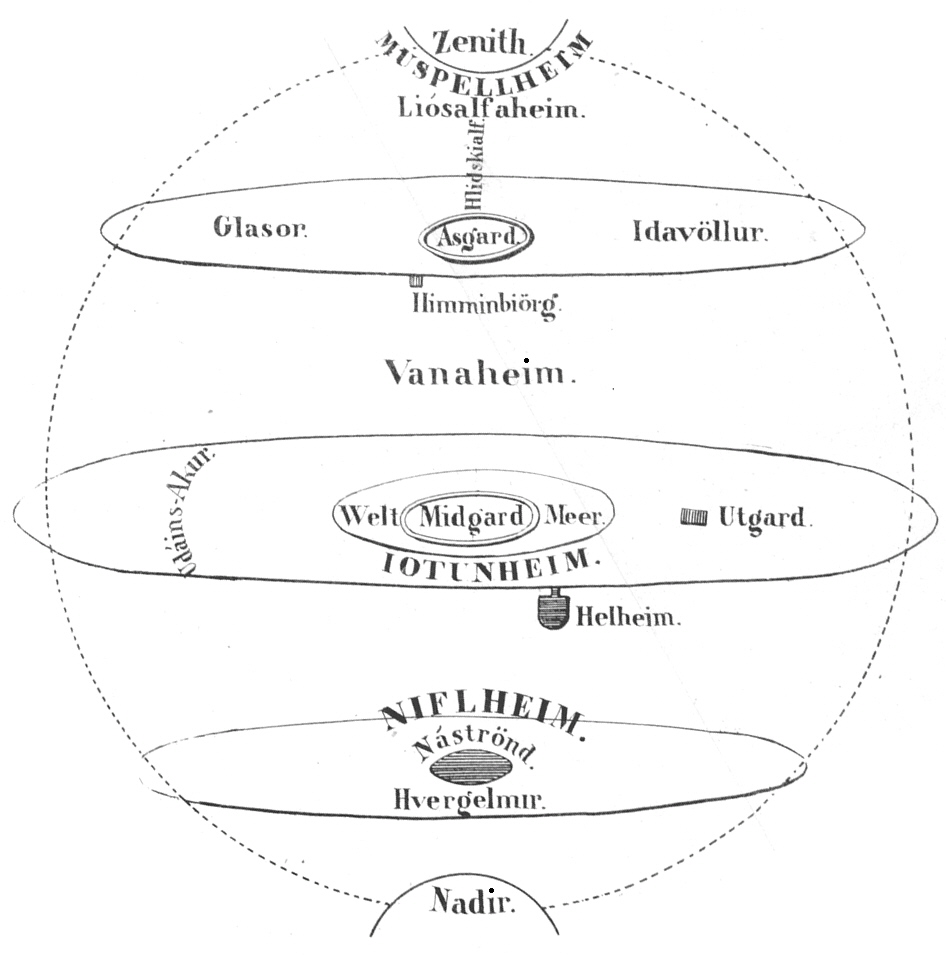
There is a vertical hierarchy, the realms are all ordered either lower or higher on the tree. Near the top are the “Upper Realms”, Asgard at the very top, Alfheim below Asgard but in the “light”, and Vanaheim and the opposite but near equal of Asgard. Near the middle was the “Middle Realms”, Midgard in the very middle with a vast ocean, Jotenheim on the far side but still in the middle, and Svartalfheim meant to be below the earth or surface of Midgard . And near the roots was the “Lower Realms”, Muspelheim deep in the south of pure heat, Nifleheim deep in the north of pure ice and the spring of Hverglemir, and Helheimat at the very bottom, the realm of the dead.
The World Tree also has three roots with key importance, defining the deepest powers. First is the Root of Law, it sits in Asgard and drinks from Urõarbrunnr. It is the root of destiny. The Norns, Urd, Verdandi, and Skuld who represent Past, Present, and Future water the root with sacred silt. The Well of Urd is a well that the Norns use; it’s basically a pool of Pure Probability. Every day The Norns carve runes into the trunk of the tree, which writes the laws of the universe, and also water the root with the Well of Urds water. This keeps the root and therefore the upper realms stable and ordered in the universe.
Second is the Intellectual Root, it sits in Jotenheim deep in the frost and mountains. It dips into Mímisbrunnr or Mimir’s Well. While the Law root is about destiny, this root is about ancient memory, what has happened, and the fundamental secrets of the universe. The well is guarded by Mimir, who is so saturated in the wells water that he is the wisest being in existence.
Third is the Life Root, it sits deep in the frozen and primordial depths of Nifleheim. It dips into Hverglemor, the bubbling spring that existed before the world was made. It is where the eleven primordial rivers that form the Eitr life essence are formed. It is guarded by a massive dragon/serpent named Niõhöggr, who forever gnaws on the root.
Beings on the world tree explained:
There are also multiple beings that live in the world tree. They would be considered primordial, above the normal world including the gods.
Starting from the bottom of the World Tree is Niõhöggr, a giant serpent like creature that is infinitely hungry. He spends his entire life gnawing on the third root of Yggdrasil, the Life root. By chewing on the root he is slowly killing the universe. He is the personification of entropy, the idea that everything eventually breaks down and dies. He isn’t a mindless beast, he is fueled by malice. He has a rivalry with the Eagle at the top of the Yggdrasil. He is also one of the few beings that survives Ragnarök. Once the great battle is over, he flies over the battlefield. He is described as bearing the corpses of the dead in his wings. He cleaned up everyone that died in Ragnarök to clear it for a reset. He also goes to a place called Náströnd, a neighboring realm of Helheim. Instead of normal grey quiet Helheim, Náströnd is for the truly vile, oath breakers, murderers, adulterers, etc. It’s a massive and terrifying building made of living venomous snakes that drip poison from the ceiling. Niõhöggr chews on the bodies of these vile people.
In the middle of the tree is Ratotaskr. He is a squirrel that runs up and down the tree forever passing gossip to the Eagle and Niõhöggr. The Eagle and Niõhöggr may not be able to talk for sure and definitely can’t hear each other, Ratotaskr makes up and/or exaggerates everything to make them angry at each other. It’s believed that if the Eagle and Niõhöggr didn’t have tension towards each other and the tree then the tree may not hold together.
At the top of the tree is a giant unnamed Eagle, he represents vision, wisdom, and perspective. While Niõhöggr is in the mud of the roots, the Eagle is in the light of the Upper Realms. Since he is at the top of all the realms he can see everything in the nine realms all at once. Also, between the eyes of the Eagle is a hawk named Veõrfölnir. He is meant to be like a zoom lens for the Eagle. If the Eagle already can see everything in all the nine realms, the hawk can see any small details the Eagle might miss somehow. The Eagle is in an eternal rivalry with Niõhöggr, and their tension, fueled by Ratotaskr, holds the balance of the tree. The Eagle is described as very knowledgeable and has sharp insults to get under Niõhöggr’s skin meaningfully.

