The role of back propagation in a machine learning algorithm

By: Ivy Dahl

Photo by Google DeepMind on Pexels.com

An algorithm is a series of steps to complete a task.

A machine learning algorithm is a computer program composed of many individual, yet interconnected parts that perform a series of steps involving numbers and the guided transformations of them to achieve a specific goal, without being given an explicit direction. Back propagation is one of those parts. It’s a journey from one number to another, calculating the error of a specific guess.

Imagine a bunch of data points on a graph, given to the back propagation algorithm by some previous part of the general machine learning algorithm, all spaced apart so that a line would have to be placed along them to connect them. Approximating a line that would fit all those points evenly, finding the medium, is a difficult task. An objective numerical way is the squared distance between a given curve and the data points. This is called a loss. The fitted curve with a high loss suggests the data points are far from the currently generated curve indicating a bad approximation. Low losses indicate a better fit as the currently generated curve closely aligns with the data points, making it a more accurate approximation.

A function could represent a line.

But a constant function wouldn’t fit this line by itself. Neither would an exponential function. But what if you put them together? And added another? You can think of this collection of functions like a toolbox that is already equipped with these functions, but still in need of a perfect coefficient to bend it to fit the line as close as possible. The goal is to find the combination of coefficients that outputs the best fitting line. The best fitting line is defined as the line with the combination of k’s that yield the lowest loss. Each k represents a random number.

Y(x) =k(0) + k1x + k2x + k3x + k4x

X constructs a curve, Y calculates the loss function of it and outputs one number, the loss, then plugs these numbers back into the general equation for the curve. Now it can start going through the numbers in order to find the minimum loss. This will lead to finding the distance between data points and the current generated curve repeatedly.

But can we make this prediction without going through countless trial and errors? Differentiability is good for fast finding of optimal number combinations. We do this by focusing on one random k coefficient on a coordinate graph. We are trying to find which value of k results in the lowest loss individually.

Knowing the local behavior of a function only, we are blind to all other points. Adjust x. This new adjusted input of x will result in a new value for y which will retain the same amount of change as x was changed. There will be a line connecting x and y and when you take smaller steps it will continue to more accurately align with the optimal line configuration, creating a tangent line between the x point and y point.The steepness of this tangent line is its rate of change, indicating a change in the curve that it’s aligning with.

Now let’s say you do this for every one of the coefficients individually. This gives multiple sets of these slopes that can be compared to the larger set of complex slopes coming together to form a line. These two sets of slopes will coincide. You might not be able to recreate a complex line like this, but if you break it into smaller slopes, it’s easier to approximate the individual slopes to the original, and put them all together once done to recreate the line with the lowest loss.

This is a brief description of how back propagation is an integral part of a machine learning algorithm by taking a specific set of inputs from somewhere else in the algorithm and creating the best fitting curve for it, so that curve can be passed forward to another part of the machine learning algorithm.

AP and IB: A comparison of two accelerated programs

By Hannan Mohammed

Most high school students in America have heard of either the Advanced Placement program or the International Baccalaureate program, and many students take classes in these programs as a way to either earn college credit or to be better prepared for college with rigorous courses. However, many students also wonder what makes these programs different from, or similar to, one another.

There are two main differences between these two programs, which are their goals and what they emphasize: Advanced Placement emphasizes college-level courses to prepare students for success in higher education, while International Baccalaureate emphasizes global citizenship and a well-rounded education to prepare students for life beyond college.

But how do these two main differences show up? The differing emphases these two programs have reflects in how/where they were created, and the classes/curriculum.

Origins

While both the AP and IB programs originated in the same time period of the 1950s-60s, they were created in different countries and for different reasons as well.

In the 1950s, after the end of World War II, there was a gap between high school graduation and college graduation in the U.S.; the Ford Foundation created the Fund for the Advancement of Education, conducting two studies that found that high schools and colleges should work together to let high-achieving students work at a higher level. A pilot program was launched in 1952, and the College Board started administrating the Advanced Placement program in 1955.

From the 1970s through the 1990s, the College Board continued to expand its reach across America, including making efforts to include low-income students and using Pre-AP initiatives to prepare middle school students to take AP courses and exams in high school.

These efforts to reach more students and give them more access to higher-level classes that can prepare them for success in college and higher education reflects the AP program’s goal of closing the gap between high school graduation and college graduation by preparing students with college-level work.

The IB program, on the other hand, originated in Geneva, Switzerland in 1962, with English and French as the official languages. Originally, the first IB exams were taken in 1970; students from 12 schools in 10 countries took exams in the IB Diploma Programme, the first curriculum of the program.

Over the course of the 70s, new requirements were added, such as the Extended Essay in 1974, and IB conferences were held in The Hague, Geneva, and London, where 32 countries were represented. As the IB program continued to expand across the world, more curriculums were added: the Middle Years Programme in 1994 for students ages 11-16, the Primary Years Programme in 1997 for students ages 3-12, and the Career-related Programme in 2012 for students ages 16-19.

Each of these programmes are meant to give students a well-rounded education from a young age, prioritizing a global perspective with world languages and drawing attention to how students interact with the world in different ways, which reflects the IB’s goal of global citizenship.

Curriculum

The second way that the major difference between the AP and IB programs is shown is the structure of the curriculum and requirements to pass.

To start, the AP program offers about 40 different courses in basic subjects such as the arts, math and computer science, English, history and social sciences. However, these classes are more in-depth with specific focuses. For example, taking an AP History and Social Sciences course could mean taking a class that focuses on African-American studies, psychology, human geography, or even macroeconomics, depending on what a high school might offer. This is one way the AP program’s goal of college-level education is reflected; through highly-focused classes that are similar to courses you might take in college.

In the May of each year, AP exams are administered to students to show their mastery of what they learned. For most classes, this includes multiple choice questions and free-response questions. Most exams take around 3 hours. Then, students are given a score of 1-5.

The scores on the exams are important, since this can determine whether a student can earn college credit for the class; most colleges require a minimum score of 3-4 before awarding credit.

The IB program has a different structure; for students going into IB high schools in America, 9th and 10th graders are required to participate in the Middle Years Programme, which is meant to prepare them for either the Diploma Programme or the Career-related Programme. Most 10th graders are required to complete the Personal Project, which gives them a chance to explore their own interests and develop research skills.

After 10th grade, students can either go into the Diploma Programme (taking and testing in 6 IB classes), the Career-related Programme (the same requirements as the DP with the CP core and career-related studies), or to take regular high school classes and test in a few IB classes.

The IB DP courses can either be standard level (SL) or higher level (HL), and while they’re more broad compared to AP courses, they reflect the program’s emphasis on global citizenship by offering a more well-rounded education. In addition, DP students also have to complete a Theory of Knowledge (TOK) class, an Extended Essay, and Creativity, Activity, Service (CAS). These extra requirements are meant to give students a chance to take their learning beyond the classroom and apply it to themselves or others, which reflects the program’s goal of helping students to succeed beyond higher education.

The IB exams are often taken in the spring of each year, which consists of internal assessments (fieldwork, laboratory work, investigations), which come from the classroom, and external assessments (essays, structured questions) which come from the IB program itself. These exams can take most of the day, and are scored from 1-7. These scores, along with completing TOK, the Extended Essay, and CAS, count towards completing the DP or the CP. Some colleges accept IB exam scores, but they are not as widely accepted as AP scores.

This curriculum structure reflects the IB’s goal of being well-rounded by giving students a broad range of subjects and it reflects the goal of success beyond higher education by giving them a chance to apply their education to themselves and the world.

Conclusion

The Advanced Placement and the International Baccalaureate programs share some similarities as programs that help high school students be more prepared and successful in higher education. However, their different goals of college preparation vs. preparation for global citizenship are reflected in their origins (AP starting in the US and IB originating internationally) and their curriculums of focused, in-depth classes (AP) and broad classes that can be applied beyond school (IB).

For more information about either of these programs, please feel free to visit their websites here:

Sports schedule for: Sept 29-Oct 4

 ATHLETIC EVENTS SCHEDULE SEPTEMBER 29 – OCTOBER 4
MONDAYSEPTEMBER 29 
TIMEBUS TIMESEVENTLOCATION
5:00pm Football vs. Como ParkHOME – HP Stadium
JV & B: 5:30pm V: 7:00pm4:30pm | 8:00pmVolleyball vs. HumboldtHumboldt High School
TUESDAYSEPTEMBER 30  
TIMEBUS TIMESEVENTLOCATION
4:00pm Girls Tennis SectionsTBD
B: 4:15pm JV: 5:15pm V: 7:15pm4:15pm | 8:45pmBoys Soccer vs. Como ParkB: HOME JV/V: Como Park High School
5:00pm Adapted Soccer vs. Park CenterHumboldt High School
TBDTBDB-Squad Football vs. SMBMinnehaha Academy Lower School
JV: 5:00pm V: 7:00pm Girls Soccer vs. Como ParkHOME
WEDNESDAYOCTOBER 1  
TIMEBUS TIMESEVENTLOCATION
4:00pm Girls Tennis SectionsTBD
JV & B: 5:30pm V: 7:00pm Girls Volleyball vs. Como ParkHOME
THURSDAYOCTOBER 2  
TIMEBUS TIMESEVENTLOCATION
B: 3:45pm JV: 5:15pm V: 7:00pmJV/B: 3:15pm | 6:45pm V: 6:00pm | 8:30pmBoys Soccer vs. South St. PaulB/JV: Roosevelt Field V: Ettinger Field
4:00pm Girls Tennis SectionsTBD
JV: 5:00pm V: 7:00pm Girls Soccer vs. SimleyHOME
JV & B: 5:30pm V: 7:00pm Girls Volleyball vs. JohnsonHOME
FRIDAYOCTOBER 3  
TIMEBUS TIMESEVENTLOCATION
    
SATURDAYOCTOBER 4  
TIMEBUS TIMESEVENTLOCATION
MS Boys: 10:10am MS Girls: 10:30am 9th-Boys: 10:50am 9th-Girls: 11:10am JV Boys: 11:30am JV Girls: 12:10am Varsity Boys: 12:45pm Varsity Girls: 1:20pm7:00am | 2:00pmCross Country Lions Invitational “Meet of Champions”Arrowhead Resort
1:00pm Varsity Football vs. WashburnHOME
JV: 5:00pm V: 5:00pm Girls Soccer vs. St. AgnesHOME

Nationwide walkout

By: Siri David

Photo taken by: Josie Hodson

On July 27th, at Annunciation school, Minneapolis Catholic school students were sitting in the pews of church during mass. Sitting outside of the windows was 23-year-old Robin Westman. Once mass started Robin shot through the window. Robin killed 2 kids and injured 19 other people. Robin shot a total of 116 rifle rounds. After Robin did this he then shot himself. Robin had attended Annunciation and was always known to be quiet and reserved to most people; it seemed he didn’t like school.

This shooting was heart breaking. Over the past decade school shootings have become a lot more common. They are the leading causes of death right now for teenagers and children. In 2025 there were a total of 90 incidents of gunfire on school campuses. It has become a nationwide issue that our schools need to be better protected and that kids should feel safe within their place of learning.

The shooting at Annunciation helped start the idea of doing a nationwide walk out. This walk out was put together by an organization called Students Demand Action. The organization used social media platforms to spread the event. Most schools had a club within their school that organized everything for them. Highland had our school’s Good Club organize the event. This club is led by three members who brought together Highland students by posting all over their social media.

The walk out lasted around an hour and a half. We met up with students from two other private schools (CDH and SPA). There were over 100 kids who were participating from Highland.

The whole goal of this walk out was to raise more awareness to the fact that students don’t feel safe in schools, and that gun violence is affecting our day to day life and whether students feel safe in school or not.

September is suicide awareness month. Why is it essential for you to know about suicide?

By: RJ Johnson

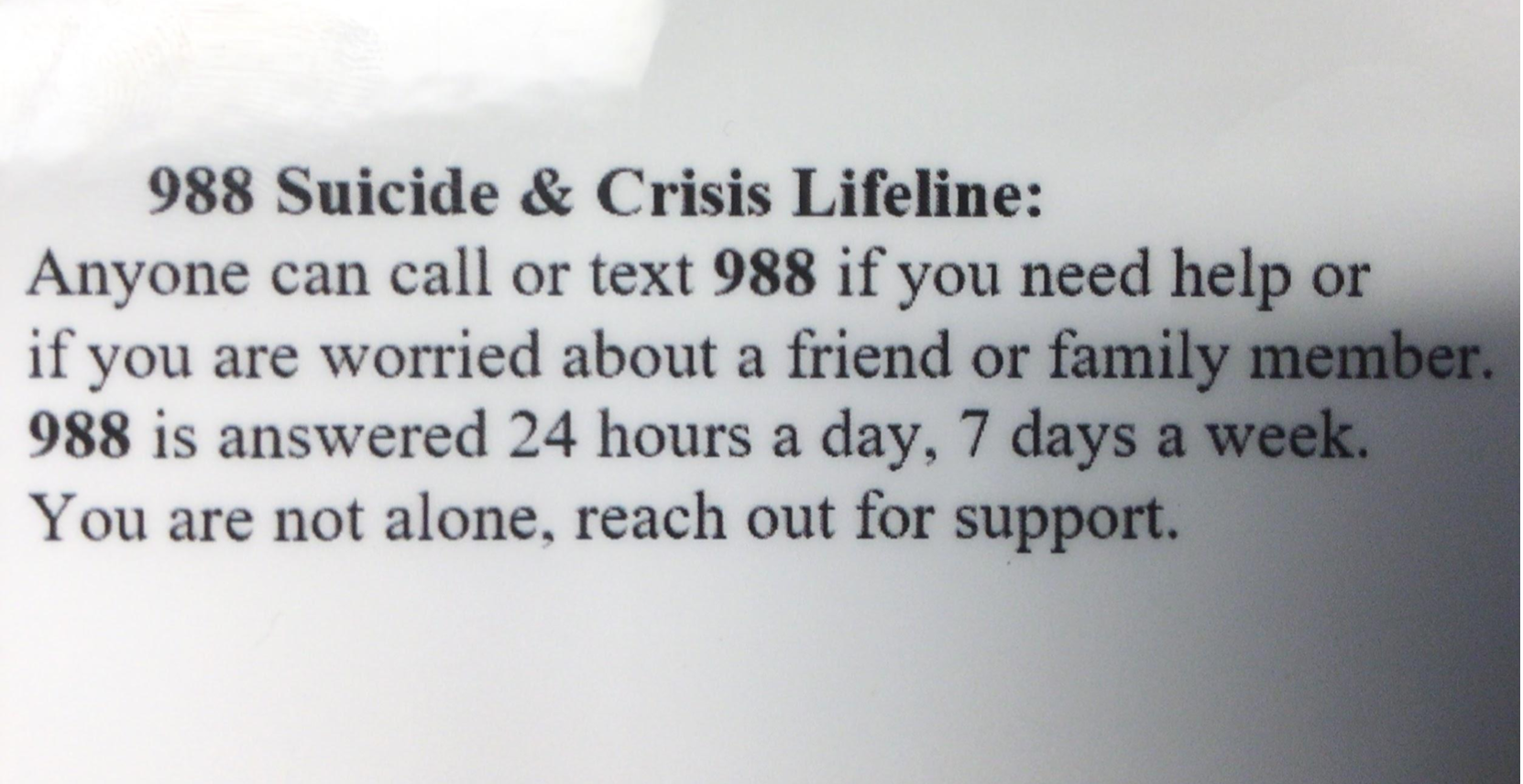
September is suicide awareness month. Why is it essential for you to know about suicide prevention month? Because it helps raise awareness about an issue that is very much preventable, and it teaches you to look out for this specific behavior.

Forty-nine thousand three hundred sixteen people committed suicide in 2023, and 9% of high school students have reported attempts this year; that’s just what’s been reported. Many people don’t share their attempts or mention them at all. Overall, suicide is the eleventh leading cause of death, but it is the fourth leading cause of death for ages 35 to 44 and the second leading cause for ages 10 to 34. Think about that for a second. The second leading cause of death in teens and young adults is PREVENTABLE.

You’re probably asking yourself, “Well, what can I do to help prevent it?” If you have family or other loved ones who are showing signs or symptoms, check in on them! Ask them genuinely if they’ve thought about committing suicide. While it might not be an easy question to ask, it’s essential.

Now, “What are some signs that someone might be thinking about suicide?” Great question. Some of the more significant signs include withdrawing from friends, saying goodbye, and giving away essential personal items. But that’s just some of the big ones. If they stop doing an activity you know they love, you should check in on them.

Studies show that most people who attempt to commit suicide, or do so, tell someone beforehand, whether it’s directly or indirectly. Even if they tell you not to tell anyone, it’s crucial to tell a trusted adult or someone who can help. Even if it’s not a close friend, but you’re worried about them, report it and they’ll make sure they’re okay.

Suicide is a significant problem that is preventable. One way to help prevent suicide is by checking in on loved ones when they show signs and telling a trusted adult who can help. You might save someone’s life.

For more information, please visit:

How to Survive an Alien Invasion in 5 Easy-ish Steps

By: Daniel Kendle

(This article is meant to be read after the Zombie Apocalypse Survival Guide).

So let’s say that you, likely a high school student, have woken up one uneventful Friday morning. You’re happy about your 3-day weekend ahead, and head downstairs to fix yourself some breakfast. Popping 2 slices of bread into the toaster, you pour yourself a sip of coffee, and turn around towards your kitchen window to see a hoard of greenish-gray, maggot-ridden corpses limping around the street.

And then you wake up.

It was all a dream! You laugh and stretch your arms in a trance of hedonistic elation. The truth is: you’re fine. Zombies don’t exist, outside of that species of ant fungus you hear about on MPR. You throw off your covers, hop out of bed, and begin to remind yourself to check out the new season of ‘The Last of Us.’ That is, until your thoughts are cut short – just like your bedroom.

Half of your house is missing.

Your lips quiver in silent shock. Like a cake cut cleanly into 2, your 3-story home has had half of it seemingly vanish. You peer below the exposed floor beneath you, into the living room. The couch, TV, coffee table…once normal furniture now appears more akin to those of a sliced-open dollhouse.

But who did this? You find your answer soon enough: in the distance, a pair of flying saucers stiffly suck up a car in a lavender tractor beam. They do the same with a tree, a dog, and some geese before speeding away together.

Obviously, most people would cry, scream, wail at this sight. A phenomenon only known to pop culture ideals, but now in real life? Oh, the horror! But you, no. You’ve read my zombie alien apocalypse survival guide, and now, you know exactly what to do. Because now, here is…

HOW TO SURVIVE AN ALIEN INVASION IN 5 EASY, UH…ISH STEPS:

. . .

#1: A BRIEF LESSON IN INTELLIGENCE

So: Aliens have begun an invasion of Earth. Now what? Well, unlike other kinds of apocalypses, aliens are functionally-different from other kinds of threats.

 The main differentiator between aliens and zombies (and most apocalyptic threats, really) is intelligence. Aliens, truth be told, are smart! I mean, they’d have to be to get those rinky-dink dirigibles off the ground, let alone across space. Zombies are the opposite: slow-moving, dim-witted creeps that skulk along the ground.

With this fact comes another soon after: while brains may be an alien’s strength, it’s also their weakness. For any species, increased intellect also comes with increased susceptibility; ergo, they can be outwitted. Say what you want about zombies, but an advantage of being stupid is defense against the cunning.

These 2 pointers will be referenced throughout this guide, for they’re among the most key points of any philosophy for surviving an alien attack. But with them out of the way, we can finally get down to the nitty-gritty.

#2: YOUR FIRST DAY

To begin, let’s establish your goals to accomplish by the end of day 1: you’ll want food, water, and at least a temporary shelter of some kind. Simple, right? Well, it would be, if not for the giant flying vacuum cleaners outside.

By the time you wake up, it’s more than expected that most surrounding infrastructure will be in ruins. Thus, you’ll want to be able to rely on your own 2 legs for transportation; cars, bikes, and even scooters won’t be able to adeptly traverse the wreckage around you. Pack a small bag of tools, toiletries and a few personal items, and set off into the hostile world.

You might initially find yourself not knowing where to start. Aliens pose a deep threat to Earth, yes, though will be more focused on mass extinction of the human race rather than just little, old you. Unless you’re a narcissist, this is great news! Having your opponents fixate on a large group of individuals actually helps your chances of survival. It’s a study of Darwinism at its finest, though now replacing “finches” with “Uncle Mike.”

All of this is to say that there probably won’t be any aliens randomly strolling around. If you’re swift, stealthy and able to keep an eye on the sky, you probably won’t face any issues looting small shops and market stands. With the limited space in your bag, prioritize preservables and seeds, along with bottled water. If you ever find yourself filling fast on food, take a second in a hidden cavity to sort out your most important goodies. Then, cache your leftover items for later.

Now we just need to find a good shelter. This is pretty simple: you’re gonna want to find an area that’s already been pillaged, to a noticeable extent. That way, any UFO’s probing the area won’t bat an eye at where you’ve set up camp. If you leave no traces, any enclosed ruins will provide good cover – for now.

#3: ALIEN COMBAT 101

You’ve done well thus far: you have sustenance, a temporary home, and some scavenged supplies for your journey ahead. But there’s another question that some may already be wondering: what happens if I actually encounter an alien?

Well, sorry to burst your bubble, ‘E.T.’ sympathists: it turns out that a meeting with one of these suckers won’t exactly be a walk in the park. I’ve already said it’s unlikely to meet an alien strolling around, but it’s never unheard of, either. So in preparation for such a scenario, here’s “Combat Wombat™’s Fun-tastic Fightin’ Guide!”

  1. Be ready with what you have equipped. If you stumble upon an alien, you don’t want to leave yourself vulnerable by shuffling through your items looking for a weapon. It’s recommended to always carry some kind of melee weapon on you at all times, though in the case you forgot, your fists are gonna have to do the job.
  2. Know the enemy. Examine a diagram of the alien invading your planet, if possible. What weak points are visible? What body parts look the most dangerous? Understanding who you’re fighting is the greatest tool a brawler can have. That and, y’know, mercy (bleugh).
  3. Acknowledge your arena’s design. In the case of a sudden battle, having a grasp on the space you’re in is always handy. Whether it’s a tree, a boulder, some sheets of metal…anything can be helpful in a scrap.

Alright, those are some good general pointers, but what about moves? Well, here’s a couple that I’ve employed once or twice.

  • “The Tentacle Twist.” If your alien assailant has at least 2 tentacles, grab them while they’re distracted, double-knot ‘em, and use the Martian like a jump rope. Extra brownie points if you and a buddy Double Dutch.
  • “The Whip Lash.” Some aliens rely on their long tongues for combat. If so, grab theirs mid-stretch and use it to treat their body like a whip, slamming them onto the ground repeatedly.
  • “The Glory Kill.” This one’s especially brutal, and not for the faint of heart. Use that survivalist strength of yours and rip out one of their long Sabre teeth, then stab them with it. Just like ‘DOOM!’
  • “The Hawk Headslam.” If facing a winged alien, harness your inner pigeon and grab them by the legs mid-flight, slamming both of you to the ground. This maneuver combos well into The Glory Kill.
  • “The False Surrender.” This is easily my favorite. If you’re in a corner, feign defeat and grovel in front of them on your knees. During their victory dance, quickly perform a forward roll into a kick with both legs. Then, as you’re catapulted and thrown onto them, twist their neck around. This also pairs nicely with The Glory Kill.

I have more, but hopefully these are enough to satiate your bloodlust. Have fun, and don’t die!

#4: HOME RENOVATIONS & THE DIFFERENT LIGHT SPECTRUMS

You’ve done well to make it this far, but by now you’re probably outgrowing home amongst the abandoned ruins. In an alien apocalypse, you’ll never want to be too settled in an area at the risk of a sudden raid. But for those nonetheless looking for a place to call home, I’ve got you covered.

I’m limited in my Home Economy know-how (and college credits), but I can safely say that camouflage is a must-have when building a new shelter. But how so? Well, not only do you have to account for your home’s physical form, you also have to deal with alien vision.

Popping on my scientist glasses for a sec, aliens see in different light waves than humans, and most animals for that matter. Unlike us, they’re able to see not only our colors, but also either ultraviolet or infrared spectrums, depending on their species’s frontal lobe development.

But here’s the problem: if we can’t see what aliens can, then how can we efficiently blend in with our surroundings? At first this may seem like an inconquerable “2 steps ahead” question, but I do have a solution: mirrors.

Humans are the only species in the universe to have invented mirrors, due to us getting the winning bid for silver manufacturing in the Universal Economic Bidding Event of 13,800,000,000 BC. Us humans won over the Gorgulocks with a bid of 43 Zeptocoins (in the event the Gorgulocks are the ones invading Earth, then this is likely the reason for it).

But I digress. Since aliens don’t know what mirrors are, building an igloo-like structure out of them is a sound idea. When they look down upon your base they’ll see themselves, probing shock, then confusion, then a philosophical quandary, then self-combustion. Awesome!

#5: YOUR MISSION

So far, you’ve learned to scavenge, fight, build, and thrive in this dystopian world. That’s all fine and dandy, but you can’t ride out an alien invasion indefinitely. No, you need some kind of end goal to fend off these parasites, and restore Earth to its former glory.

*Sigh.*

I guess there’s no point in hiding the truth any longer.

My name is Maeve Doherty. I’m an FBI terrorist crimes operative who’s been temporarily assigned to a project involving bioengineering. As of writing this, my team and I are knee-deep in work on a, uh…device meant to be used by the US military.

Earth is currently set to exceed healthy population density by 2055. We here in Area 51 have known about this for some time, and have spent the last 3 decades attempting to find a fix. None have presented themselves, however, so we’ve decided to pull the trigger on our last resort.

This device, nicknamed “Charlie Beetle,” is a 43-ton hypernuke filled with a newly-invented element: Mutonium. This element was first discovered in the Russian steppe, sampled by blood-draining a 5-legged mountain goat corpse. The result? An element that, when mixed with plutonium, can produce an explosion capable of ending all sentient life – at the absolute minimum.

The US government has spent a fortune on subterranean bunkers meant to be leased out to the 0.001%. Unfortunately, the high cost of rent for these places means that there’ll be barely enough genetic variance amongst the dozen or so billionaires in each to create even 1 new generation, let alone repopulate the Earth. To make matters worse, they probably nickname their offspring “Gen Tesla” or some dumb crap like that.

This nuclear fallout, one unavoidable for most, is the reason I made this safety pamphlet. Actually, it’s why I made the zombie apocalypse guide as well. If we’re to hope that someday, somehow, society can be rebuilt, we’ll need to insure our species’s survival until then. These 2 guides are to aid you in combatting any subsequent apocalyptic threats that may threaten that dream.

To whomever may read this: live long. Live well, happily, and craftily. If you survive this bomb and live past the gaseous effects, tell your children what you’ve learned here. Have them tell their children. Have those children tell theirs, and them theirs, and on and on until our world is safe again.

I know I likely won’t live to see this utopia, but as long as someone somewhere can…

…it might just be worth it.

  • The Survivors

. . .

(P.S: If you’re wondering why I wouldn’t just write a nuclear fallout guide… er… s-shut up.)

New beginnings

By: Treshawn Ross

As we are starting this new year at Highland, there are many different thoughts and feelings involved. I have asked a few people how they were feeling going into this school year and these are the responses.

9th grade-

Most 9th graders started off this year very nervous and excited. This nervousness is usually caused by not being familiar with the new environment and simply being around new people.

“I’m still having trouble finding my classes,” Camila told me. This is another common problem that the Freshmen are having to tackle. They are making the best of their opportunities though, many are getting involved in extracurricular activities.

10th grade-

The Sophomores are generally more experienced going into this year, which makes them seem more relaxed when compared to their younger peers in 9th grade. Mr. Berndt said “There’s a bit of a learning curve with them, learning to get to class on time. But over the weeks that has slowly trailed off.” Hopefully this experience will inspire their fellow underclassmen to adjust faster.

11th grade-

Many Juniors are feeling a bit apprehensive about this school year. 11th grade has a reputation for being difficult. Abril said “I’m mostly worried about improving my GPA now, it can definitely be important in the future.” The ACT will also weigh heavily on the minds of Juniors towards the end of the school year. Junior year is very stressful but I believe the Juniors can succeed.

12th grade-

Seniors are mostly cruising into this school year; many of them are already beginning to mentor younger students. The curriculum is still rigorous for some students though, Ivy says that she is spending more time studying for math than she used to. This year most Seniors have to focus on not having a “Senior slump”, so they can shift more easily into leadership roles in the school and elsewhere.