
By: Maeve Brady

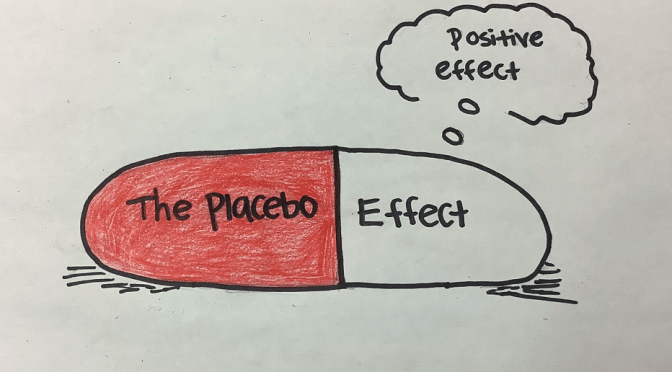
Many of us may know about the infamous placebo effect. But have you truly taken the time to analyze it and its components? If you did, do you understand it? Even after wondering about it for a long time, many still can’t comprehend it. Today, I will be explaining the placebo effect and how it affects our youth in schools and the broad picture of it.
Have you ever heard of a placebo? Well, it’s the reason the placebo effect even exists. A placebo is an inactive treatment, surgery, and more. Also, under certain circumstances, a placebo can also be considered to be an action. A placebo directly correlates to the placebo effect because the placebo effect is the feeling you get after you take the placebo. The placebo effect works by turning on the body’s natural mechanisms that may help us feel better. Our brains make many substances that can lessen pain, anxiety, nausea, and more. This is also known as placebo analgesia.
Like I said, the placebo effect derives from the mind rather than the actual effect the drug has. This can be seen in the fact that you can be aware that you are taking a placebo for the effect to still work. Many believe that you have to be unconscious of the placebo in order for it to work, but in reality, if you have the expectation of the placebo having a positive effect on you, then it may. There is also such a thing as the Nocebo effect; it’s the opposite of the placebo effect where you believe that a placebo has a negative effect on you.
According to Olsen (2021), a Senior Media Relations Officer at Dartmouth, in a recent research conducted by Tor Wager and Diana L. Taylor, who are distinguished professors in Neuroscience, “‘Our findings demonstrate that the participants who showed the most pain reduction with the placebo also showed the largest reductions in brain areas associated with pain construction.’” After further research, according to Olson (2021), “With the large sample, the researchers were able to confidently localize placebo effects to specific zones of the brain, including the thalamus and the basal ganglia.” Scientists believe that because these two areas are involved in the sequence of connecting pain to action, the placebo effect may occur in them and largely impact these regions. Scientists also believe that the prefrontal cortex may have something to do with it.
The placebo effect may affect our youth in many different ways. In recent research conducted by psychologists Ulrich Weger, Ph.D. and Stephen Loughnan, some students were under the impression that the material they studied was enriched and better for the test while some believed that it was worse. According to the two psychologists, “Participant performance was indeed enhanced, compared to a group that did not think the priming process would improve their knowledge.” This demonstrates that the students’ actions could overall affect their academic performance.
The placebo effect is a very complex phenomenon whose properties are still being researched. I hope that from this text you’ve learned a little about the basics and how it affects our youth.
For more information, please visit:


