Note: This article goes over a military branch of a fictional nation.
Description
The Mage Corps is the second smallest branch of the VFDF, with at least 10,283 active personnel as of 2049, but the majority of those enlisted in the branch aren’t referred to by their assigned title “Mages”. Within the ranks of the Mage Corps, there are Mages referred to as “Couriers”. Couriers are personnel assigned to support Mages in any way or form, acting as bodyguards for other Mages.
The official motto of the corps is “Videam Odds” which is translated as “Let’s See The Odds”, which represents the branch’s history of daring operations against much larger foes. Service members have the title of Mages, even if they are referred to as Couriers.
Personal Equipment
Mages are allowed to freely change their equipment to fit their needs as long as they stay within the branch’s guidelines for personal equipment. Mages upon completing boot camp, are allowed to commission personalized staffs that will be used until the end of their career. The Mage Corps uses the Altering Camouflage pattern, first designed in 2009. The camo was chosen over the Army’s Uni Deception Camo, or UDP, due to the army’s camo’s lack of actual concealment in any environment.
Every camo pattern utilized by the Vaserian Federation Defense Forces
Background
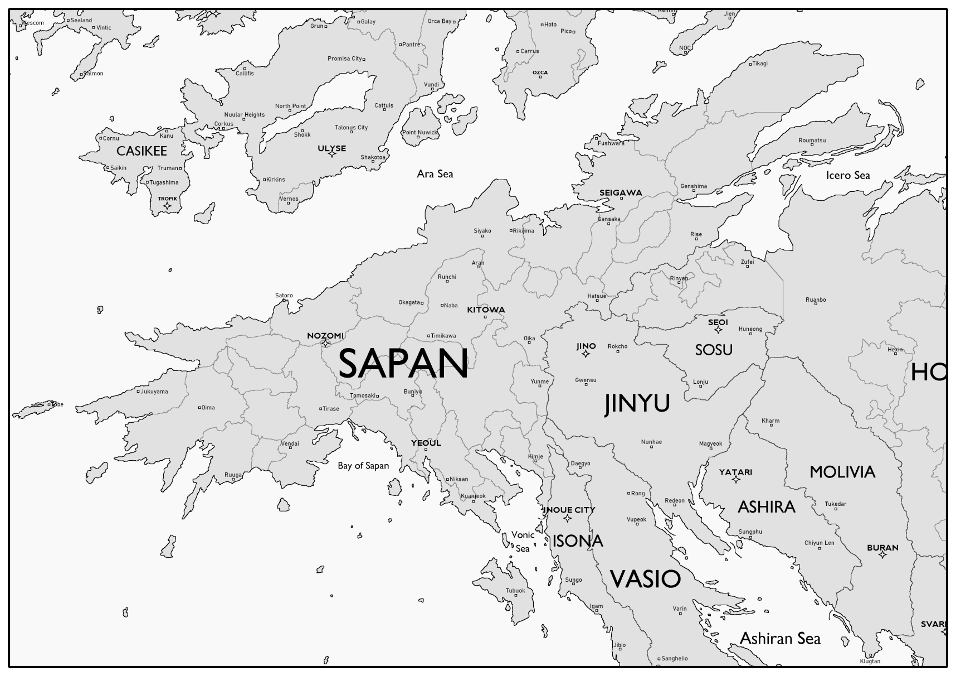
Map of the Vaserian Federation
Long before the Hero’s victory over the Great Empires, and the many centuries before it, the human species along with its subspecies have always been able to use the power of their souls to create what’s known as “Magic”, and in the modern era, those who master the many arts of magic played a crucial role in turning the tides of war.
In 1917 AH (After Hero), the Vaserian Congress passed the Mage Corps Act, establishing the Mage Corps as the fifth branch of the Vaserian Federation Defense Forces, also referred to as the VFDF. The main reason as to why the Mage Corps is its own branch was so that Mages can act more like a corpsman that can be transferred to each branch of the VFDF. Although the act was passed by Congress, many of the top brass within the VFDF saw the change as a radical move geared to make the Mages act more independently from the other branches.
The Mage Corps would see their first sight of combat in The Great Vaserian War of 1920, where Mages attached to the 1st Marine Division of the Vaserian Federation Marine Corps, took part in the defense of the Vaserian coastal city of Romas on July 1st, 1920, from the invading Royal Sapanese Forces.
This picture is of a half-dead, half-alive tree. I drew the tree half-dead, half-alive because of my other drawing of a half-sun, half-moon that looked cool, so I thought that a half-dead, half-alive tree would also look cool.
I like how it turned out, it is not as good as my last drawing, but I still think it looks cool. I like how you get to look at one picture, but with two different things on it. But I do think the image needs a little work on it. Like the branches; they need to be longer or add more of them and the same for the roots. I also think the leaves need to be a little bigger.
For my next image, I am thinking of drawing a cool optical illusion that messes with your mind.
Babies are nice. Babies are cute. Everyone likes babies (except for those who don’t). Some babies, however, are different. Some scream, cry, wail to get attention. Some can’t do simple mathematics, read, or assert their viewpoint on a topic through civil debate. Thus, babies aren’t all that exciting to me, as a person who fancies such activities. I don’t care for the infants, nor do they for me, if I may ponder.
Granted, I’ve noticed something in our most recent generation of children. They seem to linger towards a heinous cryptid, an entity that feeds on their short minds – feeding them sludge in return. Yes, it’s time we talk about the dreaded horseman that has taken control of our youth.
Everyone, welcome back to JOYSTiCK, a serial that (usually) reviews any video game our grubby mits come across. Today’s mini-review is about the white whale of my time here writing articles: ‘Cocomelon.’
‘Cocomelon’ is a multimedia enterprise that came about in the 2000’s. The brand focuses on preschool nursery rhymes available on YouTube and other media sites, and is one of the most successful children’s entertainment companies in the world. It’s been estimated that the organization is worth around $500 million.
Now, I should note that I’m not exactly the target audience for these videos, let alone the game I’ll be reviewing today. I can’t say I’ll be getting a new fix on life from “Who Took the Cookie? Puppy Song!” or “Tortoise and the Hare Race” anytime soon. I mean, I have so many other things to do, like betting on horse races! When watching the latter example, I can’t have even half the fun because I can’t feverishly lose money [under ethical circumstances]. What’s a guy to do?
Well, for an adequate amount of fun, (and return on investment), you can play the all-new game in the franchise: ‘Cocomelon: Play with JJ.’ Released fairly-recently, the games are pretty basic: you play as JJ, the main character toddler in the ‘Cocomelon’ universe, as he explores various parts of his house and plays minigames. There’s also a collection mechanic, since you can get stickers after completing these games and/or exploring the house.
As a mini-review, I don’t have too much to say on the game. For a mobile game it’s pretty competent, actually. Because of the limited environments the designers had to create, each feels slathered in detail, and “hardcore fans” might be able to recognize certain elements in the rooms, but I couldn’t. All I can say is that the game is alright on the visual front.
In terms of gameplay…it’s fine? Like, when you’re 16 and playing a game designed for toddlers, things can’t be the most “invigorating.” You control the main character, dragging them around box-shaped places looking for stuff to do. Sometimes you can click on something to have it do a little animation, but these usually just act as a little distraction, probably for little kids to click on and lose their minds over. You can also find various members of JJ’s family, who also perform an action.
The nursery rhymes were pretty boring. Basically just think of a bog-standard kid’s song, slap a small little game onto it and repeat that a dozen times. For example, the “Yes Yes Vegetables” song has you feeding JJ. The “Itsy-Bitsy Spider” song lets you control a spider navigating a bathtub. Very simple stuff; you also get a sticker at the end of each.
In conclusion, ‘Cocomelon: Play with JJ’ is so small of a game it has basically nothing of note to discuss. Even if it was an ironic pick to review, the game’s still pretty lame. It could’ve used some combat or grotesque themes, because as it stands it’s a lame kids game. I give it a 4/10, which is probably more than it deserves.
COCOMELON DEMON: Are you sure about that?
THE REVIEWEE: Wha-? Who are you?!
COCOMELON DEMON: I am the very being that lives in your soul.
THE REVIEWEE: …
COCOMELON DEMON: I’ve been the one watching you since you were born.
THE REVIEWEE: But…I’ve never seen you before in my life.
COCOMELON DEMON: That’s the point.
THE REVIEWEE: But-!
COCOMELON DEMON: Shh…(strokes finger over The Reviewee’s cheek)
THE REVIEWEE: …
COCOMELON DEMON: (softly) Don’t let the voices hear you.
THE REVIEWEE: …
COCOMELON DEMON: Come. I have much to discuss with you (opens portal to Cocomelon dimension).
THE REVIEWEE: …okay.
(The pair disappear to the Cocomelon dimension).
JJ: Hey gang, it’s me: JJ! Now that the regular person writing for this serial is gone, I’ve finally got a body to control to voice the gospel of Eldresassigul, Flesh-Bringer of the Peasentfolk. My first objective is to proclaim ‘Cocomelon: Play with JJ’ as a 10/10 game. With such stunning graphics, tight gameplay, and witty dialogue, it’s clear that the game is set up to be the most influential of this decade, and I’m shocked by how underrated it is. After all, I’m the star!
Anyways, those who oppose the label will be sent down to the mines of the underworld to be sacrificed to cryptids of decay and famine handed off to our support team to receive a small talk about their “misdirection in life.” Until then, I’ll leave until my next review: ‘Cocomelon: Shadows Die Twice.’ See you then!
NOTE: This Article covers a war between fictional nations
BACKGROUND
Following the end of the First Continentals War in 1950, the Kirston Empire, located in the Eusonan continent, was facing an economic crisis that stemmed from its debts for its participation in the war. Their solution to this debt was to sell off parts of their territory for cash, resulting in the 1957 Treaty of Saant, which formed The United Republic of Litho and the Federal Republic of Envoa.
The official flag of The Kirston Empire
The official flag of the Federal Republic of Envoa
The official flag of the United Republic of Litho
In 1967, the Kirston Empire elected a new Viceroy to the nation, Elena Oplau, the Fair Maiden of Saint Mons. Oplau, born in the city of Saint Mons, was a staunch supporter of regaining the territories of Envoa and Litho, which to her and her supporters, was seen as an illegal treaty that went against the vision of the Eternal Virgin Empress, Lyria Tran. On May 24th, 1970, Oplau, with the support of the grand congress, invaded Litho to regain its lost territories.
Map showcasing the perceived invasion of Litho
LITHOAN FRONT
An Art Piece showcasing a dogfight between a Kirston IF-8 fighter jet against a Lithoan SI-10 fighter jet, both aircraft originating from the Vaserian Federation.
On the 1st of May, 1970, Kirston forces invaded the United Republic of Litho through the Rikin plains, flowing through the Lithoan countryside with over a hundred thousand troops over the border through a massive armored offensive. The Lithoan armed forces were forced to fall back to the Grai Mountain Range, where they would put up an intense guerrilla war against the Kirston Imperial Forces.
By 1971, Kirston forces would deplete nearly half of its invasion forces, fearing of losing the sufficient manpower, the Kirston government began a massive recruitment campaign granting those who volunteer a large amount of government grants. This act of handing out grants would be used to coin the war as “The Grants War”.
Despite the large influx of volunteering troops, the Kirston forces were unable to move past the Grai Mountain Range, and as the winter of 1971 began, the Lithoan armed forces began their counter offensive. The Lithoan forces recaptured the country’s capital, Juno, on December 10th, however this was one of out of a few successful counter offensive campaigns, as the harsh winter conditions led to the fall of the northern region. The harsh winter would result in a complete halt of any major offensive by any side until the winter passed by. Oplau and her supporters needed a victory, but it couldn’t be won during the Lithoan winter.
ENVOAN FRONT
An artist’s interpretation of the Ruge offensive at the Kirston Institute of the Millennium, showcasing a Kirston MT-88 tank of the 5th Armored Division being hit by an Envoan SH-7 scout helicopter.
On January 2nd, 1972, another front was started, this time on the border with Envoa. Caught off guard by the invading Kirstons, nearly half of the country had fallen to the hands of the Kirston Imperial Forces within three days, with its capital of Ioniv falling in a matter of a few hours. By March 10th, mainland Envoa had fallen to Kirston forces, but the Envoan navy continued the fight, even scoring a kill on the pride of the Kirston Imperial Navy, the KIN Opposer in the second battle for Nolan Island.
By the first of March of 1973, a large mob of Envoan partisans successfully took over the city of Tuve, resulting in the large uprisings across the country and the successful return of the Envoan forces on the mainland in the battle of Crownady. The war was turning against the Kirston armed forces with the return of the Envoan armed forces, and as the war turned against the Kirstons, there was only one way the war could end.
THE GRANTED OFFENSIVE
An Envoan Special Forces operative posing for a camera crew during an extraction in the mountains of Kirsto, circa April 2nd, 1973.
As the snow melted, the reunited Envoan army and a hardened Lithoan military, forced the Kirston military to retreat back to its former borders. As the two armies marched into Kirston soil, they began to loot and spread fire to the Kirston countryside in a scorched earth tactic to demoralize the Kirston population, however this would only embolden those to defend what remained pure.
By April 10th, nearly 20% of the Kirston’s forests were burned as a result of the scorched earth tactic, but nonetheless the Kirston military still fought on despite the odds. As the Envoan and Lithoan armies crept towards the capital of Kirsto, pressure was forced onto the Viceroy, Elena Oplau, to decide the fate of the empire.
SIGNING OF SUKUYO
“The Orange Breeze” by Kirston painter Jon Reese.
With the war nearing its third anniversary and the increasing pressure against the Kirston officials to resolve the conflict, it was time for the war to end. Oplau, unwilling to call an end to hostilities, insisted they wanted a conditional surrender but due to the harsh reputation of the empire in the war, neither side wanted to openly agree for a ceasefire unless an intermediary assisted in its conclusion. Upon hearing the news of a potential end to the conflict, the King of the Vaserian Federation, Crizk Flaw, hastily answered the call for the conclusion of the war.
Flag of the Vaserian Federation
King Flaw, was ironically, a flawed king. He spent the first 4 years of his 10 year administrative term trying to force congress to increase the powers of the monarchy, with Flaw often being warned by congress of being impeached, which was a warning supported by nearly every Vaserian. When the call for an intermediary to conclude the war in Kirsto was announced, Flaw readily accepted it to save his reputation.
On May 22nd, 1973, the officials of the three warring nations met in the Vaserian capital city of Sukuyo to conclude the conflict, and by May 24th, the conflict would end with Kirsto ceding parts of its territory to Envoa, and a controversial 10 mile wide settlement exclusion zone along the Lithoan border, ensuring that a build up at the Lithoan border would never happen again. In return for these concessions, the three nations agreed to work together in rebuilding each nation’s infrastructure; however, only Kirsto and Envoa would fulfill this deal.
Map of Kirsto, Envoa, Litho circa 2049.
By the end of the war, over 80,000 people were killed in the war, with at least a million being forced to flee or endure the conflict. Nearly 40% of the forests of Kirsto were burned due to the scorched earth tactics, but as of 2049, the country has reclaimed nearly 30% of the burned land.
This is a drawing of a half-sun, half-moon. I drew it because I thought of the daytime and nighttime, so I decided to draw a half-sun, half-moon picture. I really thought that it would look cool because we see the sun and the moon every day.
I really like how the moon and the sun turned out and how the blue looks on the drawing. Also, I like how one blue is showing the nighttime and the other blue is showing the day time, but I think the stars need a little work. For this drawing I used makers and pencil. Overall, I think I did well on the drawing.
For my next drawing, I am thinking of drawing another half-half picture because of how the half-sun and half-moon turned out.
Note: This story goes over the themes of war and crisisin a different world
THE ZONE
The Arcerium Rising Exclusion Zone is a designated exclusion zone established by the Organization of Nations, or the ON, and is located on the Arcerian continent, dividing the habitable zones from areas contaminated by Arcerium and Arsoulium. The Arcerium Rising Exclusion Zone is commonly referred to as “The Zone”.
The Zone is a highly contested region that is mainly contested within the borders of the Federal States of Arcasia, with many factions fighting for control over specific regions.
ARCERIUM AND ARSOULIUM
Arcerium is a natural element that is used to power mega structures such as mega cities, ships, and spacecraft. Arcerium also acts as a propellent to its sister element, Arsoulium, which has side effects that can rapidly heal dead cells and is commonly used as an opioid to treat cancer, however it can place users into a rabies like state in prolonged exposure.
BACKGROUND
The cause of the exclusion zone was due to the rapid eruptions of multiple Arcerium pockets across the continent, which resulted in Arcerium and Arsoulium contaminating the majority of the continent. The nations of Arceria, The Republic of Krinia, The Federal States of Arcasia, and The United Republic of Alakis, were all affected heavily by this event, with an estimated 1.5 billion people being left in the zones. This event is commonly dubbed as the “Arcerium Rising” event.
KRINIA
“Flag of the Republic of Krinia”
Before the Arcerium Rising Event, Krinia had engaged in a war against its neighbor, Alakis, after their invasion into Krinian territory, with both nations calling upon their allies to join the war, resulting in the start of the Second Continentals War. This war would be forced to a ceasefire after the Arcerium Rising Event occurred, and with the presence of Krinia’s allies, The Polaris Alliance Treaty Organization or PATO, was able to quickly respond to the crisis, and evacuate millions of refugees to safe zones.
ALAKIS
“Flag of The United Republic of Alakis”
Having started the Second Continentals War, Alakis was unprepared to fight a defensive war as they had poured all their resources to their Krinian offensive, which left large populated areas to be contaminated by Arcerium and Arsoulium. Alakis’ allies, the Croatoke Defensive Pact or CDP, did little to help with the contaminated areas as they were mainly focused on keeping PATO forces at bay, resulting in millions perishing as a result.
ARCASIA
“Flag of the Federal States of Arcasia”
Arcasia, having not involved itself in the war, had other issues at hand. A month earlier, Arcasia’s government brutally suppressed protests against State Controlled Arcerium refinery plants, and on the onset of the Arcerium Rising Event, the people of Arcasia began calling for independence against the government, and started the Arcasian Civil War.
This civil war was kept under wraps by the federal government, as they had installed a nationwide firewall and lockdown to prevent information from getting out. For ten years, Arcasia had kept everything under wraps until a coup led by General Tomia Lukoskiv, overthrew the government and called for an immediate intervention by the Organization of Nations (ON), to which they accepted.
ARCASIAN CIVIL WAR
The civil war is still waging on, with the Arcasian government being supported by the ON to fight a brutal campaign against rebelling groups, such as the Independent States of Arceria Organization, a collective of rebelling states joined in a combined effort to gain independence from Arcasia.
It is unclear if there will be resolution to the civil war, but it is clear that it will continue for the foreseeable future.
This drawing is of a Porsche 911. I drew this Porsche 911 because I let my friend pick a car, and he picked it, so I drew it.
I like this drawing a lot more than the other two cars I drew because of how the purple on the body looks and just how the body looks. I think this is the best one I have drawn out of all the cars, but I think the black on the car does not look good and should be gray.
I am thinking of drawing more things, and for the next drawing I am thinking of drawing a half-sun, half-moon or something else to draw.
This drawing is a Lamborghini Huracan. I drew the car because I wanted to draw a sports car this time and thought about the Lamborghini Huracan.
I like this drawing more than the first one because the car looks better to me. I like how the pink looks on the car, and how the wheels look. I like how the car turned out because I didn’t think it would turn out this good. But overall, I think the colors of the car need a little work. I would have made the grey on the wheels a different color, and I didn’t really like how the black on the bottom turned out.
I am thinking about making the 3rd and final drawing of a car and making it look the best out of all the cars.
I drew this car because I like cars. This drawing I drew is a 1970 Dodge Challenger, and I drew it because I thought of the ‘Fast and Furious’ Vin Diesel car.
I really like how the car turned out and how the color of the car looks. I also like how the green makes it pop. But I think the wheels and engine need a touch up. The wheels aren’t very round and the engine does not look like an engine, but I still really like it.
I am thinking about drawing more cars and making them look better each time. My favorite part about the car is the body and how the color looks on it.
*Note: This is a work of fiction. This story is set in a fictional world where there are countries at war.
Background
On July 9th, 2020, the Republic of Nashua declared war on the island nation of Foseta on the basis of the nation harboring anti-Nashuan militant groups which threaten Nashua’s national security. But from the beginning of the war, the Nashuan military were unable to set foot on the Fosetan mainland due to the large Fosetan navy that constantly defended the western coast.
The main naval defenses of Foseta was concentrated on the western coast, which saw the majority of fighting during the war, however this concentration of ships and military personnel in the west would see the eastern coast to be left undefended by the main fleets of the navy. This factor would be exploited by the Nashuan navy as they were getting desperate for a victory after countless defeats off the western Fosetan coast.
Prelude
At 400 hours, Central Vaserian Time, on September the second, 2020, two ships belonging to the Ridge fleet of the Nashuan navy, the dreadnought NRS (Nashuan Republican Ship) Vitician and the landing ship NRS Julupe, are ordered by Admiral Se Gull to capture the Fosetan coastal defenses on the southern tip of the island of Hosi, which would allow the Nashuan ships to cross the Tsuvuki Strait and land troops onto mainland Foseta.
“Flag of the Fosetan Commonwealth”
“Flag of the Republic of Nashua”
Stationed on the island are a small detachment of Guardsmen from the Fosetan 110th coastal battery unit of the Coastal Corps, and a company of 200 marines from the 8th Marine regiment. Despite the low number of stationed troops on the island, the small detachment was armed with an array of artillery pieces, including two 305mm twin turret coastal artillery pieces but only one was operational.
At the time, both the NRS Julupe and the Vitician were unaware of the presence of the two 305mm pieces stationed on the island as the artillery pieces were originally meant to be decommissioned a year prior in a public press conference, but for unclear reasons, one piece was left intact and operational.
Battle
At 700 hours, the NRS Vitician, just 16 miles off the coast of Hosi, fired its four fourteen inch caliber guns off its port side, their intended target being the coastal guns located on the island, not including the two 305mm artillery pieces. As planned, the NRS Julupe began to depart from the Vitician but due to miscommunication between the Viticians captain, Karl V. Dimo, and Julupe’s captain, Diamon Gein, the NRS Julupe’s path coincided with the path of the Viticians next barrage from its guns.
Realizing that the Julupe was in the incoming path of the Viticians guns, the Vitician ceased her firing, giving the Fosetan marines and guardsmen time to prepare a counter barrage. One Lieutenant from the Fosetan Coastal Corps, Lieutenant Viron Ick, was asleep when the first barrage from the Vitician was fired; however the ceasing of her guns gave him and his men enough time to arm one of the 305mm coastal guns.
At around 715 hours, the Julupe landed the 28th Nashuan Marine Regiment onto the shores of the island, but their landing point was facing towards a steep hill that made it difficult for the marines to overrun, leading to the deaths of many marines as they were gun downed by the few Fosetan marines that dared to fire down the hill.
While the 28th Marines began to make ground around the shoreline, Lieutenant Viron Ick quickly calculated the distance and elevation needed to target the NRS Vitician and at 730 hours, the 305mm gun fired at the dreadnought. One shell missed the ship completely, however one did hit the stern of the Vitician. Completely caught off guard by the 305mm gun, the Vitician, whether it be out of fear of being hit once more or to target the 305mm gun, began to blindly fire at the coastline, damaging the 305mm gun but also committing several friendly casualties as the impacts would hit near the 28th Marines position.
Although damaged, the 305mm gun was able to fire once more upon the Vitician, this time both shells hit the lower parts of the hull, sealing the fate of the dreadnought. Captain Karl V. Dimo, assessing the situation, quickly orders his men to abandon the Vitician and at 750 hours, the dreadnought sunk to the bottom of the strait. With the loss of the Vitician, the remaining marines of the 28th alongside the NRS Julupe and the Vitician surrendered to the Fosetans at 800 hours.
Aftermath
Within only an hour of fighting, 62 Fosetan military personnel were killed in combat while 45 Nashuan Marines and 5 Nashuan sailors of the Vitician were killed. With the failed landing of the island, the Fosetan navy quickly began to protect the eastern coastline to prevent any more Nashuan ships from exploiting the low numbered coastal defenses. For his actions at the battle for Tsuvuki Strait, Lieutenant Viron Ick would receive the Hernikan Cross for his actions in sinking the NRS Vitician.
Facing humiliation, the Nashuan naval command fired and publicly executed Admiral Se Gull for his failure for not accounting for the presence of the 305mm gun. Just five weeks after the battle, Nashua would sue for peace with Foseta as they had failed to conduct landing operations on the Fosetan mainland.
On November 9th, 2045, the Vaserian Federation Defense Forces would declassify a document that contained information about a Vaserian submarine, the VSS (Vaserian Sailing Ship) Commerth’s role in stalking the NRS Julupe and the NRS Vitician before and during the battle of Tsuvuki Strait. The document would note that the submarine was well aware of the Nashuan ships destination but did not notify Foseta of this information, which would sour relations between the two nations.
The Official Online Newspaper, Literary Magazine, and Video News of the Highland Park Scots