Category Archives: News

The Jamaican hurricane

By: Karl Salkowski

(Image created by ChatGPT)

On October 28th, 2025, a category 5 hurricane hit Jamaica. This was Hurricane Melissa, the strongest hurricane in Jamaica’s recorded history. Hurricane Melissa caused an incredible amount of damage, with economic losses totaling over 30% of Jamaica’s GDP.

Hurricane Melissa was identified as a Category 5 hurricane, making it the first of its kind to hit Jamaica. Officials have confirmed over 75 deaths across the Caribbean, with at least 32 in Jamaica. The hurricane caused massive damage to the island, with over 5 million tons of debris blocking roads and isolating communities, making it difficult for rescue teams to make their way through the island.

Although hurricanes hit Jamaica fairly frequently, none of them had this magnitude of destruction. Hurricane Melissa is the worst natural disaster Jamaica has ever faced. It displaced tens of thousands of people and caused major economic loss, projected to be over 4 billion.

Hurricane Melissa had sustained winds of 185 mph and a central pressure of 892 mb, making it one of the most powerful hurricanes to ever land in the Atlantic. Jamaica’s fisheries and agriculture were hit especially hard, with most being completely destroyed in the storm. The storm crippled Jamaica’s infrastructure, food production, roads, and power lines.

Jamaica received humanitarian aid almost immediately; food, water, and medical supplies arrived swiftly to the island from several global organizations. Due to the massive destruction of infrastructure across the island, it is projected to take years for Jamaica to fully recover.

Jamaica however has remained resilient, beginning efforts to clean and rebuild across the island. Tourism is incredibly important to Jamaica, as it is one of the largest parts of their GDP. On November 11th, 2025, Jamaica welcomed its first cruise ship to reach the island after the storm. This milestone is symbolic of Jamaica’s path to recovery as the nation adapts to Hurricane Melissa’s damage.

For more information, please visit:

About solar and lunar eclipses

By: Hannan Mohammed

According to the Planetary Society, we see around two to five solar eclipses every year and about two lunar eclipses each year as well. When these occur, we like to observe and take photos of these phenomena. But what is an eclipse in the first place? And what is the difference between solar and lunar eclipses?

Image by Wibu lu via Wikimedia Commons

Solar Eclipses

A solar eclipse occurs when the Sun, Moon, and Earth align in such a way that the Moon blocks sunlight from reaching the Earth and casts a shadow over an area of the Earth’s surface. For this to happen, the Moon needs to be perfectly aligned between the Earth and the Sun. But, a total solar eclipse doesn’t occur very frequently because the Moon doesn’t orbit in the same plane as the Earth and the Sun. Instead, it orbits in the ecliptic plane, where it’s tilted by five degrees, and because of this, the Moon’s shadow often misses Earth.

There are only two times a year where a new moon has an opportunity to show a solar eclipse when it crosses the Earth-Sun plane, called ‘eclipse seasons’. When a total solar eclipse happens, the Moon directly blocks most of the Sun. However, the Moon doesn’t completely block the Sun, allowing the Sun’s outer atmosphere—called the corona—to be briefly visible to us on Earth. A partial eclipse occurs when the Moon and the Sun aren’t aligned well enough to show a total eclipse, so only a part of the Sun is blocked.

But what about the shadow that’s cast on Earth’s surface during a solar eclipse? It has two main parts, called the umbra and penumbra. The umbra is the inner shadow, usually around 50 miles wide, and only within it is a total solar eclipse visible. The penumbra, on the other hand, is the outer shadow that can span around 1,000 miles; only a partial eclipse is visible from this area.

The Moon’s shadow traces a path across the Earth’s surface as it continues to orbit our planet, called the eclipse path, and it takes around four to five hours for the Moon’s shadow to fully pass over Earth. Within the eclipse path, the path of the umbra is called the path of totality, and along the path of totality, a total solar eclipse lasts for about a few minutes.

Image by Robert Jay GaBany via Wikimedia Commons

Lunar Eclipses

A lunar eclipse occurs when the Moon is covered by the Earth’s own shadow, preventing sunlight from reaching it. This phenomenon works similarly to how solar eclipses work; when the Earth is positioned between the Sun and Moon and casts its own umbral shadow onto the moon. This doesn’t happen every month for the same reason that total solar eclipses don’t happen frequently: the Moon rotates on its own ecliptical plane, and when it rotates around Earth, it won’t always line up with Earth’s shadow.

However, when it does, we can observe that the Moon becomes a shade of red. Why does the Moon appear to change color? This is due to the Earth’s atmosphere scattering blue light coming from the Sun. As it does so, the edges of the atmosphere reflect a bit of red light onto the Moon’s surface, making it appear red. This is what’s usually called a ‘blood Moon’.

It’s important to note that blood Moons are only seen during a total lunar eclipse; when there’s a partial lunar eclipse, the Moon doesn’t fully pass through the Earth’s umbra, so only parts of the Moon will appear to be red. Lunar eclipses are also much longer than solar eclipses, as a total lunar eclipse can be as long as an hour and 45 minutes.

For more information, please visit:

What is the p53 gene?

By: Hannan Mohammed

According to the National Institute of Health, the human body has over 30 trillion cells, each in their own cycle of growing, dividing by mitosis or meiosis, dying, and being replaced. There are around 200 different kinds of cells in our bodies, but during the cell cycle, any one of these cells could begin to replicate uncontrollably, leading to cancer.

However, there is a small gene in the nucleus of each of these cells that can protect our cells from dividing uncontrollably and becoming cancerous tumors. This is called the p53 gene.

What is the p53 gene?

The p53 gene, or the tp53 gene, is located on chromosome 17, in the nucleus of many of our cells. The gene specifically controls instructions that are required to make a protein named tumor protein p53, which binds directly to the DNA in the nucleus of the cell. But, what does the protein itself do?

Image by Thomas Splettstoesser via Wikimedia Commons

What it does and why we need it

As implied in the name (tumor protein p53), this protein helps to prevent the creation and growth of tumors by controlling cell division to ensure that damaged cells don’t divide uncontrollably.

Because the p53 protein is bound directly to the DNA in each cell, it can detect whether a cell’s DNA is damaged. A cell’s DNA can be damaged by many things, including radiation or exposure to toxic chemicals, which can cause the processes of cell growth and cell division to go wrong; this is where the p53 protein becomes extremely important.

The protein plays an important role in determining how the regulation of damaged cells will occur. For example, if the DNA in the cell can be fixed, the p53 protein will activate other genes to repair the damaged DNA. However, if the damage to the DNA can’t be repaired and the cell still poses a risk of uncontrollable growth and division, the p53 protein will send signals to tell the cell to begin the process of apoptosis, or self-destruction.

The p53 gene and protein’s importance lies in its function of regulating cell division, which is crucial in preventing many types of cancer throughout our bodies. However, some people have mutations of the p53 gene.

What this means is that the p53 protein no longer functions as it should, which can lead to fast and unregulated cell growth and division without the protein to prevent this. These non-inherited (or somatic) mutations are linked to half of all cancers. An inherited mutation can lead to a cancer syndrome called Li-Fraumeni syndrome, which increases a person’s risk of developing multiple kinds of cancer, such as breast cancer and bone cancer.

For more information, please visit:

What is a government shutdown?

By: Alayanna Bouwens

Photo by Tom Fisk on Pexels.com

A government shutdown happens when Congress doesn’t pass funding bills in time; funding bills or “appropriation bills” act like a budget plan and are  designed to fund the government until the end of each government year or “fiscal year” which ends on September 30. During a government shutdown, essential services related to national security and public safety, like emergency medical care, air traffic security and control, law enforcement, and border security, continue to function, though they may face disruptions. 

During this time government workers like air traffic control workers, senators, military employees, FBI workers, border control, etc. are paid something called “back pay” which is a pay check they receive of money that has been stored in case of a shutdown. Workers that are essential to the functioning of our government are required to work without pay while workers that are deemed not essential like department of education workers, NASA employees, national park services staff, etc. are sent home for the remainder of the shutdown. 

This government shutdown affects us because it interrupts government services, delays things like loans, makes longer lines and more delays at airports, national parks and museums close as they have a lack of funding. Lots of small business struggle as loans come to a halt, and causes financial uncertainty for government employees. Overall, it doesn’t affect our day to day lives (if you don’t work for a government agency) but it is still an important subject to know about as a shutdown is a big thing and affects government functions and staff heavily.

For more information, please visit: 

Who is Nobel Laureate María Corina Machado?

By: Karl Salkowski

Photo courtesy of Adobe stock

Maria Corina Machado is a Venezuelan politician and activist. She was born on October 7th, 1967, in Caracas, Venezuela, and served as a member of the National Assembly of Venezuela from 2011 to 2014. Maria directly opposed the governments of previous Venezuelan president Hugo Chávez and current president Nicolás Maduro. Maria has advocated heavily over the last two decades for democratic reforms and human rights across Venezuela.

Nicolás Maduro took office in 2013 and has been serving Venezuela since. The 2024 election is widely believed to have been fraudulent in order to extend Maduro’s regime, as he had already become widely unpopular among the common people. Political scientist Steven Levitsky called the official results “[O]ne of the most egregious electoral frauds in modern Latin American history.”

Maria had been an outspoken critic of Maduro since the beginning of his presidency, and due to this, she was banned from competing in the 2024 presidential election. Despite facing persecution and having to go into hiding, she decided to stay within Venezuela to organize opposition efforts and continue rallying for what she believed in.

Maria believes in classical liberalism. She focuses on individual freedoms, free markets, and limited government, which directly oppose the views of the previous presidents. Maduro created a more authoritarian government, attempting to take away individual freedoms in order to extend government power.

She was nominated for the Nobel Peace Prize due to her consistent effort towards creating a safer and freer Venezuela. She resisted authoritarianism and fought to build a more democratic and fair government. She has made a commitment to non-violent resistance and strived to restore freedom and democracy in Venezuela.

Maria gained international recognition and support for her action in Venezuela. She has won many other awards, including the Sakharov Prize for Freedom of Thought and the Václav Havel Human Rights Prize. These awards are given to people who defend human and civil rights and lead and mobilize nonviolent resistance.

Overall, María Corina Machado was awarded the Nobel Peace Prize due to her unwavering support of democracy and her dedication to providing human and civil rights to all.

A history of Halloween

 By Hannan Mohammed

Today, Halloween is known as a holiday for people to dress in their scariest costumes and go door to door trick-or-treating, asking neighbors for candy to take home with them. Some people may even carve pumpkins into jack-o’-lanterns to celebrate the holiday. But, how did Halloween and its ways of celebrating it come to be, and what was this holiday originally?

Sanhaim

Originally, the holiday of Halloween was known as Sanhaim, a pagan festival celebrated by the Ancient Celtic people. According to an article by BBC, this festival was celebrated about 2,000 years ago, usually on November 1. This was also the first day of winter for the Ancient Celts, and so this festival was also seen as an important transition in the year. According to the World History Encyclopedia, this holiday may have even represented the Celtic New Year.

This holiday was seen as the day in the year where a gap between our world and the spirit world was open, so that the spirits of the dead could cross over into our world. And, according to the World History Encyclopedia, these spirits could pass freely through to the human world and be either good-natured or harmful.

To celebrate this festival, the Ancient Celts would wear their own sort of costumes made from animal skins and heads, a little similar to what we would wear today, and priests (called ‘druids’) would light large bonfires to offer animal sacrifices.

Hallowed Evening

Over time, the popularity of Sanhaim spread across Europe, becoming especially well-known in Ireland. However, Christianity was also spreading by the 5th century, and one way that the Catholic Church attempted to convert the Celts was to incorporate pagan holidays into their calendar.

To do this, All Saints’ Day was moved to November 1 by Pope Boniface IV in the 7th century, incorporating elements of Sanhaim into the holiday. Because of this, the day before became known as the ‘Hallowed Evening’. As the centuries passed and All Saints’ Day became more widespread, this name was shortened to Halloween, and more traditions that we associate with the holiday today became more prominent:

Carving Pumpkins

The holiday tradition of carving pumpkins to create jack-o’-lanterns came from Ireland, centuries ago. Using turnips rather than the pumpkins we use today, Irish people would carve scary faces into the turnips in order to ward off a spirit called Stingy Jack.

A famine in 19th century Ireland forced the immigration of millions of Irish people to the United States, and they brought this tradition with them, making this Halloween activity more well-known. Over time, pumpkins became more widely used as they were easier to carve than turnips.

Image by Lirazelf via Wikimedia Commons

Souling

Trick-or-treating used to be an activity called souling, and it originated in medieval England as a tradition to take part in on All Saints’ Day. To participate, people would go door to door exchanging prayers for food. By the Victorian era, the food that was most often exchanged was a pastry called a ‘soul cake’. Today, people often exchange a greeting of ‘Trick-or-treat’ for pieces of chocolate and candy.

Image by Malikhpur via Wikimedia Commons

Conclusion

Overall, the holiday of Halloween was first celebrated by the Ancient Celts as the festival of Sanhaim, and the holiday was incorporated into the Catholic calendar as the ‘Hallowed Evening’. Over time, the spreading popularity of this holiday and other traditions such as souling and carving turnips and pumpkins turned this into the Halloween that many people celebrate today.

For more information, please visit:

Nationwide walkout

By: Siri David

Photo taken by: Josie Hodson

On July 27th, at Annunciation school, Minneapolis Catholic school students were sitting in the pews of church during mass. Sitting outside of the windows was 23-year-old Robin Westman. Once mass started Robin shot through the window. Robin killed 2 kids and injured 19 other people. Robin shot a total of 116 rifle rounds. After Robin did this he then shot himself. Robin had attended Annunciation and was always known to be quiet and reserved to most people; it seemed he didn’t like school.

This shooting was heart breaking. Over the past decade school shootings have become a lot more common. They are the leading causes of death right now for teenagers and children. In 2025 there were a total of 90 incidents of gunfire on school campuses. It has become a nationwide issue that our schools need to be better protected and that kids should feel safe within their place of learning.

The shooting at Annunciation helped start the idea of doing a nationwide walk out. This walk out was put together by an organization called Students Demand Action. The organization used social media platforms to spread the event. Most schools had a club within their school that organized everything for them. Highland had our school’s Good Club organize the event. This club is led by three members who brought together Highland students by posting all over their social media.

The walk out lasted around an hour and a half. We met up with students from two other private schools (CDH and SPA). There were over 100 kids who were participating from Highland.

The whole goal of this walk out was to raise more awareness to the fact that students don’t feel safe in schools, and that gun violence is affecting our day to day life and whether students feel safe in school or not.

Bunnies

By: Sylvia Yannsdottir

Image taken by Josh Backflip via Wikimedia Commons

Bunnies are a very common animal, and oftentimes in the city you will see a few casually around your neighborhood. In the United States, the bunny population is an estimated 6.5 million, 4.3 million of which are wild bunnies, while 2.2 million of them are household pets. This number may seem high, but their population has been decreasing slowly over the past few years. This is because of multiple factors: like habitat loss, changes in available food and shelter, diseases, and increasing predators.

Typically, wild bunnies live up to 8-12 years. They are very small, and cute. They have excellent eyesight, digestion, and hearing. They have a wide variety of colored fur too, some of which are just one solid color, like brown, white, black, or grey, but sometimes they have a mixture of colors of fur.

Bunnies can have multiple litters per year, usually 3-5 every year. Each litter can contain anywhere between 4-12 babies. In the cities, it’s not too uncommon to find a nest of baby bunnies in your backyard.

Bunnies are very social and expressive animals that thrive in groups. Research has actually shown that they are very good at communicating, and they are excellent at forming strong bonds and friendships with each other. Bunnies can actually become very sad if they are deprived of being social with others.

Another thing that really shows how expressive bunnies can be are their binkies. A bunny can express its happiness through a leaping, spinning, kicking behavior called a “binky.” These are a very fun aspect of their behavior.

For the most part, wild bunnies are very calm, and unproblematic to their surrounding environment, although in some cases in the city it can be a struggle to maintain a garden if there are constantly bunnies eating the plants you may be trying to grow.

Elephants

By: Maya Song

Image by Byrdyak via Wikimedia Commons

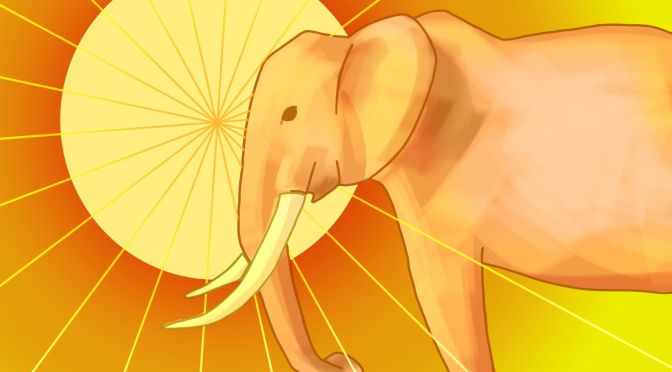
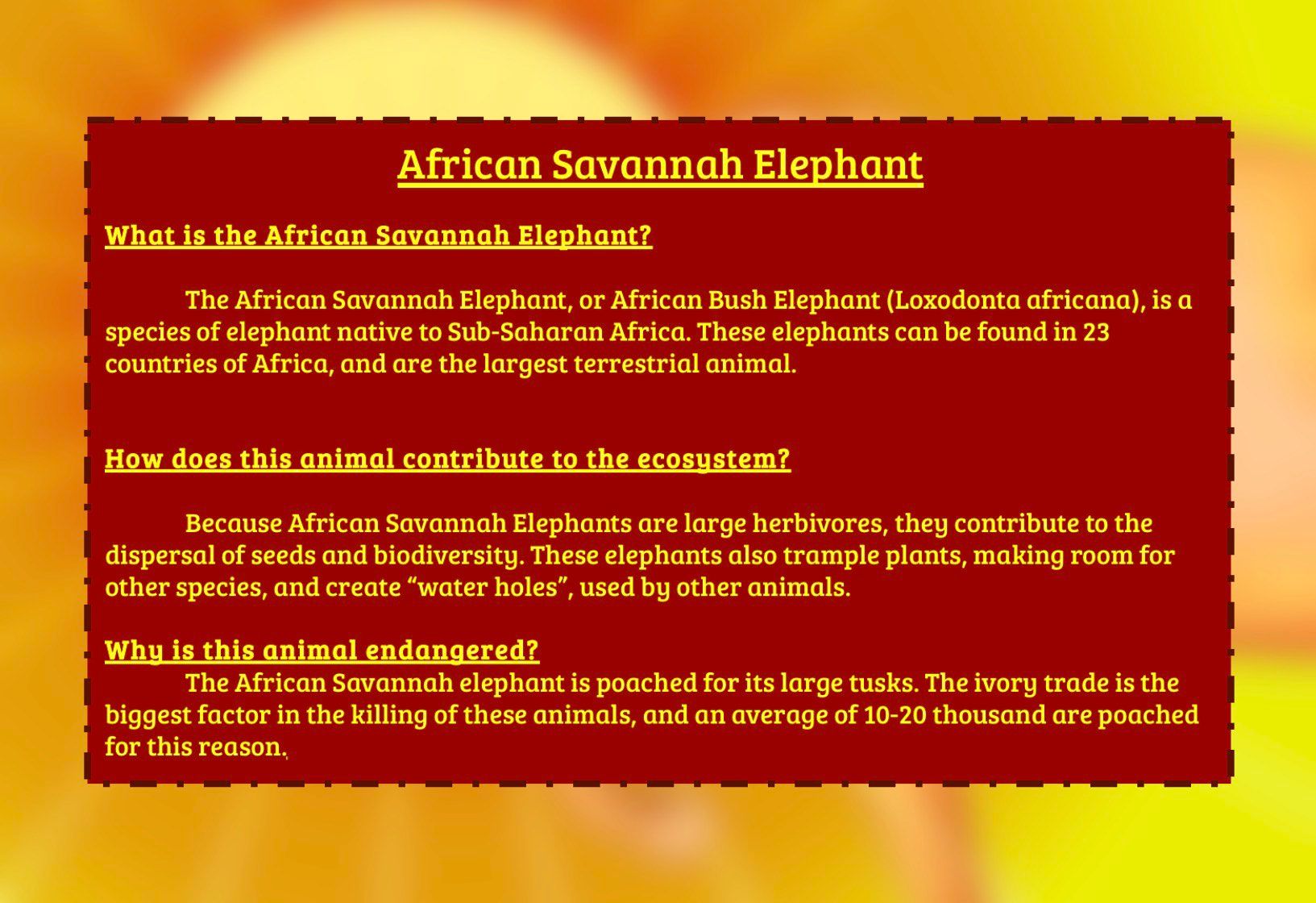
The elephant is one of the largest mammals on earth. Elephants live across Africa and Asia and are very popular sightseeing animals. There are approximately 415,000 elephants in Africa and 40,000-50,000 elephants left in Asia. It is estimated that there were once 20 million elephants in just Africa and an estimated number of 26 million on the whole earth. The elephant’s population is continuing to decline because of causes like habitat loss, and poaching, which is also known as illegal hunting.

The elephant’s habitat is very large, they can live in places like forests, savannas, deserts, wetlands and grasslands. Most elephants just need areas with a lot of space as they are very large. They also need their food and water; the elephant is a herbivore and eats food such as grass, bark, leaves, fruits, and roots. An elephant can feed for up to 12 hours and eats over 100 pounds of vegetation in just one day.

When the elephant is pregnant the baby elephant also known as a calf stays inside the mother for about 22 months which is one of the longest gestation cycles. After the calf is born its mother and other elephants in the herd will help the calf stand up as baby elephants are able to stand up a few minutes after birth. When the calf reaches the four month mark they start to eat things besides their mothers milk but will continue to drink its mothers milk for up to two years and can drink 3 gallons a day.

Elephants are social animals and will travel in herds. Most elephant herds are large families that include members over multiple generations; and usually they travel with these same herds for the entirety of their lives.

Elephants usually live around 60-70 years, they usually die because of starvation or a disease called anthrax. Annually there’s a range from 40,000 to 70,000 elephants dying.

For more information, please visit:

Empty nets and a dying ocean

By: Maya Vossen-Nelson

Image created with Canva

The ocean absorbs large amounts of heat without a large increase in temperature. Given this property, the ocean has always played a central role in stabilizing Earth’s climate system, but in the past 100 years humans have created a climate that produces heat at an intensity that has overwhelmed the ocean. According to the US National Oceanic and Atmospheric Administration (NOAA), the most telling sign of the overworked oceans is that over the past 100 years, the average global sea surface temperature has increased by approximately 2.2 degrees Fahrenheit each decade. This is significant because a large amount of heat needs to be absorbed by the ocean for water temperatures to rise even slightly.

According to NASA, 90% of global warming is occurring in the ocean. The ocean is not able to keep up as efficiently as it used to and is creating devastating consequences. 

When the ocean temperatures begin to rise, this is an indicator of extreme levels of carbon and methane in the atmosphere that are trapping solar rays and damaging the ozone, thereby trapping heat in the Earth’s atmosphere. The levels of carbon dioxide dissolving from the atmosphere into the ocean have become so high that the water has become acidic.

Fisheries and fishing boats are reporting more frequent marine heat waves and whole fish community die-offs. At the very least, in response to the warming sea temperatures, many fish populations are migrating to colder waters. This has become so noticeable that many fishing businesses are being forced to change their fishing strategies and some are even considering calling it quits.

A perfect example is the seafood industry on the east coast. Boston NPR station, WBUR, reports that “The Gulf of Maine is warming faster than most of the world’s oceans. As a result, iconic New England species like cod and lobster have shifted north or moved deeper into the ocean in search of colder water.”

Without any interventions, it will only be a matter of time before the world’s fishing industry is turned on its head.