According to ballotpedia.org, on Election Day, in November, 35 senate seats were up for grabs. 14 seats held by Democrats, and 21 seats held by Republicans were up for election in 2022. One of those Democratic senate seats belonged to Senator, and Pastor, Raphael Warnock of Georgia.
Now may be a good time to explain what a runoff is. A runoff election occurs when no candidate running for a spot gets more than 50% of votes. That is what happened in the election between Raphael Warnock and Hershel Walker.
Something that I found very interesting about this race is the fact that this was not the first time that Senator Warnock had won a runoff race. Back in 2020, he ran against then-incumbent Republican Senator Kelly Loeffler, and since neither candidate got 50% of the vote, that election went to runoff as well.
This election was a Special Senate election, because Loeffler had been appointed by Governor Brian Kemp to fill the remaining 2 years of the six year term previously being served by former Senator Johnny Isakson, who was elected in 2016 but resigned at the end of 2019, citing his health.
The fact that Senator Warnock has been a part of, and won 2, senate runoff elections is incredible, and also shows how split the state of Georgia is between being Democratic or Republican.
But on to the effect this election could have, and will have, on American politics.
This election gave the Democratic Party a very narrow advantage in the senate, with Democrats and the few similar voting Independents occupying 51 of the senate seats, with Republicans occupying the remaining 49.
Before this election, the senate was split evenly, with Vice President Kamala Harris being the tie breaker.
Now, with the majority, Democrats will be able to process legislation and nominations much faster, filling a Supreme Court vacancy would be easier, and Vice President Harris will not be needed as often to break up tied votes.
So, although the Democrats didn’t continue to hold the majority in the House of Representatives, they still have control of the White House and now the Senate, allowing them to get more bills passed more efficiently.
Although a rail strike isn’t something that most deem significant, it can actually have a crippling effect on a country’s economy. At the beginning of December, last year, the United States was on the verge of a nationwide rail strike that would have cost our country over $2 billion per day, adding up to over $14 billion that could be lost in the first week.
It isn’t well known, but according to the Association of American Railroads, “Freight railroads account for about 40% of U.S. long distance freight volume (measured by ton-miles) – more than any other mode of transportation.”
Now, let’s talk about some other detrimental effects this strike could have had. The money, around $2 billion a day, would have crippled our economy, which would have resulted in trouble shipping and moving goods without the help of the trains that cross our country every day. But more on that later.
There are a few more harmful effects this strike could have had. First, the over 100,000 workers who could have lost their source of income if forced to strike. Second, the millions of job losses that could have occurred in just the first week.
Additionally, 33% of our country’s grain, 75% of new automobiles, and many other natural resources and commodities are shipped by rail. Cutting off that flow for just a few days would have a ripple effect throughout our entire economy, and right before the holiday season, the thing nobody wants are delays.
There are around 115,000 railroad employees in our country, who get paid anywhere from $48,000 to roughly $83,000 annually.
Now, let’s get to the big question: Why were they going to strike? According to Rutgers University, “The ongoing dispute revolves around work-life balance issues, including scheduling, time off and adequate staffing.” Rutgers also says, “The (rail) industry has been cutting staff despite reaping soaring profits for many years.”
Luckily, the strike was averted when President Biden signed legislation on December 2nd, preventing it exactly one week before the strike was expected to occur.
FTX Holdings was founded in May, 2019. It was one of the first large crypto exchange platforms that the world came to know. As it was founded right at the beginning of the crypto explosion, it proceeded to make absurd amounts of money off the back of it. FTX became a world renowned company, and in the 2022 Super Bowl, became an American household name with one of the most popular and successful Super Bowl ads in recent years.
This sounds like the setup to a story about an extremely successful company on the forefront of cryptocurrency technology, right? Like many people that believed in this company, including celebrity endorsements such as Larry David, Steph Curry, and Tom Brady, you would be wrong.
On November 11, 2022, FTX Holdings filed for bankruptcy, and in the process, close to $11 Billion has gone up in smoke.
Humble Beginnings
FTX was founded by Sam Bankman-Fried (SBF) in May of 2019. Before SBF founded FTX, he founded an investment and trading firm called Alameda Research. Alameda consisted of SBF and roughly 10 of his friends, making random crypto trades for a pretty decent profit. When the company was at its height in 2017-2018, it made a respectable profit month after month.
When the crypto scene started to grow and gain more public attention, larger trading firms got into the scene and made it harder for little companies like Alameda, to make as much money. This is when SBF pivoted his business model and decided to go from exchanging crypto, to being the exchange himself. This pivot birthed the FTX crypto exchange.
The FTX Business Model
Before we dig into why FTX’s business model failed so catastrophically, we should look at what model DOES work for exchanges. The ideal business model for the average person putting money into a bank or exchange is where the organization holds your money and gives it back when you want it. While it is a good form of banking, it doesn’t make much money. Crypto exchange “Coinbase” uses this model, and only makes money by charging fees on substantial transactions.
What MOST banks will do is they’ll take your money, and invest it in physical assets such as real estate and long term stock options. This allows banks to be a better investor than you, and make a bit of money off the back end. This also allows banks to give their customers interest on their holdings, so everyone makes a little money. As long as real estate and other investments don’t crumble all at once, everyone’s happy. They still have enough money to pay people out if they want to withdraw some, or all, of their money.
Something very important to note about real banks, is that NO MATTER WHAT they are required to pay out customers up to $250,000. This is called FDIC insurance, and makes sure that even if a bank goes completely under, people can still make it out with a decent amount of money.
Where we run into major problems with crypto exchanges (cryptobanks) is the FDIC does not apply to them whatsoever.
Here’s a unique scenario to think about. Imagine that you give a bank $100,000, and instead of investing that money into something stable such as real estate, they take the money and buy a high quality Babe Ruth rookie card. The money you gave them is technically still there, but it’s no longer liquid. Now, take this scenario and multiply it by thousands of customers. For every $100,000 dollars put into the bank, a new rookie card is acquired. Now, uh oh, someone wants their money back, so the exchange has to sell one of the cards, no big deal, the card is sold for more than it was bought, you get your money back and the bank keeps a little.
Now the real problem occurs when a whole lot of people want their money back, all at once, and you need to sell a whole lot of these Babe Ruth rookie cards to be able to do that. If you sell all of these cards, they will end up having very very little value, and you’ll never get the money to pay back your customers. Take this scenario, and instead of a Babe Ruth rookie card, the exchange is investing in a worthless, self minted, crypto coin. That’s FTX.
Going criminal
While SBF was somehow keeping FTX afloat, his first company, Alameda Research, was making a large amount of terrible crypto investments. It was being run by the 28-year-old girlfriend of SBF, who was having an extremely hard time making good investments for Alameda. In referencing her direction and methodology around making massive crypto bets, she said, “’Ya know [I] adjusted myself to you know, okay we’re farming comp, uh and then it’s like oh were farming these things that are like foods, and now we’re farming these whatever weird, like meta food things, I don’t know.’ She goes on to say,‘Yeah I feel like I did manage to get, yeah, get away from my initial skepticism and end up embracing the mindset of like great, gonna go out and look for like, whatever like the weirdest, dumbest thing people are talking about today and like that’s gonna be the thing I’m working on today.’” Through this interview, it becomes pretty apparent that she has little to no idea what she’s doing regarding handling multi billion dollar cryptocurrency bets.
As Alameda was losing obscene amounts of money hand over fist, SBF started taking money directly from FTX’s accounts and secretly fueling the dumpster fire, Alameda Research. While on the surface this seems sketchy at worst, this is a 100% illegal way to conduct business. This is the point at which FTX and SBF start to resemble Enron. What was going on behind the scenes here was completely illegal and SBF should face criminal punishment.
The collapse
In early November, 2022, a leak was made of FTX’s finances. The leak showed that FTX was “loaning” money to Alameda to keep up its failing bets, and in return, Alameda was giving them FTT Tokens. FTT Tokens are the tokens minted and sold by FTX as mentioned in its business model. The FTT Token was only being propped up by FTX’s profits. As more people invested into FTX, these FTT Tokens gained more “value” even though there was literally no solid financial support behind that said value. FTX would continuously buy the FTT Token to keep its value up. The leak brought to light that almost ALL of the money on FTX’s books was being held in this made up, completely valueless FTT Token. So, instead of having people’s real money in their vaults, FTX was filling it with these worthless crypto tokens. People started to realize that this was a major red flag, and decided to start pulling money out.
Very shortly after this leak was published, the CEO of a similar crypto exchange, Binance, said publicly that he had a large amount of this FTT Token and was scared for its stability. Instantly, he announced that he had decided to dump it all. With the CEO of Binance dumping all of his FTT Token, the value plummeted and everyone who had money in FTX also started to pull their money out of the business.
The house of cards that was FTX fell apart and literally overnight, the company went from the largest and most valuable Crypto Exchange, to worth absolutely nothing. FTX collapses and as a financial powerhouse, simply ceases to exist.
The aftermath
There will be a lot of changes in the wake of this catastrophic financial oversight. The company that Wall Street counted on to do accurate accounting for FTX, Prager Metis, is facing serious consequences as it was their responsibility to notice a fault this large in the company. The people involved in FTX and Alameda all should also be facing serious jail time.
Several other things were noticed as well. As I mentioned Binance earlier, it would be good to note that after FTX collapsed, people were rightfully skeptical and decided to look deeper into Binance’s finances (sick rhyme). What they found was that almost 50% of THEIR reserve is also in their own Crypto Token. In the Crypto world, this has immediately popped up as a huge issue, all over the place, and is an extremely dangerous balancing act to keep up.
As mentioned earlier, this situation is very reminiscent of that of the Enron collapse, which I have covered in a previous article. While the similarities between the two fraudulent companies are deeply woven, it brings me great joy to announce that the new CEO of FTX, whose job it is to oversee the company’s liquidation, is none other than John J. Ray, the same guy that liquidated Enron 20 years ago.
What can we learn?
What I have taken away from this incident, is to not blindly trust companies with your money. You never know who is up to what kinds of shady business, and who will hang you out to dry whenever they want. While keeping your money in banks is a decently safe way to operate, nothing will ever be safer than a big treasure chest full of money buried in your backyard.
Even before the COVID-19 pandemic, there was the start of a worldwide pilot shortage. The COVID-19 pandemic only exacerbated the issue. A study was done by the consulting firm Oliver Wyman, and it projected a 79,000 pilot deficit by 2032 if current trends continue, absent a downturn in future demand and/or strenuous efforts by the industry to bolster the supply of pilots.
North America as a region also needs more in the numbers department. The region already has a shortage of around 11,000 pilots, around 11% of the pilot supply, and this gap will only widen throughout the decade. By 2032, North America will be short 30,000 pilots if current trends continue.
Through a large part of the 20th Century, flying was a luxury reserved for only those who could afford it. Pilots were more prestigious than they are today, as the job commanded as much respect and pay in the 1950s as doctors. Aviation has become more commonplace and affordable for the average citizen, so the job has become less flashy.
Main factor
That leads to the main factor of the shortages: the barrier and cost of entry to this profession are incredibly high. Before pilots can perform their first takeoff with passengers in the back, they must get many required licenses, ratings, and certifications.
However, many airlines heavily favor those with a college degree, so those who want to get into the field usually have to start by getting a degree. According to data from Statistica, the total cost of attending a university for four years in the US is $133,000.
Prior to the pandemic, some major US-based airlines required college degrees for applicants. However, most have dropped the degree requirements, but candidates with a college degree are strongly preferred.
Every aspiring pilot needs to get a private pilot license. This is essentially the aviation equivalent of your everyday driver’s license. As of 2022, this license requires 40 hours of flight time. These flight hours are with an instructor and are expensive.
According to pricing estimates from the Illinois Aviation Academy, getting your private pilot’s license costs a total of $10,680. This includes flight hours with the instructor, plane rental, FAA exams, and ground training.
To start actually making money as a pilot though, you need 15 additional hours of instruction for an instrument rating, and 215 hours of flight time to obtain a commercial license. According to St. Charles Flying Service, this costs, on average, around $25,000. There are also numerous other factors that add cost such as books, housing, and transportation.
Even after all this time and money invested, If you desire to work as a commercial airline pilot, you still need to obtain another license. To become a commercial airline pilot, you need to get an Airline Transport Pilot (ATP) license. This is the biggest required flight time hours of them all, you need 1,500 flight hours to get this license, with some exceptions.
This 1,500 hour requirement was a huge increase from the previous requirement of 250 hours, and drove many away from the industry. The FAA changed the requirement in 2015, after a deadly plane crash in 2009 near Buffalo, NY. In response, Congress passed the FAA Extension Act which provided the FAA with authority to establish training requirements for commercial pilots. Airlines have lobbied the FAA to lower the requirement, possibly down to 750, but there has been no changes so far.
The United States is unique in this way, with other established countries such as Germany, the UK, and Canada all being at the 250 hour quota. According to the Bureau of Transportation Statistics, the total number of fatal accidents per 100,000 flight hours has dropped from 1.10 to 1.05 between 2015 and 2020, a roughly 4% difference.
If one were to pay for all that flight time themselves, they could be looking at around $135,000 in rental costs, so pilots usually let someone else pay for these fees by working at a job that doesn’t require a full ATP license. The most common job to fill the flight hours requirement is as a flight instructor, but other common gigs include flying skydiving planes, towing banners, or flying for airlines who are using small single engine planes.
After spending tens or even hundreds of thousands of dollars over a couple years for education and training, you can finally apply to fly a commercial airliner. On average, it takes four years to finish all the necessary training and requirements but can be done in as fast as two years.
Secondary factors
Commerical airline pilots in the United States have to adhere to many of the FAA’s strict safety rules, which include a medical/psychological exam every 12 months for pilots under 40 and every 6 months for those 40 and over. The FAA has a mandatory retirement age of 65, and they can’t continue after that no matter their health or ability.
Around 6,000 pilots per year retire before they hit the mandatory retirement age. By 2029, not a single baby boomer will be legally allowed to fly a commercial plane in the US.
The pandemic hit the aviation industry especially hard, and many airlines offered early retirement for pilots. This made the shortages worse when demand returned, and the airlines couldn’t keep up with staffing needs. Commercial pilots’ job is all seniority based, so those who took early retirement, and tried to come back, would be starting at the bottom of the pay scale and other things like scheduling.
On average, commercial pilots fly 900 hours per calendar year in the US, which is 75 hours per month, and about 17 hours per week. FAA regulations cap the number of hours at 1,400 in a calendar year. This also puts a restraint on the number of pilots available on any given day.
The US also loses a number of pilots to foreign countries such as China because they do not have enough local pilots to fill their fast growing airline industry. It is estimated that 10% of China’s pilots are foreign. The average starting salary for China’s airlines is $312k to foreign pilots, and some make up to $500k per year.
The obvious solutions would be in to increase pay and improve the working conditions, but the airlines are usually concerned with their bottom line. Another solution for the industry would be to try and recruit more female pilots, as they only make up 6.7% of the world’s supply.
Airlines are also now opening their own flight schools, where cadets can train for a reduced cost, and then are sometimes guaranteed a job upon completion of training with the specific airline. I think that this is definitely the best long term solution.
Hmong New Year is all about celebrating the culture and showcasing Hmong dance groups, fashion shows, cultural food and so much more. People sometimes ask why Hmong New Year happens at the time of year that it is celebrated, the reason for that is because Hmong New Year is celebrated during the time of the end of a harvest and it’s celebrated to honor our ancestors and spirits. Every year the River Centre is packed with people who are dressed up and are there to celebrate the culture.
At Hmong New Year, there are tons of activities for people to do and the most popular activity is called “Pov Pob” which translates to “throw the ball”. This game was originally meant for women to find a husband. During this, you throw the ball to a boy you like in hopes he tosses it back, but it can now be played with your significant other or your friends and family.
Also during this celebration, a singing and dancing competition is held. Each of these are based on traditional backgrounds, for example, the dancing is a traditional style of dancing which normally is showcased by all girl groups, and during the singing competition, every contestant (usually) sings an older Hmong song or a popular Hmong song.
Now, for most people’s favorite part: the food. Every year the variety of food is different but some staples that show up every year are sticky rice, spicy papaya (which is a spicy salad) and egg rolls. Each of these are usually made by the community elders, or Hmong caterers, and everyone appreciates a good break for the food during the celebration.
Hmong New Year is a great time to celebrate and give thanks to our ancestors and show off our cultural clothing. There are many activities to do during this celebration.
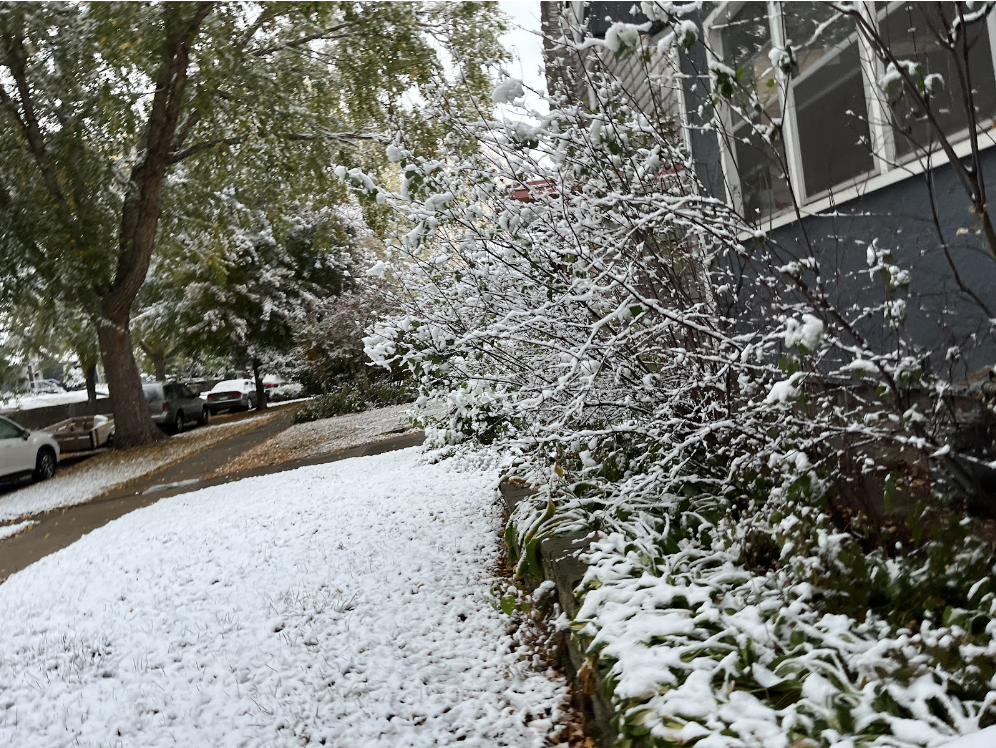
This November has had record-breaking storms and temperature swings, but why? Every possible answer can be linked back to one major factor: climate change.
In 2014, the number of geophysical events had tripled the number there were in 1980, but this isn’t too much of a shock for the general population to hear. We all know climate change is deeply impacting our animals and future, but its impact on our daily life is less apparent. We know it causes hot weather in the summer and natural disasters in other areas, but in Minnesota, it doesn’t affect us in any months other than July and August, right? Wrong.
Hot summer days have become significantly more common than cold winter nights, as hot summer averages have doubled if not tripled their commonality, while cold winter temperatures have become a third of what they were in 1980. According to the EPA, “if the climate were completely stable, one might expect to see these highs and lows each accounting for about 50% of the records set. Since the 1970s, however, record-setting daily high temperatures have become more common than record lows across the US.”
From 2000-2009, the record lows have been half as frequent as the record highs. However, 2022 has seen record lows in the past month, and they are expected to continue. In the areas and days where temperatures are significantly cold, their level of extremity is dangerously high.
A 2018 NPR article stated, “New research suggests that global warming could cause temperature swings to get unusually extreme. Climate scientists already know that as the planet warms, there’s a bigger chance of extreme weather: bigger hurricanes, for example, or heavier rainfall. But a temperature roller coaster could be on the way as well, according to the study, which appears in the journal ‘Science Advances.’” This is due to drier soil from a warming hemisphere. Drier soil leads to temperature fluctuations and vulnerability.
Clearly, we’re already seeing this play out not even five years after the article’s release.
On Kare 11, it was stated that this winter holds third place for temperature swings in Minnesota for the past fifty years with a 71º difference between the highest and lowest temperatures this month. This year is surpassed by only 1977 (77º) and 1978 (73º).
Additionally, the 2nd of November was a record-breaking warm day in Minnesota. The highest temperature recorded was 79º at Theilman, and the Twin Cities reached 76º, according to the Minnesota Department of Natural Resources.
November is one of the fastest-warming months in the state, gaining 4.2º yearly. However, January, December, and September respectively are all ahead of November in fastest warming months.
Just a week after November 2nd, a powerful storm occurred. In the Twin Cities, temperatures fell 20º in a span of four hours, reaching a 40º fall after twelve hours had elapsed. Additionally, Warroad received a total of 9.1” of snow on November 10th.
On November 29th, the Twin Cities nearly matched Warroad’s level of snowfall with 8.4” Many schools in the state were canceled, released early, or had activities canceled. Additionally, transportation for many was delayed as vehicles struggled through the rough, slippery roads.
Next time you think about extreme weather, and the switches from warm to cool within mere days, don’t forget about the part we play in causing it.
Almost 9 months ago, on February 24th, 2022, the country of Russia invaded its neighbor country, Ukraine, starting a war between the two countries.
For a month or two, this war had captured the attention of the majority of people around the globe, but since then, the war has not been talked about nearly as much, except for in occasional discussions about the U.S. and how much aid it has provided, and how much more it should.
Other than that, the war has pretty much fallen out of the global spotlight, letting daily news and other global issues fall back into their spots at the top of most news sites.
Let’s quickly go over some of the major facts of the war that you may have missed in the past few months.
This war has been called the biggest land war in Europe since World War II, claiming over 32,368 lives to date (according to Ukraine’s Interior Ministry), and the number is almost definitely going to rise until the war comes to an end.
Another hard to believe number is the 7.8 million refugees from the war. (Data accurate as of 11/15/22) This number, although already big, seems even bigger when you know that the population of Ukraine was around 43.8 million before the war, meaning that 1 in every 5.5 Ukrainian residents has at some point left Ukraine as a refugee.
Although the war is still ongoing, nearly 4.5 million Ukrainian refugees have since returned to their home country.
These 2 statistics have been changing constantly since the beginning of the war, but one recent event relating to the war has brought some of the attention back to the warring countries.
According to the New York Times, the country of Poland said that a Russian-made missile was likely to blame for the deaths of two Polish citizens in an explosion near Poland’s border with Ukraine on Tuesday, November 15th.
This is the first time a member of NATO (the North Atlantic Treaty Organization) has been directly hit during the 9 month long conflict, at the beginning of which Ukraine was considering joining for the protection from Russia.
It is not known, at the time of this writing, who fired the missile, or where it came from, but it has been described by the Polish Foreign Ministry as “Russian-made.”
Both Russia and Ukraine have used Russian made munitions during the conflict, which is why no one has been quick to assume where it came from.
Although the war has been long-lived and taxing, I believe that we need to pay more attention to it as it has had an impact on millions of lives, and can affect many more if this war turns out to last for months or years longer.
On Tuesday, November 8th, 2022, the US Midterm Elections took place. How did it go and how did those results compare to what was expected to occur? This article is here to explain just that.
Before I begin, I will note that all the information in this article was gathered from multiple sources from each side (the exact numbers used agreed upon by both Fox News and the New York Times), thus is verified information and holds no bias.
This year, the elections held were mainly for senators, representatives, and governors. Around 86% of the combined number of seats were up for election this year.
Prior to the election, the Senate had a 50-50 split between democrats and republicans. However, the Vice President breaks any voting ties within the Senate, and the current Vice President is democrat Kamala Harris. This number gave democrats a very narrow majority since the last elections were held for (some) Senate seats during the 2020 election.
The House of Representatives also had a narrow democratic majority, with 222 democratic-held seats and 213 republicans, meaning around 51% of the House of Representatives was democrats following the 2020 election.
Additionally, the president elected in the 2020 elections was a democrat (Joe Biden). This means that from 2020 following the election to 2022 prior to the election, the Senate had a slim democratic majority, the House of Representatives also had a slim democratic majority, and there was a democrat in office.
However, the 2022 midterms looked bad for democrats for two main reasons: party in power and redistricting.
The first is significantly more simple: whichever party holds office typically loses a large amount of their seats. Since the current president of the United States is a democrat, they were projected to lose several seats in these midterms simply because of the party Joe Biden is a part of.
The second, redistricting, is more complex. Redistricting typically takes place after a census, and it is exactly what it sounds like: the border lines for districts are changed, which typically benefits one of the two major parties.
The most recent redistricting affected both parties. New Mexico, Illinois, Nevada, and Oregon’s districts were drawn in a way that benefited democrats. However, Texas, Georgia, Ohio, Tennessee, and Florida’s districts were beneficiary for republicans.
When asked who redistricting would affect more in an interview with NPR, Michael Li, redistricting expert, said, “Republicans have an advantage that I think will play out.”
However, democrats greatly overperformed expectations in both the Senate and the House of Representatives.
In the Senate, democrats won the majority with 50-49 seats. Georgia will hold a runoff election later, which will determine whether the seats are 50-50 with the vice president as the tiebreaker or 51-49. Either way, the democrats will hold their Senate majority for at least the next two years.
However, in the House, the republicans have taken control with 218 seats called by various sources and 210 for democrats, with 218 seats needed for control.
Of the thirty-six governor elections and thirty-four called races, each party has seventeen governors. In Minnesota, our governor will remain Tim Walz, another democrat.
All in all, the election did not go as expected, and is going fairly well for both parties, with democrats coming out a bit better currently. However, there are still races left to be called.
RSV refers to respiratory syncytial virus. This illness shares some similarities with the flu: they both affect the respiratory system (nose, throat, and lungs) and generally occur during late fall through early spring.
Who does this virus affect?
Anyone can be infected, but RSV is the most common and dangerous in children under two years old.
How do I know if I have RSV? Is there a cure?
The virus often presents itself as a cold, with symptoms such as fever, cough, and congestion. However, it can lead to more severe conditions. In fact, RSV is the leading cause in young children of pneumonia and bronchiolitis – a lung inflammation disease quite similar to bronchitis.
Patients can be tested for RSV, but there is no cure for it and antibiotics do not help treat the virus. Thankfully, it tends to clear up by itself within a week or so.
And, what is this “triple-pandemic?”
Americans are referring to influenza, COVID-19, and RSV as a “tripledemic,” as all three of them are quite prevalent in the United States right now. Flu cases always spike in the fall, but they’re even higher than usual this year. With COVID restrictions now greatly loosened, cases are expected to rise in the coming months. RSV wasn’t much of an issue for the past two years because a large portion of people still wore masks. This year, however, cases are greatly increasing, which is more than likely also a result of the lifting of COVID restrictions and people using less caution towards viruses overall.
To best protect yourself from RSV, the CDC advises that you should thoroughly wash your hands, cover your cough, and avoid close contact with people who appear to be ill.
For more information on RSV and the triple-pandemic, please visit
Once again, we find ourselves revisiting an old topic. Much like my James Webb articles, this covers space exploration. The difference between the two is the successfulness.
The Artemis Program is NASA’s newest project, hoping to get humans back on the moon. Conceived in 2010, the Artemis Program had a lot of support and dreamers behind it. It was initially scheduled for its first test flight in 2017, but here we are in 2022 with still no launch. The failures of Artemis and its SLS launch system have created an environment of high costs, short budgets, and many sad space fans like me.
Where we run into problems
There are multiple issues with NASA’s current dream for lunar inhabitants. First off, we’ll have to cover the issues that are seen on paper. The rocket is NOT cheap. The SLS is a new launch system that is supposed to be able to carry the crew and supplies needed to start a lunar surface base, and a lunar orbital station. While it IS capable of such feats, flying it comes at a sizable cost. It runs off of several RS-25 rocket engines, which cost nearly 150 million dollars to make, for a SINGLE USE engine, in a time when private companies have cheaper multi-use engines. While the SLS is one of the heaviest lifting rockets in existence, its 4.1 billion dollar-per-launch price tag is something that cannot be ignored.
The second and more severe problem is that Artemis 1 has been delayed over and over again due to malfunctions in the SLS’s overpriced engines. On August 29th, 2022, the Artemis 1 launch was supposed to take place. Before it was sent into space, leaks sprung up in the hydrogen fuel lines. Additionally, sensores stated that one of the four main engines was not cold enough to support fuel injection for launch. These problems were non-ignorable, delaying the launch for another week. When the problem was deemed fixed, it was set to launch once again on September 3rd. Surprise, surprise, it never left the launch pad.
Similarly to the first failed launch, a hydrogen leak occurred, but this time it was much larger and much more dangerous. Cold liquid hydrogen is relatively stable, but when liquid hydrogen begins to mix with warm Florida air, it becomes gaseous, and VERY dangerous. This explosive hazard was deemed non-ignorable once again and the launch was postponed “to a later date”.
That “later date” has been announced! Just recently, NASA announced that the new launch date for Artemis 1 is November 14th, 2022.
Hope for the future
While the Artemis program is over budget, riddled with problems, and yet to actually start, there is still hope. After dumping more than 23 billion dollars into a project, there is little chance that NASA will scrap the project. Even if there are more issues on the 14th, there will always be hope for future endeavors.
This can’t be promised, and can’t be stated as a fact, but I will anyway. Man will make it back to the moon whether it’s in the next several years, or the next several decades, the younger generations WILL see humans return to the moon.
The Official Online Newspaper, Literary Magazine, and Video News of the Highland Park Scots