Category Archives: Getting To Know/History

The Trabi

By: Charlotte Aver

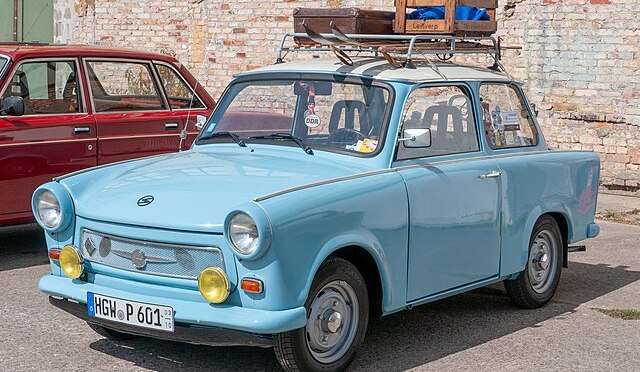
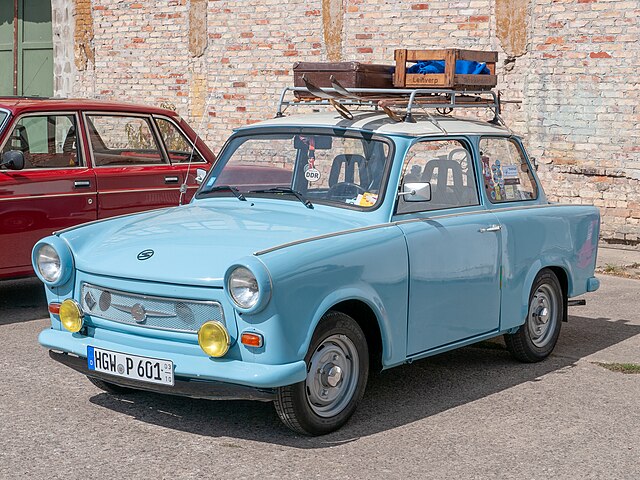
Trabant at 12. Internationales Maritimes Fahrzeugtreffen, 18 August 2018, by Matti Blume via Wikimedia Commons

The Trabi is a car from the Soviet Union. They were produced from 1957 to 1991 and they were made quickly and were not solid at all.

The Soviet Union made it so that it was the only car that a person could own. The Trabi’s were free to the public if you got on the waitlist. However, it could take up to fifteen years to actually get your car after being put on the waitlist, even though it was free it still had a cost. The Trabi’s were made quickly and by hand and therefore were not sound. They were thin and fragile: the windows were hard to roll up or down, the bottoms of the cars were thin enough to break, the seats had no cushion to them and they broke down all the time. Though it was free it was bad quality and would take years to get to you.

An oversight that was made while the Trabi’s were being made was that there were no spare parts, so when they broke down there was nothing to fix them with, making the fifteen years you waited for the car useless.

The people that drove Trabi’s were everyday people where as the leaders all drove Mercedes. This goes to show that communism, which was the Soviet Union’s goal, is impossible to achieve with humans because humans are incredibly susceptible to corruption and selfish desire.

During the 1980’s there was a huge push to tear down the Berlin Wall, which happened in October of 1989. During this time there were many slogans and sayings that were used about freeing East Berlin, one of them was “free the Trabi” because it was a car that only existed on the east side of the Berlin Wall. After the Berlin Wall fell there was a section left up and artists from around the world were invited to come and paint murals on the wall; this section of wall is now known as the East Side Gallery. One artist painted the Trabi breaking through the wall and by painting this immortalized the saying “free the Trabi”.

The Trabi is a true symbol of the people of the Soviet Union and East Germany, how they lived and what little they were given by their government.

Interview with Ms. Thao

By: Treshawn Ross

Introduction

Ms. Thao is our new school counselor who works with students in 10th through 12th grade letters RO through Z. She has been doing a great job and I had an opportunity to interview her. I asked her a series of job related questions and also a series of more personal questions. 

Job related

Treshawn: How have you enjoyed working here so far?

Ms. Thao: “I really like working here so far, the staff is super supportive and amazing. And I love getting to know the students.”

Treshawn: Was there anything specific to Highland that made you interested in this job?

Ms. Thao: “Yes, having worked in St. Paul for a lot of years you hear a lot about Highland and the school pride. This is a very active and a good community. The pep fests and competitions are nice. The students here want to make a difference.”

Treshawn: How have you enjoyed working and interacting with the students here?

Ms. Thao: “It’s been really good (working with students). They are really understanding and patient as I get accustomed to the new environment.” 

Treshawn: Have there been any surprises relating to your new position at this school or has it all been business as usual?

Ms. Thao: “IB is very new to me, I had a lot to learn about the IB program and the immersion programs. It’s very nice that this school offers those programs.”

Treshawn: How does this school environment help you adjust to your new position at the school?

Ms. Thao: “I think Highland has a very welcoming environment and that’s made my transition very smooth. As I mentioned, I think the staff is very supportive.”

Treshawn: Is there any advice you would like to share with the students at this school? 

Ms. Thao: “Yeah! I would say that as a counselor I’m here to support all Highland students so I want you all to come down and say ‘Hi’. Even if you don’t really need help.”

Personal (outside of school)– 

Treshawn: How was your Thanksgiving break? Did you do anything fun?

Ms. Thao: “It was good, very chill. Family stuff was very nice, I caught up with friends and family.”

Treshawn: What’s your favorite thing (or things) to do outside of school? Like hobbies or interests. 

Ms. Thao: “Pickleball is something I started doing a year ago and now I feel more improved. I also enjoy reading when I can. And I love spending time with my family.”

Treshawn: Favorite music genre/artist?

Ms. Thao: “Old school in the sense of the 90’s and 2000’s. In all genres mostly”

Treshawn: Do you celebrate Christmas? If so what’s your favorite thing about the holiday?

Ms. Thao: “Yes I celebrate Christmas. I enjoy spending time with my family and watching the kids open up gifts. Also, the food, I love food.”

Treshawn: Do you have any hidden talents?

Ms. Thao: ”That’s a great question! I really love karaoke even though I’m a more quiet person, I enjoy it!” 

Treshawn: Ending thoughts (anything you’d like people to know)?

Ms. Thao: “I worked with Ms. Esso previously and this is my second time working with her. Actually, in exception to Ms. Skaar, I’ve worked with everyone here previously. I work with students 10th-12th grade letters RO-Z.”

The history of Thanksgiving

By: Treshawn Ross

The First Thanksgiving: By: Jean Leon Gerome Ferris via Wikimedia Commons

Origins of Thanksgiving

Thanksgiving originally began in Plymouth, Massachusetts in the year 1621. Around  90 Native Americans from the Wampanoag tribe attended the celebration with 52 English people or “pilgrims”. This celebration was to mark a successful harvest and is remembered historically as the first Thanksgiving. No one in 1621 called this feast Thanksgiving despite modern thoughts around the event.

Native perspective

Many Native Americans today view Thanksgiving as a reminder of the heinous crimes committed by the pilgrims and the generations that came after them. Quite soon after the first Thanksgiving, a war ignited between the pilgrims and the Wampanoag people and this heavily weakened the Wampanoag politically and militarily. Thus, the Wampanoag became one of the first Native American nations to be victimized by the pilgrims.

After the Plymouth harvest

Different states of the early U.S. and eventually the federal government proclaimed days of thanksgiving at different times in a very non-centralized way. These days were more solemn and somber rather than fun and feasting as many Americans now know it. After many years of advocating for a national Thanksgiving holiday, magazine editor Sarah Hale got her wish. America had a new holiday with storied roots.

A Presidential decree

Thanksgiving got its date partly during one of the bloodiest conflicts in U.S. history, the Civil War. On October 3rd, 1863, President Lincoln issued a Thanksgiving proclamation to help heal the spirit of the broken nation. This decree set the standard of when Thanksgiving would be celebrated, “[O]bserve the last Thursday of November next, as a day of Thanksgiving”. This would last for decades until in the late 1930’s and early 1940’s when President Franklin D. Roosevelt moved the date to the second to last Thursday of November. 16 states refused to follow this proclamation which led to intense confusion. In 1941 congress passed a law establishing the fourth Thursday in November as the national holiday known as Thanksgiving.

For more information, please visit:
The history single combat

By: Treshawn Ross

Peresvet’s duel with Chelubey: Viktor Vasnetsov

Single combat explained

The history of single combat is a very long one, this phenomenon became popular during ancient warfare. When people think about ancient battles the image that pops up is lines of men in a large formation, clashing until one side breaks. But often before the clash there would be single combat, often called “champion warfare”. One champion would go into the space between the two armies and meet his counterpart. Then they would fight, usually to the death, without interference from either army, as the men would watch in astonishment as the champions battled. If their side’s champion won they would feel confident in the upcoming battle, and their adversaries would feel disheartened or vengeful as a result.

Common myths

One major myth about single combat in the ancient era is that these skirmishes decided entire battles; this was rarely recorded and only popular in mythology. Another myth is that single combat was unique to one culture in the ancient world or in future eras. This is not true; single combat was popular in Rome, Greece, England, Brazil and New Zealand.

Famous instances of single combat in history

The Battle of the Champions between Sparta and Argos is the largest instance of this, each army brought 300 of their best warriors and they fought a brutal battle which left minimal survivors. Another example is the Battle of Kulikovo where Alexander Peresvet and Chelubey fought in single combat and both died. Also in 222 BC the Roman consul Marcellus killed the Gallic king Viridomarus in single combat. The Vikings had a system for duels known as the Hólmgang which was heavily regulated.

Decline in single combat

As armies became more modernized and disciplined, dueling became less popular or in some cases it became outlawed. The risk of ruining the moral of an entire army before the main clash of a battle was too great to bear for many kings and generals. Although, during the 1700’s and 1800’s another form of single combat became popular. Dueling with pistols became a way to settle scores and fight for honor in a more “gentlemanly” way. This was mostly indulged in by nobility or upper classes. But this eventually became banned as well during the mid 19th century.

For more information, please visit:
Root beer rankings and a brief history

By: Nils Hileson

Bottles of root beer tried

Root beer was made in the 18th century by Charles Elmer Hires based of a tea that has similar ingredients. Root beer is commonly made with sassafras root, wintergreen, sarsaparilla and other natural ingredients. It also has a lot of sugar and caramel coloring in it commonly. Its name is derived from the root ingredients used to make it and beer was added to the name just to appeal to miners.

For a time root beer was sold as a syrup or powder to be added to sodas before it became a popular soda itself. I myself like root beer quite a bit so I decided to try six different root beers and rank them from worst to best.

Brownie caramel cream root beer: this one is the worst not because it is particularly terrible but because of how disappointing it was. I was expecting actual caramel flavor but it just tasted like watered down root beer. Very disappointing.

Henry Weinhard’s root beer: not very sweet nor did it have much spice. Didn’t have much flavor for a root beer, so it’s ranked low.

Old Red Eye root beer: had a nice amount of spice for a root beer but was lacking in everything else. Was very watery and kinda disappointing.

Root Naturals Apothecary craft soda: a little less sweet than a normal root beer but had good levels of spice. A fine choice for a root beer.

Drive-in style Dog n Suds root beer: had quite a bit of sweetness, and a little less spice than the others I’ve had. I prefer my root beer to be pretty sweet so this root beer was good.

Boylan Bottling Co: definitely the best root beer out of all of them. The spices they used were different from a normal root beer’s but it was a welcome change of taste. They also used cane sugar, which I’m not sure how much that changed the flavor, but I think it made it better. Didn’t taste watered down at all.

For more information, please visit:
History of UFO sightings

By: Karl Salkowski

Image created with Chat GPT AI

UFO stands for Unidentified Flying Object. According to the Oxford dictionary, UFOs are described as mysterious objects seen in the sky for which, it is claimed, no orthodox scientific explanation can be found.

UFO sightings have been reported throughout all of recorded history and across the world. There are many accounts of unexplained aerial phenomena throughout 500-1500AD. Many paintings and depictions of these flying objects still exist, including strange symbols and imagery. However, it’s likely that most of these medieval UFO sightings were just natural atmospheric phenomena such as comets, auroras, or rare cloud formations.

The US is home to many UFO sightings, with some of its most famous dating back to the 1950s and 60s. During the beginning of the United States’ rocketry initiative, UFO sightings began to spike. This includes several famous sightings and initiatives such as the Roswell UFO Incident, Project Blue Book, and the Robertson Panel.

The Roswell UFO incident took place in 1947 and was one of the first in a series of new sightings. A ranger from Roswell, New Mexico, found a 200-yard-long wreckage near a US Army airfield. The local newspaper reported it was an alien spacecraft, although the military declared the wreckage was only a weather balloon.

As sightings of UFOs increased in the 1940s and 50s, the United States Air Force began investigating these reports. In 1952, this became Project Blue Book, and it recorded over 12,000 sightings between 1952 and 1969.

In 1952, the United States created a panel of scientists to investigate these sightings. This panel was known as the Robertson panel, named after its head, H.P. Robertson, a physicist at the California Institute of Technology. This panel determined that over 90% of sightings were astronomical and meteorological phenomena and that there was no evidence aliens exist.

Within the last 20 years there has been a massive decline in these sightings. As smartphones with high-quality cameras continue to become more and more present, grainy images and blurry photos just don’t cut it anymore. Overall, most UFO sightings can be explained by either military tests or just various natural phenomena.

For more information, please visit:
St. Paul – A safe haven for gangsters

By: Treshawn Ross

John Dillinger

In the early 1900’s to 1935 St. Paul was known as a safe haven for gangsters and criminals.

How it started– This system was known as the “O’Connor Layover Agreement”, named after the police chief at the time (John O’Connor). The key conditions of this agreement were that the criminals had to check in with police when they arrived in the city, they had to pay bribes to city officials, and lastly they agreed not to commit major crimes in St. Paul during their stay.

Gangsters who thrived under the O’Connor system– John Dillinger and “Babyface” Nelson both hid in St. Paul after their numerous bank robberies. Alvin Karpis and his gang of kidnappers also used St. Paul as a hideout. The bootlegging kingpin of the city Leon Gleckman used St. Paul not only as a hideout but a headquarters from the St. Paul Hotel.

The degradation of the O’Connor system- In 1930 Chief O’Connor retired from the police force. This left Tom Brown as his successor. Tom Brown portrayed himself as a righteous lawman who would fight crime; this allowed him to obtain the vacant police chief position. Tom Brown disposed of the O’Connor system. Instead of upholding the previous order, he allowed violent crimes by the gangsters hiding in St. Paul to go unpunished. This inevitably raised the city’s crime rate and brought more attention.

The Fall- After a famous shootout with the Karpis gang, Tom Brown was demoted after being questioned by the public and the mayor about how the gang escaped. He still retained a high office in the police department and after numerous scandals relating to the John Dillinger and Karpis gangs he was put under investigation. He was publicly disgraced but faced very little punishment. The FBI then began to hunt down the murderous gangs in the city, killing John Dillinger and many of his associates. Alvin Karpis was arrested for his crime and he served his sentence in Alcatraz. Many other corrupt officers were laid off and this led to reform and less corruption in the St. Paul police force.