Category Archives: Entertainment

Melanie Martinez ‘PORTALS’ album review

By: Fletcher Pike

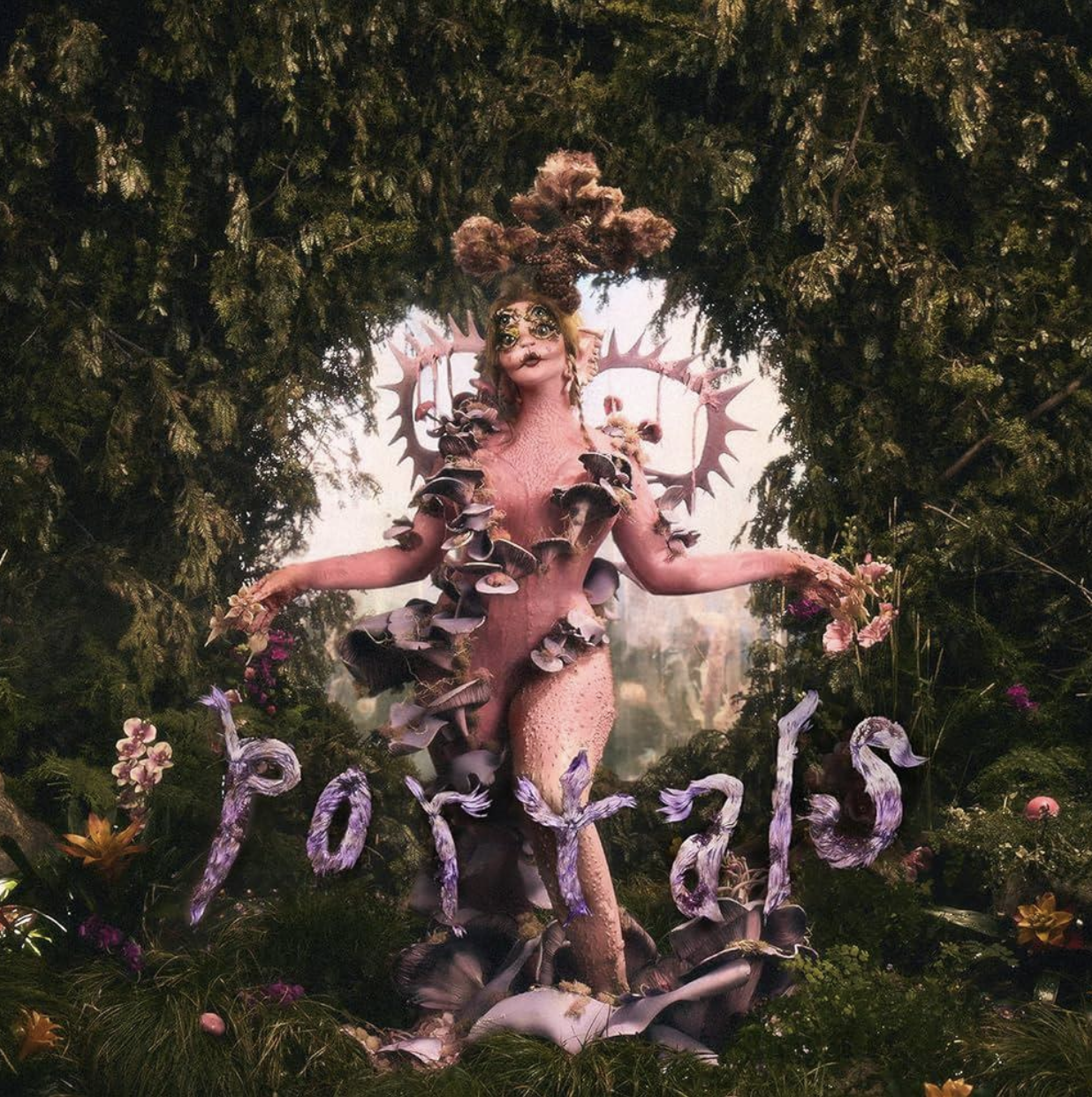
The official album cover for ‘PORTALS’

Melanie Martínez is a popular artist known for her unique and creative sense of style. She most recently released an album titled ‘PORTALS’ last year on March 31st. Melanie’s trilogy of albums, ‘Crybaby’, ‘K12’, and ‘PORTALS’, all follow a tale of her character Crybaby.

Melanie incorporates both story and depth within her songs, which is found throughout her albums. In this new album, ‘PORTALS’, Melanie enters a creative new era and her character Crybaby has been reincarnated into a pink, alien-like creature in a magical forest. This album contains 13 songs in total along with an additional 3 included in the deluxe version of the album.

TRACK 1: DEATH

The first song on this album, “DEATH” represents the reincarnation of the character Crybaby, and her return to the world in a new form. The song starts out with a short interlude that evolves into a catchy rhythm that features a heavy guitar, bass, and drums with interesting lyrics that really follow the theme that the song represents. I think this is a great opening to an album and I rate it a 10/10.

TRACK 2: VOID

“VOID” is the first song that Melanie produced on her own for this album, and the first thing she wrote was the bass line featured in the song. I really enjoyed the vocals, lyrics, and drums that were in this song. I will rate this song a 9.5/10 because I do think it was a little bit repetitive.

TRACK 3: TUNNEL VISION

“TUNNEL VISION” was the very first song that was teased to Melanie Martinez’s fans through the trailer promoting the new album, making it quite popular. It starts off with a brief vocal segment that was included in the trailer followed by a unique beat featuring drums and a high pitched guitar. This is a great song and I rate it a 10/10.

TRACK 4: FAIREE SOIRÉE

The fourth song on her album, and probably the most upbeat, “FAIREE SOIRÉE” is a bright and vibrant song with a joyful melody and rhythm. It has a pop-like beat with a guitar melody over it as well as some great vocals. Recently, on February 9th, a music video was released for this song featuring Melanie and her backup dancers dressed as fairies with amazing choreography and costume design. This is a fantastic song and personally one of my favorites, so I give this song a 10/10.

TRACK 5: LIGHT SHOWER

“LIGHT SHOWER” is actually the very first song that Melanie wrote for this album, where she wrote it as a love song with her guitar. This song is beautifully written and composed and has a bit of a somber and slower tone to it. It features only a guitar along with Melanie’s vocals. I think this song is very beautiful and I rate it a 10/10.

TRACK 6: SPIDER WEB

“SPIDER WEB” starts off with an echoey harp that progresses throughout the entire song that evolves into a catchy beat with some really interesting lyrics that I enjoyed. I really liked Melanie’s vocals in this song. I think that “SPIDER WEB” was a fantastic song and I rate it a 10/10.

TRACK 7: LEECHES

“LEECHES” is a slower and more somber song, with a guitar melody and flowing vocals that I found to be very ambient and nice. I also enjoyed the string instruments that were present in this song. I thought it was a beautiful song and I rate this song a 9/10.

TRACK 8: BATTLE OF THE LARYNX

“BATTLE OF THE LARYNX” starts off with a guitar melody with a bit softer vocals that ascends into a really nice drum beat that I liked listening to. I think this song is a solid 9/10 since it did get repetitive at times but it was overall nice to listen to.

TRACK 9: THE CONTORTIONIST

The 9th track, “THE CONTORTIONIST”, starts off with a quiet string sound with softer vocals from Melanie that I really liked. Throughout the song, there is a snap-like sound representing a bone breaking due to the name and vibe of the song, which I found very creative. “THE CONTORTIONIST” is a really great song and I rate it a 9.5/10

TRACK 10: MOON CYCLE

“MOON CYCLE” starts off with an echoey guitar that ascends into a beat with slight drums and bass. I thought that overall this song was good, but I thought it lacked a bit of depth in contrast to the other songs on the album. I think this song is an 8/10.

TRACK 11: NYMPHOLOGY

“NYMPHOLOGY” is a really great song. It starts off with string instruments and a guitar that shifts into a really catchy beat with amazing lyrics. The lyrics in this song focus on themes of feminism and gender classification. I thought it was a beautiful song and I would rate it a 10/10.

Around the last minute of “NYMPHOLOGY”, there is a brief interlude that Melanie has confirmed to be named “Amulet”. This interlude might be short, but it is very catchy and I really liked listening to it. It has a beat that is reminiscent of “FAERIE SOIRÉE”, and interesting lyrics. I loved both “NYMPHOLOGY” and “Amulet” and I rate both a 10/10.

TRACK 12: EVIL

“EVIL” features a darker tone in contrast to the other songs on this album. It has a low heavy guitar melody that is very similar to the melody found in “BATTLE OF THE LARYNX” that really adds to the tone of the song. I enjoyed the rhythm and the instruments used in this song and I rate “EVIL” a 10/10.

TRACK 13: WOMB

The final track for this album, “WOMB” is a mainly guitar composed song that I found to be very nice. I thought it sounded upbeat with the guitar melody. At the main chorus, it switches into a segment with a heavy guitar and drums. Overall, it is a pretty good finish to an album, and I rate it a 10/10.

DELUXE TRACK 1: POWDER

“POWDER” is the first song included in the deluxe version of ‘PORTALS’. It features a more echoey tone with Melanie’s vocals having some sort of pitched down vocal effect, which I didn’t care for that much. It has a pop style beat with a low guitar under it. I thought that this song was pretty okay, so I rate it a 8/10.

DELUXE TRACK 2: PLUTO

“PLUTO” starts off with a waltz-like flute melody with a really nice drum beat over it. I loved the vocals and melody in this song and the lyrics were pretty good, with brass instruments included in some sections in the song. I rate this song a 10/10.

DELUXE TRACK 3: MILK OF THE SIREN

The final deluxe track for this album is titled “MILK OF THE SIREN” and features a slower tempo compared to most other tracks on this album. This song starts off with Melanie’s vocals that evolves into a slow waltz-like beat with solemn drums. At some parts it shifts into a heavy drum part with an interesting chorus. I think this is a pretty good song overall, but I thought that it was a bit repetitive to listen to. I will rate this song a 8/10.

Overall, ‘PORTALS’ is a wonderful and creative album that is a fantastic start to Melanie’s new era. It is clear that much thought and creativity has gone into the creation of this album. I am anticipating any further albums Melanie might release in the near future, which might be a while since Melanie’s albums usually have a 4-5 year gap between them. This was a great album, which leads me to rate it a 9.5/10.

‘Minor’ review:

By: Sophia Elmstrom

‘Minor’ by Gracie Abrams is her first ever EP and her debut music. Gracie Abrams is a fairly new artist who got her start by a school project which she never thought would lead to anything.

Gracie Abrams is a folk pop singer and her range of musical talent is truly incredible. Once you start listening to Gracie you will not be able to stop. The first time I found her was when I first listened to ‘Minor’. The first song I ever listened to was “I Miss You I’m Sorry”. This song and this whole EP truly changed the way I viewed music and how I saw Gracie Abrams as an artist.

The EP ‘Minor’ contains 7 songs in total and their names are: “Friend”, ”21”, “Under/Over”, “tehe”, “I miss you, i’m sorry”, “Long sleeves”, and “Minor”. ‘Minor’ is a breakup album with all these songs being about heartbreak in your teenage years. My ranking of these songs is:

  1. Friend: 10/10
  2. Minor: 9.5/10
  3. I Miss you, im sorry: 8/10
  4. 21: 10/10
  5. Long Sleeves: 6/10
  6. Under/Over: 5/10
  7. tehe: 7/10

The reason my favorite song on ‘Minor’ is “Friend” is because the lyrics and music are beautiful. The lyrics show what it is like to go through a breakup and have your ex still want to be your friend. You know you cannot do this because it won’t work like that and she knows just because her ex is okay doesn’t mean she is.

I believe that this is a song many teens can relate to and I think it is an amazingly crafted song. “Friend” is 2:57 long and my favorite lyrics are “I’m sure you’re doin’ fine but I don’t wanna hear it”. I really like this lyric because it shows that she knows her ex is okay after the breakup but she really does not want to hear about it.

Another song that I believe to be crafted beautifully is “21”. This is a song about moving on and having to accept that your ex will have a life without you. “21’s” lyrics are strong and have many meanings behind them. Gracie Abrams herself said in an interview that she took many of these lyrics directly from her journal.

The song is 3:06 long and my favorite lyric is “When the night is over, don’t call me up I’m already under”. The reason I really like that lyric is because it is referencing her other song on the EP “Under/Over”.

Overall, I really like this album and it led me to love Gracie Abrams and all of her music. I rate this album a 10/10 because of the lyrics and meaning behind songs.

Basically, this is ‘Wakfu’ Season 1

By: Julia Yang

*Note: This article will contain potential spoilers for the show

When I say ‘Wakfu’, I’m referring to the anime-influenced French animated show— not the game.

Before we start, I’d like to say that I’m not the best at explaining things.
So, the story in short, ‘Wakfu’ is all about a special boy named Yugo. Yugo travels through different realms, saving the universe and his race alongside his friends.

The End.
Now, let’s actually start.

The show begins with Yugo, the boy I mentioned earlier, who first shows up as a baby with a newborn tofu— tofu is a species of bird, small, round, yellow, and harmless. Yugo is an orphan given to his new found father by a dragon named Grougaloragran in his human form. Grougaloragran tells Yugo’s new found father, Alibert, about Yugo’s past and origin through the tofu, Az.

Yugo, Az, and Alibert grow up together enough to the point where Yugo looks like he’s 12 years old. From this point on, this is where Yugo’s adventure begins.

An Iop— a race with ginger hair and not the best intelligence— named Dally, or Sir Percedal of Sadlygrove, barges into the restaurant that Yugo and Alibert are working in. This Iop is being possessed by his sentient demon sword called a shushu. Dally isn’t strong enough to fight back the possession, so he’s basically just destroying the place without meaning to. Ruel, Alibert’s old friend, explains to Yugo that he needs to take the demon’s eye out of Dally’s forehead to get rid of the possession. Yugo uses his powers and newfound knowledge to take down the possessed Dally, to which the demon resorts back into his sword form.

Yugo’s current powers— as of this episode, allows him to use blue portals to travel to nearby places. Yugo, Ruel, and Dally become friends.

Whilst this is happening, the village breaks out into an unusual disease where if anyone is touched by a black, gooey, strange creature, they’ll be turned into moss. Yugo, Ruel, and Dally leave the village to find the cure to this odd virus.

They run into two girls named Amalia and Evangeline.
Amalia is a sadida. Sadida have the ability to talk to, grow, feel, and bend plants. Evangeline is a craw. Craw’s have the ability to create magical arrows for a bow.

Amalia is traveling with Eva (Evangeline) to find out what’s wrong with the forest since sadida have very good senses for the world.

Of course, they all travel to the source of the disease.
Skipping the adventure so I don’t waste your time, they cure it and everyone who got turned to moss turns back to their normal selves.

They all go back to Yugo’s village where they get ambushed by a xelor named Nox. Xelor’s are time wizards— they look like humanoid robot people. Nox stops time and says he came to get information about Grougaloragran from Yugo.

Yugo, being an infant when he “knew” Grougaloragran, has no clue what Nox is talking about. Nox pulls a special feather off of Az that tells Yugo a message to find his true family. Nox threatens to hurt Yugo if he doesn’t tell what he heard, which sets Alibert off and Alibert breaks through the time stop and harms Nox. Nox, before anything worse had happened, teleports away, resuming present time.

Yugo and his friends leave the village in search for his true family.

Their search ends up with an island in the middle of nowhere where Yugo meets his strange brother. Yugo’s brother is a dragon.
The dragon’s name is Adamai. Adamai explains that dragons and eliatropes— the race Yugo is, are born from dofus’— dragon eggs.

Yugo and Adamai are born from the same dofus, meaning Adamai and Yugo are brothers.

Adamai explains how both Yugo and himself need to find a thing called an eliacube. The eliacube is basically a cube of an extremely large and powerful amount of wakfu originating from the eliatropes.

Long story short, Nox has the eliacube in order to go back 20 years and see his dead family. Yugo and friends need to obtain it from him because in the wrong hands, the eliacube can, and will, be very dangerous.

Nox invades the sadida kingdom to obtain wakfu from their Tree of Life and gain more wakfu for the eliacube. The Tree of Life quite literally holds all the lives of the sadida in it. If that tree dies, so does a whole race. Stakes are incredibly high.

Yugo and Adamai manage to stop Nox and get the eliacube in safe hands— their hands.

This is basically the end of season 1 of ‘Wakfu’. I won’t be saying anymore as some may wish to watch this later and I don’t want to spoil anything further.

I’d personally rate this season a 7/10. Although I may not like this season as much as the other seasons, it’s still a good watch.

The original dub of the show is in French, but I watched the first 3 seasons in English. The English dub is of lower quality than the French, so that’s most-likely why I dislike the first season. If you’re watching it in English too, I promise it gets better in later seasons.

Again, this is a very bad representation of what actually happens in the show, so feel free to add ‘Wakfu’ to your list of things to watch.

Overall, I find the show super good, and I’d highly recommend giving it a chance.

‘Wakfu’ can be found on ‘Netflix’ as an original series.

Explaining “Taylor’s Version” and why it is important

By: Sophia Elmstrom

‘Fearless Taylor’s Version’ (first re-recorded album)

“Taylor’s Version” is a term that is used widely among people around the world. It is a term that you yourself have for sure heard at some point.

You might be asking yourself what it is, well here is the short answer: re-recorded albums. Taylor’s Version is when Taylor Swift re-records her albums that she has had released for a while and calls them Taylor’s Version.

This all started in 2019 when her producer, Scooter Braun, and the label he worked with sold all of Taylor’s music without her permission. Taylor had decided to fight back and gain all her music back, she re-recorded it and re-released it with the name of ‘Taylor’s Version’. Once Scooter sold all of her music that meant that all the income would come to him and the label instead of Taylor herself. Although Taylor surely does not need the money it is an ethical thing to do by streaming Taylor’s Version and showing support for her.

There were six albums that she would need to re-recorded once she made this decision; ‘Debut’, ‘Fearless’, ‘Speak Now’, ‘Red’, ‘1989’, and ‘Reputation’. Taylor first got the idea to record these when Kelly Clarkson, a talk show host and fellow pop star, suggested it. So far, Taylor has re-recorded 4 of the 6 albums and still has to release ‘Reputation’ and ‘Debut’.

Many Swifties have their own speculations about when these albums are coming out; they call them easter eggs. These Swifities will watch music videos, lyric videos, award shows, and concerts for clues about upcoming albums and songs. During the 2024 Grammys it was speculated that Taylor would announce ‘Reputation Taylor’s Version’ while she was winning the award. Instead the Swifties got something they never would have expected, a brand new album. This album is called ‘The Tortured Poets Department’.

Although every single one of these albums were a huge success and broke records, the one that broke the most records was ‘1989 Taylor’s Version’. ‘1989’ is an album many people grew up with and were very excited about, this caused it to break many impressive records such as the most single day streams ever for an album.

Included in the recordings of these albums there are some songs Taylor likes to call “vault tracks”. Vault tracks are songs that never made it on the original album; she has about 5 vault songs for each re-recording.

My favorite re-recording so far has been ‘Speak Now’, it is the most different to the original. Many Swifties think that is bad but I love that she was embracing her new voice and trying new things out. I also think that the vault songs for ‘Speak Now’ are the best: “Timeless”, “Electric Touch”, “When Emma Falls in Love”, “Castles Crumbling”, “Foolish One”, and “I Can See You”.

In my opinion, Taylor did a great job at claiming back her music and getting many people to support her.

JOYSTiCK empirical non-review – Everything being added in the Minecraft 1.21 update

By: Daniel Kendle

Every year, the game ‘Minecraft’ implements a series of new features into the game as part of a themed update. While we don’t have the name for the newest update, update 1.21, we do have a good amount of features already-showcased in snapshots for the game, where players can test and report feedback on the new additions. Today we’ll be looking at the features that have been announced so far.

The first item of interest is a new block, called the Crafter. It’s a variant of the Crafting Table, a legacy feature that lets players craft items, placing materials in a 3-3 grid. It’s arguably the most useful block in the game, and the crafter promises to be an interesting alternative. The Crafter lets you automatically craft things, having items be input into the machine by means of hand or pipeline.

You first open up the interface of the block and click on any of the 9 gridded squares to let input items not go into the slots. Then, you connect a line of Hoppers (an equivalent of pipes) and send items through them. Just give the crafter a pulse of energy and you’ll have items flying out of its output slot. It’s a fairly-complex system, but one that’s a lot easier to use in game than how I write it here.

The Crafter will be great for automatic farms, since in the past you could only harvest raw materials like pumpkins from a pumpkin farm, eggs from a chicken farm, and sugar from a sugarcane farm. But with the new block, you can combine the 3 into a single Crafter to dispense pumpkin pies, which can speed up the process of manually-crafting. This is just an example of how the block will impact farms in ‘Minecraft,’ and I’m excited to use it in the future.

The next feature is actually a new animal, or “mob,” as the game officially calls creatures in the game. The Armadillo is a passive creature that spawns in the variants of Savannahs and Badlands, and brings with it a new type of armor, not for you, but for your pet wolves or dogs.

Armadillos are very skittish, and will curl up into a ball if you sprint near it, or if hostile mobs are around. They can still be hurt in this state, so it’s not the most effective defense. However, if you use a brush on the animal or just wait for a time, they’ll drop scutes. 6 of these scutes can be combined into Wolf Armor, which gives your pets some extra defense. This is great for adventurers, and I overall really enjoy the Armadillos and the new items they bring.

On the cosmetic front, we now have some cool new decorative blocks. The Tuff block can now be made into bricks, stairs, slabs and chiseled variants of the porous rock, donning a cloudy-gray texture throughout its family. The chiseled pair of blocks especially are interesting, as Tuff is the first stone to have 2 different chiseled variants, which is fun for building.

The family of Copper blocks have been upgraded too. Prior to update 1.21, Copper blocks consisted of stair, slab, and cut variants, as well as Lighting Rods. Now we have some new types such as Copper Grates, a transparent-ish block that looks like a factory catwalk, or copper trapdoors and doors. Alongside Chiseled Tuff is Chiseled Copper, though I think that the latter is far less interesting of a design.

For the last Copper block added, we have another technical feature like the Crafter: the Copper Bulb. The bulb will light up when a Redstone pulse (the ‘Minecraft’ equivalent of electricity) is received. Interestingly, the bulb doesn’t need a constant source of power to remain lit, just a single pulse. This means the block is effectively a T Flip-Flop, a term in the game’s community for a type of Redstone circuit. As someone who’s not super well-versed on Redstone technology, I’m not too keen on what it does, but after some later nerfs from future snapshots the Copper Bulb isn’t as viable as it once was, so there’s something. But to conclude this portion, I think that the new Tuff and Copper blocks are cool, but nothing super exciting.

The largest part of the update so far – and what the bulk of this overview will be about – are the Trial Chambers, a new underground structure being added to the game. They’re sprawling dungeons that are one of the few structures in ‘Minecraft’ that have a replayability factor to them.

When entering a Trial Chamber, the first thing you’ll see are all of the new Copper and Tuff blocks, as the structure’s made of the families. You’ll also eventually find the new Trial Spawner block – one that spawns hostile mobs for you to fight, and a reward from its lid once they’ve been slain. They appear all throughout the chambers, in the corridors and the chambers themselves.

The chambers have spawners, but also some traps, these can range from trapping snow littering the floor of one to buttons on the walls letting arrows or water spew out. These can be hazardous to your pursuit of loot, and help make the Trial Chambers a difficult challenge. The replay factor comes in how the spawners will respawn another set of mobs around 30 minutes after their previous spawning, letting you get infinite loot and infinite battles. The spawners also scale to how many players are around it, letting however many players join the fight to get equal fighting time.

In addition to rewards from the Trial Spawners and various chests, barrels and pots around the chambers, the coolest source of loot to find is from the Vault, a block similar to the spawners in appearance. From the previous 4 sources of loot, you can occasionally find/receive a Trial Key, which can be used to unlock a Vault, giving you even better rewards than you would otherwise. A player can only unlock a Vault block once, which I do hope they change. It would be cool to have an infinite source of loot, with the only caveat being that you’d have to fight for another Trial Key.

Within the chambers are 2 new hostile mobs, which will round out the features introduced in the update so far. The first is called the Bogged, a variant of the normal Skeleton. It can spawn from Trial Spawners and in swamps and mangrove swamps, and has a murky, rotting texture that looks really cool, honestly. They shoot poison-tipped arrows instead of normal ones, and drop them in addition to damaged bows, normal arrows and bones. To compensate, they’re weaker in health and have a slower cooldown between shots.

The more unique mob is called the Breeze. They’re exclusive to the Trial Chambers, also being summoned from their spawners. They’re similar to the Blaze, another hostile mob, and both are manifestations of their respective elements: fire for the Blaze, and wind (or air) for the Breeze. It’s essentially a head floating on top of 3 rods, surrounded by swirling wind. It shoots a projectile called a Wind Charge at players, and can leap and dash around to evade hits. The charge doesn’t hurt the player unless it hits them, but if it misses close enough to the player they’ll be launched, allowing them to be hurt by fall damage. The charges can also activate buttons, levers, doors and trapdoors, letting the traps in the chambers be all-the-more effective in hindering you.

When slain, the Breeze can drop a handful of Wind Charges, which function similar to how the Breeze itself uses them. You can even throw them to the ground mid-jump and propel yourself further into the air, which is really fun.

Overall, the Trial Chambers, Trial Spawners and Vaults, and the Breeze and Bogged are my favorite additions to the update so far. More will be revealed in the future, but for now that’s all the features revealed right now. The update is scheduled to release in mid-2024, and I’m very excited.

What to expect regarding Beyoncé’s new music, straight from the hive

By: Charlie St. Dennis

Picture it. Super Bowl Sunday, 2024. 123 million viewers are tuned in, and right after halftime, an ad for Verizon appears. The concept of the ad was for Beyonce to do stuff and see if she could “break the internet.” She was alongside actor Gary Hale who, after repeatedly telling Beyonce she didn’t break the internet, was instructed to “drop the new music.”

Along with my fellow BeyHive members, I was very excited to open Instagram to find that she did, indeed, drop new music, which was part of a trilogy (this part being “act ii”). What many were surprised to find out was that the two singles she dropped, TEXAS HOLD ‘EM and 16 CARRIAGES, were… country?

Yep, Beyonce released country music. To many this came as a surprise, but not to me. She just completed her ‘Renaissance World Tour’, which was heavily influenced by black queer musicians in three genres they originated: bounce, house, and disco. It only makes sense that she would follow suit with another genre originated by black musicians: country!

Considering that Beyonce has been my most listened artist for years, and I can confidently say I know all of her songs, it’s safe to say that I absorb a lot of speculations regarding what her next steps will be, and here are some of the most likely theories!

  1. “act iii” will be Rock & Roll This is one of my favorite theories because it stems from Beyoncé’s British Vogue photo shoot from 2021, just months before the announcement of ‘Renaissance’. She shot with 3 different themes, one being disco (potentially ‘Renaissance’), one being at a rodeo (potentially “act ii”), and one being on a motorcycle with a Joan Jett-esque haircut (potentially “act iii”, and potentially Rock & Roll!)
  2. What is the title of “act ii?” Many Beyonce fans believe that the title of “act ii” will be ‘Rodeo’, considering she announced the album just days before the start of the Houston Rodeo, which is where she was born. This would also, obviously, apply to the country theme. While many fans agree that this is the likely name, some have other ideas. Other name ideas include ‘Enlightenment’ or ‘Reflection’, in the spirit of learning new genres and reflecting on their history. Another prominent one is ‘Redemption’, which many people see as a way of Beyonce announcing she’s reclaiming these genres that were once originated by people of color.

3. Guest Artists! One of the writers of “Texas Hold ‘Em”, producer Killah B, was asked if there would be any guest artists on the new album, including perhaps another music industry icon Taylor Swift, and his response was “Let’s just say, she’s (Beyoncé) on the approach of shocking the world. I’ll let your imagination decide what that means”.

Another theory about guest artists is Lady Gaga. 15 years ago, Gaga and Beyonce released the music video for their hit joint single, “Telephone,” which ends with the two stars driving on an old country road with a banner saying “To Be Continued.” Many believe that they will, finally after all these years, come together to make a new song, after the promo video for the album featured a car driving on a beaten country road.

Stay tuned for “act ii” on streaming on March 29th! We got “Texas Hold ‘Em” to number one, let’s get the whole album!

Top 3 online FPS games in 2024

By: Hyde Moua

1. ‘Valorant’ is currently the No. 1 FPS (First Person Shooter) game with 34,840,111 viewer hours. Valorant was released in 2020 and is a team-based first person shooter game with each team having a maximum of 5 players per team. Each player can select a wide range of agents to play, having 22 different agents with different abilities per agent. Each agent is also set with a role that describes the character and what they’re made to do and accomplish for their teams.

    ‘Valorant’ has 8 maps you can currently play on competitively for rankings, but in total there are 13 playable maps in other game modes. ‘Valorant’ is similar to another game called ‘Counter-Strike’, having movement and shooting style very similar to each other. You can get the game here: https://playvalorant.com/en-us/

    2. ‘CSGO: Counter-Strike Global Offensive’ is currently the No. 2 FPS with 15,513,976 viewer hours. ‘CS-GO’ was released in 2012 and is also another 5v5 team game like ‘Valorant’. CS-GO has a more realistic look and feel to the game with everyone having the same use of weapons like grenades, molotovs, smoke screens, etc.

    ‘CS-GO’ has a total of 11 playable maps that YOU can select to play, so you can play on 1 map and 1 map only if that’s what you’d prefer. ‘CS-GO’ is playable on Steam, but here is a link to its offical site: https://blog.counter-strike.net/

    3. ‘Apex Legends’ is currently the No. 3 with 11,261,100 viewer hours. ‘Apex Legends’ was released in 2019 and is a Battle Royale game with 23 Legends for you to play as during your Battle Royales, each with different abilities and skills you can maximize to win every game. Each game there are a total of 60 players per game, which are composed of either 30 duos or 20 squads of trios.

    Playing on the same map every game, you and your squad should try to find the best possible place to land every game because the map doesn’t change. You can get the game here: https://www.ea.com/games/apex-legends

    Red Velvet’s ‘Russian Roulette’ mini album review

    By: Fletcher Pike

    Red Velvet is a popular K-pop girl group that was formed in 2014 with five girls, Irene, Wendy, Seulgi, Joy, and Yeri. Since then, they have released 3 full albums along with numerous EP’s, or extended plays, which are also called mini albums. One of these mini albums, named ‘Russian Roulette’, was released on September 7th, 2016. This mini album is their third ever mini album and includes 7 songs in total.

    Track 1: Russian Roulette

    This song is definitely the most popular song from this album, possibly even one of the most popular Red Velvet songs in general, having reached second on billboards. This song features a bright and joyful melody and was a big hit when the album was released. 

    The music video that accompanies this song is colorful and bright but holds a bit of a darker meaning, as all the girls in the video are doing dangerous actions hence the name of the song “Russian Roulette”. This is a great song and I would rate it a 10/10.

    Track 2: Lucky Girl

    “Lucky Girl” is personally one of my favorite songs on this album. It starts off with a catchy brass sample that evolves into a vibrant beat. Sections of this song seem to have different kinds of styles or genres, as some parts are slower while other parts are faster, which was pretty interesting to hear. I think this has to be one of my favorite songs by Red Velvet, so I rate it a 10/10.

    Track 3: Bad Dracula

    “Bad Dracula” is also a very good song from this album. Like “Lucky Girl”, it starts off with a brass sample that reminds me a lot of old jazz music. It also includes a glitchy electronic melody over that and topped with some great vocals. I really liked this song and I will rate it a 10/10.

    Track 4: Sunny Afternoon

    “Sunny Afternoon” pretty much lives up to its title when it comes to the instruments included in the song. It’s bright and reminds me a lot of summer. This is a very good song with its stunning vocals. I rate this song a 10/10.

    Track 5: Fool

    I thought that “Fool” was pretty good, but it seemed a bit out of place on this album. The reason I think it is unique to the other songs on this album is the simplicity of the song. 

    Most of the songs have a bit more instruments added but this song does not have that many. It is a cheerful song with a sunny guitar melody accompanied along with a glockenspiel. I will have to give this song an 8/10.

    Track 6: Some Love

    I’ll be completely honest with my opinion, but this is not my favorite song on this album, but it is still alright. It features an airy and echoey melody paired with a pop style beat. I will have to give this song a 7/10.

    Track 7: My Dear

    I really enjoyed this song and I think it is a good way to end an album. “My Dear” is upbeat with an electric piano bass along with some brass elements. I liked this song a lot and I would rate it a 10/10.

    Overall, this album is an amazing creation made by Red Velvet that includes some of my favorite songs by them. I would have to rate this album a 9.5/10 and I would definitely recommend it to anyone who’s a fan of K-Pop.

    JOYSTiCK Empirical Ep. 10: ‘Pokémon Scarlet and Violet’ – Magikarpal Tunnel (PART 4)

    By: Daniel Kendle

    And now, the saga… is getting old…

    You can tell this is a long chapter because I had to break apart this article like… eggs into 2 articles, in-between these 2 paragraphs. On a different note, however, we can finally break away from me going over the plot and gameplay in it beat-by-beat and talk about things in a looser order.

    To start, let’s talk about the Victory Road portion of the game. After heading to the first gym, [the neighbor] accompanies you and promises to check up on you as you complete each story. Each gym is pretty simple: you first get registered, and then you have to complete a little mini-game before challenging the gym’s leader. These vary in quality – some are fun, like the one where you push around a big olive, the one where you slide down an icy slope like some kind of snowboarding-thing, or rounding up 10 of these sunflower Pokemon hidden around town. Then you’ve got the stupid ones, like where you have to take the “Emotional Spectrum Challenge,” oh boy! In this challenge you have to press a button to make a specific face in the super-duper narrow time frame of like, 10 seconds. That’s it, it’s so dumb that me explaining it here makes it sound better than it actually is, honestly.

    Once completing the challenge you can challenge the leader and their Pokemon. Each leader has 3-4 creatures, with one at the end being a Pokémon not of their type specialty, but Terastallizing into theirs. For example, the Electric-type gym leader has a Ghost-type monster that transforms into an Electric-type later on into the battle. Defeating all of the members of their team nets you a badge, allowing you to train Pokemon of higher levels.

    Once you’ve beaten the leaders of all 8 gyms you can take the Champion Assessment, where you take on 4 extra-powerful trainers and the champion of the region. You go to this previously locked-off area in the main town and head up a small passage towards this big white building. This is where the assessment takes place.

    To begin, you need to take a small quiz. It’s easy, actually, it basically grills you on surface-level questions, like what starting Pokémon you chose, which gym and leader gave you the most trouble, blah blah blah. It’s easy, really, and once every question is answered you’ll be able to take on the league. I don’t really want to spoil much about the champion fight, or the end of this plot line, but I’ll just say that I actually think it’s handled pretty well, and I overall enjoyed it a lot. It’s probably my 2nd favorite out of the 3 lineup, and I think that, for being the only plot to be part of older games, it still holds up nowadays. Nothing super complex, but I like it, and I like [the neighbor] and all of the characters that appear in it (besides the internet streamer), so I think it’s a cool time.

    My favorite storyline is the Path of Titans, personally, as I think it’s the most interesting. Like I said, on the surface it’s as basic as it gets: “BIG POKÉMON BIG? ME DEFEAT POKEMON” and all that. However, it definitely has the best story out of the 3 plots, if the most simple of structures.

    First, the gameplay portion. In Paldea you’ll find 5 different Titans, each lurking around a specific area. There’s a big rock carb, a stork, a metal worm, a big fish with a tiny sushi-dragon as it’s friend, and depending on whether you bought ‘Scarlet’ or ‘Violet,’ either a past or futuristic version of an elephant Pokemon, coming from the crater region of the map. Each fight is split into 2 parts: the first has you fighting the Titan normally, only with a much larger health bar, and the second has it beefed-up from eating some of the herbs it’s guarding, and the boy from the lighthouse joins you. You 2 team up to fight each Titan in the second phase, and defeating it nets you access to the cave it was guarding, where you and the boy make a sandwich, and by giving it to your bike-dragon it’ll gain special powers. The powers it gets are quite useful actually, so you should be sure to… wait… ?

    …Where’s that noise coming from? What’s going on?

    Actually, because I’m writing this article (and generally just a pretty mean person) I know where that sound is coming from, because it’s time for our ‘HOW-TO DO’ section of this article. A new feature I’ve decided to introduce into this year’s batch of JOYSTiCK reviews is to have a section that goes over how to complete a certain section of each game that one might have trouble with. It’s my li’l gift to you; don’t say I don’t do anything for you guys.

    | | “HOW TO: DEFEAT THE ‘LURKING STEEL’ TITAN: | |

    The Lurking Steel Titan is the 3rd strongest Titan in the game, so out of the 5 it’s the middle-most in terms of difficulty. If your ‘mons are around level 30 or-so you’ll be fine. Since you’re able to do any parts of the 3 plot lines out of order (something I failed to mention earlier), you can do this whenever you want though. Whether you’re level 5 or 50, you can still take this on.

    I mentioned earlier that I picked the fire croc Pokemon when starting the game, as well as how the Fire-type is strong against Steel-types. Looking at the title you’ll probably be able to see where I’m going with this, but having the croc is great for defeating the Titan. If you didn’t pick it, then don’t worry. There are plenty of different Fire-type Pokemon around Paldea for you to choose from, as well as any Fighting-types, which are also strong against it. The Pokemon guarding the herbs, named Orthworm, is a pure Steel-type, so it doesn’t have a secondary type that gives it any remaining weaknesses or strengths.

    Each and every Pokemon has a unique ability that it can call it’s own, letting it have certain traits and effects during battle. Orthworm’s is called Earth Eater. Normally Ground-type attacks are super effective against Steel-types, but Earth Eater, like its name implies, makes it immune to the type, so be careful there.

    As for the battles themselves, they’re not super hard. Just spam some Fire moves, and maybe some status-inflicting moves that make it paralyzed or go to sleep. Other than that, you’re free to collect the herb, being the Salty Herb. Making it into a sandwich and giving it to your bike-dragon will let it jump a lot higher than usual. This may sound dumb, but Paldea has a lot of cliffs and high-up edges for you to jump onto, making this needed perk or power-up really useful. It’ll help open up a lot of the world for you, so don’t snuff out its potential.

    For a final note in this How To Do section, you can catch it in Area Three of the Eastern Province, a large quarry. Once you defeat the Titan, you can catch normal-sized Orthworm that only appear after it’s defeated.

    …..

    Like I was saying before I was “interrupted,” giving the sandwich to the dragon can give it powers that can aid you in transportation. The crab Titan gives you the ability to dash, letting you ride it faster than normal, the stork lets you swim over water, the worm I already talked about, the elephant lets you climb walls (this is the best one, in my opinion) and the fish and sushi dragon let you glide. Once you have all 5 herbs eaten and their powers, you’ll be at the apex of your dragon’s abilities and can explore the region in its entirety.

    Now, unlike the Victory Road path, I don’t really want to delve very far into the story of the Path of Legends, because it’s actually pretty great, and I don’t really want to spoil too much for a first-time player. Basically, it’s very simple, but sweet honestly, and has a very fitting (if less grand) ending compared to the other 2 paths. I liked it a great deal, so that’s all I’ll say.

    For the final path, Starfall Street, I don’t want to spend too much time talking about this plot because I don’t really like it. You essentially start a child-friendly coup against the bullies of “Team Star” or whatever, where you go around to all 5 of their bases and challenge them, where you have to defeat their leader in a battle and fight a dumb car. That’s it, that’s all you do! Just go to a base, challenge them, defeat 30 Pokémon by sending yours out to automatically-fight them (to do this, you just press a button and the Pokémon runs out and auto-battles wild Pokémon), fight their leader and – again – wreck that motor. It’s really boring, personally, and it doesn’t help that it’s accompanied by relatively-cringe dialogue.

    The story revolves around a group of bullies who turn out to be the ones being bullied, crazily-enough. By going with the disguised principal of the school you go to, you bust up their operations and learn more about what really happened, and it’s just uninteresting to me. I also won’t spoil the ending, but it’s definitely the worst out of all 3 plot’s finales, involving a character that you barely see throughout the story. I did like the character enough, though, but they just don’t really feel all that satisfying to end with on.

    Once the 3 stories are completed, you’ll unlock the ending of the game, The Way Home, where you go inside the crater with [the neighbor], the kid from the lighthouse and some girl named Nickel to find the source of the professor and your bike. Again, I won’t spoil anything that happens here (this was the extra area I was talking about in Chapter One, if you remember it. All I’ll say about the inside of the crater is that it’s really cool and pretty, and the source of that elephant Titan, as well as other “Paradox” Pokemon. That’s neither here nor there, and I really enjoyed the ending battles and story, and it’s definitely one of the best finales of a Pokémon game in recent memory.

    Alright, now that we’ve talked about the main points of the game, we can talk more about gameplay rather than story. We’ll be going about in a looser manner; more piece-by-piece than anything else.

    If you want to “craft” new moves for your Pokemon to learn, using the new auto-battling feature is a good way of collecting Pokemon drops, such as furs or scales. If you bring them to the Technical Machine Machine (or TM Machine), you can create new moves. While I didn’t craft a lot of moves – it’s a lot easier to just find them in the wild by themselves – Auto-Battling is insanely-useful. I mentioned it in the review of Starfall Street, but by pressing the R button you can send out a Pokémon to battle others by itself, as well as pick up items. This is great for grinding levels for your team and is an awesome feature.

    Picnics are another cool feature. You can access them through the main menu, and setting one up lets you interact with your Pokemon team. You can pet them, play soccer with them… bathe them, and most-of-all, make sandwiches! When you make one, you choose a variety of toppings, slap them on some bread and eat it with your party, netting you special effects related to different types. You’ve got encounter boosts, letting more Pokémon of a certain type spawn, teensy and humongo powers, which dictate whether smaller or large ‘mons will spawn, and a handful of others. Also, buying other types of food throughout the stores of the region will net you effects too.

    Now we come to my favorite non-story-related part of gameplay: the old stakes that you can find throughout the region. Eight stakes can be used to unlock a hidden shrine somewhere in the world, and with 4 shrines that makes for 32 stakes in total, with 4 different colors. Each shrine contains a legendary Pokemon to catch, with each being very powerful. And I’m not judging the designs for the new Pokemon in ‘Scarlet’ and ‘Violet,’ but the quartet definitely has some of the best designs in the region. This is an awesome feature overall, and I love their inclusion a lot, as they bring a good reason to actually explore the region outside of story stuff.

    To just about cap-off this monster of a chapter, let’s turn our attention to Tera raid battles. These are crystals scattered throughout the map that you can enter and fight a Pokémon with a unique, random typing, letting you and either your friends online or AI trainers battle it out to catch it, similar to the Titan creatures. Each raid is under a time limit, and during harder raids later in the game, the opponent will often create shields to stall out the battle with. When you do catch (hopefully), you’ll be rewarded with not just the monster but also some random items, a lot of which are very useful. I like these Tera raids, but the harder they become (indicated by how many stars they have) the shields and the Pokémon become more and more annoying, culminating in 7-star raids, which are almost impossible without 4 friends with perfectly-optimized choices for ‘mons. You can only bring a single creature into a den with you at a time, and if it faints the timer will be cut shorter. Still, I do like these.

    With that reel of features out of the way, I think that’ll do for gameplay in ‘Pokémon Violet.’ Overall, if there’s one thing the game succeeds in more so than any other, it’s this, and that’s probably for the best, honestly. While the game may not have the best graphics or region design, I do believe that it wins in the part that really makes a game a game. I obviously only scratched the surface in terms of the game’s contents, but I really only talked about stuff that impacted my play-through. Stuff like taking photos, online support and trading don’t concern me very much, and I just don’t have a lot to say about them that others haven’t. Like, Pokemon hasn’t had the best online options in the past, but here it’s pretty cool. Trading’s fun and I like photo-taking enough, but other than those, there’s not much else.

    Also, I should mention that I haven’t played the additional DLC (downloadable content) that sold later in 2023. I do plan on it, but for now I’ll leave it be. Maybe in the future I can talk about the 2 side packages, I don’t know. But I digress; the game’s fun, that’s cool, so let’s move onto the last chapter, being…

    CHAPTER FIVE: THE MUSIC… IS GOOD! (WOULDA THUNK IT?)

    If there’s a universally-agreed upon truth about the Pokemon series, it’s that the games’ scores are capital-G GREAT. This chapter’s going to be super-short, but I just wanted to list some of my favorite tracks from the game. I unironically listen to this soundtrack all the time, it’s cool.

    • The Treasures of Ruin theme is my favorite in the game, I love it. It’s so eerie, perfectly-fitting for how the beasts are these evil, malicious cryptids, locked-away in ancient shrines long ago.
    • The theme for the boy from the lighthouse is really solid, I like it a lot, especially with how it feels very desperate (adding to his story in-game).
    • The gym leaders’ theme is cool. Definitely not as good as the ones from the last games’, but still fun.
    • I don’t care too much for the background themes of the West, North and South Provinces, but the EAST Province track goes HARD; I enjoy it.
    • Finally, the song from inside the giant crater of Area Zero is really pretty. If you listen to it you’ll hear these melodic vocals, like from some kind of choir and whatnot. It’s super pretty, and gives off this “untouched for millennia” vibe the place has, but you’ll need to see that for yourselves.

    I digress, but the music is really awesome, truly. Definitely the best part of the game alongside the gameplay. But with that, it’s time we bring an end to this article, finally.

    CONCLUSION: ‘Pokémon Scarlet’ and ‘Pokemon Violet’ are very mixed bags in terms of quality. If I haven’t made it clear enough already, these 2 games have a range of really good, really-needed content, as well as stuff that makes me want to hit a wall really, really, really, really hard. For as much as the games are bogged-down by nonsense, though, I can’t bring myself to dislike them. In fact, I like these games. They’re nothing revolutionary for video games as a whole, but for the series they’re a massive departure from the old and into a new era for the franchise, and one that I’m personally excited to see what comes next.

    There are parts that I didn’t talk about, but didn’t feel the need to, exactly. I can’t really factor in the designs of new Pokemon into my verdict because art is subjective and all that. I don’t concern myself with stuff others wish the game had, like voice acting, and that’s fine in my books. Not every review for the game needs to shed light on the product as a whole, just the parts that mattered to them. And in a way, that’s kind of like life. In it, we should strive to focus on things that truly matter to us, not dwell on myriad inadequacies that only bog down our lives. Seize the day, dear reader, and remember that life, while difficult, will always be in your hands with what to do with it. These games may be open worlds, but the true open world in life… is your imagination…

    …is what a LOSER would say! I couldn’t care less about ending a 9,000+ article with lessons about the open-endedness of existence. What do you think I am, genuine? No, we (me) here at JOYSTiCK value integrity and dignity above all else, because we couldn’t be seen teaching the children of the world good morals. I review video games for school assignments; my viewpoint on mortality has the worth of a wet sponge. ‘Pokémon Scarlet’ and ‘Pokemon Violet’ got the big-kid rating of 7/10, and I honestly couldn’t see them any other way. They are games that are both really fun and kind of trash at the same time, but honestly, after sending my fingers into a coma writing all of this, I think that it’s for the best, really. Thanks for reading this entry of JOYSTiCK, and I will see you in a month or so.

    JOYSTiCK Empirical Ep. 10: ‘Pokémon Scarlet and Violet’ – Magikarpal Tunnel (PART 3)

    By: Daniel Kendle

    And now, the saga… continues…

    CHAPTER FOUR: THE PART WHERE I TALK ABOUT THE ACTUAL GAME

    If I didn’t have to talk about playing the game in a review of a video game, I’d imagine that the 3rd chapter would’ve been a nice, if a bit depressing, conclusion to this article. However, the world doesn’t turn if I don’t either, and we’ve a review to return to!

    I’ve been a bit of a nagging sag throughout this review, but here’s where I upturn this grave of an article: ‘Pokemon Violet’s’ a mixed bag of quality for sure, but I actually think its gameplay is pretty good, honestly. Nothing crazy, but the changes it makes to accommodate the game’s new changes and open-ended structure are generally-good most of the time. Shocking, I know – I managed to get a good amount of enjoyment out of this game, seeing how long this chapter is. To begin, I’ll go over the evolution (or lack thereof) of the Pokémon series’ core mechanics.

    Pokémon’s had a main concept in-place since the very first games in the mid 90’s: catch creatures called Pokemon and use them to battle against other Pokemon in kid friendly sport. You play as a strong, independent 10-year-old child as you make your way across a region, fighting gyms with trainers using these Poke-animals things, until making your way to defeat the champion of the game – the apparent strongest trainer to fight, and become the champion yourself. Along the way you’ll catch many-a-critter, come across varied landscapes and routes, fight an evil team and uncover some kind of story. It’s a tried-and-true formula, and it worked for the years we’ve had these games on store shelves.

    ‘Pokémon Violet’ does most things listed above, though differently to account for its new structured setting and gameplay differences. You begin as a strong, independent 10-year-old child who’s just moved to Paldea to begin school at a fancy private school (as a side note, I’ve heard that, even though you can name your character whatever, their official title is “Florence,” which is fine, but considering you can give your character a variety of nicknames, ranging from “Joe” to “Cheeseboy” to “Gentle Ben,” it doesn’t really matter).

    You meet [the neighbor] and the 2 of you become friends and head off towards school after picking a starting ‘mon, getting the choice between a grass cat, a fire crocodile, and a… duck. Being a man of integrity and known for only having correct opinions, I (obviously) pick the fire crocodile and head off.

    [the neighbor] teaches you about catching Pokemon, and I think this is a good place to talk about catching the animals. To begin a battle, you either run into or throw a Pokeball at one, launching you into a battle screen in the world. You can click the buttons labeled either “Battle” (use elemental moves against the opposing creature), “Pokemon” (swap out one creature for another mid-battle), “Bag” (grab items from your inventory to use on your Pokemon) and “Run” (run away from the encounter).

    “Run” and “Pokemon” are well-expressed through the blurbs above, so let’s focus on battling. A Pokémon can have up to 4 different moves at once, of which let you inflict damage or stat buffs and decreases to you or your battler. Each move has a certain amount of PP (power points), which dictate how many times a move can be used. Your objective in battle is to either cause an opposing ‘mon to faint by depleting it’s health (shown on a bar), or to catch it in a Pokeball.

    When using a move, it can either be not very effective, standard, super effective, or have no effect on an opposing Pokemon, as part of the series’ type system with categorizing the fantasy creatures. As to not get too far down a rabbit hole, each Pokemon can have 1 or 2 types, usually being either elemental or very broad terms that reflect its appearance. For instance, that fire crocodile I mentioned earlier is a Fire type. Fire types are strong against Grass and Steel types, but are weak against Water and Rock types. Every type has different weaknesses, resistances and immunities, and having a Pokémon with 2 types lets them have a mix of the 3.

    Anyways, one feature that’s exclusive to ‘Violet’ is this device that lets you power up your Pokémon’s moves. If you click the glowing button to the left of your moves, your Pokémon will be overtaken by crystals and become “terastallized,” which is a 4-dollar word to say, first off, but will also change your creature into having one, single type. This “Tera Type” can be either one of the Pokémon’s original types, or a completely different one altogether. This allows for a good amount of variety and strategy in battles, and if you’ve read my past JOYSTiCK articles, you’d know that I like games that feature at least a bit of strategy to them, and since the Pokemon series is a strategy series, any extra bit of newly-introduced gameplay folding to this genre is appreciated. I really like Terastallizing, it’s cool (they even give your ‘Mon a big hat to where during their transformed period, that’s automatically a win).

    Moving away from battling for now, we progress through the beginning of the game on our way to school, which takes about an hour in real-time. We head up a lighthouse, stroll down to a small town area, and catch some more Pokemon. We make our way to the entrance of the city where your school is, and [the neighbor] battles you again before you both go inside. This battle is similar to the one from earlier on with her.

    Now, before we continue, you may be wondering about that bike-dragon I mentioned back in Chapter 3. Well, before you go off to school, just after catching your first few Pokemon, you go see this hurt dragon and help him out of a scripted sequence in a cave, where after you decide to take him in and have him be yours. For the opening tutorial portion of the game he doesn’t do much, but after the introduction to your school, you’ll be able to ride him. Both ‘Pokémon Scarlet’ and ‘Pokemon Violet’ have unique mounts, but they’re not much more than variations of the same model, working pretty much identical to one-another. One just looks more prehistoric, and the other is an actual robot, letting the 2 be a sort of past and future pair. We’ll talk more about the mount later as we get into the open-ended majority of this title.

    For now, I actually quite like the tutorial. In addition to setting up characters, your bike-dragon, and major gameplay elements, it’s also just a well-designed hour or so to begin with. But now, let’s talk more about school, the town it resides in, and the rest of the game.

    You and [the neighbor] head inside the city gates and she leaves to go get you one of those Terastallizing devices I talked about earlier. Now you finally get to explore your first big-kid city, and I might as well go over some basics. I’ve talked a little bit about cities and how they’re kind of uninteresting in the game, but I’ll be the first to say that the beginning town – this large, somewhat-modern, somewhat ancient capital – is pretty cool, honestly. Being easily the largest town in the game has it’s benefits, and it’s probably the only city in the game that feels fully-furnished, like it was designed and plotted-out to its fullest potential.

    Being so large, you obviously have to have a lot of stores to go into and buy things from. Kind of. Instead of past Pokemon games where you could enter a building and have a fully-furnished shop, now they’ve been replaced with menus with a select few things to purchase. This is definitely a downgrade in terms of quality, but at the same time I don’t think that having a simple menu to buy stuff from isn’t the worst idea, honestly. Like, yeah, it’s definitely less interesting to walk inside a shop selling clothes or whatever and be greeted by a selection of some boxes and words, but then again, what else are you doing in a store? You go to buy stuff, easily. So, while it’s not the most interesting thing in the world, streamlining buying stuff is fine, in my opinion. The only store in the game to have its own interior are these chain sandwich eateries, which is a weird choice, honestly (the “sock store” is RIGHT THERE, guys).

    After exploring around a bit and some mishaps, you eventually make your way to school. I actually don’t have as much to talk about here as others may; you’re able to take classes here on your downtime during the main game, but I never did too much here. You’ve got a language class, an art class, a history class (this one I did try out, and it was pretty cool), among others. From what I’ve heard you get some rewards out of each class by “completing” them, so-to-say. From the history professor you get the locations of some vaults (of which are connected to those stakes briefly mentioned in Chapter 1; this’ll be talked about later), but the others I’m unsure of. Overall, a neat addition, but not one really for me.

    Outside of that the school basically functions as a plot area. After being introduced to some class basics, you meet this professor in a video call, hiding down inside this big crater in the middle of the region, Area Zero. He (or she, depending on if you bought either ‘Scarlet’ or ‘Violet’) tells you to take care of your bike-dragon, as it’s weak and whatnot.

    You also get an introduction to the 3 main plot lines of the game. The first is Victory Road, where you take on all 8 gyms and become the region’s champion, like I talked about at the beginning of this chapter. You also have the Path of Legends, where you have to take on these super-sized Pokemon to collect these special herbs they’re protecting. You team up with this kid you met earlier in the tutorial, who was leering around the lighthouse you visited before. After agreeing to the job you’re tasked with finding 5 different lairs of the jumbo creatures.

    After time passes through a cutscene, you and your classmates are each tasked with an “independent study project” (woof) where you’re given an excuse by the game to explore the open-world. Once introduced to the project, you head outside with the boy from the lighthouse and [the neighbor], and you get a call from a mysterious stranger. They tell you that they need your help with disbanding a group of bullies known as Team Star, living in these large bases around the region. The stranger enlists you into an operation and you get the final plot line of the game: Starfall Street. And after learning you can RIDE your bike-dragon (again, “is the ball blue?”) you can finally set off on your journey, and really experience this new world.

    I think the portion with you at the school as kind of boring, personally – it’s really just a half hour of text boxes and dialogue, and it’s never terribly fun, seeing as we’re practically being dragged through a dark ride where every 5 minutes you hear a line in the same vein as “school is love, and love is the most beautiful thing in the world,” like they’re licking your boots clean or something. That’s all you do. That’s all they do!

    …and that’s not all that I can do! The heat death of the universe is quickening its pace (GOOD) and I can’t be bothered to talk into the void forever, so we’ll have to continue making this into a 4-parter. At this point the fabric of space-time is unraveling around my keyboard as I leave off this video game article devoted to talking about school and will next time cover something equally odd, like taxes! …or more school, sure!