Category Archives: Editorials/Student Voice

Editor’s Note: The Plaid Line publishes editorials that contain opinions that are those of the student authors. They do not purport to reflect the opinions or views of the the Plaid Line, HPSH, or its staff.

Minnesota Legislative session: What a mess!

By: Charlie St. Dennis

Image taken from Wikimedia Commons

The Minnesota Timberwolves won their playoff game against the Denver Nuggets on Sunday, May 19th, successfully moving on to the Western Conference Finals against the Dallas Mavericks. While many Minnesotans celebrated at home, bars, or watch parties, a small group of Minnesotans were stuck at the State Capitol working tirelessly to pass as much legislation as they could before the end of the session, which occurred at 12am on Monday, May 20th.

For those who are unaware, Minnesotans are put into state legislative districts, which typically consist of roughly 85,000 people per senate district, and about 42,500 per house district. We elect these leaders, and the current state makeup is 70-64 with a DFL majority in the House, and 34-33 with a DFL majority in the Senate as well. Having such narrow majorities in both legislative bodies makes it incredibly difficult for legislation to pass, because it means you need *every* DFLer on board, or your legislation might die.

Unfortunately, that happens often. I’ll start reviewing this past legislative session with what I consider the *wins* for Minnesotans. Powerful bills challenging oppressive institutions, like the Minnesota African-American Family Preservation Act, introduced in the house by Rep. Esther Agbaje (DFL) gained bipartisan support from DFLers and Republicans alike, including Sen. Bobby Joe Champion (DFL) and Sen. Clare Oumou Verbeten (DFL), and Rep. Walter Hudson (R) and Sen. Jim Abeler (R), who ended up sponsoring this important piece of legislation. The goal of this legislation is to promote family reunification and appropriate social services for disproportionately affected African-American families.

They were also able to work with intergovernmental relations from the Minneapolis City Council and passed worker protections legislation for Uber/Lyft drivers. They also passed HR1989, a billed lovingly nicknamed the “Taylor Swift Ticketing Bill,” which was a bill basically saying that companies like Ticketmaster and AXS must disclose ticket prices with fees included, instead of just revealing right as people pay.

While this may not sound like a lot, you’re right, it’s not. I skipped over some of the really boring stuff, but mostly this year had a pretty blank slate, at least until the last day. The DFL realized they had a lot of work left to do due to some long, unnecessary debates from the Republicans. This leftover work notably included FairVote Minnesota’s Local Options Bill, which guarantees ranked choice voting as an option in local elections across the state. In addition to this, many activists and DFLers across the state were pushing for the Equal Rights Amendment to pass, which had been pushed to the last week of session for a second year now.

The DFL wanted to accomplish all of their legislative goals before that upcoming midnight deadline, so their solution was to make multiple omnibus bills, which means to combine pieces of legislation together and speed up the process. Once combing these omnibuses, they put it into one big omnibus: not so lovingly nicknamed “Omnibus Prime” or the “Megabus.”

This was appalling to Republicans. Despite admitting last year that they don’t read the bills (they accidentally legalized cannabis), now they suddenly care about having time to read this legislation. When Speaker Melissa Hortman (DFL) recognized a motion from Rep. Jamie Long (DFL) for a roll call vote, Minority Leader Lisa Demuth (R) began yelling “Madam Speaker!,” questioning her integrity as she thought she was not following the rules, along with several other Republican colleagues. This yelling went on for upwards of 30 minutes, which successfully left the legislature out of time to pass any legislation on to the Senate.

While I agree that the “Omnibus Prime” package was a lot to deliver on the final night of session, I also believe that Speaker Hortman, who has served in the House for 20 years now, is a reverent leader who knows what she’s doing. She recognized a motion, as she should, and they were going to begin a roll call vote, as they should. Because the *Republicans* didn’t understand the rules, we weren’t able to get nearly as much done this session as we could’ve. Although, despite not having the greatest record this past session, this has been the most productive biennium in 50 years.

My message for Republicans: you do not get to spin the rules just because they aren’t in your favor. You do not get to throw a hissy fit because you don’t want to progress our state. And lastly, the voters in November will look at the TV ads, campaign mailers, and lawn signs for your candidates and legislators and think of the way they acted like toddlers once given a position of power. And best believe they will vote accordingly.

What is the 2024 ‘Celebrity Blockout List’?

By: Fletcher Pike

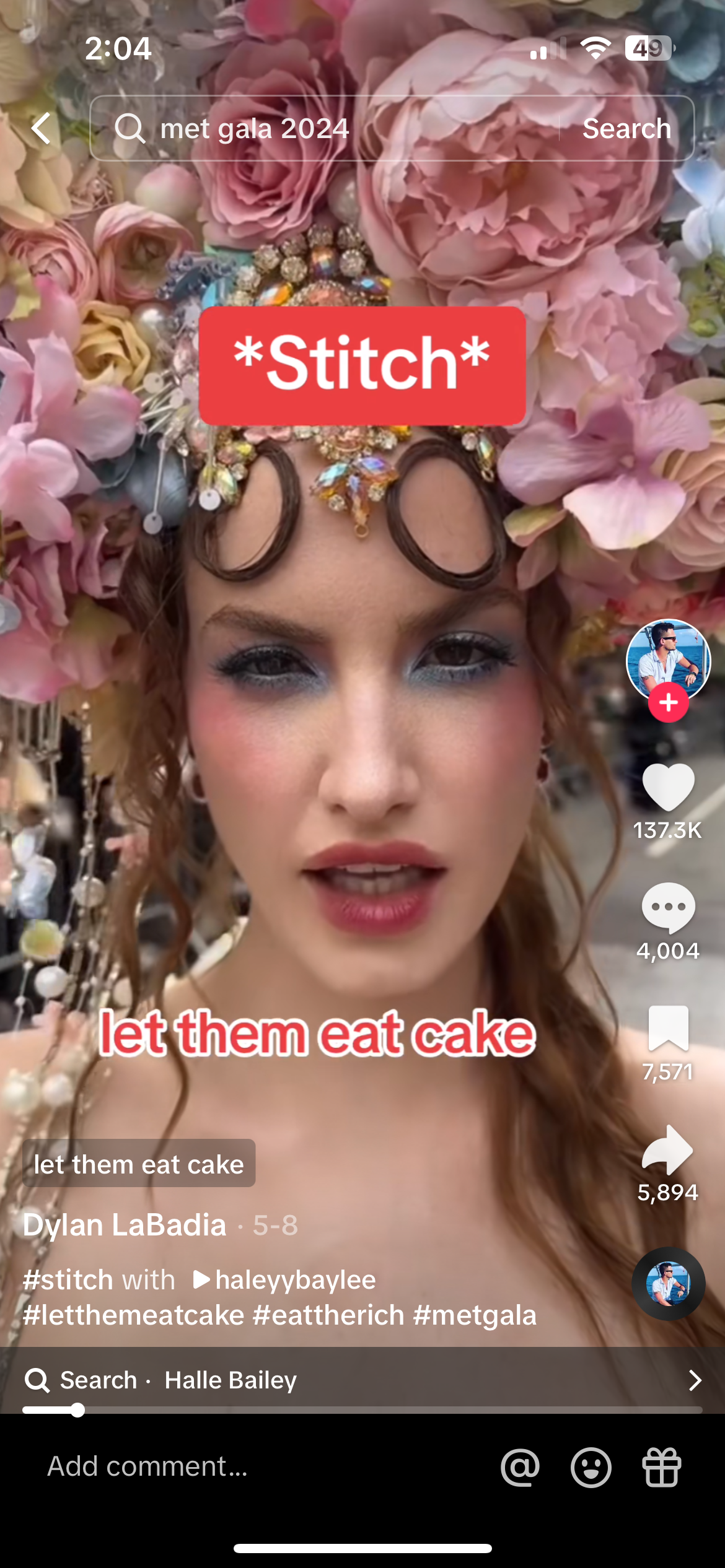
Screenshot of Dylan LaBadia’s repost of Haylee Baylee’s original post

The 2024 ‘Celebrity Blockout’ is a newly formed social media movement that has recently started in the past few weeks to bring awareness about the events that are happening in Palestine, more specifically Gaza. It was mostly formed on TikTok and has now spread to several other social media apps.

The movement initially began when a TikTok influencer and content creator, Haley Kalil, also known as Haylee Baylee, posted a video on her account, featuring her at the Met Gala. In the video, she wears an extravagant outfit with an audio over the video from the 2006 film, ‘Marie Antoinette’, saying “let them eat cake”. The famous sentence was supposedly said by the French queen Marie Antoinette in response when informed of the famines occurring in the country.

The video received severe backlash and angered many people at the lack of awareness about the Israeli-Palestinian conflict and how several celebrities and influencers have remained silent about it or brought awareness about the situation. People on TikTok began posting videos, suggesting that they should begin to block celebrities who have not spoken out about Gaza.

Several popular celebrities have been mass blocked, with some even losing millions of followers. Some of the celebrities that are being blocked include Taylor Swift, Travis Scott, and the Kardashians, with Kim Kardashian having lost about 3 million followers since the Met Gala.

People on TikTok have overall mixed opinions about the Celebrity Blockout, with many standing for it and blocking many celebrities, while others argue that blocking celebrities will not help bring awareness or help the situation in Gaza.

In my personal opinion, I believe that it is extremely important to bring awareness about Gaza or Palestine in general and do as much as we can to help, but I’m uncertain that blocking celebrities is necessarily relevant to helping Gaza.

Positive & negative effects of video game addiction

By: Hyde Moua

Image created with Openart.ai

I think that video games are beneficial and will have a positive effect as long as you don’t play for more than 4 hours every day because I also enjoy playing video games a lot and I think they have clearly helped me in my basic everyday life.

Some positive effects of playing video games are that your memory and learning abilities are enhanced. Your reaction time can also be enhanced if you play video games like first person shooters that are necessary to have faster reaction times to beat the opposing players.

Some more positive effects of playing video games are increased problem solving skills, decision making, and multitasking capabilities. Video games positively affect the brain by boosting cognitive functions which will also improve your hand eye coordination along with your spatial awareness because most games will need you to be aware of your surroundings. In a way, video games can be a workout disguised as fun because video games regularly increase and boost brain connectivity.

Some negative effects of video game addiction are vision problems. The most common type of vision problem is eye strain, which can lead to headaches or poor concentration. Video game addiction can also lead to seizures and psychological problems that will occur over time.

Some more negative effects are when video games are overused as a coping mechanism. This really becomes a problem when video games disrupt your normal and healthy life. Excessive video game addiction can also lead to mental health problems such as depression, social anxiety, and a lack of motivation. Video games will worsen the symptoms of a person who already has depression because excessive gaming removes a person from their real life responsibilities, relationships, and emotions, which can result in feeling numb and socially isolated from your life.

Personally, I think that video games are enjoyable every once in a while because I have gone through some of these symptoms due to excessively playing during the weeks. Overall, I think everyone should play video games, even if it’s just a little bit, because this way you can have the benefits of better problem solving, and decision making during stressful situations, and faster reaction times which could potentially benefit you in work or future situations.

How Uber and Lyft drivers fought to stop their own exploitation

By: Jocelyn Knorr

Image taken from Wikimedia Commons

You’ve probably seen the social media buzz—Uber and Lyft are finally being held to Minnesota’s minimum wage laws. But how did we get here, and why weren’t they held to these laws in the first place? To find the answer, we have to go back to 2013, when the rideshare companies began operating unregulated in the Twin Cities. Minneapolis scrambled to let them operate legally, drafting amendments to the city’s taxi laws to allow them in; at the time pay was less of a priority than regulation of who could become a driver, as the lack of regulation made it attractive to people who would otherwise find it difficult to find jobs, such as those convicted of assault or other violent crimes.

Things moved fairly smoothly for a while—Uber and Lyft became the default way to get around the city without your own automobile, especially after they were allowed to pick people up at MSP airport.

Uber became the biggest startup in the world in 2019, and even COVID couldn’t stop it. When the pandemic impacted employment, more and more people turned to rideshares as a way to make money; they became an important source of income for students, and disabled people who couldn’t work a full day.

Immigrants also use rideshares as a source of income; according to the Minnesota Department of Labor and Industry, 61% of rideshare drivers in Minnesota are foreign-born. Rideshares allow immigrant workers to find work, skipping over the preconceived notions of hiring managers.

However, this is when issues began to arise—or rather, were noticed. Things like sales tax, meant to be borne by riders, began to be skimmed via “administrative fees.” Uber claimed that there was an option for drivers to charge riders for tolls and other fees, but no option for that ever seemed to have existed in the Uber app. While Uber and Lyft claimed that their drivers made above minimum wage, the truth is that it was actually well under.

At the same time, international strikes were staged by drivers, hoping to bring awareness of what companies were doing to them. A new group of Minnesota drivers, the Minnesota Uber/Lyft Drivers Association, spoke to the state’s Democrats in 2022. They pledged to strike a deal with rideshare companies, and began pushing a bill to set a minimum pay floor.

New York state began an inquiry about a year later; they found that rideshare companies had systematically shorted their drivers out of a collective $328 million via the methods outlined. They instituted a pay floor for drivers in accordance with New York minimum wage—Minneapolis did something similar, ensuring drivers a rate of $1.41 per mile.

This enraged Uber and Lyft, who threatened to leave the city of Minneapolis. They did something similar in Austin in 2016, over fingerprint background checks for drivers—the city council had to revoke the ordinance entirely to make the rideshare companies come back.

Meanwhile, in the Minnesota Senate, Omar Fateh (D), who represents District 62, spent most of 2023 pushing for a statewide minimum pay rate. The Democratic party only has a one-vote majority, and Senator Fateh (D) held up proceedings until the bill was passed—Democrats would be forced to either pass the pay minimum, or work with Republicans to get anything done.

The minimum pay bill passed just under the wire on May 18, 2024. It guarantees $1.28 per mile in accordance with both Uber and Lyft and U/LDA; under Minnesota laws, drivers will now make $15.57 per hour. The rideshare companies have since agreed not to pull out.

However, all is not completely sunny. There’s something to be said about the House and Senate going over Minneapolis’ head and acquiescing to large corporations. To quote Minneapolis City Council member Aisha Chughtai (D), “Preemption is bad. Period. Any and all attempts to undermine local control are bad. It’s a Republican and corporate tactic used around the country. Watching our [Governor Walz] cave to multibillion dollar corporations in insisting on preempting Minneapolis is gross.”

The law, too, doesn’t go into effect until January 1, 2025. How many people will be unable to keep their head above water until then? Will Uber and Lyft manage to alter the terms? We just can’t know. For now, we ought to keep these people in mind for the next year; both the rideshare drivers, whose income is still not safe, and the legislators that made this happen—especially in November, when many of them are up for re-election.

OPINION: My definitive Beyoncé album rankings

By: Charlie St. Dennis

As the craze behind Beyoncé’s new release, ‘Cowboy Carter,’ finally dials down, I’ve found myself taking more time to listen to some of her other albums from earlier in her career. In 8 solo studio albums, she has accomplished an admirable feat of having such a versatile discography with no stand-out “duds.” Here is my definitive ranking of each of Beyoncé’s albums, and why:

8. ‘Dangerously in Love’ (2003)

Recorded entirely during the longest and final hiatus of her hit girl-group, Destiny’s Child, Beyoncé recorded this as her first solo album. Though there’s nothing particularly bad about this, it even gave us some hits like “Crazy in Love” and “Naughty Girl,” there’s nothing that particularly stands out about it either. It is home to some of Beyoncé’s weakest tracks, which I won’t hold against her, considering she was very new to her career. My favorites off this album are “Dangerously In Love 2” and “Crazy In Love (feat. Jay Z).”

7. ‘I Am… Sasha Fierce’ (2008)

Perhaps her most commercially successful album, with 9 chart topping singles, ‘I Am…’ is a classic. It also introduces us to Beyoncé’s alter-ego, Sasha Fierce. Fierce is said to only come out on stage, and shows Beyoncé’s more “aggressive and sensual” side. This is a good album, although I like Beyoncé’s more deep work, and we don’t see too much of that on this album (even though it is there, in some parts). While the hits on this album include “Single Ladies (Put A Ring On It),” “Halo,” and “If I Were A Boy,” my personal favorite is “Diva.”

6. ‘BEYONCÉ’ (2013)

This is probably my most controversial ranking here. Many dedicated fans of Beyoncé would place this in what they’d call their “Holy Trinity” of her discography…but not this dedicated Beyoncé fan. While I do enjoy this album, I don’t think it particularly stands out. It does capture Beyoncé in her first state of vulnerability caught on recording! We see this vulnerability on tracks like “Heaven,” “Pretty Hurts,” and my personal favorite, “Blue (feat. Blue Ivy).” We also hear more upbeat tracks, which are good as well, including “Feeling Myself (feat. Nicki Minaj),” “***Flawless (feat. Nicki Minaj),” and “XO”. These are tracks that I generally enjoy, but they don’t do it for me *quite* like some of the upcoming albums.

5. ‘B’Day’ (2006)

I think ‘B’Day’ did a great job at showing us a little taste of all that Beyoncé was capable of. She was fresh out of Hollywood and the award show circuit due to her success as Deena Jones in the movie-musical ‘Dreamgirls’ and she was ready to release music of her own. She uses country and creole influences, and gives us a perfect blend of deep & danceable. My personal favorites from the album are “Listen (from Dreamgirls)” and “Get Me Bodied (Extended Mix).”

4. ‘4’ (2012)

‘4’ is a very interesting album because it is like a roller coaster but without all the bumps. It goes up and down and has its dance songs, motivational songs, and its sad, more depressing songs, but it’s all very intricate and well put together. It’s hard to pick a favorite song, considering I like them all very much. I’d say one of my favorite songs of all time is “I Care,” so that’s definitely my favorite off the album. I also love “Party (feat. Andre 3000),” which delightfully serves as a celebratory song for any and every occasion.

3. ‘Renaissance’ (2022)

Renaissance’ is like nothing else I’d heard before. It is distinct and clear in its intent to educate and to bring up the events of the past. We hear features from previously little known black queer icons such as Big Freedia, Kevin Aviance, Kevin JZ Prodigy, among many others. Not only is it educational and intentional, it’s also just really good music. You get a little neo-soul out of “Plastic Off The Sofa,” you get some classic house from “Break My Soul” and “Pure/Honey,” and of course you get some disco from songs like “Cuff It” and “Summer Renaissance.” I find the album to be quite versatile and cohesive, and that really works well for it. My favorites on the album are “Church Girl” and “Pure/Honey.”

2. ‘Cowboy Carter’ (2024)

If you’ve been reading my pieces in the Plaid Line for awhile now, you now that I really enjoyed ‘Cowboy Carter’. That still remains true! The album is a lovely way of stepping into territory that was new to Beyoncé, but also something she has dipped her toes in before. Songs from ‘Lemonade’ and ‘B’Day’ have foreshadowed Beyoncé’s country feature. Anyways, I really loved this album, and it very quickly moved its way up the ladder in terms of my favorite Beyoncé albums.

My favorites at press time, because they always change, are “Tyrant,” “Sweet * Honey * Buckin’,” and “Daughter.”

1. ‘Lemonade’ (2016)

And lastly, but definitely not least, we have ‘Lemonade’. As you may know, I also really enjoyed ‘Lemonade’. It might just be the perfect album. It tells a story that can be listened to as one, or in individual parts, however you choose. It ranges from sad R&B, to a more upbeat equivalent, and has heavy Caribbean, Creole, and Houstonian influences. I implore you to read my prior review for my depth, but take my word for it when I say I truly love this album. My favorites are “Hold Up,” “All Night,” and “Freedom (feat. Kendrick Lamar).”

This was incredibly hard to write because I love all of these albums so so much, but here was my best shot. So, with that, there is Beyoncé’s studio solo discography. I hope you enjoyed this review, and let me know what you think of Beyoncé’s discography!

Body image and the media

By: Brogan Frey and Abisola Dosunmu

Image created with Wonder

If you’ve been on social media in the last decade, you’d recognize the constant push and pull for our brains attention, interest, and money. For some, it’s blatant, with the ads pulled from what you’ve liked or previously engaged with, on what you’ve shared or reposted. For others, it’s more subtle, with notifications to get the rush of dopamine into our brains, and the constant and never ending stream of content that keeps us on our phones scrolling (and makes what we’re scrolling through more personalized). It’s all led to an almost dystopian reality, a social epidemic of “perfect” faces and bodies beaming up at us through our screens.

The media is constantly impacting our daily lives. Our society greatly relies on the media to get all or most of our information, and that includes teenagers. According to a 2023 survey, 29% of teens get news from social media everyday, with another 23% getting news from YouTube. And while this is understandable, after all, using social media can help relieve the hardships of navigating through several websites and articles to find one source, this can also be quite harmful. The risks of social media are great. While on social media, people can be exposed to harmful or inappropriate content, dangerous people, they can be cyberbullied, they are at risk for identity theft, and that’s just naming a few. But the largest one that affects so many young people, is the interference with sleep, exercise, homework, or family activities.

If you asked a group of teenagers what the ideal body looked like, could you guess what they’d say? The majority of teenagers that we have asked described a very specific body type for men and women. For women, they said that the ideal body type is extremely thin, much like fashion models. For men, they said that the ideal body is tall and slender, but also muscular and toned. These body types are quite hard to acquire, but many will spend their whole lives trying.

When we look at images in magazines, on tv, or on social media, what we’re seeing isn’t real—it’s all edited and airbrushed to look perfect. These “perfect” bodies set up unrealistic expectations for how both men and women should look. As a result, many people end up spending a fortune on products trying to match these impossible standards. Some go to extremes and develop eating disorders or become ill in their pursuit to resemble the models and influencers they see online.

All of this quickly culminates into self esteem issues, anxiety about your appearance, and eventually body dysmorphic disorder, a condition defined by anxiety about how you look and the things you feel are “wrong” with your body.

Now, this frenzy about one’s appearance isn’t only limited to children and young adults. Anyone can experience this, though it may be more acute in anyone under the age of twenty-one due to the time period adolescents spend on social media affecting their still developing brains.

So, how do we stop this? There are countless resources available online and in schools, aiming to help people who idealize these bodies develop a realistic idea of what bodies are really supposed to look like. There are also several self help options that may not completely eradicate the self esteem issues at once, but will definitely help with time.

  1. Take brain breaks – knowing when to take time off of social media is vital to improving your self esteem. Implement that by limiting and scheduling your screen time, and recognizing when to drop the phone.
  2. Find what you like about yourself – find things that don’t necessarily include your looks, (like your personality) and capitalize on them. Focus on what you like about yourself, not what you don’t.
  3. Appreciate what your body can do – things like laughing, dancing, and making yourself and other people happy are things our bodies do everyday that don’t involve feeling conventionally attractive. Instead of looking at what you feel your body can’t do and feeling insecure, research what your body does everyday to keep you alive.

Below are some resources you can use if you need someone to talk to. A counselor is always available in the counselor’s office, in room 1303. If you need more support, here are a few therapists and counselors in the Twin Cities who specialize in body image:

Norris Vorasane – provides therapy to a diverse range of adult clients, including, but not limited to, BIPOC, LGBTQIA2S+, military, students, and immigrants.

Dr. Alina Aloma – she is a bilingual Latina psychologist specializing in multicultural, gender, and LGBTQ affirming care.

Anna Stern – she is more interested in who you are than helping you be normal. Antiracist, affirming, social justice oriented and accountable.

For more information, please visit:

What is Yom HaShoah?

By: Jocelyn Knorr

March of the Living, 2016. Photo taken from Wikimedia Commons

Yom HaShoah is a Jewish religious and secular holiday honoring over six million Jewish people killed in the Holocaust and the Jewish ghetto uprisings in Poland. Created in the 1950s by the Knesset, it falls on the 27th day of Nisan in the Hebrew calendar—in 2024, that was May 6th. Holocaust Remembrance Day in Europe is celebrated on January 27th, the anniversary of the Auschwitz liberation by Soviet troops, but this was thought to be too focused on the accomplishments of other people; the Knesset chose to solemnize a date belonging solely to the Jewish people.

In North America, it is celebrated in several ways; many synagogues run public educational programs and hold talks by survivors, and the Mourner’s Kaddish is always recited, occasionally in addition to other prayers. Typically, the lights are dimmed and each member of the congregation lights a candle ceremonially. The names of the six million victims are sometimes read aloud, emphasizing the scale of the slaughter. The poetry of Holocaust survivors Primo Levi and Paul Celan are read on occasion.

Outside of North America, a march is held yearly at Auschwitz-Birkenau, the largest of the death camps—called the March of the Living, it is testament to the fact that we are still here. In my opinion, this belies a core part of Yom HaShoah that many non-Jewish people may miss when looking in from the outside. Yom HaShoah is celebrated today to force us to recall a tragedy that otherwise may be lost to history. This is history, yes, but it had a massive impact on our world today—in 1933, an estimated 9.5 million Jewish people lived in Europe. Nearly two-thirds of a population was wiped from the face of the earth, two-thirds of a community is missing today. Jewish culture is all about survival in the face of resistance; everyone from the Roman Empire to Nazi Germany has tried to eliminate us, but we have survived. We honor those lost, and turn our faces towards the future; ready to weather whatever comes next.

What’s on your ballot in 2024 and why it’s important

By: Charlie St. Dennis

Photo by Element5 Digital on Pexels.com

If you’ve at all been watching the news over the past few months, you might be aware that there’s a presidential election coming up in November. The two major parties, Democrats and Republicans, have nominated President Joe Biden and former President Donald Trump, respectively. Even though that’s getting a lot of attention, rightfully so, the ballot is going to be full of elections this year. Here is your guide to what you will be voting for.

US Senate

Sen. Amy Klobuchar (DFL) has represented Minnesota in the Senate since 2007, and is expected to be the DFL’s nominee for a third term in the Senate. Currently, 7 Republicans have filed to be on the ballot for the August primary, where they will ultimately decide their nominee. The DFL is expected to endorse Sen. Klobuchar at their State Convention in Duluth later this spring. The MN GOP has declined to endorse thus far.

US Representative

If you live in St. Paul or Minneapolis, you either live in District 4 or District 5. District 4 contains all of Ramsey County and a portion of Washington County. This means it contains all of Saint Paul and its Eastern surrounding suburbs, like Woodbury, Stillwater, West St. Paul, and more. District 4 has been represented by Rep. Betty McCollum (DFL) since 2001, and in her 23 year tenure, she has yet to face a formidable primary challenge. That remains unwavered this year. The DFL is expected to endorse her at the CD4 Convention later this month. May Lor Xiong, an educator, is the Republican poised to win the nomination. She ran in 2022 and lost with roughly 32% of the vote.

If you live in Minneapolis and it’s surrounding suburbs, however, you are likely in CD5. The district has been represented by Rep. Ilhan Omar, who has held the seat since 2019. Rep. Omar is currently facing a formidable primary challenge from Former Councilmember Don Samuels, who resides in North Minneapolis. Samuels has painted himself to be a more “pragmatic” alternative to Omar, who has proven to be one of the most progressive members of Congress. This race will likely be close, but Rep. Omar is expected to secure endorsements of many elected officials and potentially the DFL party, which will be decided on May 11th. Samuels previously ran a well-funded campaign against Omar in 2022, but was defeated in the primary.

State Legislature

This year, every state house seat will be up for election. State house seats are up every two years, and many Twin Cities Metro candidates are not facing formidable primary or general election challengers. The state legislature makes decisions that directly affect you, more so than the federal government. While these races may not seem exciting, they determine your rights.

Ballot Measures

In St. Paul, voters will vote on a childcare ballot measure. Voters would be voting on an increased property tax. The money from the increased tax would fully cover childcare for newborns to 5-year-olds from low-income families who fall 185 percent below the poverty line. That makes up the majority of the children in our city.

School Board (Minneapolis Only)

Since St. Paul voted on 4 school board seats last year, this year we have off. Minneapolis, on the other hand, will be voting for 4 seats. The seats are currently occupied by Kim Ellison, Ira Jourdain, Sharon El-Amin, and Adriana Cerrillo. Cerrillo and Ellison are running for re-election unopposed, Ira Jourdain is stepping down to run for State House, and El-Amin faces a challenger in Janie Gholston. Minneapolis Federation of Teachers President Greta Callahan is running against Lara Bergman for Jourdain’s seat. The Minneapolis DFL will reconvene their convention in May to endorse in that race.

Important Dates

It is important to note that regardless of the endorsement process, the voters will ultimately be selecting each party’s respective nominee. The statewide primary will be Tuesday, August 13th. Those nominees will engage in a 3-month general election campaign cycle, which will come down to Election Day, which is Tuesday, November 5th.

All elections are important, not just the ones getting attention. All 16, 17, and 18 year olds are able to pre register with the Secretary of State’s Office. Once you are 18, you can vote in all of these elections. Check your voter status at: www.mnvotes.org

OPINION: Why Lauryn Hill is one of the greatest musicians of all time, even with just one studio album


By: Charlie St. Dennis

When discussing music, and hip-hop in general, debates frequently occur asking who the best of that genre is. Honorific titles spread like wildfire, like “The King of Pop” Michael Jackson, “Queen of Soul” Aretha Franklin, and “King of Rock” Elvis Presley just to name a few. One title that was “given” a few years back was “Queen of Hip-Hop” which was given to Lauryn Hill. While I think this is a fitting title, I think Lauryn Hill should be in the conversation of larger, more broad titles, perhaps “Queen of Songwriting”.

The problem I run into here when having these conversations is that people frequently bring up the fact that Lauryn Hill has only released one album. They say this in an attempt to contradict me, saying she isn’t even eligible for these conversations. I, however, think that’s just another testament of what makes her great.

With a running time of 77 minutes, Lauryn Hill wrote all but one of the songs on ‘The Miseducation of Lauryn Hill’ single-handedly. The album explores a number of different genres, ranging from neo-soul to traditional R&B to progressive rap. The meanings and intentions behind these songs range, as well. Songs like “Nothing Even Matters” and “Ex-Factor” address love, while songs like “To Zion” and “Every Ghetto, Every City” discuss motherhood and reflection on the life you lived. We’ll dive deeper into that…

The album went on to hit No.1 on the Rap charts, and on the Billboard 200 Top Albums. Hill also won 5 Grammy awards, including Best New Artist and Album of the Year, becoming the second Black woman to receive the album accolade, and she became the first artist to win the Best New Artist award for a hip-hop record.

She is deserving of these accolades. There is a reason why the album has sold over 20 million copies around the world. That reason is because this is music that is not only catchy, but resonates with people, whether they can relate to it or not. She showed us that you can rap and make catchy songs, but also be vulnerable. Because she tackled these topics, she brought a sense of openness and emotion to the rap industry, which allowed for artists to emote on record. At the time, Hill was just trying to figure out her life, she was only 23. 25 years later, these testaments still remain true.

Songs like “To Zion (feat. Carlos Santana)” not only feature a catchy beat and an ear worm of a guitar riff, but it also tackles the topic of Lauryn Hill having to choose between continuing her career or starting a family. She says on the record that everyone told her “to use her head, but instead I chose to use my heart.” She continued her career as she recorded the album, while beginning the early phase of parenting her newborn son, Zion. This put an end to the narrative that women had to “make a choice”: Successful celebrities like Serena Williams and Cardi B have seen successes in continuing their careers while also being a mother, and credited Hill for giving them the hope that they can.

Songs like “Every Ghetto, Every City” serve as funky autobiographies telling us about the little girl that grew up to become *the* Lauryn Hill. Songs like “Everything is Everything” stand out because just about everyone can attach it to their life, because we can all understand the philosophy that life moves slow but change does come, which Lauryn references in the song when she says, “after winter must come spring.” She also references civil rights leaders like Betty Shabazz, and makes deep connections to the Civil Rights movement, just adding to the deep hidden meaning behind the song. Interestingly enough, now-EGOT winner John Legend started his career playing piano on this track!

Moral of the story, I love Lauryn Hill. I believe that there is more to a song than what you hear upon first listen, and I think this album is a good testament to that. When speaking about my love of Ms. Hill, people often bring up the fact that she’s only released one album and ask me if I want another one from her.

My answer? No. In just 16 songs, Ms. Hill perfectly sums up life. Her life, my life, and our life collectively as a society. The album is perfect, and even though Ms. Hill may not be (she has had her share of controversy and financial issues over the years), she has achieved with one album what many artists fail to do with ten: perfection. This is the perfect legacy to leave behind.

Your favorite artist wouldn’t be in the game today if it weren’t for Ms. Lauryn Hill. And that’s why she is the greatest of all time.

The pink tax: Yet another case of everyday sexism

By: Lila Dingmann, Serafina Zambreno, and Erin Moore

Over one lifetime, the gender wage gap adds up to $500,000. If women were paid as much as men, the female poverty rate would be cut in half. There is a 44% income gap between senior men and women. However, the wage gap is still denied by a large portion of the world.

Women experience sexism in a variety of forms in their daily lives, yet because they don’t see, understand, or relate to it, many men deny its presence. The gender wage gap is believed to be made up by roughly 50% of men according to an online poll of nearly nine thousand people.

However, it is undeniably true that women make $0.82 for every $1 a man makes and women of color only make $0.79 on that same dollar. This already sets women at a financial disadvantage, but on top of that is something even lesser known than the gender wage gap: the pink tax.

The average price on feminine products is higher in comparison to their masculine counterparts. This includes the unnecessarily expensive prices on period products, birth control, feminine hygiene products, and most items targeted toward women. Products are indirectly made for women when they are decorated with glitter, pastels, flowers, or the color pink–hence the name, “the pink tax.”

In 2010, consumer reports showed that women may pay up to 50% more than men for identical products. Women pay $1,351 more per year because of pricing, which becomes around $2,300 when adjusted for modern inflation, according to a California study in 1994. A study by the New York Department of Consumer Affairs in 2015 found that women’s products had a higher price tag 42% of the time, over double the 18% of the time that men’s products were more expensive.

Companies try to explain this increase away by the fact that women’s products are more expensive to manufacture, however, in many cases, the only difference is the item’s color.

Feminine products are priced 7% higher on average than their masculine equivalents (the smallest difference being 4% found between children’s clothing and the largest being 13% found between hygiene products). Examples of this include the following: BIC “for her” pens were double the price of a gender-neutral pack of pens, a pink wireless mouse was 39% more expensive than an identical blue mouse, a women’s pack of razors was 51% more expensive than the same men’s pack of razors, and a feminine train set costed 11% more.

Services, such as haircuts and dry cleaning also show very similar results: unequal prices.

In addition to being paid less than men, women also must spend more for the same products. This is only a small portion of the daily effects that sexist ideologies have on our everyday lives.

Some companies have recently begun making efforts to end the pink tax, which proves with enough unity and work, we can make a difference. CVS, as of February 2023, reduced the price on period products and decided to cover the sales tax for feminine products in twelve states.

This article was written to spread awareness about the pink tax, as it’s a very prominent financial issue for women, but not enough people know it exists. To combat the pink tax, you can purchase the cheapest versions of feminine products, buy masculine products instead, or speak up when you notice gender-based pricing in a store to leaders and other people in power.

For more information, please visit: