Category Archives: Editorials/Student Voice

Editor’s Note: The Plaid Line publishes editorials that contain opinions that are those of the student authors. They do not purport to reflect the opinions or views of the the Plaid Line, HPSH, or its staff.

Minnesota phone ban

By: Alayanna Bouwens

I’m sure we are all aware of the Minnesota state wide, and school wide ban on phones; but what is that ban really about and how does it affect our learning? The ban states that in elementary and middle schools phones will be completely banned from the time school starts to the time school ends, while in high schools the ban aims to limit students time on their phone during class by banning the phones in classrooms but allowing students to use their phones during passing times and lunches. The ban, and specific rules, vary school to school. Here at the Highland High School, phones are banned only in class while for the Highland Park Middle schoolers, phones are banned from 8:30-3.

One of the big things today’s teens battle is phone addiction. Whether it’s pulling out your phone during an awkward situation or reaching for it when you’re bored, nearly every student today struggles with some sort of screen addiction. The phone ban is designed to help students learn how to be without their phones, or other screens, during the school day. This also encourages more genuine face-to-face interactions and helps cut out unnecessary distractions from learning, schoolwork, etc.

The Minnesota phone bans purpose is to help students stay focused by limiting screen time during school hours. Screen addiction is a very common struggle among kids today and the phone ban was created to help break those addictions down. The rules change school to school but the goal is always similar; to reduce phone use so students can be more present in class while promoting face-to-face interactions. The ban encourages better habits, fewer distractions, and more real-life social interaction throughout the day.

For more information, please visit:

Montessori to high school      

By: Charlotte Aver

Photo by Kaique Rocha on Pexels.com

Last year I was in a Montessori public middle school, making it my 9th year in a Montessori school. I had 4 teachers and their names were Christine, Kyle, Brooke, and Amy; they had told us to call them by their first names. This year I have had teachers tell me that under no circumstances am I or any other student to call them by their first name. This amongst many other things is something that has been a culture shock to me coming from a Montessori school.

One of the most different things is how our day is structured. At my Montessori school we would have meetings in the morning and midday, in between we would have lessons and a work time to finish all of our work. In the afternoon we would have occupations which are essentially the same as electives. Something that made this conventionally odd schedule possible was that my graduating class of 8th graders was only 16 people and we had all known each other since 3rd grade. Here in high school there are bells separating the day, and A days and B days. We also have upwards of 200 people in one grade.

The classroom at my Montessori school was much smaller than anything at this school. We had three connected rooms, and a modular, and that was our whole middle school. We only had enough chairs and tables for half the middle school class to sit at once which meant that we would sit on the floor for the majority of the time. This obviously is not true for high school, and I am incredibly thankful for being able to sit at tables and chairs.

In our classroom we also only had four iPads and a Mac book, this made it excessively hard for us to do some of the work that was assigned to us. In high school, every student has their own iPad.

We also ran a farm stand and had our own farm at my old school. We would work throughout the year to make our own money as a class. At the end of the year we would use the money we made to go on a trip at the end of the year.

The transition was quite jarring but I feel as though I have adjusted quickly. Almost everything is different from Montessori to public High school except for the essential idea that you are learning. There are pros and cons to each way of learning: not enough students, too many students, no technology, too much technology. Which ever way you were taught it all evens out in the end.

Nationwide walkout

By: Siri David

Photo taken by: Josie Hodson

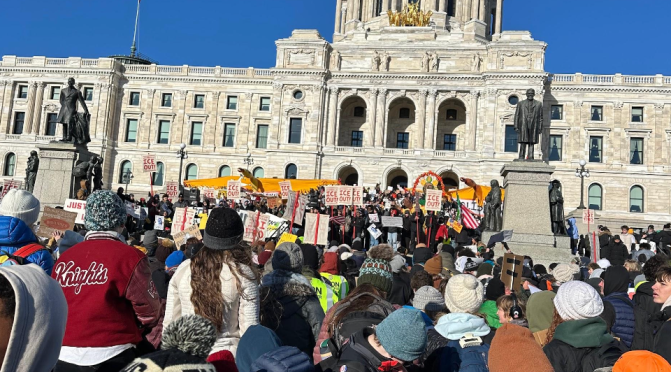
On July 27th, at Annunciation school, Minneapolis Catholic school students were sitting in the pews of church during mass. Sitting outside of the windows was 23-year-old Robin Westman. Once mass started Robin shot through the window. Robin killed 2 kids and injured 19 other people. Robin shot a total of 116 rifle rounds. After Robin did this he then shot himself. Robin had attended Annunciation and was always known to be quiet and reserved to most people; it seemed he didn’t like school.

This shooting was heart breaking. Over the past decade school shootings have become a lot more common. They are the leading causes of death right now for teenagers and children. In 2025 there were a total of 90 incidents of gunfire on school campuses. It has become a nationwide issue that our schools need to be better protected and that kids should feel safe within their place of learning.

The shooting at Annunciation helped start the idea of doing a nationwide walk out. This walk out was put together by an organization called Students Demand Action. The organization used social media platforms to spread the event. Most schools had a club within their school that organized everything for them. Highland had our school’s Good Club organize the event. This club is led by three members who brought together Highland students by posting all over their social media.

The walk out lasted around an hour and a half. We met up with students from two other private schools (CDH and SPA). There were over 100 kids who were participating from Highland.

The whole goal of this walk out was to raise more awareness to the fact that students don’t feel safe in schools, and that gun violence is affecting our day to day life and whether students feel safe in school or not.

September is suicide awareness month. Why is it essential for you to know about suicide?

By: RJ Johnson

September is suicide awareness month. Why is it essential for you to know about suicide prevention month? Because it helps raise awareness about an issue that is very much preventable, and it teaches you to look out for this specific behavior.

Forty-nine thousand three hundred sixteen people committed suicide in 2023, and 9% of high school students have reported attempts this year; that’s just what’s been reported. Many people don’t share their attempts or mention them at all. Overall, suicide is the eleventh leading cause of death, but it is the fourth leading cause of death for ages 35 to 44 and the second leading cause for ages 10 to 34. Think about that for a second. The second leading cause of death in teens and young adults is PREVENTABLE.

You’re probably asking yourself, “Well, what can I do to help prevent it?” If you have family or other loved ones who are showing signs or symptoms, check in on them! Ask them genuinely if they’ve thought about committing suicide. While it might not be an easy question to ask, it’s essential.

Now, “What are some signs that someone might be thinking about suicide?” Great question. Some of the more significant signs include withdrawing from friends, saying goodbye, and giving away essential personal items. But that’s just some of the big ones. If they stop doing an activity you know they love, you should check in on them.

Studies show that most people who attempt to commit suicide, or do so, tell someone beforehand, whether it’s directly or indirectly. Even if they tell you not to tell anyone, it’s crucial to tell a trusted adult or someone who can help. Even if it’s not a close friend, but you’re worried about them, report it and they’ll make sure they’re okay.

Suicide is a significant problem that is preventable. One way to help prevent suicide is by checking in on loved ones when they show signs and telling a trusted adult who can help. You might save someone’s life.

For more information, please visit:

The ‘Barbie’ movie

By Kate Tabor

Image created with Chat GPT

The ‘Barbie’ movie, directed by Greta Gerwig, is surrounded by a lot of controversy. For some reason, the exact point the movie was trying to make, went over so many people’s heads.

The movie itself is about the female experience, to put it simply. The societal expectations, the unfair standards women are held to, and the hardships that we as women all face and are not given enough credit for.

Most of the criticism about this woman is centered around the idea that Barbie is a doll with big boobs, and that’s it. She’s something to look at, something for young girls to be inspired by. What’s funny about that idea is the fact that when young girls actually are inspired by Barbie, or any other female icon, they’re criticized for it and beaten down.

What Greta Gerwig has done with the ‘Barbie Movie’ has made so many women and girls feel seen. She actually took Barbie, the women that so many women and young girls look up to, and had her experience what real women and girls experience. She captured exactly what it feels like to be a woman.

Not only that, but she turned it around in order for Barbie, what a lot see as just a pretty doll, and had her be inspired by a real human woman. What I’m trying to get across here, is that no matter who you are, as a woman in this society, you’re going to feel put down by society and its expectations of you. You could be the most beautiful and biggest female icon in the world, and still feel like you’re not enough.

This, of course, is not the only point that stands out in the movie, and most certainly is not the main point Greta was trying to get at, but it’s a very good one.

 No matter how beautiful and great and special you are as a woman, which every woman is, there are always men, and sometimes women, who will try to tear you down. All you need to remember is that every single woman feels the exact same way as you.

A pope for the ages

By: Maya Vossen-Nelson

As the world celebrates the selection of its 267th Roman Catholic Pope, it is also important to reflect on the influential life of Pope Leo XIV’s predecessor: Pope Francis.

Pope Francis was elected as pope in March 2013 and soon became known as a reform-minded leader of the Catholic Church. His time as pope was dominated by “firsts”. Pope Francis was the first pope to address the United States Congress and the first pope to visit the Arabian Peninsula. In December 2023, Pope Francis approved the blessing of same-sex couples for the first time in Catholic Church history.

Pope Francis dedicated himself to a life of compassion and humility that emanated through his first and final acts as pontiff. In Pope Francis’ first papal trip he visited Lampedusa, a Mediterranean gateway to Europe for asylum seekers. Through his visit he effectively drew attention to the refugee and immigrant humanitarian crisis that so much of the world was ignoring and set the tone for his continued leadership in immigration reforms during his papacy.

Pope Francis issued Laidao si’ “Praise Be to You”, an influential document addressing the climate crisis, denouncing wasteful consumption and endorsing the rights of Indigenous people.

In a historic act, Pope Francis made public apologies to sexual abuse survivors that were victimized by the Catholic Church and its long history of coverups.

Pope Francis served as pope during many 21st century global tragedies which made his moral guidance and judgement even more influential. During a time when Catholicism had been weaponized to justify political agendas, Pope Francis prioritized his service to the Catholic God and made bible interpretations without outside influence.

While remembering any significant figure in history it is fundamental to recognize the whole person and not present them in only a positive or negative light. In this spirit, it is important to recognize Pope Francis’ shortcomings as a pope including his denial and delayed response to sexual abuse cases within the church.

Kith and Kin Chorus

By: Maggie Hong

Kith and Kin Chorus is a Twin Cities-based group of singers, ranging all abilities and experience levels. Kith and Kin aims to be an inclusive, welcoming arts community, especially for those who have been marginalized and excluded from such spaces in the past. Each year, the chorus hosts open sings, concerts, and fundraisers for local organizations.

Kith and Kin was founded in 2017 by Rachel Ries, a Minneapolis-based musician and songwriter. Seeking a sense of community and a way to take action through music, Rachel founded Kith and Kin Chorus, named for the ever-important ideas of friends and family. Now, over 70 singers join her to spread joy and good throughout the Twin Cities. No audition is necessary, and no experience with sheet music or theory is needed to join. The chorus sings a wide range of material, from pop and rock to folk and indie, and often collaborates with local artists. Each season concludes with a concert benefiting a local justice organization.

Music has a unique ability to connect people across culture, race, and language. It speaks to the soul, rather than a political identity or persona. It asks nothing more than an open ear. K+K embodies these musical values, lifting its voice to make our cities safer and healthier for everyone.

Most recently, K+K has closed their 8th season with a concert benefiting Rock the Rez MN. Past organizations have included: Open Arms of MN, Raíces Sagradas, and CAPI USA. Season 9 will begin in fall of 2025, meeting Monday evenings in Minneapolis. Joining is a great way to get involved with your community, meet new people, and make a difference for our cities.

For more information, please visit:

Separating art from artist: When do we cross the line?

By: Hermekay Dehaney

American rapper Kanye West and socialite Kim Kardashian pose together at the red carpet of the Met Gala in 2019 by: Cosmopolitan UK via Wikimedia Commons

Separating art from the artist has become a controversial and recurrent topic over the past decade; its main belief is focusing on the work itself of that artist rather than the artist’s reputation and controversies at hand. Usually, when this topic gets brought up, it surrounds a celebrity getting “canceled” over various allegations and actions, which sometimes include severe repercussions such as criminal offenses.

These fallouts usually lead to a moral dilemma of people asking, “When should we separate, or is it okay to separate art from the artist?”

I believe that when the topic around a celebrity is about separating them from their art, then you know what they did was bad. Consider R. Kelly, a famous R&B singer whose crimes landed him in jail for 30 years, with the help of the documentary ‘Surviving R. Kelly’. Despite his sentencing, his music was still played on social media, at parties, and even sometimes at weddings. I would say nowadays people are starting to distance themselves from him, but there are a few outliers.

On the other hand, Kanye West is more of a complex case. He is considered one of the top artists of this generation with multiple platinum albums including, ‘The College Dropout’. and ‘Graduation’. In recent years, his crazy erratic behavior in public and online, especially his antisemitic views, have landed him in this topic.

Although people online do blame his mental health issues which potentially contributing to his sometimes outlandish behavior, there are others that don’t see his mental health as being the sole reason for his behavior. As someone once put it, “That’s an explanation, not an excuse“. So, even though I do believe it’s a factor, that doesn’t fully explain his weird behavior.

People have tried to draw a line on what is acceptable and unacceptable, but it’s not that easy. When someone as influential as Kanye uses their platform to spew hate and misinformation, especially to his impressionable younger fan base, that becomes dangerous.

The art that the artist puts out is sometimes a reflection of themselves. Their beliefs and values are sometimes mentioned in the lyrics, making it impossible to separate the two. Continuing to support such artists, even if you don’t agree with their actions, is still indirectly supporting them. They’re still making money from streams and maintaining cultural relevance despite their actions.

This topic is very subjective of when the line is crossed which leaves a gray area. Obviously, humans are not perfect, so when the opinion of canceling every artist who missteps comes about, that’s unreasonable. Some artists have committed serious and harmful acts that impact others while some have made non serious controversies. What one person sees as totally “cancellable”  others may not.

I saw a comment which stated, “Art is based on context. I don’t think the artist needs to be a moral example to appreciate their work. But as always, we have to remain conscious and educated. We can pretend art lives separate from reality,” and to add onto that, this topic is not very limited, it’s not a one-size-fits-all discussion, but the truth is that It gets to a point where if you’re asking the question, the answer is most likely no. 

Environmental Racism in Minnesota 

By: Alice Rapacz & Cameron Garcia-Nelson

Image created with Canva

Environmental racism is a big problem in Minnesota. Environmental racism is when neighborhoods of color and indigenous neighborhoods are at a higher risk to environmental harm. These neighborhoods are at a 91% risk of above air pollution guidelines. There are many neighborhoods here in Minnesota that are affected like the Rondo neighborhood and the East Phillips neighborhood. The harmful pollution can come from factories, waste facilities, construction, and vehicles. White neighborhoods have much better health compared to neighborhoods of color and indigenous neighborhoods. The pollution causes people to have asthma-like symptoms and heart disease. Nitrogen dioxide is what pollutes the air and causes people to have these symptoms.

For my final capstone project in my Critical Ethnic Studies class, my partner and I decided to do our project on environmental racism because it is a very real and current issue that affects people all over Minnesota. For the project it contained our final product, a paper, and an evaluation of what we learned from our project and the class.

For our final project, we decided to do a website that would be able to inform Highland Park students, staff, and community about environmental racism. We did a lot of research learning about what environmental racism is, who is affected by it, how, and so much more. We read stories from people who suffered from the harmful pollutants in the air and how their health was at risk due to it. We learned about different forms of pollution and what areas they affect. We put all this information on our website so that people reading it would be informed. 

Here is the link to our final capstone website. There is some of the information above and so much more so that you can be educated on about environmental racism. We also included how you can help and make an impact on changing this issue. 

The importance of Greta Gerwig’s ‘Little Women’

By: Kate Tabor

Image created with ChatGPT

The movie ‘Little Women’ by Greta Gerwig has been my favorite movie since it came out in 2019. At the time, I would’ve been 11. I’m not sure exactly what it was that made me originally fall in love with the film, but I do know why I continue to love it.

I’m not really sure how many times I’ve seen the movie, but enough times to be able to recite almost every scene. In case you aren’t familiar with the story of ‘Little Women’ The story follows four sisters in the years after the Civil War, and goes back and forth between them then, and their childhood.

In a way, I believe the story encapsulates the spectrum of what it means to be a woman. Each sister has their own passions, and their own way of going about them.

Jo, the “main character” has dreams of being a writer in New York, and hates everything “feminine.”  She goes about the notion that women don’t need a man, or love, in order to be fulfilled, and she claims she doesn’t want love. She goes on to marry Professor Friedrich Bhaer, who she met and has grown close with in New York. The reason I find this very interesting isn’t because I think what she believes is any less true, or takes away from her point, but rather it amplifies it. It shows that yes, women are their own people, with their own dreams and passions and brains, which Jo argues herself in the movie, but yet you can still yearn for love while being all that and more.

Oftentimes, without even meaning to, women and girls give up pieces of themselves for the men that they love, or the men who claim to love them, and though we live in our modern society, this still happens, though in smaller and unnoticed ways.

However, this all begs the question, is it wrong for women to yearn for traditional love? Of course not. Meg, the eldest sister, had a dream to marry a wealthy man and to live a life of comfort. She wanted to be a mother, and a wife, by the standards of back then. She wanted to embody that traditional mold of a woman. I find there’s nothing wrong with that, and it even strengthens Jo’s original point, too. At the end of the day, a woman should be able to choose her passion, whatever that may be.

Amy, the youngest sister, and my favorite, has dreams of being a successful painter. She’s oftentimes underlooked. She strives for greatness, and won’t settle for average. Maybe she’s my favorite becaus she reminds me the most of me, but I think it’s also because she has big dreams, and isnt afraid to chase them. She knows what she wants, and won’t settle for less, and I really admire that about her. Especially for those times, it wasnt common for women to be supported in pursuing their own passion in a work environment.

I could say much more about this movie, and go into even greater depth, but to summarize this all, Greta Gerwig showed the side of women that often gets overlooked, especially in the media. She shows the real side, a side that doesn’t revolve around men, but doesn’t neglect the idea of love. So, if you haven’t before, go watch her version of ‘Little Women’.