All posts by HPSH Plaid Line

UEFA Champion’s League group stage review (so far)

By: Dylan Moore

Group A: Looking at the standings in this group, you would be initially surprised. But anyone who has watched this group knows Napoli’s undefeated record is no fluke. After a 3-0 thrashing of Liverpool, Napoli showed their true intent in this group stage. The Italian team has taken Europe by storm, along with their new star Georgian player, Khvicha Kvaratskhelia. 

As for the rest of the group, things are going as expected. Aside from the previously mentioned loss to Napoli, Liverpool has dominated the ties as expected. Meanwhile, Ajax and Rangers have scrambled for the leftover points, Ajax obtaining the lone win in a 4-0 destruction on Rangers. 

Group A standings pictured above 

Group B: On the note of surprising group standings, here we have group B. Perennial bottom 3rd & 4th place CL group finishers Club Brugge have put in a great shift this UCL season, topping their group with 10 points. 

To the surprise of many, it’s Porto and not Atletico Madrid that are in second place. Not surprising to anyone, is Leverkusen’s last place standing, given their poor form all season. New manager Xabi Alonso hopes to change the seemingly doomed fate of the German side. As things stand, second place is anyone’s game.

Group B standings pictured above

Group C:  This year’s group of death has been fascinating yet unsurprising, as these groups always seem to be. The ever unfortunate Viktoria Plzen is yet to even get a point, as European juggernauts Bayern Munchen are yet to drop any. 

The only surprising result thus far is Barcelona’s underperformance. They have been unable to get a win against Inter, regardless of their impressive additions in the recent transfer window. Inter looks to hang on to the 2nd spot as Barcelona faces the daunting task of playing Bayern yet again. 

Group C standings above 

Group D: This group has been in utter chaos. With the amount of games left, any team could end up in any position. Aside from Tottenham coming out to lead the group after a rocky start, there are yet to be many storylines besides the even-matched teams thus far.

Group D standings above

Group E: On the note of close groups, we have group E. The 2020 champions sit atop the group with 7 points, but RB Salzburg are very close behind. This is yet another group where any team could finish anywhere. This is surprising, considering the reputation of both Salzburg and Zagreb to finish in the lower 2 spots of the group regularly. 

Group E standings above

Group F: The last UCL group is seemingly set up for reigning champions Real Madrid to easily qualify for the round of 16. Whether or not you believe this, they are certainly taking advantage of their easier group. Although this group is rather bland, Real Madrid and Shakhtar Donetsk had an electric game this last matchday, with a bloodied-up Antonio Rudiger scoring a last minute header. 

Group F standings pictured above 

Group G: The story from this group has been Erling Haaland playing his old team. His wonder goal against Borussia Dortmund has propelled City to a much-expected first place in the group. Rounding out this rather uneven group is Sevilla and Copenhagen, who have both underwhelmed as expected. 

Group G standings above

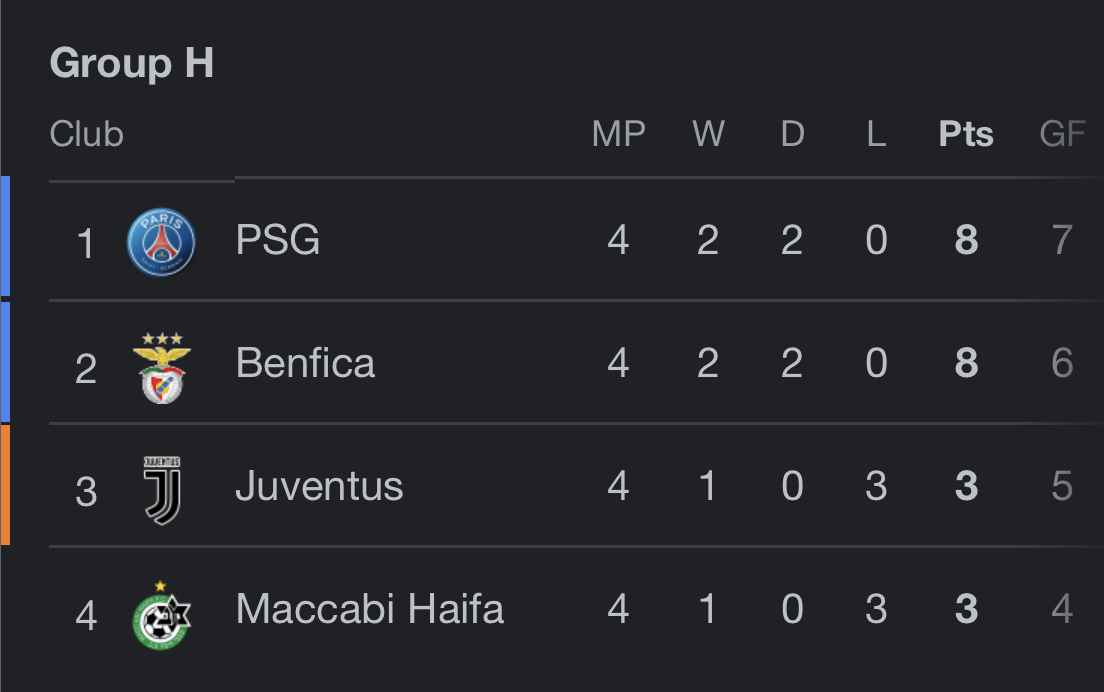
Group H: This group raises many eyebrows. Initially, you are attracted to fallen giant Juventus with a measly 3 points sitting in 3rd. But the team that really deserves credit is Maccabi Haifa. The Israeli team managed to win 2-0 against Juventus in the most recent match.

All this being said, all credit to Benefica, who have really made this group competitive, due to powerhouse PSG’s mediocre performance.

Group H standings above

In the vast majority groups, plenty is still at stake in these last 2 match weeks. Lots to look forward to as a fan of the game, with many surprise teams popping up to take advantage of their group, and many teams looking to surprise us still. Expect an article reviewing the group stage in the weeks to come.  

All images taken from:

Differences between college and high school

By: Addison Strack

The transition from high school to college is a big one, and there are some major differences between the two that will be talked about in this article.

One of the first major differences between high school and college is that throughout high school, you rely on your counselors and teachers to organize your schedule.

Once you get to college though, you will have to create your own schedule. You will have to arrange your classes to fit your agenda, and organize your schedule according to other things going on in your life.

Another difference between high school and college is the amount of time you spend in classes. In high school you will have back to back classes for around six hours a day, Monday through Friday.

Once you get to college you’ll only spend around twelve to sixteen hours in class each week, and usually you’ll have breaks in between classes. Some days you may only have one class, depending on how you create your schedule.

The workload and testing in college is also a lot different than in high school. In high school, your teachers will assign you homework, and remind you of when the homework is due. There will usually be tests that cover smaller amounts of material, where you will have to recall and understand information that you have been taught. If you are absent during a test, there are usually make-up tests available as well.

In college, you may not be assigned homework, but you will have a substantial amount of notes and studying to do outside of class. You will have to use what you have learned in your lessons, and apply it to different situations on the tests, which will usually cover larger amounts of materials. Since these tests cover larger amounts of material, they will be more infrequent. There usually aren’t make-up tests either.

One final major difference between college and high school is the financial part of it. You can go to high school for free, and most of the textbooks you need will be provided for you by the school.

Once you get to college, if you live on campus, you will have to pay for housing and dining, and you will also have to buy your own textbooks. Some colleges require computers as well.

The bottom line is that once you get to college, you will have a lot more freedom, but with that freedom comes more responsibilities. You will have to learn how to manage your time and money, and how to stay organized, all while balancing your school and social life.

If you would like to read more about the differences between high school and college, please use the links below:

Musket game review from the student section

By: Ayamei Her

Image taken from: hpsh_football

During the first quarter the Highland Scots weren’t doing too good, the Central Minutemen were up 7 and the Scots were at 0 points.  A lot of the students had hoped that the Scots would soon catch up and win the musket this year, and the Highland student section never failed to cheer on the football team and keep things lively and exciting to keep up the hope that we would catch up to the Minutemen. 

Image taken from: hpsh_football

When the second quarter started, the Scots were still down points and some of the students were losing hope in our team and hoping that the Scots would be able to bounce back and keep our musket.

Halftime came along and students were talking about how they did not know if the football team will be able to keep up with the Minutemen, but the student section didn’t give up on cheering for our team to give them the extra motivation to keep going and win the game.

After halftime, and at the start of 3rd quarter, the Scots were bouncing back and starting to score points, and eventually they started to catch up to the Minutemen.

Halfway through the 3rd quarter, the Scots and the Minutemen were close putting 14-7 on the board. 

Image taken from: hpsh_football

As the student section was cheering the team on, the Scots were doing better and better as the clock was ticking during the fourth quarter. At this point, we were now 17-14 giving us a leg up and giving our students more excitement, and a heavy rush of thrill and adrenaline, hoping that we could keep our score and win this big game.

At the end of the game, when the winning point was scored, the student section was proud with joy and excitement for this is the 4th year in a row that the Highland Scots won the musket game!

Review/summary of ‘Living Dead Girl’

By: Stephanie Caballero

Warning: Before reading please note that this book involves topics such as sexual assault, pedophelia, eating disorders, and abuse. Only eating disorders and abuse are discussed in this review

This review/summary includes spoilers.

‘Living Dead Girl’ by Elizabeth Scott is a young adult novel. We follow the story of Kyla, known as Alice, through the book. Alice is 15 and currently living with her abductor. Alice was taken at the age of 10 by Ray. Ever since that day, she has had to forget her entire life before Ray.

During her time with Ray Alice has to endure many types of abuse. To keep the appearance that Ray likes she has to maintain a frail body and less than 90 pounds.  Alice struggles to keep that weight as she is a growing 15-year-old.  When she is able to go out she sneaks food that ends up being thrown up.

Alice’s appearance matters a lot as it’s what keeps her from being punished or killed by Ray. She is to maintain a child’s body, shave every hair that grows on her body, and stay feminine. The punishments she received for not being to his liking were things such as standing for days or being starved.

Alice (Kyla) is not the first Alice; Ray has abducted many other kids/teens before her who he also named Alice. Most Alice’s end up dead after the age of 15-16 then he gets a new Alice. 

Although Alice is given much freedom and opportunity to escape, one thing keeps her from not doing so, is her family. From the moment when she was kidnapped to now, Ray has always had power over her by telling her that if she escapes he will kill her entire family.

Alice is given false hope by Ray by saying that he has never had a favorite Alice but her. He tells her that soon he will get a new Alice which makes Alice (Kyla) happy even if it means she will die. As the time approaches for a new Alice, Alice begins to grow excited, she is happy that he will capture a new girl and that she won’t have to play into Ray’s fantasy anymore. She says to Ray that she will find him a new Alice and will shape the future Alice to be as perfect as she is. 

Alice finds a little girl who she thinks will be perfect to play into Ray’s fantasy. She begins to hang out with her at the park every day more and more to try to get closer to her. When Kyla and Ray are about to capture her, Kyla begins to remember everything she went through which causes her to not want to give the little girl up.

In the end, Kyla ends up stopping Ray, leading to both his and her death. Kyla is at peace with herself in her final moments, not regretting her decisions and finally going against Ray.

I enjoyed this book and would recommend it to people who enjoy reading graphic things and about crime. Once again, please note that this book does involve topics such as sexual assault, pedophelia, eating disorders, and abuse. This book is a tough one to read, but definitely worth it.

Overall, I would give it a 8/10 as I liked how at the end Alice accepted that what she went through was difficult and that she didn’t need to put someone else through it. I would have given it a 10/10 if we had gotten more background about Ray and his past victims. 

‘Prey’

By Leticia Bugg Sam

About ‘Prey’ the movie:

‘Prey’ is about a girl named Naru and she’s a skilled warrior of the Comanche Nation.
She fights and protects her tribe against the most highly-evolved predators on earth.

Naru has a brother named Taabe and a mother named Aruka. Naru was invested into finding out who was the Predator ever since she was a little girl. She’s been keeping track of the Predator when it comes to earth and when it leaves, and what it does while it’s here.

She liked hunting but the more she liked hunting the more she wanted to hunt down the Predator. Everyone in her tribe doesn’t think that she can be a good hunter or can hunt at all.

One day when she was old enough, she decided to hunt the Predator but before that she had some practice and the taste of revenge before hunting it.

Characters:

Naru: Naru is a girl who’s a skilled warrior of the Comanche Nation. Her father died to protect his family when she was young in the movie and we never got to meet her father, or ever hear his name. His death was important because she wants to take revenge for his death.

Predator: The Predator is a creature that the tribes call the Predator. The Predator kills and takes out anything that gets in its way. The Predator is like half creature and half robot. He/she can go invisible so that people can’t see him/her. It’s weakness is when he/she doesn’t have its mask on it can’t really see or do anything without it.

Brother of Naru, Taabe: Taabe is a warrior of the Comanche Nation which means that he protects and hunts for his family. Though he was supportive of his sister, he didn’t really believe her when she talked about the Predator.

Naru’s mother Aruka: The mom is a woman who stays home and takes care of her family. She is also a woman that helps the tribe and makes medicine. She taught her daughter how to use medicine that she later uses in her fight against the Predator.

I would give this movie a 9/10. You can watch it on Hulu.

Fall coffee review

By: Alexa Ramirez

Fall has quickly taken over, leaving a variety of red, orange and yellow leaves, crisp cool air, and has the world pulling out their coziest sweaters and curling up with an endless amount of blankets. And out of all of these fall things, the pumpkin flavor beats them all. So in honor of fall, I’m going to be going to different coffee shops in Saint Paul in search of the perfect pumpkin drink to enjoy this fall.

I chose to go to Nina’s, a small business just outside of downtown St. Paul, but also to buy from two chain shops. Starbucks, a national and very attainable one, and Caribou, one that’s unique to the Midwest and is very common in MN. This system allows for a small business to be represented, but also for people to be able to go out and get the drinks they’re reading about, as some shops are more attainable and common than others.

The first place I went to was Nina’s. It’s located in St. Paul on 165 Western Ave. When I first walked in I noticed a calm, productive environment of people working, studying, and discussing; the perfect coffee shop feel. I ordered the Iced Pumpkin Chai (in a small size) which was written down as one of their specials. I really enjoyed this drink. It had a nice ratio of pumpkin and chai flavor and was also sprinkled with cinnamon which really tied it together. It cost me $6.09 which I thought was slightly overpriced, but definitely not because of the quality of the drink, just because of the quantity that was given to me since the size was small. It paired really nicely with the vanilla frosted donut and made for a nice fall treat. I would definitely order it again and maybe try it hot instead of iced. I rate this drink a 5/5 and would definitely recommend it!

The next place I went to was the Caribou inside of the Lunds and Byerlys in the Highland Village. The coffee shop itself was really pretty and was nice to spend time in. I wish I could’ve given my drink the same review. I ordered the Iced Pumpkin Latte in a small size. Its flavor was fine, but I could barely taste the pumpkin I had expected over the bitter coffee flavor of the drink. It cost me $5.19 which I thought was overpriced for the quality but especially the quantity of the drink. They hardly gave me any of my drink and instead filled the cup with ice to fill the space which was frustrating to pay 5$ for. I wouldn’t recommend this or buy it again. I rate this drink a 2/5 because I love Caribou, but this drink did not represent fall and wasn’t worth ordering.

Lastly, I went to Starbucks. I ordered a small Iced Pumpkin Spice Latte that came with whipped cream and cinnamon on top. The pumpkin flavor was strong, sweet and was not overtaken by the coffee flavor, which I really enjoyed. The cinnamon flavor also added to the fall theme that I have been looking for and did not get at Caribou. The drink cost $5.45 which was a little bit on the expensive side given the small portion, but I definitely enjoyed it so I felt I got my moneys worth. I would definitely get this drink again and recommend it paired with a warm chocolate croissant. I rate it a 4/5 because the drink itself was great, but I think if you’re really looking for that fall feeling, there’s better places you can go.

I loved writing about and exploring all these places, but I without a doubt enjoyed Nina’s the most. It made me happy to be able to support a small business, while also getting the most out of my money and time. So, to anyone looking for a great environment to spend time in while enjoying a delicious fall drink, Nina’s is definitely the way to go.

Comparing online second-hand stores

By: Emilia Moberg

Now more than ever, it’s easy to buy clothing online. There are thousands of different brands, high-end to cheap, well-established to newly created. However, there are other ways to engage with fashion online besides purchasing brand-new clothing.

Thrifting is a widely popular way to buy clothing, due to the often low prices, unique pieces and participation in sustainability. In recent years, there has been a shift of focus to sustainable clothing. Upcycled clothing, clothing made in ethical work environments and thrifted clothing are a few examples of sustainable clothing options.

While some still opt for “fast fashion” for a variety of reasons, including lack of accessibility to sustainable clothing, or the cheap price points, there are many online retailers that sell second-hand clothing. In this article, I will be comparing two of these sites.

Depop was founded in 2011 by Simon Beckerman, as a clothing marketplace app focused on combining the social aspect of Instagram with online buying and selling. Before Depop, Beckerman ran an arts and fashion magazine called PIG. However, as the internet cemented itself in our modern culture, Beckerman saw the decline of print media and felt a need to switch to a digital platform.

Grailed was started in 2013 by Arun Gupta as a high-end menswear resale platform. The site includes a variety of luxury brands like Supreme, Rick Owens, Marc Jacobs and many more. Grailed streamlined the high-end clothing buying process through their app, whereas in the past these items were not as easily accessible online.

Both companies have similarities and differences. The pair were started to fulfill a need in the fashion industry and have a majority young audience, with 90% of Depop’s users being under 26. Through the app interface, users are able to sell items from their homes.

However, the two platforms cater to different audiences. Depop is a one stop shop for thrifted items; it’s easy to look up general keywords and find something close to what you’re looking for. Grailed is more geared towards consumers looking for specific, luxury pieces.

Highland Park’s cross country season

By: Gabe Kleiber

Photo by Jen Rusch

The Highland cross country team started practicing on August 15th, but didn’t make their racing debut for the season until half a month later.

On September 2nd, the team started off the year with the Irish Invite, which was hosted at Rosemount High School. This race was a 2 mile, and the course had a wide open field at the beginning and end, great for a fast start and well timed kick. The girls did amazing during this race, with both varsity and junior varsity winning 1st place. The JV boys got 4th, and many of the boys varsity runners were sick, shortly prior to the race, so they didn’t run as hard. But overall, the team did well here, especially the girls.

A week after this, on the 9th of September, the city conference 2 mile was hosted on our very own course right outside the school. Both varsity and JV girls teams, as well as the boys varsity ended up winning, with the JV boys getting 3rd. The team clearly was more prepared for this race, with every part of the team either winning again or placing higher than the last race.

One runner that stood out to a lot of people was Luna Scorzelli, a Junior from Highland. She ran 2 miles in 10:53, beating out the entire rest of the field by 40 seconds! The rest of the varsity girls did amazing too, with 7 of the top 10 finishers being from Highland. Overall, a very solid race across the board.

One thing we know for sure, is that this season, so far, has been great for the girls varsity. In the Roy Griak Invitational, one of the largest races in the Midwest, with teams from multiple different states competing on the same course, the girls placed 5th out of over 50 teams and almost 500 competitors! This happened on September 23rd, and the season doesn’t end until early November. Who knows if Highland can keep up their amazing season, but we can certainly hope.

Clubs and activities: The who, what, when, and where of HPSH extracurriculars

By: Jo Knorr & Erin Moore

Image taken from: HPSH BSU Instagram page (@hp_bsu)

Jo and I have talked to many friends and wondered ourselves about getting involved at Highland. When we looked for more information, we realized there were so many different places to learn more, but most information was spread out. Thus, we decided to write this article so there could be one place to find almost everything you need to know about clubs at HPSH.

Adoptee Club
Adoptee Club is a place for adopted children, and their siblings, to come together and discuss their unique experiences and perspectives. This club met for the first time this year on October 12th, at 7:45. They meet in room 2204. (Ms. Kallestad’s room.)

African Students Association
HPSH African Students Association is a club for African students at Highland to play games, talk, and learn about African culture. However, this club is not exclusively for African students, according to their interview in HP News. ASA meets from 3:15-4:15 every Thursday after school in the CCRC.

Asian Culture Club
The Asian Culture Club is open to everyone—People of Asian descent, friends, and those just looking to learn! Club meetings are held every other Friday from 3:00-4:15, starting September 30th. Meeting location is room 3210; snacks are provided.

Black Student Union
Black Student Union (otherwise known as BSU) is a club focused on diversity, cultural awareness, and support within the Black community. The Black Student Union holds meetings every Wednesday in room 1204 between 3:15 and 4:00.

Book Club
Book Club is, well, what it says on the posters. At the beginning of each month, books are voted on, and the winning book (YA, usually tying into a social issue of some kind) will be read throughout the course of the month. This month’s book is I Hunt Killers, by Barry Lyga. Meetings are held in the library; the next one will be Tuesday, October 25.

Climate Justice Club
Climate Justice Club focuses on educating students about climate change, making an impact in our community to improve the environment, and fighting for a healthier Earth. Their meetings are held at 7:45am in room 2314. CJC meetings will be the first and third Tuesday of each month.

Debate

Contrary to popular belief, debate is a sport—the art and science of speech and civil argument. Debaters are given evidence for two sides of an issue, and it is up to them to fit things together and think up rebuttals on the fly to their opponent’s remarks. If you debate all throughout high school, Augsburg University might even offer you a scholarship! Debate meets on Wednesdays and Thursdays from 3:15 to 4:30. It’s held in 2220, Mr. Hayes’ room.

Girls Alliance Association
Girls Alliance Association, or GALA, is a girls empowerment group set on providing a supportive community for the girls of HPSH that educates and advocates for important women’s issues such as health and inequality. GALA meets in room 2203, on the second and fourth Fridays of every month, at 3:15.

Gender Sexuality Alliance
The Gender-Sexuality Alliance is a club for those in the LGBTQ+ community, allies, and those questioning their gender, sexuality or romantic orientation. Individuals come together for support, conversation, and a place to discuss the ins and outs of being in the community. Meetings are in room 2208 every Wednesday after school.

The Good Club
The Good Club meets every other Wednesday from 7:45-8:10am in room 2208. The Good Club describes themselves on their Instagram account as “a club who strives to help our community and world by learning and taking action. It’s a good way to meet new people, get involved in the community, and get service hours!” Their next meeting is on October 26th at the usual time.

HOSA
Otherwise known as the Highland chapter of the Healthcare Occupational Students of America, HOSA is a club for those who want to go into the medical services in the future. It offers lectures from real medical professionals, first-aid lessons, and an introduction to many tools and terms you’ll be using in the professional world. It meets next on October 20th, at 7:30. Meetings are conducted in the nurse’s office.

Jewish Culture Club
Jewish Culture Club is for Jewish and non-Jewish students alike to learn more about Jewish culture. Meetings are every other Thursday at 3:10pm in room 2202. In their first meeting, they had snacks, made cards for Rosh Hashanah, and introduced themselves. If you’re interested in learning more about Judaism, be sure to check it out.

Knit and Crochet Club
Knit and Crochet Club is a club for anybody who wants a quiet space to knit, crochet, and make friends. From beginners to experts, everyone is welcomed! Meetings are after school on Mondays, in room 1215

Model UN
Model UN is a club where students, by roleplaying a delegate from a particular nation, can simulate the functions of the real United Nations in miniature. This will help students develop their research skills, comprehend international relations, flex their problem-solving muscles, and understand the complex issues that affect our globe. If you are interested in learning more, please contact Ms. Rise, in 2201.

Muslim Student Association
The Muslim Student Association is a club by, and for, students who are practitioners of Islam; those who want to learn are also welcomed. The club holds prayer services and celebrates holy days together. Club meetings are every Monday, from 3:15 to 4:15. They are held in room 1204.

Robotics
Robotics is a club for technologically and STEM-minded students to get together and build a robot! Participants will then compete in competitions that can even go up to the national level. In the first half of the year, meetings will be held on Tuesdays. In the latter half—once the season picks up—meetings will be Tuesdays and Thursdays. They meet in the wood shop.

Science Club
Science Club meets in room 2305 at 7:45 every other Wednesday (their first meeting was on September 21st). Science Club is for learning more about various aspects of science and discussing it with others also interested in it. Members of the science club also write for The Nucleus, a science journal. Want to check out The Nucleus? Their website is: thehighlandnucleus.weebly.com.

Student Council
Student Council is open to anyone, and is for those interested in helping the school community and being part of decision making for school events. For example, in the first meeting of student council, they voted and decided on the spirit week themes and the homecoming dance theme, and in the second meeting they sorted grade shirts and held signups for handing out shirts, the pep rally how-to video, and selling homecoming tickets. They meet around once a month, and will hold their next meeting on November 1st at 3:10 in room 2214 (Ms. Becker’s room).

Theatre Club
Highland’s Theatre Club is for students interested in performing or helping with the various productions put on by HPSH throughout the course of this year. Currently, the plays ‘Clue’ and ‘The Children’s Hour’ are in rehearsals, performing in early winter of 2022. To join Theatre Club for tech crew, or later performances, contact Ms. Nancy. Later in the year, Theatre Club will have winter one acts, a spring musical (‘Addams Family’), and a spring play, all of which require zero experience for auditioning.

For more information, be sure to check out HP News, club fliers in the hallways, club social media accounts, and listen to the announcements in advisory! If we missed any clubs, the previously mentioned sources would also be great places to find information on those.

JOYSTiCK Ep. 1: Metroid Dread – Too late of a revival?

By: Daniel Kendle

19 years is a long time for a sequel, especially a story-related one. But when your sequel sells the best out of the entire franchise, reinvigorates an entire audience, and wins eight awards… is it okay?

Hello, and welcome to JOYSTiCK, the HPSH serial that enjoys reviewing and exploring video games. Today’s topic is of the Nintendo game Metroid Dread, and how well it was executed, particularly about if it’s worth almost 2 decades of wait.

(This review is story spoiler-free by the way, though if you don’t want to know about the bosses, E.M.M.I’s and/or power ups, then this isn’t for you.)

…..

Metroid Dread began development as a Nintendo DS game, its 2nd prototype being shown off to staff of Nintendo of America, as well as other companies during E3 2009. Reportedly, it wasn’t meeting the standards of Metroid’s producer Yoshio Sakamoto, and the game’s progress was halted because of the DS’s power not being able to handle Yoshio’s vision. It was decided that more powerful hardware would be needed if the game’s full identity was to be created. Fear-based gameplay was Dread’s focus, and a truly-intimidating antagonist for the game required much more demanding hardware. This reason, the antagonist not being able to handle the DS, is widely considered why the game was put on hold for the time being.

But then in 2021, Nintendo’s E3 direct showcased a reveal for the game, now being made by both Nintendo and MercurySteam, a developer on previous Metroid games. Fans were hyped, not just because of it being the first main-line Metroid game in close to 2 decades, but also the fact that it was to be released only months after the reveal.

October 6th, 2021, the game was released to critical acclaim and financial success; nines and tens across the board and becoming the highest-grossing Metroid game, selling at around 3 million units. It satisfied fans of the originals, and also became many’s first experience with Metroid.

In my opinion, the Metroid Dread is hands-down the best Nintendo Switch game ever made. Games like The Legend of Zelda: Breath of the Wild, Super Mario Odyssey and Splatoon 2 get thrown around that title, but what I feel Dread succeeds in, that those 3 don’t, is simple: polish. But before I continue, let’s start the review.

PART ONE: GAMEPLAY AND PROGRESSION

If you’re not well-versed in video game vocabulary, then the term ‘Metroidvania’ might not mean anything to you. Metroidvania defines a set of games, of which the word is made up of two games; ‘Metroid’, (obviously) and ‘Castlevania: Symphony of the Night’. These two games basically co-created the genre, whereby games like Hollow Knight, Guacamelee, Ori and the Blind Forest, and Cave Story are part of.

Metroidvanias play as large, normally 2D games that feature one large map instead of multiple regions, connected to one-another via many entrances and passages. The thing that makes Metroidvanias unique is their system towards progression, where the player has to traverse and back-track across the map, finding pickups that act as gaining new powers in order to further progress in the game.

Keeping that in mind, Metroid Dread does something different than other Metroidvanias.

Dread had the conscious decision to have mostly every “lock” (something to use a power up to overcome) and “key” (the power up) not very far away from each other. Things like the Space Jump and Morph Ball each have obstacles now solvable thanks to them, only a few minutes away. And this goes for, again, most items. There are exceptions, but this is Dread’s defining difference from the rest of the pack, and even previous Metroid games.

While this has been seen as a controversial design element, I personally like this WAY more. Prior entries like Super Metroid and Metroid Fusion are fantastic games in their own right, but getting lost, while a cornerstone of this franchise, isn’t much fun for me. I want to be entertained, and while finding your way through vast areas is fun for some, I don’t agree.

In short, I believe that if one of your main gameplay elements has a player backtracking, it’s not very fun in my opinion. I want to be able to experience a rich world full of new discoveries and adventures, not a rich world where half of the game is looking around previously-cleared rooms. It’s something that’ll make some disregard my review entirely, but what are opinions for, hey?

Moving on to how the main character, Samus Aran, plays, a widely agreed upon aspect of Metroid Dread is how gosh-darn smooth she handles! If you’ve never played a Metroid game before, the main weapon and piece of Samus’ moveset is shooting, and this might be the best it’s felt to do that yet.

The game is the first of its prior entries to feature 360o aiming, compared to previous entries’ 8-way shooting (they were on much weaker hardware, so I wont discredit them for that). You can shoot while running, jumping, crouching, and falling, so Samus can have a very versatile array of ways to kill something.

Speaking of ‘array,’ her powerups in this game are great! Some of my favorites include the Screw Attack, which basically turns her into a ball of death when jumping, killing anything touching you, the Ice Missiles, which can freeze things in place to make temporary platforms, and the Morph Ball, which has you curl up into a ball to travel around small passageways with ease. These were all in previous games, but they’ve been tightened and worked to a new level of polish.

The game runs at a slick 60fps, allowing for quick, uninterrupted movement. I can imagine the game feeling a lot worse to control if not, or at least close to, this framerate.

PART 2: GRAPHICS

This is a gorgeous looking game, even with the Nintendo Switch having graphical hardware somewhere between an XBox 360 and PlayStation 4, both consoles releasing years before. All games in the Metroid series range from okay to phenomenal graphics, and Metroid Dread might just take 1st place.

In order to maintain a solid framerate, the game has background elements and animations played at a decreased framerate, around 30fps. This could come off to some as disorienting, but in my experience, it becomes normal at some point.

Since the game is split up into several different areas, we obviously get many different environments as well. The first area, Artaria, doesn’t have much of a theme, as its main purpose is housing the tutorial areas and introductions to the game’s mechanics. However, you eventually reach other parts of the map, places like Cataris, a lava-filled place with blistering heat, Burenia, an oceanic sea laboratory with coral and dark trenches, and Ghavoran (my personal favorite) a rainforest with alien plants and animals spread about, things like giant spiders and meat-eating trees. The game makes sure that each place you head to is distinctive and unique, and that’s a good thing.

Other than that, there isn’t too much else to talk about concerning graphical fidelity. Textures are great, and so are color palettes, color variety, and so on. Metroid Dread is an incredibly polished game in terms of its looks and style, and since I’m not the most qualified person to talk about video game animation and art design, I’ll stop here.

PART 3: BOSSES AND THE E.M.M.I’S

The bosses in Metroid Dread have obviously had lots of love and dedicated time put into them. Metroid has always had memorable boss fights, whether it be Ridley, Kraid, or Nightmare (these three are from previous games). So, when MercurySteam had their hands on an all-new Metroid game, they delivered things on par with the past’s greats.

The first boss, Corpius, involves them turning invisible at scripted moments, having to focus dealing damage to the ends of its tail. Upon defeating him, you gain the Phantom Cloak power up, allowing you to become invisible through charging up a meter. Most bosses in the game follow this design: have a moveset consisting of varied attacks and abilities, then upon defeat drop a pickup that relates to one of said abilities. Corpius is a good way of introducing players to this system.

The next ‘big’ boss you fight is Kraid, a big lizard-thing from previous games. He has similar attacks to prior titles, flinging claws and breathing fire and poison projectiles. Also, if you pick up the Bomb power up before fighting him, there’s a way to insta-kill him during his second phase, allowing speed runners to beat him quicker than normal and move on. Metroid Dread has loads of these skips, allowing those skilled enough to bypass obstacles that would normally be roadblocks to those not in the know. While he doesn’t drop anything directly, a room accessible upon his defeat is nearby. This is also something the game does; having a boss not drop anything when defeated but having a room be stationed on the way out of their arena.

Next is Drogyga, an underwater plant-octopus thing. I have less to say about them, they don’t drop a power up or have a room nearby for one, they’re okay. The fight is similar to plant-creature fights from other games but underwater, so it’s an interesting spin, but not one that I find super fun.

Escue, a beetle that shoots out lightning projectiles, is okay as well. They’re arguably the most forgettable main boss of the game, being in a small room out the way of anything else. You do get a power up this time, the Storm Missile, which let’s you lock-on to many targets and fire out an array of missiles all at once, which is fun.

But going from 2 meh bosses, we have Experiment No. Z-57, my personal favorite boss. This lizard-bug-octopus thing has an incredible fight, involving all the power ups you’ve collected so far. It even has a speed run skip! While it doesn’t drop anything itself, you’re led to Artaria once again to nab the Screw Attack, which I consider a link between the two. Just… excellent work, this one.

Golzuna is a crab-esq boss that attacks using a grid like system of bombs in the air. While considered to be a forgettable encounter by others, I enjoy this one. You gain the Power Bomb upgrade from it, allowing you to place rows of bombs to get to high areas or out of reach places.

And before anyone asks, I’m NOT reviewing the final boss, as this is a spoiler-free review.

There are also many smaller bosses that are encountered, the two main ones being Chozo Warriors and Robot Chozo Warriors, each bird-like Sapiens. The normal Chozo’s are sleek, fast, and nimble, attacking using a spear in two different ways: slashing at you on the ground, or leaping to a wall and slamming down in a general area. At their second phase though, they have their face split open and become these horrifying, animalistic creatures. Before they had very controlled, graceful movements, like a dancer with a sword or something, but now they move wobbly and fluidly, more like some kind of creature than a sentient being. It’s a cool change, and they also now spew out black ink to attack.

The Robot Chozo Warriors, however, move in a more formulaic way. This is something all standard robot enemies do, though seeing as the Robot Chozo’s need more versatile ways of attacking you (they are a mini-boss, after all), they still move a little more smoothly than other ‘bots. They attack you using laser projectiles and ramming moves, which makes them fun to fight against. If you end up fighting 2 of them at once however, it’s just annoying.

But now… the E.M.M.I’s.

E.M.M.I’s are large, spider-like robots that control a large part of each area’s map. While not exactly bosses, killing each one lets you gain another power up. Killing one, however, is extremely hard.

E.M.M.I’s are immune to EVERY weapon you have, even the gear you get at the very end of the game. While you can avoid them, make too many vibrations and noises in their vicinity and they’ll track you down, eventually finding you and killing you. There’s a fraction of a second to react whenever an E.M.M.I finds you; parrying it will let you break free and stun it for a few seconds. But this is extremely hard, and is unlikely to be mastered, keeping gameplay interesting.

E.M.M.I’s can be defeated, however. Within their ‘patrolling area,’ you’ll eventually find a room containing a mini-boss, a giant eyeball. The fights are pretty easy, but upon defeating one you gain access to the Omega Blaster. With this, you can both blast a rapid-fire stream of laser projectiles, along with charging it for a few seconds in order to deliver a powerful, devastating beam that – after breaking it’s face-shield with the flurry of lasers – kills it. This is how you get the power up and free the designated area of the E.M.M.I.

I love the E.M.M.I’s; they’re so fun and rewarding to evade and later conquer! While I do think the SA-X from Metroid Fusion is a little better, these guys are very close to it’s level. I could go on and on about them, but to wrap things up, here’s some more things I think about them.

  1. While I love most, the two E.M.M.I’s in Artaria are both somewhat forgettable. The first one is a damaged, broken version, which serves as a tutorial for killing one, so I guess that’s fine. But the second one – this time working – doesn’t have any flashy moves or special abilities. They both kind of left my mind the further I went into the game.
  2. E.M.M.I’s each have different colors for the areas they appear in, though I think having more visual differences would make them stand out more. Maybe the one that drops the Ice Missile could have icicles and permafrost all over it, stuff like that.
  3. The E.M.M.I’s move in a disturbing, insect-like way, contorting and reforming their bodies to fit whatever surface they have to scale; I love it.

PART 4: CONCLUDING THOUGHTS

As I’ve said before, Metroid Dread is the best Nintendo Switch game yet, beating out Breath of the Wild and other contenders. It’s a masterful look at gameplay, beautiful graphics, and dreadfully-awesome enemies. It’s a game that I’m convinced will go down as an instant classic among many.

But the million dollar question is here: is Metroid Dread really worth 19 years of wait?

Yes. Metroid Dread is one of few games I’ve given a 10/10 score, and by golly it deserves. I cannot recommend this game enough, and if you haven’t played it yet I urge you to do so.

…..

And that’s a wrap for this episode of JOYSTiCK, specifically the pilot episode. Thanks for reading, and I hope you’ll come back for the next episodes. And if your interest in the Plaid Line has grown by this report, then check out others’ works.