

By: Hoaseng Thao

Environmental storytelling is the use of a game’s setting to convey a story to the viewer, and is often used to give the viewer context to the game’s story. Many games can do environmental storytelling very well, but there is one game that in my opinion, does it the best in one level. That game is ‘Half Life 2’.
‘Half Life 2’ was developed by Valve, or Valve Corporation, you may know them for their online gaming platform, “Steam”, or their other games such as, ‘Counter Strike’, ‘Team Fortress 2’, ‘Portal’, ‘Dota’, etc, but ‘Half Life 2’ will always be the game I will always associate them with, but why is that? I like to attribute it to the game’s unique gameplay and storytelling. I will be going into its storytelling, but more specifically, how its first level is the game’s best example of environmental storytelling.
WAKE UP MR. FREEMAN
You, Gordon Freeman, are woken up by the mysterious entity only known as the G-Man. He appears to bring you back from a long slumber following the events of the first ‘Half Life’ game.
The G-Man calls out to you to “Rise and shine”, he begins to compliment your work during the events of the first game, and how such a task led to your resting period, but now is the time that you are needed again.
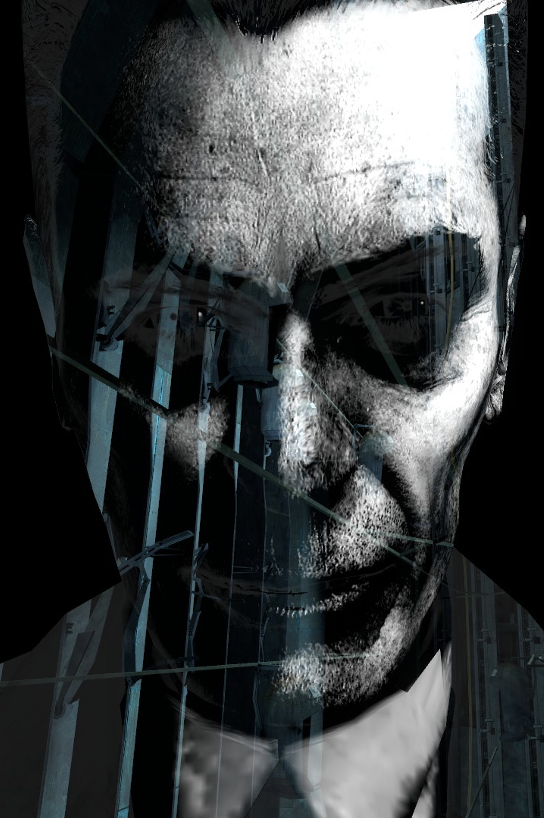
In between the G-Man’s speech, we see the testing chambers that started the Black Mesa incident in the first game, but we are also given a glimpse into an area that does not resemble any place on earth. The place behaves like a machine, with futuristic pods being transported to an unknown location as the G-Man calls out to you for one last moment.

The G-Man says to you, “The right man in the wrong place can make all the difference in the world”, an eerie line that both references the events of the first game, but also foreshadows what lies ahead of you. So wake up Mr. Freeman, wake up and smell the ashes.

SMELL THE ASHES
You are teleported inside a train, a passenger looks over and sees you saying that he didn’t recall you getting on, but he shrugs it off as if it wasn’t the most out of place thing in the world. Interacting with the other passenger, he says how he can never get used to being relocated, but what does this mean?

If we look at the two passengers, we see them wearing identical clothing, a blue jumpsuit with what appears to be an identification tag on them. The world that we knew back in the first game seems like a utopia compared to what happens in the present, and as the train halts at its stop, a passenger remarks, “Well, end of the line”.
CITY 17

You are brought into a train station, old and grimey. You’re immediately flashed by a robot drone as it scurries away. Walking down you can see an aged man being broadcasted on a large holographic screen, welcoming you with a smile to City 17, calling it the finest remaining urban center while thanking our “benefactors”, whoever they may be. And as the screen cuts out, his smile goes away in an instant.
Exploring the place, you’re greeted by a truly dystopian sight, it appears earth has turned into an authoritarian police state, as an officer harasses a man who simply wants to get his luggage. But the most surprising thing is witnessing an enemy from the first game, the Vortigaunts, be shackled for force labor as it sweeps the trash littered station.
Proceeding through the station, you witness propaganda pieces of the aged man from before, making it seem like he’s the leader of Earth or as it seems. Multiple NPC’s can be interacted with, a lady waits for her husband, recalling how he was detained and was promised he’d be on the next train, or the train after that.
Another warns you to not drink the water, saying it makes you forget as he doesn’t recall coming to the station. One man talks to himself, mumbling how the trains are always full but no one goes in or out, while another tries to bring up the courage to continue walking.
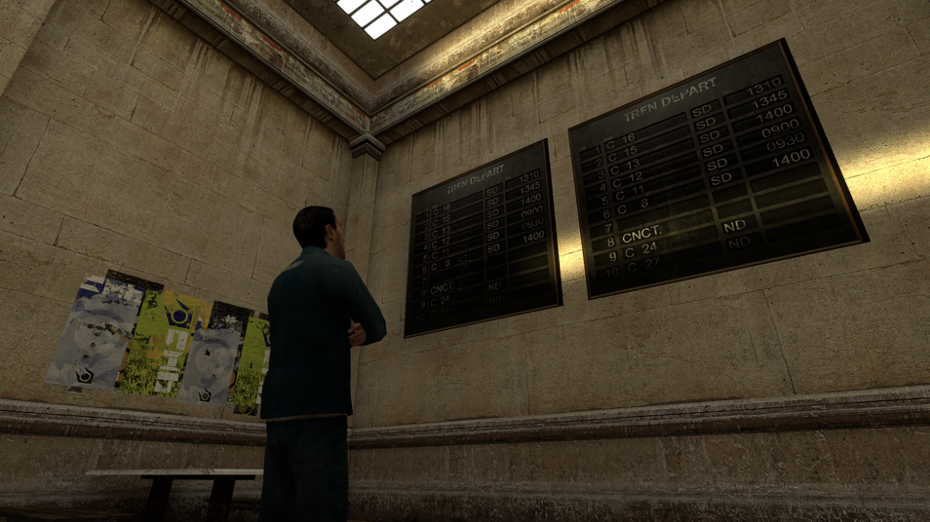
A pair talks about the aged man, his name being Dr. Breen, they talk of him in disdain, however they refer to not talking loudly of it or being arrested for it. As you walk past, and reach a checkpoint, you’re immediately detained by the gas mask wearing police officers, one calling out to you to follow them.
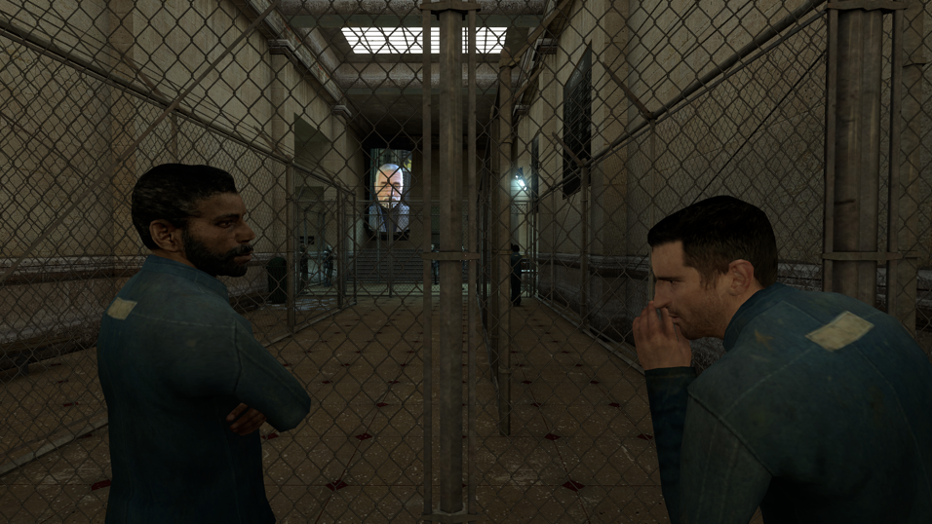
Proceeding with his orders, you witness another man sitting down in a confined room behind a locked door, saying he didn’t do anything wrong. You’re ordered to enter a room, in it is a chair covered in blood, a torture room you will be in. The cop guiding you is asked by another cop if he needs assistance handling you, but he declines and the other cop leaves the room to the two of you.
In a cheery tone, the cop says how he’s going to need some privacy for what’s about to happen. The cop turns off the cameras, and as you wait to be tortured, you’re greeted by a plot twist.
ABOUT THAT BEER I OWED YA
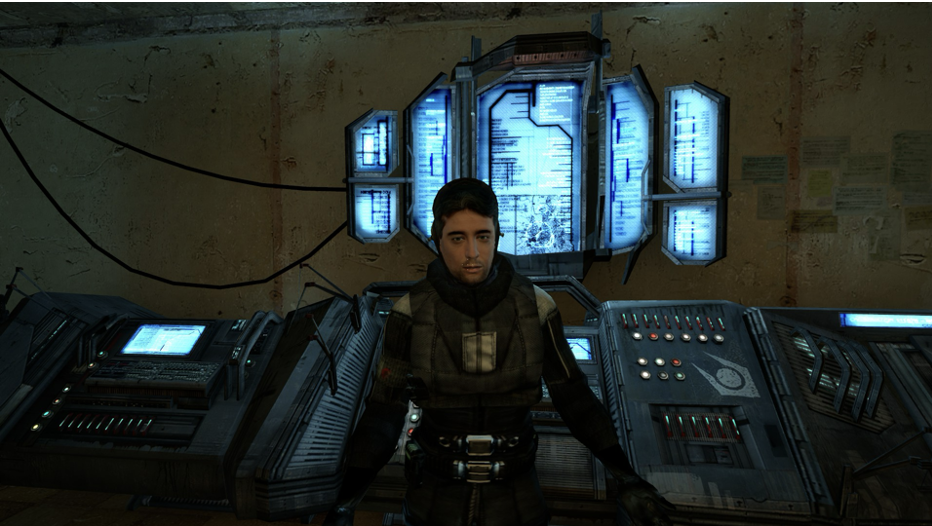
The cop reveals himself as Barney, an old colleague of yours from Black Mesa, who immediately apologizes for his scary demeanor from before in order to act in front of the cameras.
Barney fills you in on what’s been happening, saying how he’s been undercover with Civil Protection. In the meantime, you’re greeted through a screen by a fellow scientist, Dr. Kleiner, who is surprised to see you alive after the events of Black Mesa.
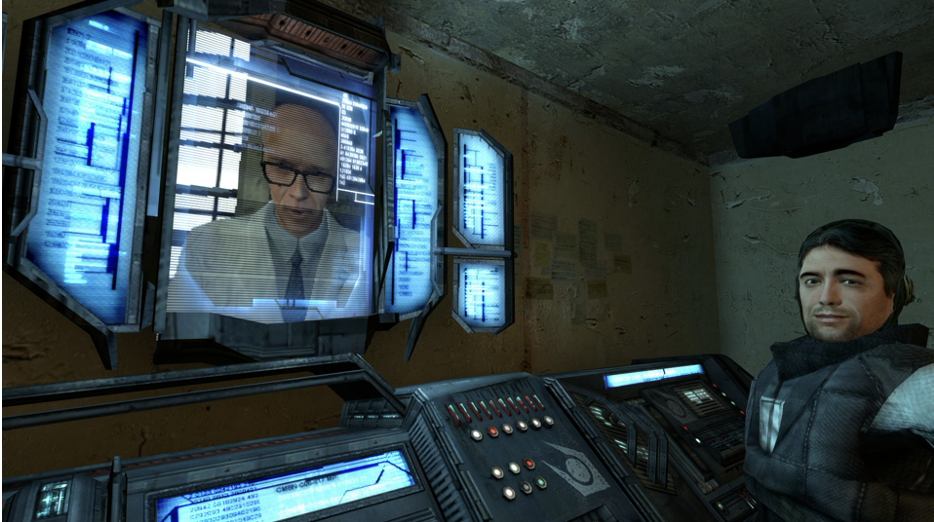
The two are thinking of a way to get you out of there and to Kleiner’s lab before realizing that another character, Alyx, could be of use, but in the meantime it’s up to you to get there. But soon enough, a knock on the door causes Barney to rush you out of the room, and guides you to jump out of a window leading outside.
Once landed, you’re met by a small corridor and a door that presumably leads to freedom.
FINAL THOUGHTS
That was the end of the first level, or rather the first map of the first level, but in this single map, you are given enough information to digest as a player of the world you’re in. You’re brought back from sleep only to be brought into an entirely different world where it is clearly ruled by an authoritarian leader that uses unethical methods to make its society “better” for the people. But in the midst of this is a secret group that seeks to rebel against this system, and they need you, the player, to help them in their cause.
This, and the little tidbits of detail such as the propaganda posters, Dr. Breen’s slip up of his smile, and the dialogue between NPC’s is what makes this level the best example of environmental storytelling in gaming.
There are more things like this further in the game, and I highly recommend playing ‘Half Life 2’ to not only experience the story it has, but also play what I believe is one of the most important games of all time.
You can play ‘Half Life 2’ and its previous entry on Steam, at https://store.steampowered.com/app/220/HalfLife_2/




 Plaid Line + PRIZM + Scottie News