Tag Archives: Editorial

The importance of Greta Gerwig’s ‘Little Women’

By: Kate Tabor

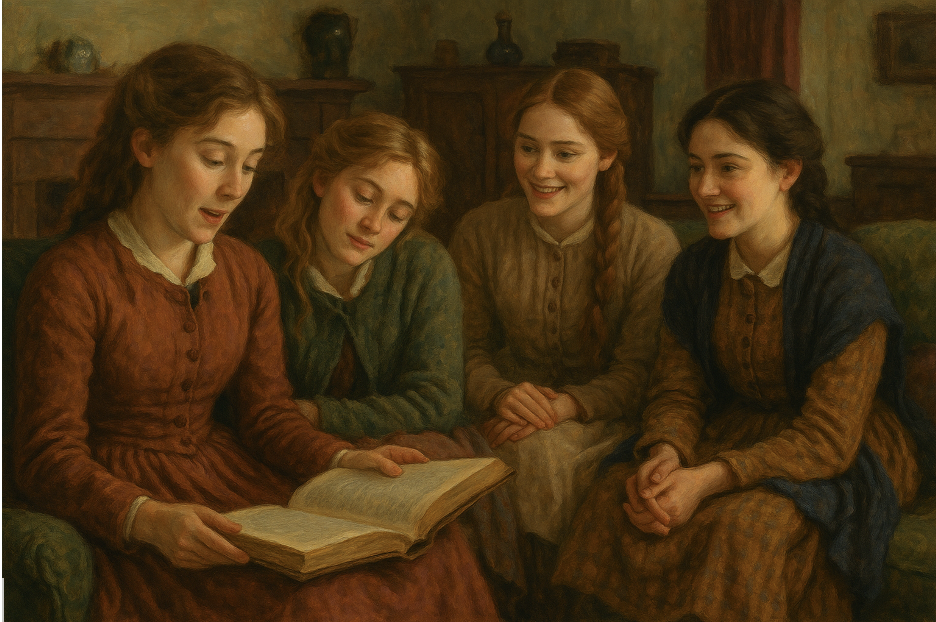
Image created with ChatGPT

The movie ‘Little Women’ by Greta Gerwig has been my favorite movie since it came out in 2019. At the time, I would’ve been 11. I’m not sure exactly what it was that made me originally fall in love with the film, but I do know why I continue to love it.

I’m not really sure how many times I’ve seen the movie, but enough times to be able to recite almost every scene. In case you aren’t familiar with the story of ‘Little Women’ The story follows four sisters in the years after the Civil War, and goes back and forth between them then, and their childhood.

In a way, I believe the story encapsulates the spectrum of what it means to be a woman. Each sister has their own passions, and their own way of going about them.

Jo, the “main character” has dreams of being a writer in New York, and hates everything “feminine.”  She goes about the notion that women don’t need a man, or love, in order to be fulfilled, and she claims she doesn’t want love. She goes on to marry Professor Friedrich Bhaer, who she met and has grown close with in New York. The reason I find this very interesting isn’t because I think what she believes is any less true, or takes away from her point, but rather it amplifies it. It shows that yes, women are their own people, with their own dreams and passions and brains, which Jo argues herself in the movie, but yet you can still yearn for love while being all that and more.

Oftentimes, without even meaning to, women and girls give up pieces of themselves for the men that they love, or the men who claim to love them, and though we live in our modern society, this still happens, though in smaller and unnoticed ways.

However, this all begs the question, is it wrong for women to yearn for traditional love? Of course not. Meg, the eldest sister, had a dream to marry a wealthy man and to live a life of comfort. She wanted to be a mother, and a wife, by the standards of back then. She wanted to embody that traditional mold of a woman. I find there’s nothing wrong with that, and it even strengthens Jo’s original point, too. At the end of the day, a woman should be able to choose her passion, whatever that may be.

Amy, the youngest sister, and my favorite, has dreams of being a successful painter. She’s oftentimes underlooked. She strives for greatness, and won’t settle for average. Maybe she’s my favorite becaus she reminds me the most of me, but I think it’s also because she has big dreams, and isnt afraid to chase them. She knows what she wants, and won’t settle for less, and I really admire that about her. Especially for those times, it wasnt common for women to be supported in pursuing their own passion in a work environment.

I could say much more about this movie, and go into even greater depth, but to summarize this all, Greta Gerwig showed the side of women that often gets overlooked, especially in the media. She shows the real side, a side that doesn’t revolve around men, but doesn’t neglect the idea of love. So, if you haven’t before, go watch her version of ‘Little Women’.

Reasons why books are better than their movie adaptations

By: Fletcher Pike

Image created with ChatGPT

If you’ve ever watched a movie adaptation of a book, like ‘The Hunger Games’ or ‘Divergent’, you might wonder about the differences or similarities between the book and its movie adaptation. In this article, I will list several reasons as to why books are better than their movie counterparts.

For one, reading a book allows your mind to create your own interpretation of the story. Your brain creates your own version of the characters using descriptive words within the book that seems to make it more personal and creative. However, most movies might not correlate to your personal interpretation of what you thought characters or places looked like. This can lead to some dissatisfaction as some things might not seem as familiar to you.

Another reason is that movie adaptations usually leave out details from the book. As reading a book can usually take longer than watching a movie, the movies might leave out some interesting details or information about the plot or characters. The average film is only about 2 hours long, but books can have hundreds or even thousands of pages of descriptive words and details that can take several hours to read.

Another reason is that books help build your vocabulary. When you read a book, your brain is actively progressing in grammar and spelling. Reading several books makes you an overall smarter person as you are continuing to build your reading level and vocabulary.

Some might think that movies are more interesting than books, but books allow you to immerse yourself further into your own interpretation of the story.

Overall, I think that books are much better than movies as they provide a creative outlet for the endless stories that books contain.

The impact of having a sister

By: Kate Tabor

Image created with ChatGPT

Having a sister isn’t always easy. Having multiple sisters can be even worse. As the youngest to two older sisters, I can vouch for this. Even so, I have to admit that I would be lost without them.

Even though sisters can easily annoy one another, I think that a sister bond can be one of the strongest relationships a girl can have. Now, of course it has its flaws, such as stealing clothing, and passive aggressive insults being thrown at one another at the dinner table, but those things are easily overcome. One moment, two sisters could be screaming at each other till their throats are sore, and five minutes later they’re best friends again.

I think that’s what makes a sister bond so special; the knowledge that even though we can get frustrated with each other, we’re always gonna come back to each other and be friends. Some may say that not talking about an argument may not be the healthiest thing, which in some cases I agree, but I think in most sister fights it’s okay, and those feelings can be trusted to be acknowledged and validated through future actions.

As for heart to heart moments between sisters, I find those happen in the moments that matter the most. I can’t count how many times my mother has told my sister to get in here and help comfort her, which oftentimes leads to an awkward pat on the back that lacks what’s really important. That’s not to say that sisters can’t be vulnerable with each other though, I just think that those are rare moments where you and your sister can truly see each other, and that’s when you really need each other.

In a lot of ways, having a sister is like having your best friend also be your enemy, but in the best way possible. You can trust each other to call each other out when needed, but also to have each other’s backs and stick by their side when they need it most.

And even though I hate to admit it, my sister is my best friend. Though right now, I’m extremely annoyed by her.

The reductionist’s approach to climate change will be our downfall 

By: Maya Vossen-Nelson

To fight climate change, the world is shifting away from gas only cars and turning to electric vehicles. The alternatives to gas only cars are hybrid cars, which use a combination of electricity and gas to fuel the car, and electric cars, or EVs, that run on only electricity. Electric vehicles are essential to limiting the effects of climate change, but the shift to electric vehicles must be done smartly. Right now, the reductionist’s approach is creating climate crisis solutions that lack the very instrument that they are trying to achieve: sustainability.

In practice, reductionist thinking analyzes complex problems by breaking them down into more simple parts. The solutions that arise from this thinking lack complexity and they negate how change to an isolated part affects the system as a whole.

Reductionist solutions often show up in politics as a quick solution to a large problem, and yet are dysfunctional.  In 2022, California announced that by 2035, all new passenger cars, trucks and SUVs sold within the state will be zero-emission vehicles. This absolutism policy fails to address how the world’s current production of EVs cannot support such a rapid shift while upholding ethical and climate obligations. 

EVs and hybrid cars use rechargeable lithium ion batteries to power the vehicle in place of gas. Lithium and cobalt are metals that make battery subunits that are essential components to the efficiency and operation of these lithium ion batteries.

Unfortunately, the acquisition of lithium and cobalt used in the production of electric vehicles is not sustainable or humane. Nearly 70% of cobalt is mined in the Democratic Republic of Congo where workers rights and laws are nearly non-existent. The relaxed worker regulations enable child labor in dangerous mines and without safety equipment. The children who are forced to mine with their hands are constantly poisoned by cobalt and many are killed from mining accidents. Mining cobalt also produces hazardous tails and slags that can leach into the environment causing further negative impacts on nearby communities. These issues will increase over time without intervention especially given that according to the Washington Post, cobalt mining is expected to increase 2,000% by 2040.

Without lithium ion battery recycling there is not enough mineable lithium to supply all electric vehicles, phones, and other products. According to the U.S. Geological Survey, the Earth has 88 million tons of lithium but only ¼ is available to mine. That number may change as technology advances. There could be 2.8 billion EVs produced from 22 million tons of lithium and there are 1.4 billion cars on the road as of January 2023. The growing population and growing amount of other products that rely on lithium and cobalt needs to be considered.

With the extensive use of lithium ion batteries and the attached humanitarian issues with cobalt mining in the Congo, the world cannot stop producing gas-only cars until there are plans in place to prioritize resource diversification to rely less heavily on lithium ion batteries. A more holistic approach must be part of the discussion surrounding the electrification of the automotive industry for EVs to make a sustained impact on the course of climate change.

Is social media hurting or helping students?

By: Teagan Mack

Photo by Pixabay on Pexels.com

Social media has a huge place in student’s lives today. Social media platforms like Instagram, TikTok, and Snapchat provide the opportunity to talk with friends, update people on their life, and stay up-to-date on the latest news. Whether reading posts or watching videos, social media is now an important part of the daily routine. Is it helping or hurting students, though?

On one hand, social media can be a really useful tool for learning and personal growth. Many students use YouTube to watch tutorials, watch educational videos, and even learn about new tips and tricks. Instagram and TikTok even have educational accounts that love teaching students new topics or skills. You can learn anything from historical data to math tricks. Students can also get involved in online study groups, connect with classmates, and be engaged in discussions that help with schoolwork.

Social media also allows people to stay in touch with friends even when  they are occupied or cannot meet physically. These connections can provide emotional support, especially during periods of stress such as during exams or when there are deadlines for projects.

Social media, however, has its dark sides. One of the most common problems with social media is that it can negatively impact one’s mental health. Spending too much time viewing social media can lead to depression, anxiety, and low self-esteem. Watching others who share their “perfect” lives can leave you feeling inadequate or not good enough.

Social media also exposes students to cyberbullying, where nasty comments and negative interactions can affect a person’s emotional well-being.

Of course, there is the issue of misinformation and fake news being shared, which can confuse students and affect their understanding of important topics.

So, is social media ultimately helping or hurting students? The answer is that it depends on how we use it. If we use social media to support our learning, stay connected with our friends in a positive manner, and engage in helpful discussions, it can be an excellent tool. But if we allow it to distract us from our studies, drain our energy, or damage our mental health, then it may do more harm than good. We have to find the balance and also notice how we are spending our time online. If we recognize that social media is causing more stress than it is good, then taking a break can be the best thing that we can do for our minds as well as our studies.

Would you pay 5 million dollars to immigrate?

By: Evie Beaumaster

Image taken from Whitehouse.gov

5 million dollars is the cost that Donald Trump put on his “Gold card”, which is an immigration visa that will be available for purchase. Trump recently announced these at a press conference in the Oval Office.

There is already a similar visa in place called the EB-5 Visa which is available for people to invest in businesses in America. These visas cost $1,050,000 or $800,000 in investment for businesses here. While this visa is strictly for businesses, it is available for anyone to buy if they meet the criteria.

Trump’s “Gold Card” visa would replace the EB-5 Visa but it is an astronomically high cost for a business visa. There are very few people in other countries that have enough money for this visa. The “Gold Card” would also not be an effective route to citizenship. 5 million dollars is a lot of money just to live somewhere. 

Other countries have tried similar visas, often called golden visas; they have existed in many European countries but they are sparking concern about who exactly is spending that money for a visa, with people saying that many times it is people using the visas for criminal purposes. Some of the European countries that have these visas are: Spain, Italy, Greece, Portugal and Ireland. These countries started the “gold visas” as a way to make up economic shortfalls.

 One of the negative effects of these visas was that richer immigrants came and bought out a lot of local housing and they drove up rental costs and home costs. Many of these countries have since stopped these programs due to the European Union’s warning about people fleeing from Russia as well as these visas being used for corruption, tax evasion, and money laundering. Many countries in the Middle East are considering these golden visas in addition to the US. These visas are raising concerns about how, and if, these will be used by criminals.

Trump has also voiced how the “Gold Card” would be extremely successful and he seems fully sold on the idea that wealthy people will flock here and spend money and pay taxes. When asked if Russian oligarchs would be able to come, Trump responded, with “Yeah possibly I know some oligarchs that are very nice people, it’s possible”. For people who may not know, an oligarchy is defined as a form of government where a very small number of people have power. There is a large number of oligarchs in Russia, so they might try to immigrate to America with this new visa. While he said that people coming here would be “vetted” he has not expressed any information about how this system would be happening, and he did not say how people would apply, and how these applications would be approved.

At the end of the day, the story that is being spread from the US government is that, if you are rich enough to pay millions to get to America, you are rich enough to stay. We must ask ourselves, is this the message we want to send to the world after our country was founded by poor immigrants. Because, after all, most people in America had a relative that came here at some point who was not rich enough to buy a ticket to a “better” life.

For more information, please visit:

Public education in America is severely underfunded and under appreciated

By: Evie Beaumaster

With a new president there are many new laws and budgets that affect education for millions of people in the United States. Donald Trump is the new president of the United States and he has a lot to say about education and how much money is spent on it and how the government should be allowed to interfere with education.

In the fiscal year of 2025 the budget request for K-12 education will be 82.4 billion dollars. However, only 52 billion was approved in this past year. This budget comes from the US Department of Education and can be accessed on their public website. There are 95,852 public schools in the United States in 2025, and while that may seem like a lot of money for so few schools, that budget is shockingly low for how much money our public school system needs in America. The cost per student per year is about $17,280. Students are usually in school for 13 years and usually a year or two of preschool. This budget is very low for the 50 million students that attend public school in America.

Compared to the budgets of other things that get government funding, education is among the lowest. In comparison, the US military, as a whole, gets 15% of government spending. The highest category for government spending is Social Security, which gets 21%. Education is only the fourth highest spending category out of the 11 categories.

The quality of education is also an area of concern among Americans. The White House also recently released a presidential action that asked for the end of schools indoctrinating their children with “[R]adical, anti-American ideologies while deliberately blocking parental oversight”. The action then goes on to say that children are forced to assume different identities and “wonder if they were born in the wrong body”. This shows how the government we have in place doesn’t think of education first, it thinks of “radical” ideas that children may pick up in school. According to article 19 from the Universal Declaration of Human Rights “Everyone has the right to freedom of opinion and expression; this right includes freedom to hold opinions without interference and to seek, receive and impart information and ideas through any media and regardless of frontiers”. This article shows that children’s ideas and personal beliefs are a human right and it doesn’t matter if they are picked up at school.

The school system in America is currently being set up for failure and it is heading towards a dark place of censorship and terrible underfunding.

Recently, President Trump has vocalized his plans to dismantle the Department of Education. This would be a very bad thing if passed by congress. According to their website, The Department of Education oversees many things concerning the education system including, the federal role in education, annual performance reports, and promoting the quality of education. The education department is also responsible for making the budget for public schools. When President Trump was asked about this he said “We are ranked number one in cost per pupil, so we spend more per pupil than any other country in the world, and we are ranked at the bottom of the list”. This is a really bad sign because other countries may spend less money on education but that could be because in other countries a lot of education is paid for privately. Trump also added that he “wanted the states to run schools”, meaning that the education budget would not be coming from the federal government but from the state government which would not actually have enough money to properly sustain the school system.

Public schools in the US are often shunned and called terrible, but maybe it’s not the people that are to blame; it’s the funding—- or the lack thereof. This overall will be a very bad thing for students because this education system will be effecting the whole world. Millions of people go through these public schools, and it will educate the future generations that will eventually lead this country.

For more information, please visit:

The problems in Hollywood

By: Gabriella Bell

Photo by Paul Deetman on Pexels.com

Through the many years of the rising popularity of television and film, this led to positive feedback and attention put onto Hollywood celebrities, both actors and directors alike.  While there were several good aspects that came along with the fame that certain actors gained from their roles in movies and shows, there was also a lot of negative exposure put onto actors, especially child actors. This oftentimes included instances of sexualization, (financial) exploitation, and unhealthy working conditions, among many other things.

On the topic of child actors, there are so many instances where they have been put on a pedestal and risen to fame, and continuously failed by so many corrupt aspects within Hollywood society. This often involves both the public, as well as their higher ups (directors, older actors, agents, etc.) This can be seen from as early as actress Judy Garland, who is commonly recognized for her role as Dorothy Gale in ‘The Wizard of Oz’ (1939).

In Judy Garland’s experience in her role as Dorothy alone, she was exposed to extreme body shaming from the entertainment industry. Garland was forced into a strict diet as well as medications in order to keep her working longer hours, and to keep her weight down. This contributed to her long-term struggles with substance abuse and her mental health.

Another more recent actress subjected to similar experiences could be Nickelodeon star, Jeanette McCurdy. In her memoir, ‘I’m Glad My Mom Died’, she openly discusses her struggles while involved within the industry, particularly regarding her mental health. She also touches on the financial exploitation she experienced at the hands of her mother especially, which ultimately limited the control she had over the income she was making while acting on Nickelodeon.

While these are only two examples of the problems with child actors in Hollywood, there are so many more actors who were, or are being, subjected to exploitation, sexualization, substance abuse, or body shaming. The experiences of these actors should only fuel the need to establish stricter and safer laws in order to help protect their rights more than what’s currently being done now. With more actors coming out with their own personal experiences of navigating the entertainment industry, I believe that this could further motivate stronger protections and better support systems for child actors in Hollywood.

Judges retiring after Trump’s win

By: Baarika Suresh

Photo by KATRIN BOLOVTSOVA on Pexels.com

Questions concerning the relationship between politics and the judiciary have been raised by the practice of judges “unretiring” after a political shift, especially after Donald Trump’s recent victory. In this context, “unretiring” refers to former judges who return to active duty, usually at the invitation or persuasion of the newly elected administration, after having reached the mandatory retirement age or leaving the bench for other reasons. Significant discussion over judicial independence and the wider ramifications for the legal system has been spurred by this practice.

In the US, judicial retirements are frequently viewed as a strategy to maintain impartiality and make sure that judges are not influenced by political pressures as they age. However, it can appear that the judiciary is becoming politicized when judges decide to return to the bench, especially following a presidential election that has significantly changed the political scene.

Four seats were included in a deal reached in November between Senate Republicans and Senate Majority Leader Chuck Schumer. In exchange for a Democratic commitment to fill the four circuit court vacancies for the Trump administration, Republicans agreed to confirm Mr. Biden’s district court nominees as soon as possible. However, Judge James Wynn has since changed his mind about accepting senior status, so the number has been lowered to three.

The return of retired judges raises questions about the possible decline in public trust in the judiciary’s impartiality and independence, particularly under a president with a strong ideological agenda. The rule of law’s foundational tenet of a neutral justice system may be compromised if such retirements and reappointments appear to be politically motivated.

It might also establish a worrying precedent for upcoming administrations, when political control over the judiciary might become even more pronounced. Instead of concentrating solely on legal knowledge and integrity, it might even promote a cycle in which judicial selections and reappointments become increasingly politically charged.

Finally, even though unretiring judges might be viewed as a practical reaction to political changes, the practice needs to be closely examined to preserve the harmony between judicial impartiality and political influence.

How large vehicles are killing us

By: Nathaniel de Sam Lazaro

Image generated using Canva AI

Every year, around 40,000 people in the United States are killed by vehicles. This includes both those who die driving when they get in accidents and those who are hit by vehicles while walking or biking.

Per mile driven, our nation’s roads are almost twice as dangerous as many comparable nations. Furthermore, the death rate on our roads has been increasing for the past decade, despite all of the new safety features being included in cars, now mostly consisting of features that assist drivers in keeping the speed limit, staying in lanes, and braking.

Even worse, the number of pedestrians killed by vehicles has nearly doubled since 2010, and is now the highest it has been since 1981. According to a recent piece published in ‘The Economist’, the blame for this is on the increase in the weight of vehicles.

The average new vehicle in America now weighs 4,400 pounds. American vehicles are getting bigger and heavier. Vehicles weighing over 5,000 pounds made up 31% of the market last year, up from 22% in 2018. This trend shows no sign of stopping.

This increase in weight is an issue because it means an increase in force of vehicles, force being mass times acceleration.

Ironically, for a long time, the conventional wisdom has been that this increase in vehicle size has been making us safer. This is because very heavy vehicles are able to better protect those inside if they get into a crash with lighter vehicles. However, this causes a much greater decrease in the safety of those in the lighter vehicles, creating an endless arms race of heavier cars. It’s even worse for pedestrians and cyclists, who lack the safety provided by the walls of a car.

The biggest issue is the difference in weight. According to an estimate by ‘The Economist’, fatalities could be reduced by 12% if the heaviest 10% of cars got just 10 percent lighter. And, to be clear, this is all focused on passenger vehicles, not commercial vehicles like semi trucks.

Another thing that makes this issue more difficult is the fact that the shift to EVs has also made cars heavier, with their battery adding a lot of weight to new electric vehicles.

The solutions to this problem are also quite complicated. Regulations could be changed to encourage lighter vehicles, but this could also disincentive electric vehicles. One of the reasons that larger vehicles started being sold so much was that they were made exempt from fuel efficiency regulations in the 1970s. 

Some changes have already occurred. The National Transport Safety Board last year changed their definitions of vehicle safety to account for those outside the vehicle in question, accounting for those in the other cars and pedestrians as well.

I think more should be done. We should be passing laws to encourage lighter vehicles and make our roads safer. We should also redesign many aspects of our roads, which are wide, with many uncontrolled intersections, and designed to make driving comfortable and easy. These conditions, however, encourage very fast car speeds, the other half of mass times acceleration.