Category Archives: News

The beauty of covalent bonding!

By: Maeve Brady

Chemistry, and just science in general, correlates with everything in our lives. Now, something that directly relates to the water we drink, the air we breathe, and the DNA we contain is covalent bonds or also known as covalent bonding. Now, after hearing about this, you may be wondering, what exactly is covalent bonding? Well, after the further analysis I will provide in this article, I hope you gain a better understanding about its properties and how it appears in our everyday lives.

A covalent bond is a common occurrence in our lives. In simpler terms, according to the distinguished researchers at the University of Hawai’i at Mānoa, “The puppies represent atoms. The bones represent one of their electrons. Both puppies share both bones” Covalent bonding is a phenomenon where elements may share electrons in order to fill their valence electrons to get a full set. This is unlike ionic bonding, where elements steal electrons instead of sharing electrons. Covalent bonds have the goal of sharing their valence electrons to completion.

For context, in the periodic table, all of the elements have valence electrons who are located in the outermost electron shell of an atom. According to its properties, every element wants to become more stable by gaining a full set of eight valence electrons, this minimizes their energy usage and with this full set, or close to full set, of valence electrons, the element becomes less reactive. In certain circumstances, depending on the group in the periodic table, we may see different results in how reactive they are. You can check what group they are in.

If an element is in group five, then it has five electrons existing in it. And if it is in group sixteen, then it has six electrons, not sixteen.  So, in the case of group eighteen, these elements are known as “noble gases”, and they have a complete set of eight valence electrons, meaning they have a full set and are not reactive; they don’t have a reason to bond with different groups in the periodic table besides themselves.

But there are a couple exceptions to this principle. One example is Helium. Helium is a noble gas with only  two valence electrons instead of eight. This is because helium’s single electron shell is already completely filled. Therefore, it still demonstrates this stable and sparse reactivity.

The aspect of covalent bonding is the formation of a complete set of valence electrons after two elements share the adequate amount of electrons with one another. And with this type of bonding there are subcategories of polar and nonpolar covalent bonding.

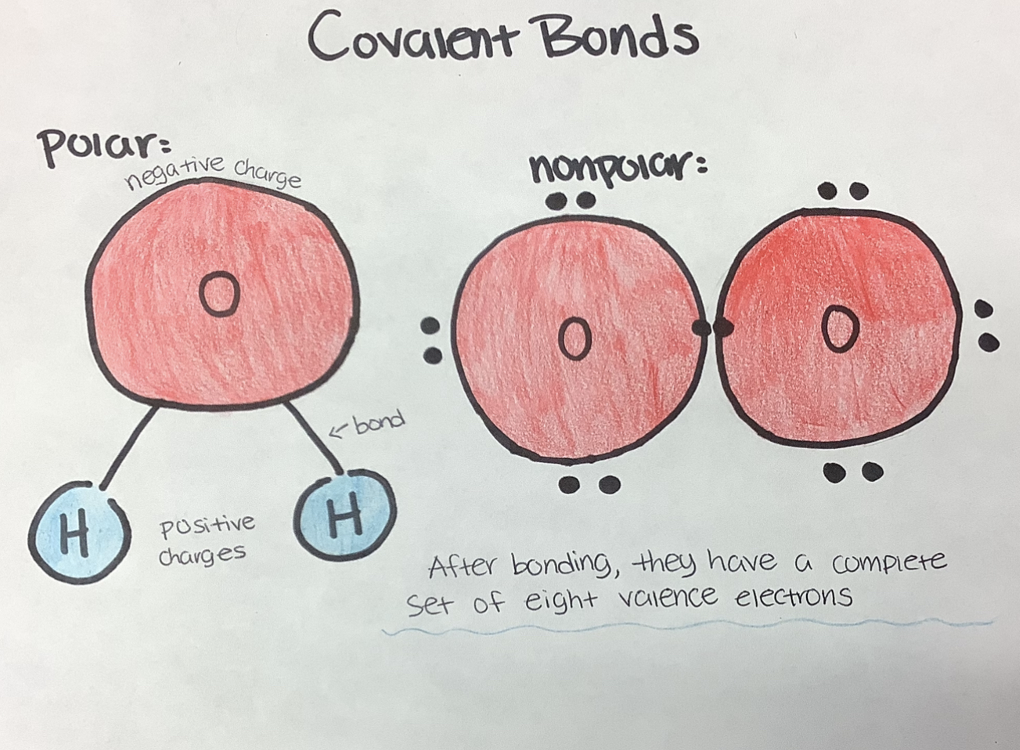
An example of polar covalent bonding would be the bonding of two hydrogen atoms and an oxygen molecule, the chemical structure of water. Oxygen has six valence electrons while each hydrogen molecule has one. This means that oxygen is almost stable and only needs two more electrons for full completion. And this is where the word “polar” comes in. “Polar” is essentially this sense of having polarity, and in the context of covalent bonding, it means a non-uniformed and unequal way of bonding. So, in the case of the chemical formation of the water molecule, oxygen and the hydrogen atoms both share their electrons, which gives them both a full set of valence electrons. But because oxygen has a higher electronegativity-oxygen has the tendency to attract electrons towards itself-so it tends to “hog” the valence electrons, hence, creating this negative charge to the originally neutral element. And with this, it creates these positive charges to the two hydrogen atoms.

Now, on the other hand, there is nonpolar bonding. Nonpolar bonding is described as the more uniformed way of bonding and in the context of covalent bonding, it is when two elements equally share valence electrons. Now, in general, you may come across more nonpolar bonds between the same elements, but that is not always the case. In fact, nonpolar bonding can be executed between two different elements as long as they share valence electrons relatively equally. The most prominent example of nonpolar covalent bonding is when two oxygen atoms can each contribute two valence electrons to complete the others’ set.

Now for the big question. How can we find Covalent Bonding in our everyday lives? Well, that is simple to answer. If we truly analyze it, we can tell that covalent bonds are in more than we may have initially thought. For example, one of the most popular examples is the properties H2O. According to the distinguished researchers at the University of Hawai’i at Mānoa, “The unequal sharing of electrons between the atoms and the unsymmetrical shape of the molecule means that a water molecule has two poles-a positive charge on the hydrogen pole (side) and a negative charge on the oxygen pole (side). We say that the water molecule is electrically polar.” This demonstrates that a polar covalent bond is how H20 comes about. And we use water in our everyday lives. It is the basis of everything, and something we rely on so heavily. Besides water, covalent bonds also may be found in our air and more, as mentioned in the first paragraph.

Thank you so much for following me along as I explain the basics on covalent bonding! I hope you now have a better understanding of this process and how it appears in our everyday lives.
The new age of blood shortages

By: Maya Vossen-Nelson

Nearly 6.8 million people donate blood per year in the United States, providing vital resources and support to cancer patients, surgeries, accident and burn victims, and organ transplant patients. In July 2024, the American Red Cross reported a record low in donor participation dropping by 25%. This shortage began during a nationwide heat wave over the summer and donor numbers have not returned to their normal levels since.

Recently, factors such as climate disasters have increased the demand for blood units and the drop in donations are unable to replace the inventory. Blood centers are reporting that limited donor sites, loss of staffing at blood centers, new illness and medication constraints for donation eligibility, along with a decrease in workplace donation events since the rise of remote working have all contributed to lower donor numbers.

Blood shortages are a pressing symptom of the overburdened, under-resourced healthcare system. As of March 4, 2025, of the 53 community blood centers and 90 hospital based blood centers in the United States, 46% have less than a two-day supply of blood.

Amid these unresolved blood shortages, surgeons have turned to blood supply usage efficiency as a method of mitigating the lower supply consequences. Adoption of Patient Blood Management (PBM) policies currently include using preoperative strategies to increase red cell mass, intraoperative cell salvage, and the management of anemia in patients.

To most patients, this medical jargon carries little meaning, overshadowing its influence in medicine. The Association for the Advancement of Blood & Biotherapies (AABB) describes the importance of, and medical situations where, PBM is used: “PBM encompasses all aspects of the transfusion decision-making process, beginning with the initial patient evaluation and continuing through clinical management. These techniques are designed to ensure optimal patient outcomes, while maintaining the blood supply to guarantee that blood components are available for patients when they are needed.”

Preoperative strategies to increase red cell mass include pre-op testing 3 to 4 weeks in advance of the surgery to undergo blood testing and receive proper supplements or medication to resolve anemia.

On average, patients with anemia require an additional liter of blood during surgeries and require longer hospital stays compared to their counterparts. Given that 22.8% of people worldwide are anemic, resolving anemia even temporarily for a surgery would significantly decrease pressure on blood centers.

Intraoperative cell salvage (ICS) is a method used during surgery to collect red blood cells lost during surgery and reintegrating them into the body. Before the blood transfusion, the red cells are processed and repaired. This blood management method requires no additional blood.

These strategies have increased the ability for blood centers to cope with the blood shortages, but the ultimate fix is recruiting more donors. Of the 37% of eligible donors, only 3% choose to donate. Your donation is more important than ever. To schedule a blood donation with the American Red Cross visit: https://www.redcrossblood.org and select from countless donor drives near you.

For more information, please visit:

What is this strange effect?

By: Maeve Brady

Many of us may know about the infamous placebo effect. But have you truly taken the time to analyze it and its components? If you did, do you understand it?  Even after wondering about it for a long time, many still can’t comprehend it. Today, I will be explaining the placebo effect and how it affects our youth in schools and the broad picture of it.

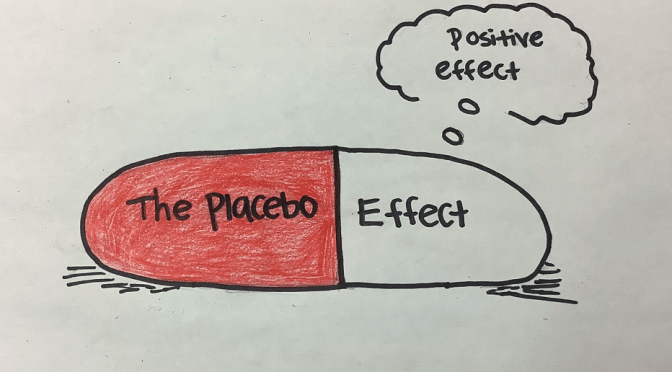
Have you ever heard of a placebo? Well, it’s the reason the placebo effect even exists. A placebo is an inactive treatment, surgery, and more. Also, under certain circumstances, a placebo can also be considered to be an action. A placebo directly correlates to the placebo effect because the placebo effect is the feeling you get after you take the placebo. The placebo effect works by turning on the body’s natural mechanisms that may help us feel better. Our brains make many substances that can lessen pain, anxiety, nausea, and more. This is also known as placebo analgesia.

Like I said, the placebo effect derives from the mind rather than the actual effect the drug has. This can be seen in the fact that you can be aware that you are taking a placebo for the effect to still work. Many believe that you have to be unconscious of the placebo in order for it to work, but in reality, if you have the expectation of the placebo having a positive effect on you, then it may. There is also such a thing as the Nocebo effect; it’s the opposite of the placebo effect where you believe that a placebo has a negative effect on you.

According to Olsen (2021), a Senior Media Relations Officer at Dartmouth, in a recent research conducted by Tor Wager and Diana L. Taylor, who are distinguished professors in Neuroscience, “‘Our findings demonstrate that the participants who showed the most pain reduction with the placebo also showed the largest reductions in brain areas associated with pain construction.’” After further research, according to Olson (2021), “With the large sample, the researchers were able to confidently localize placebo effects to specific zones of the brain, including the thalamus and the basal ganglia.” Scientists believe that because these two areas are involved in the sequence of connecting pain to action, the placebo effect may occur in them and largely impact these regions. Scientists also believe that the prefrontal cortex may have something to do with it.

The placebo effect may affect our youth in many different ways. In recent research conducted by psychologists Ulrich Weger, Ph.D. and Stephen Loughnan, some students were under the impression that the material they studied was enriched and better for the test while some believed that it was worse. According to the two psychologists, “Participant performance was indeed enhanced, compared to a group that did not think the priming process would improve their knowledge.” This demonstrates that the students’ actions could overall affect their academic performance.

The placebo effect is a very complex phenomenon whose properties are still being researched. I hope that from this text you’ve learned a little about the basics and how it affects our youth.

For more information, please visit:

Highland’s 2025 Chinese New Year’s most significant performances

By: Jooney Freddieson and Aalovely Lor

Chinese New Year is one of the most important traditional holidays in Chinese culture.

It is typically between the end of January to mid February and in 2025, Chinese New Year was from January 29th to February 12th.

Every year, Highland Park Senior High School students and teachers celebrate Chinese New Year by performing dances as well as singing and showcasing a play.

( 舞獅 ) Lion’s Dance performed by Julian Falk & Liam Hefferan

The Lion’s Dance is not just a performance but it is a cultural tradition that traces all the way back to ancient China; evolving through each generation.

This dance is significant because when the lunar new year comes around the celebration is intended to ward off evil spirits.

The Lion’s Dance is not only filled with vibrant colors, but it is followed by loud noises, energetic music, and bright lights.

The lion represents a symbol of power, courage, good fortune, and protection in Chinese culture that chases away negative energy or “Nian”.

“Nian” is a mythical monster known to attack villages and leave negative energy in the beginning of the lunar new year, according to Kpbs.org. Which is why the Lion’s Dance is typically known to be performed at the beginning of the Chinese New Year event.

The monster is known to be scared of loud noises, bright lights, and bright colors, which is why the Lion’s Dance is a great tool to chase the monster away.

During the performance the dance was accompanied with loud drums played by two students, symbolizing the terrifying loud noises to scare away “Nian”.

The dancers mimic the lion by swaying, leaping, shaking, often in a playful manner. This adds an element of humor which entertains the audience.

It was cool to see how the music followed the lion’s movement as it got faster and slower.

Our favorite part of the dance was when the lion came close to the audience and interacted with them. The interaction between the lion and the audience created, and added, a more humorous atmosphere.

The Legend Of The White Snake was performed by Highland’s Chinese Immersion 11 class!

Their play gives us insight into the old Chinese folktale about an ancient white snake who transforms into a beautiful woman before quickly falling in love with a young man. 

Despite getting married, he was still unaware of her true form until a monk told him he wasn’t married to a human being; he was married to a snake.

The young man gives his wife wine which transforms her into a big white snake, causing the man to die from shock.

Even though her husband had played that trick on her, she still revived him with her own potion. Once awakened, he realized she was still the person he always loved, someone who’d never do him wrong.

The significance of the Chinese Immersion 11 class reenacting this folktale is that the new year is the year of the snake.

They executed this play perfectly by bringing up beautifully painted sets and a perfect script in between the mix of humor and accuracy.

One highlight from the play was the humorous switch when she turned into the big white snake. The crowd was definitely excited to see the wife go backstage and switch out with the masked snake.

Our favorite part of the play was when the white snake was battling the monk and his two guards for her husband back after he’s been locked up. The music in the background played a comedic role in the fighting; intense but random.

Here is the amazing Chinese Immersion 11 class!

‘Girlhood (it’s complicated)’

By: Kumari Wijetunge

Official poster of Girlhood (it’s complicated)

‘Girlhood (it’s complicated)’ is an exhibit that you can see at the Minnesota History Center that will be up from September 7, 2024 to June 1, 2025. This is an extremely well put together and powerful representation of the impacts made by women throughout history with themes like education, fashion, work, and politics. The exhibit explores how girls over the years have navigated growing up in a society that underestimates our voices and abilities.

The exhibit counters traditional narratives of girlhood by highlighting the struggles and complexity of girls’ lives. It emphasizes that being a girl is much more than society paints it to be but instead involves navigating multiple roles and identities. Through a collection of over 100 historical artifacts, personal diaries, and interactive displays, ‘Girlhood (its complicated)’ shows how girls have contributed to society in significant ways, often breaking down barriers that were set before us.

One of the main themes of the exhibit is girls’ access to education and how it has evolved over centuries, with many girls fighting for the right of education. The exhibit shows the historical struggle and the events that led to girls and women securing educational opportunities.

The work of girls and young women is also shown in the exhibit and how they balanced family responsibilities like chores with personal ambitions and activism. Artifacts like clothing, diaries, and toys highlight the way girls have navigated their roles in the household and beyond.

‘Girlhood (its complicated)’ also features an exclusive section dedicated to girls and women in sports, specifically basketball. This part of the exhibit showcases the growth of women’s sports and the stories of female athletes who empowered others. Through photographs, personal stories, and trophies, visitors can learn about the history of women’s sports and the ongoing fight for equality.

Throughout the exhibit visitors reflect on their own experiences and perceptions of girlhood. Overall, ‘Girlhood (it’s complicated)’ is a powerful reminder of how important it is to recognize the different experiences of girlhood throughout history and the present. By interacting with artifacts and stories, visitors can leave with a greater appreciation for the resilience and strength of girlhood.

The ban of TikTok

By: Samson Belihu

Hello, and today I will be talking about the ban of TikTok that’s GOING to happen in the U.S.

You may ask why the U.S. government wants to ban TikTok. Well, let me tell you.

The main concern that the U.S. recognizes is that TikTok collects a lot of data on users, including location, browsing history, and even device details and since it’s owned by a Chinese company, critics worry that this data could be shared with the Chinese government. The government could then use that information for spying or to influence American politics. Though TikTok denies sharing data with China, U.S. lawmakers point to China’s laws that could force companies to cooperate with the government. Many of the lawmakers are politicians, particularly from the Republican Party.

Another worry is that TikTok could spread fake news or propaganda, affecting elections or creating social unrest. Though TikTok has taken steps to try and stop the spread of misinformation, many U.S. lawmakers still see it as a national security threat.

The push for banning TikTok mainly comes from conservative politicians like Senators Josh Hawley, Marco Rubio, and others, who argue the app is a threat to national security. They worry that TikTok could be used for spying or spreading fake news for the Chinese government.

TikTok has been told to either sell to an American company, create a new U.S. controlled TikTok, or make sure they store all data safely and away from China. If they don’t do one of those things, they could face a ban in the U.S. The owner tried to file an appeal to the Supreme Court, but failed due to the concern of the information that could potentially be sent back and forth.

In my opinion I find myself stuck between both of their sides.

If TikTok is a way to sell people’s info to the Chinese government I find that troublesome, but I also think TikTok has become a way for people to express themselves and find support, and if it’s banned all of it will be taken away. People’s lives have been changed for the better due TikTok

France searches for a new president

By: Barrika Suresh

Photo by Atypeek Dgn on Pexels.com

The French president, Emmanuel Macron is coming near the end of his second term, as he was re-elected in 2022 and will remain president until 2027. French presidents only serve two terms, as there is a limit. There is mounting pressure on Macron to name a new prime minister and diffuse the ongoing political crisis. Apple News reported that “The president called for ‘a meeting of different political forces’ to discuss forming a new government after the collapse of the last minority administration” according to the Greens after meeting Macron.

Some backstory to this is that no single party gained an absolute majority in the Assembly following the 2022 elections. Despite gaining the most seats, Macron’s Ensemble! Coalition was unable to win a majority.

Significant gains were made in the elections by the right-wing group National Rally, led by Marine Le Pen, and the left-wing alliance Nupes, which consists of the Socialist group, Communist Party, France Insoumise, and the Green Party of France. In other words, Macron was now in charge of a minority administration, putting his government in a scenario known as a “cohabition” in French politics, where the president and prime minister are from different parties.

Macron’s failure to obtain a majority resulted in ongoing deadlock and made it impossible to pass important laws. This meant that in order to pass legislation, Macron and his prime minister, Michel Barnier, had to approach the opposition one at a time for support. This is extremely difficult in the current political climate.

Political unrest has resulted from Macron’s legislation majority’s collapse, with demonstrations and discontent mounting over the government’s failure to enact important reforms, particularly on matters like labor laws and pensions.

As a result, Macron’s political standing deteriorated, and the opposition-controlled National Assembly made it extremely hard for him to carry out any of his plans. Parliamentary speaker Yael Braun-Pivet urged the president’s centrist campe to join forces with the Republicans, independent MPs and the Socialists to have a majority, so there is no longer a possibility of censure, (which is a formal vote of disapproval against a government official).

Local bands: Rock Melon

By: Persephone Pond

Rock Melon is a local band based in Highland Park, Saint Paul. This surf-pop-indie band consists of six talented students from around the Highland Park area. This article will go over a few need-to-know facts about the band before listening to their music.

Before going over the music the band has released as of late, it’s important to know the talent behind music. Here’s a quick introduction to the band.

Zack Nelson (he/him) is a senior at HPSH and the founder of the band. He plays both the guitar and bass. Elzie Bieganek (she/her) is one of the two talented vocalists of Rock Melon, currently attending SPA as a junior. Erin Moore (she/her) is a junior at HPSH, and the second vocalist of Rock Melon. Ryan Mitchell (he/him) and Izzy Montgomery (she/her) both play guitar, and Syan Blackwood (they/them) plays the drums for the band.

Now, the music itself this small band produces showcases a wide range of talent in terms of instrumentals, vocals, and production. All music is recorded by the band, and released on all streaming platforms.

Their latest releases include three singles from their upcoming album. The three tracks are “First Love’s Name”, “Eucalyptus”, and “The Architect”. All of these songs were written by the band members, and feature riveting vocals and soothing instrumentals.

The band plays live music around the Saint Paul/Minneapolis area, so keep an eye out for their next gig. Small venues around the metro area often support other small local bands as well. Attending live concerts is an easy, low commitment way to support these young artists.

To support this growing band, give them a follow on Instagram @rockmelonband. Stream their music on Apple Music, Spotify, YouTube music, and more!

Space shuttle equipment

By: Yohan Lee

What is the space shuttle? The space shuttle was the first reusable spacecraft and since it could be flown again it helped reduce the cost of each launch. It could take off in a vertical take off and could land like a plane.

The space shuttle was built by NASA and during earlier space missions such as the Apollo program, NASA had to build 15 different Saturn V rockets. But for the space shuttle, NASA only had to build 5.

The first space shuttle launch was on April 12, 1981 and the final landing was on July 21, 2011. The space shuttle fleet flew over 135 missions. Some of the space shuttles are in museums in California, New York, Florida, and Washington D.C.

In early 2011 you could see the space shuttle on top of a 747 before it was retired.

Here are some of the technical specifics of the space shuttle.

COMPONENTS

Orbiter:

In the cabin it contained living quarters, workstations, and controls for up to seven astronauts. The space shuttle had a payload bay for carrying satellites, scientific equipment, and components for the International Space Station. The payload could be found on top of the space shuttle. There were three powerful engines used during liftoff, fueled by the external tank.

Thermal Protection System:

The Thermal Protection System was made of heat resistant tiles and blankets that protected the orbiter from the heat during reentry.

Canadarm:

A Canadarm is a long robot arm and it was used for manipulating payloads, assembling structures in orbit, and capturing satellites.

External Tank:

The External Tank was the huge orange fuel tank located at the bottom of the space shuttle. It was made out of an aluminum-lithium alloy to minimize weight. It was used to fuel the space shuttle during its launch into space, then it would detach from the space shuttle and burn up in the atmosphere.

Solid Rocket Boosters:

The Solid Rocket Boosters are the long white rockets that were attached to the fuel tanks. They were used for an additional set of thrust for takeoff before they detached. They were made out of aluminum and ammonium perchlorate. They were also fitted with a parachute for an ocean landing so NASA could reuse that rocket.

Orbital Maneuvering Systems:

The Orbital Maneuvering Systems was a small engine that allowed the space shuttle to make small adjustments in space. 2 of them could be found at the back of the space shuttle.

Image created with Blender

NASA’s Artemis program

By: Karl Salkowski

(Image credit: freerangestock)

NASA is the National Aeronautics and Space Administration. NASA was created on October 1st, 1958 after president Eisenhower signed the National Aeronautics and Space Act. NASA is a government agency of the United States, and it is responsible for U.S. space exploration, space technology, Earth and space science, and aeronautics research.

In total, 24 astronauts have made the journey from earth to the moon. Half of those astronauts only orbited the moon while the other half landed on it. Neil Armstrong and Edwin “Buzz” Aldrin were the first two people to walk on the moon. It’s been over 50 years since anyone has walked on the moon, but why is that?

The main reason is money. Building these rockets was incredibly expensive and NASA relied heavily on funding from the government. Once the Apollo 11 mission in 1969 was a success and the U.S. had won the space race, NASA faced major funding cuts. Originally, there were 20 Apollo missions, but due to a lack of funds the last 3 were canceled.

Since then NASA has focused on other projects. One notable example being the International Space Station. However, one of NASA’s new projects aims to land humans back on the moon.

NASA’s Artemis program consists of 4 main parts: an uncrewed flight test around the moon, a crewed flight test around the moon, sending humans to explore the region near the lunar south pole, and finally establishing a scientific base on the moon. These missions will aptly be named Artemis I, II, III, and IV respectively. With these missions, NASA’s goal is both to “explore the moon for scientific discovery and to inspire a new generation of explorers” according to Nasa.gov.

Artemis I launched 2 years ago and was a huge success for NASA and its partners. However, the crewed mission (Artemis II) which was slated to launch in late 2025 has now been delayed to April 2026. Artemis III also suffered delays and is currently being projected to launch no-earlier than mid 2027.

If you want to learn more about the Artemis missions, please go to: