Category Archives: Events

Get your wag on! Walk for animals

Every year, the Animal Humane Society hosts a walk where people can not only walk but also donate money to help animals in need. They aimed to raise 1 million dollars for vulnerable animals and raised 900,000 dollars.

They walk through Theodore Wirth Park, turn around at the Golf Chalet, and head back to the Animal Humane Society. The walk starts at 10 am and they have fun activities and booths for before, during, and after the walk. The activities include: dog games (featuring games and training tips for your dog) hair and face painting, Chip n’ Nail Clinic: where you’ll find reduced fees for nail trims, microchipping, gland expressions, and photo booths. They also have a merchandise booth!

You are not committed to walking the full 2.5 mile walk, and can also participate in cute pet contests.

They have three competitions: best celebrity look alike, best dance moves, and best hairdo. (Sign up by 11:00 am to participate!)

There is also a complimentary shuttle service that starts picking people up at the satellite lots at 7:45 and loops through the lots until 2 in the afternoon.

They also have a team of dogs that perform some athletic tricks called The Purina Pro Plan Performance Team. This show is at 9 am and at 11 am. There is live music at 12:30 pm and then another Purina Team performance at 1 pm.

The Animal Humane Society is a shelter that gives any animal a chance to be adopted. While they could qualify as a no kill shelter, they choose not to and only euthanize pets with an incurable disease or untreatable behavior issues. Euthanization is only used when they’ve exhausted all other options.

Find out more about the Animal Humane Society here: https://www.animalhumanesociety.org

The Trump’s administration’s first state dinner

The Trump administration held their first state dinner, in honor of French President Emmanuel Macron, on Tuesday, April 24. First Lady Melania Trump was the head organizer of the event, and it was a prime opportunity for her to prove herself. She chose not to bring in an outside event planner.

White House state dinners are a historical tradition. They are usually held in the State Dining Room (though larger ones, such as those held by Barack Obama, are held outside under tents) and are an opportunity for the President to meet with, and honor one or more foreign heads of state. According to the White House Historical Association, the first state dinner was held in 1874 by President Ulysses S. Grant to honor King David Kalakaua of the Kingdom of Hawaii. President Barack Obama held 13 state dinners during his tenure.

The Trump dinner was attended by around 150 people, none of whom were journalists or Congressional Democrats. It was decorated in a gold and cream color scheme. The menu for the dinner was in an American style, inspired by French cuisine. The first course featured goat cheese gateau, tomato jam, buttermilk biscuit crumbles, and young variegated lettuces. The main course featured rack of spring lamb, burnt cipollini soubise, and Carolina gold rice jambalaya. For dessert, they ate nectarine tart and crème fraîche ice cream. Fox News reported that for entertainment, Mrs. Trump opted for the Washington National Opera over popstars, as was done for most of the Obama administration’s state dinners.

Following a less formal dinner with the Macrons, at Mount Vernon (the home of George Washington), on Monday night, the First Lady greeted the Macrons on Tuesday morning dressed in a white Michael Kors skirt and blazer, and a Hervé Pierre hat. For the dinner, she wore a Chanel Haute Couture dress, which received great praise from many media outlets, including CNN, for its elegance.

ABC News reported that the President used the toast as an opportunity to thank his wife, saying “To America’s absolutely incredible first lady, thank you for making this an evening we will always cherish and remember. Thank you, Melania.”

But, though it was elegant, the Trumps’ first state dinner was not without argument. Trump lambasted the Iran deal, which he is against and Macron is for. The Iran deal is an agreement reached in 2015 between Iran, the United States, the United Kingdom, Russia, France, China, Germany, and the totality of the European Union, which lifted sanctions on Iran in return for limiting their nuclear program until 2025. Trump opposes it because he believes it is inadequate; having no control over Iran’s development of ballistic missiles and other non-nuclear weapons and their behavior in the Middle East (i.e., supporting Islamist terrorist organizations), and for its temporary time frame. He blasted the deal, calling it “insane” and “ridiculous.” However, as CNN reported, Trump seemed more amenable in a news conference afterwards, saying “We can be flexible. You know, in life you have to be flexible, and as leaders of countries, you have to show flexibility.” After the dinner, it is unclear what the fate of the Iran deal will be.

In one particularly memorable moment of the dinner, according to The Hill, President Trump brushed a piece of “dandruff” off of Emmanuel Macron’s shoulder, saying “They’re all saying what a great relationship we have, and they’re actually correct. We do have a very special relationship. In fact, I’ll get that little piece of dandruff off — we have to make him perfect. He is perfect.” The President of France laughed.

National children’s dentist month

February in every year is National Children’s Dental Health Month. According to Lakeville Orthodontics, each February the American Dental Association (ADA) sponsors National Children’s Dental Health Month (NCDHM) to raise awareness about the importance of oral health. NCDHM messages and materials have reach millions of people in communities across the country. NCDHM began as a one day event in Cleveland, Ohio on February 3, 1941.

Later, in 1955, it became a one week event, and then became a world wide event. This was all good, and was set-up, but the ADA, to develop good habits at an early age. Scheduling regular dental visits helps children to get a good start on a lifetime of healthy teeth and gums, which is something the ADA strongly encourages.

The ADA also gives good outlets for information which include: a daily and weekly newspaper supplement, newsprint shopping guides, a health club newsletter, library bulletin boards, church and schools bulletin etc. The ADA also has about 161,000 member and representatives, from all 50 states, who work on raising awareness in kids.

During NCDHM the ADA also asks for donations of toothbrushes in order to help the homeless, foster children, and also the less fortunate kids. This helps make them happy, and makes them feel welcome, and that we are all one.

The ADA has free online resources that can help with oral health presentations and also fun activity sheets for kids (like crosswords, coloring pages, connect dots, etc.).

Teaching kids how to brush their teeth is one of the best things that parents can do, so I encourage everyone to get to a dentist at least once a year.

Ramadan

By: Mariam Warsamee Ilham Ali

Ramadan begins at the start of the ninth month, of the Islamic lunar calendar. It is determined by the sighting of the crescent moon; there are actual moon-watching committees all around the world to make sure there aren’t any confusion on when the correct date is. Once the crescent moon is seen, the announcement of Ramadan is shared with all Muslims around the world through the news and radio.

Ramadan this year will be on May 17th.

Ramadan is the month where Muslims fast from sunrise to sundown. Ramadan is a holy month to Muslims; instead of going out to eat it is recommended that you eat at home with your family. Muslims are required to fast because it is one of the five pillars of Islam. Muslims must fast if they are mature and healthy for the full day. Muslims fast as an act to worship God, and as a chance to get closer to God. They also fast and to show sympathy to those in need, and they are required to give zakat (charity) to those who need it, if they are able.

The reason why Muslims fast is to achieve Taqwa. Taqwa is an Islamic term for being conscious and cognizant of Allah, of truth, of the rational reality, “piety, fear of God.” It is often found in the Holy Quran.

During Ramadan, Muslims try to achieve the highest degree of obedience by abstaining from food, drink, and sexual relations while fasting from sunrise to sundown. This discipline is a spiritual and moral improvement. According to beliefnet.com, “ It is also by means of fasting that those who never have to hunger or thirst are (to some extent) made personally aware of the plight of the underprivileged, which thus evokes a degree of social consciousness.”

It is through fasting that people become aware of how much they have, and become conscious that not everyone in this world gets three meals a day. They learn to appreciate all that God gave them.

The brief history of Christmas

Christmas is a time for families, whether related or not, to come together and celebrate the holiday spirit with some hot cocoa and your favorite Christmas movie that you watch every year! As someone who really likes Christmas, I thought it’d be fun to learn the history, and origin, of Christmas.

In most areas of Europe, December was a perfect time to celebrate, as most cattle were slaughtered so they wouldn’t have to be fed durning winter. During this time, they had the largest supply of fresh meat, and most beer and wine being fermented would be ready to drink by this time. In Germany, they celebrated the pagan god Odin during mid-winter. Germans believed Odin would make flights through the sky during the night to observe his people. He would then decide who prospered and who perished.

In the early stages of Christianity, Easter was the main holiday, and Jesus’ birthday was not celebrated. However, in the 4th century, the Church decided a date to celebrate his birthday since the Bible doesn’t mention the date. There is evidence to suggest that his birth took place during the spring, but Pope Julius I chose December 25th so that they could absorb the traditions of the pagan Saturnalia festival. By having Christmas at the same time as other traditional winter solstice festivals, church leaders increased the chances that Christmas would be embraced.

In the early 17th century, religious reform changed the way Christmas was celebrated in Europe. In 1645, Oliver Cromwell and his Puritans took over England, and they vowed to get rid of decadence and thus cancelled Christmas. However, due to popular demand, Charles II was restored to the throne, and Christmas came back with him.

In 1620, the pilgrims came to America, and didn’t bring Christmas with them because their beliefs were more orthodox than Cromwell. Christmas was not a holiday in early America. Anyone exhibiting the Christmas spirit was fined five shillings. However, after the American Revolution, Americans had rejected English customs and Christmas became a federal holiday in June of 1870.

Washington Irving wrote a book called The Sketchbook of Geoffrey Crayon, Gent, which was a series of stories depicting the celebration of Christmas in an English manor house. All the traditions he wrote about in his 1819 book were nothing he actually had attended, but were things he had imagined. Many historians say that Irving had invented the traditions. Around the same time, Charles Dickens created A Christmas Carol. The story had a poignant message of the importance of charity and good will towards everyone, which struck a chord with Americans and Englishmen. Also, families were becoming less disciplined and more sensitive to the emotions of children.

For more information go to http://www.history.com/topics/christmas/history-of-christmas

Hmong New Year

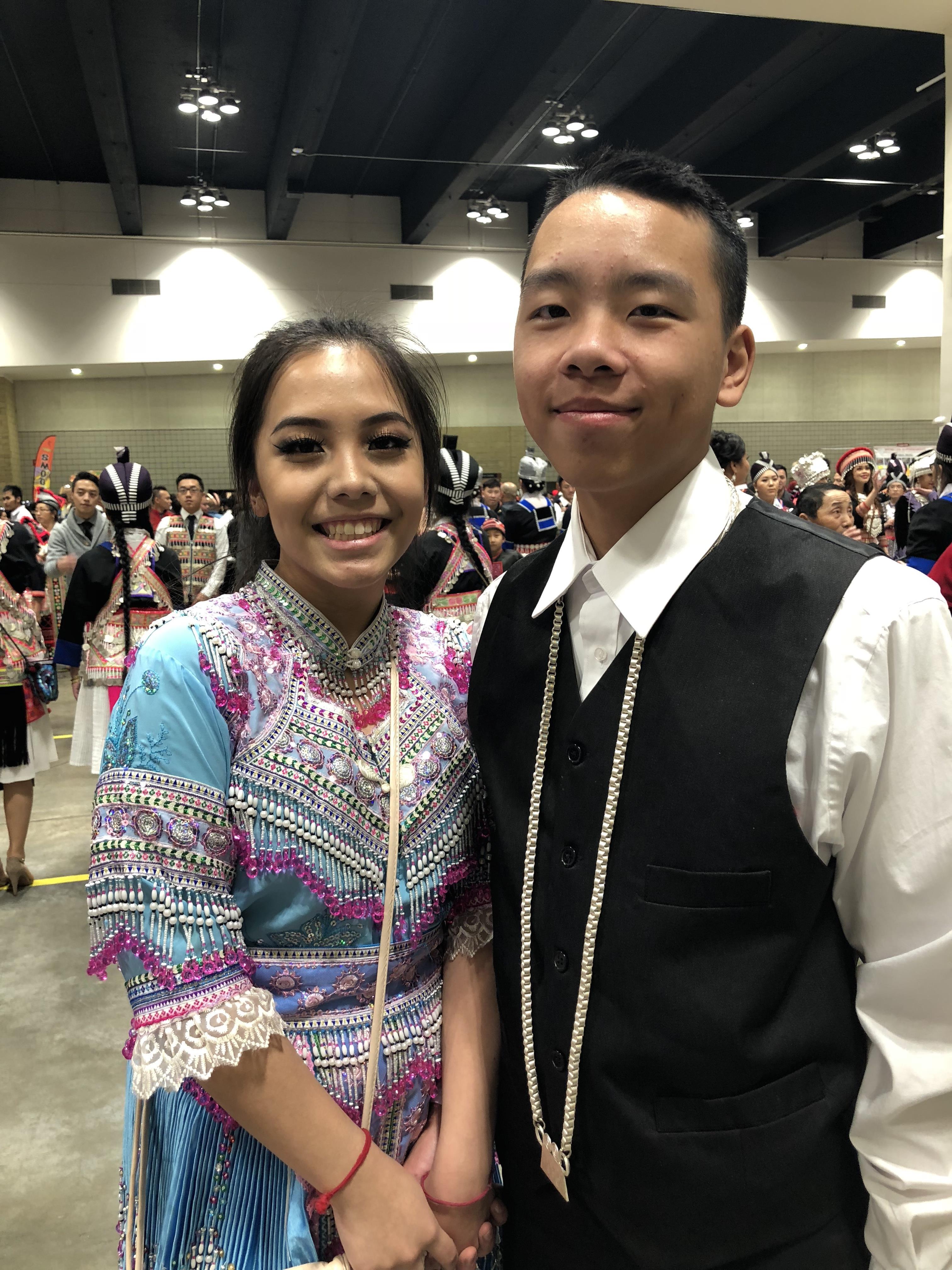
Hmong New Year is a celebration celebrated by Hmong people every year. It is celebrated from November 24th to the 26th, it lasts three days. In St. Paul, the New Year takes place at RiverCentre, near the Xcel Energy Center. Many people wear traditional Hmong clothes to the celebration. The celebration usually starts early and ends very late with an after party.

At Hmong New year, there are food stands that sell common Hmong food and drinks. There are also booths where people can sell stuff such as: movies, clothes, toys, medicine, jewelry, and more. Other than that, there are performances. The performances are usually dance groups, and singers, and there is also a Miss Hmong Minnesota Pageant every year.

Aside from performances, there is also ball toss area where most people hang out. Ball tossing is a game where the two (or more) players toss a ball back and forth. Usually a guy, who sees a girl he is interested in, will ask the girl to a ball toss game. During the game they guy will try to get to know the girl more, and hopes that she will be interested back.

picture courtesy of Timothy Lor

This year, I was able to go with some of my school friends. We stayed for a few hours: watching performances, eating food, and just hanging out around the ball toss area. It was a great time, and many funny things happened. I asked two of my friends (via text) about Hmong New Year. I asked: “How they felt about Hmong New Year?”, “What’s the experience like?”, and “What’s their most memorable memory?”

Timothy: “Hmong New Year has a feeling of excitement ready to be explored. There are many different variety of things, it is very impressive and fascinating. My experience at Hmong New Year felt very short as I had to leave early. Since I went with my friends from school and saw old friends from elementary, it was like walking into smiling faces with loud music. The most memorable moment from Hmong New Year was when a Hmong Chinese lady was singing. It was very graceful and pleasant hearing people cheer for other people, singing from all sorts of different ages, and seeing people that are not Hmong being there.”

Elizabeth: “Hmong New Year was alright for me, I liked it because I went with my friends, it’s better going with friends than going alone or with family because you’re more free. The experience was fun but tiring because we had walked around a lot. The most memorable memory for me was the food, they had really good food there.”


The evolution to modern day Thanksgiving

The history of Holidays has always been interesting to me, especially the evolution to the way a Holiday is celebrated currently. So, I decided to research the evolution from harvest festival to Thanksgiving.

Many Americans gather every year to have a nice meal with their family and give thanks to what is most important in their life, or something like that. My family doesn’t really do “thanks.” Either way, Thanksgiving is a long celebrated Holiday in America and I was curious where it all started.

Most of us probably know about the Pilgrim-Indian meal after Squanto showed sickly Pilgrims how to farm. However, many historians point out that this is more legend than fact. Truth is that historians aren’t really sure what happened on the “First Thanksgiving” and many Native Americans take offense to the widely taught version of the first Thanksgiving saying that it paints an all to sunny picture of relations between the Pilgrims and Wampanoag people, in turn masking a long history between Europeans and Native Americans that caused the death of millions of people. So, because of the doubts of the history I’ll be focusing on how Thanksgiving evolved from when it was first declared a National Holiday.

Abraham Lincoln declared Thanksgiving a National Holiday in 1863 at the height of the Civil War. Previously, many people had already celebrated Thanksgiving. Lincoln established Thanksgiving as a Holiday so Americans could ask God to “commend to his tender care all those who have become widows, orphans, mourners or sufferers in the lamentable civil strife” and to “heal the wounds of the nation.” Lincoln scheduled Thanksgiving to be on the fourth Thursday of November. In 1939, Franklin D. Roosevelt had moved Thanksgiving up a week to the third Thursday, to try and boost retail sales during the Great Depression. However, this was met with great opposition and it was then moved, reluctantly, back to the fourth Thursday of November, in 1941.

The food traditionally served at Thanksgiving has changed from venison (deer) during the Pilgrim times, to turkey currently. This may have happened because of the abundance of deer during the 1600s. The change most notably happened in the 1800s. A book written by Sarah Josehpa Hale titled Northwood; A Tale of New England highlights the ideal Thanksgiving feast, including: turkey, beef, pork, mutton (sheep), pickles and preserves, vegetables, custards, cheese, cake and pies.

Some things have been added to the Thanksgiving tradition more recently, such as cranberry sauce, which appeared in 1912 after Cape Cod Cranberry Co. started to sell canned cranberry sauce. Green bean casserole has been added as well.

For more information about Thanksgiving, visit the following sites:

http://www.history.com/topics/thanksgiving/history-of-thanksgiving

https://www.nbcnews.com/science/lot-digest-how-thanksgiving-feast-has-evolved-over-150-years-2d11656681

The origin and brief history of Halloween

It’s that time of year again! That’s right, it’s almost Halloween, my personal favorite. Halloween is a holiday that, in modern times, celebrates ghosts, ghouls, zombies and anything spooky really. And of course, free candy! Who doesn’t love the free candy? However, Halloween is a very old holiday with a rich history that not many know about, including myself. So I researched the origin and history of my favorite holiday and here’s what I found.

Halloween originated in Celtic tradition with a festival called Samhain (pronounced sow-in), which was celebrated on the same day as modern Halloween. During Samhain people would light bonfires and wear costumes to ward off ghosts. During this day, Pagans believed that the worlds between the afterlife and the living aligned, allowing ghosts to walk freely around the living world. They believed the ghosts would wreak havoc on their crops and spread illness.

In the 7th century, Pope Gregory III dedicated May 13th as a time to honor the saints, which included some aspects of Samhain, and during this time they would commemorate the dead.

In the 9th century it was changed to November 1st. Many historians believe it was changed to overshadow the Pagan festival. It was called All Saints Day, and the night before that was called All Hallows’ Eve which was later called Halloween.

By 1550s, Allhallowtide – a three day event, was recognized and almost obligatory in most of Europe. During these three days people would mourn the dead, dressed in black, and treat on soul cakes which were given out to remember the dead.

The 1700s is when some of the modern practices of Halloween come into play. People celebrating Samhain, would go door-to-door exchanging sung songs for food, and doing so while in costume, of course. Some would play pranks on people and hold lanterns made of gourds to imitate the malicious spirits that come out during Samhain. Even bobbing for apples was recorded in Scotland, but it was called “dooking.”

During the 1800s an influx of Scottish and Irish immigrants came to the U.S. bringing along their Halloween traditions.

Which brings us back to the present. Now, Halloween’s humble beginnings are but a tale lost, mostly, to time. And possibly bad record keeping.

For more information about the origins of Halloween, please check out the following websites:

http://www.nydailynews.com/life-style/timeline-origin-halloween-article-1.2406149

http://www.history.com/topics/halloween/history-of-halloween

Highland Park Senior High School Homecoming Dance

The Highland Park Homecoming Dance is a tradition at our school, and it happens every year. Some people go to the Homecoming Dance to be have fun and enjoy the music, and others think it is a good place to meet new people and hangout with friends.

I also took time to specifically ask some of the freshman what they think about the dance, and how they feel about it. Some of them told me that they were hoping to meet some cute guys and talk to people they don’t talk to doing school hours, and also to get to know more people.

I also interviewed some of the seniors, and I asked them how they felt about this being their last Homecoming Dance at Highland, and what will they miss about it. Some of them told me that they will miss their friends, and the fun. They also told me that they are so ready to leave the school because they were tired of seeing the same faces every year, spending money for the same things, and that they were glad that this was their last year so they will meet new people and see new things.

I also got to ask some juniors, who were going to the Homecoming Dance for the first time, about why they never go, and they told me that they went this year because they wanted to know how it looked.

Grand Old Days

If you didn’t go to Grand Old Days this year in St. Paul, you missed out. The festival this year was held on Saturday, June 4th, and it lasted all day long. Grand Old Days is a fun filled exciting day that runs up and down Grand Ave all day. The day is full of fun activities like bouncy houses, slides, and fun little mini games like bags or home run derby.

There is also a lot of different kinds of foods available. The food is served via food stands and is cooked right in front of you, so it is always new and fresh. The foods they serve include all your typical festival foods like corn dogs, hamburgers, and hot dogs, but there are also some different foods that in my opinion taste better. The options don’t stop at food though, and there are many drinks like Jamba Juice, lemonade, soda, and this year I even saw drinks served in whole coconuts.

Grand Old Days is a place to go if you want to go and have a good time with your friends and family or by yourself.

Once you have eaten and walked around, and enjoyed what there is to see, you can have a little rest and wait for the parade. The parade is a fantastic parade that includes small and big businesses and organizations, shops on Grand, and of course candy. The parade is never disappointing and always very interesting to see what floats they make to use in the parade. This year there was a wide variety of floats in the parade ranging from small flashy and colorful floats to huge floats packed to the brim with people throwing out candy.

Grand Old Days, as an overall activity, is a great family friendly fun event where you enjoy every second that you are there. I know that I had fun at Grand Old Days and I’m confident that if I asked people that went they would say the same.

Another thing that is very cool at Grand Old Days is the amount of local businesses that have been given space and booths at the event. Many events now are just overrun by big companies and businesses, but at Grand Old Days, and in most of St. Paul, they encourage and support small businesses and local stores or companies.

On the Grand Old Days webpage, they have a whole section devoted to local businesses, and at the event they have two whole blocks set aside for local businesses. I think that this is a very cool thing that they are doing because, like I said before, most events are overrun by big companies and businesses, but I feel that new ideas do need to be expressed and I’ve found that most small and local businesses have very unique and new ideas. Now this isn’t to say that every small business does, but it is more common. This is why I enjoy Grand Old Days as much as I do, because they give everyone a chance to express themselves and share what they have to offer.