Category Archives: Editorials/Student Voice

Editor’s Note: The Plaid Line publishes editorials that contain opinions that are those of the student authors. They do not purport to reflect the opinions or views of the the Plaid Line, HPSH, or its staff.

Florida had become hostile to African Americans

By: Jasmine Williams

Photo by Guillaume Hankenne on Pexels.com

According to ‘Rolling Stone,’ the NAACP had issued a travel advisory warning Black Americans who were thinking about going to Florida. The NAACP has said, “[Florida is] openly hostile toward African Americans, people of color and LGBTQ+ individuals.” This is surprising because of how many people actually would or would have gone to Florida.

About 34.6 million domestic people went to Florida from January 1st to March 31st for vacation. The NAACP had stated, “Before traveling to Florida, please understand that the state of Florida devalues and marginalizes the contributions of, and the challenges faced by African Americans and other communities of color.”

Ron DeSantis, the Florida Republican governor, is against diversity and inclusion. In 2022, he signed a bill that executed a ban on race topics being taught in schools. AP African American studies are inaccessible to students because he thinks it’s a political agenda. DeSantis said, “[T]he country is rotten and that our institutions are illegitimate.”

DeSantis had tried to cover up the truth of discrimination of Black Americans now and in the past. DeSantis neglects Black Americans struggles and their history, showing how inconsiderate he is about Black people. Since they would ban AP African American studies, others would not be able to learn about the history behind African Americans and their struggles and be able to help them.

The president and CEO of the NAACP, Derrick Johnson, had said, “Let me be clear — failing to teach an accurate representation of the horrors and inequalities that Black Americans have faced and continue to face is a disservice to students and a dereliction of duty to all.”

Just before this advisory for Black Americans came, the LULAC, the League of United Latin American Citizens, had announced an advisory to Latinos. DeSantis had put into place cruel penalties for undocumented people. It may be better to book your next flight to another place next vacation.

For more information, please go to:

https://www.cnn.com/2023/05/21/us/naacp-florida-travel-advisory/index.html

https://naacp.org/articles/naacp-issues-travel-advisory-florida

McCarthyism and the demolition of progress in the United States

By: Charlie Boone

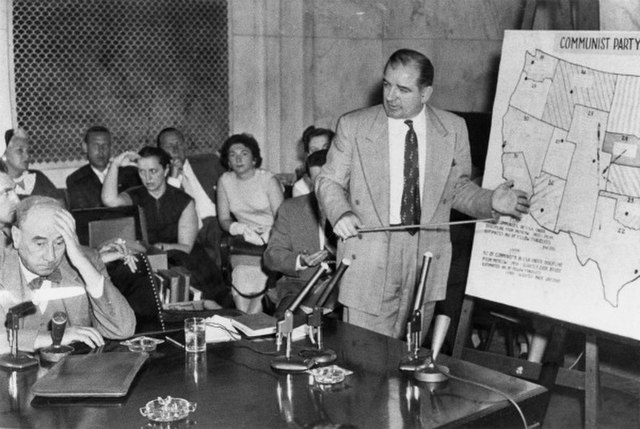
Welch-McCarthy Hearings: Image via Wikimedia Commons

Wisconsin Senator, Joseph McCarthy’s corrupt and unfounded attacks on communism during the 40s and 50s, portraying the ideology as a vague, amorphous enemy have both directly and indirectly halted societal progress within the United States and influenced the right wing’s focus on culture war issues.

While a majority of McCarthy’s attacks were rooted in white supremacy, homophobia, and anti-semitism, many modern anti-communists lead with a different approach, depicting all socialization as tyrannical; typically citing nations with downfalls directly related to U.S. imperialism and intervention i.e. coups, sanctions, banana republics, etc. and blaming it all on the bogeyman of socialism. This depiction has done arguably the most damage, as it’s a very regular talking point to say that free healthcare and education are too radical, from both the left and the right. This is an intentional move from establishment capitalists, as well as the corporations in their pockets because, for example, if you explained to the average person that the LAPD was just given an extra $3.2 billion, as reported by the LA Times, and there are over 420,000 homeless people in the United States, and 37.9 million people live below the poverty line, according to the U.S. Department of Housing and Urban Development, I think they would agree that there’s a problem.

According to the right, America is a meritocracy, and your material conditions are exclusively a product of how hard you work, rather than an amalgamation of systemic, historical, and personal circumstances. This characterization is very obviously not true, as a person born into a wealthy family will experience distinct advantages, both economically and socially, despite not working any harder than someone born into poverty or homelessness.

It’s also important to mention that in our current economic state, upward-class mobility is nearly impossible, despite the exceptions that are often highlighted to try to dismiss the problem. Obviously, hard work is important but if you looked at two people born in completely different economic situations, both working as hard as one another, their outcome is likely going to be drastically different, which again, most people would agree is a problem. With all of the barriers set up to avoid hiring people in poverty, as well as it being pretty much impossible to find a job if you are homeless, the “pull yourself up by your bootstraps” mentality simply does not work, especially in the United States where just under 900,000 Americans die in poverty, as cited by the University of Columbia in 2010, and 45,000 Americans die as a direct result of lack of access to healthcare each year according to a 2009 report by the Harvard Medical School.

The fundamental idea of capitalism is the maximization of profit for the corporation while spending the least amount of money on labor. This is important because the capitalist does not necessarily hate the worker, they simply view them as disposable, and a means to make a profit. This inevitably leads to an insane gap of wealth between the working class and the CEOs, where the workers are barely making a fraction’s worth of their labor.

My point here in explaining the exploitation and inherent inequality of capitalism is to say that without McCarthy and the general right’s demonization of communism and socialism, a much larger number of Americans would agree that the current system at the very least needs serious reform. I also believe that there would be a much larger number of prominent socialist politicians that aren’t constantly bogged down by the Democratic party without McCarthy’s direct career-ruining actions toward anyone who presented views anywhere close to anti-capitalist.

McCarthy’s accusatory and defamatory tactics have also proven to be incredibly influential in shaping the right wing’s focus on the “culture war’”. If you’re not familiar, the term culture war is used to describe a general polarization and stark divide between societal values, typically to distract voters from the fact that a majority of their frustrations are a direct result of capitalism. One of Joseph McCarthy’s commonly used tactics was to accuse his ideological enemies of not only being communists but also homosexuals, expanding the evil, amorphous fog sent out to destroy your family and attack your children.

Over time, the fog continued to grow, collecting more marginalized groups to scapegoat issues onto, as is always the case with fascism. In 2023 alone, the republican party has passed 75 anti-trans bills with 555 proposed in total, some being as egregious as making providing gender-affirming care to someone under 26 years old a felony for healthcare providers (OK SB129). Most Americans see this as ridiculous and fascistic, the same way they looked at Joseph McCarthy, but the rapid influence of far-right legislators and echo chambers continues to push culture war issues to the point of genocidal rhetoric.

Fascism is still very much alive and well in the United States, and the lack of action from the Democratic party is worrying. It’s becoming more and more apparent that many establishment Democrats would rather have a fascist in office than a progressive, and the continued push for “business as usual” neoliberal politics is going to swing that door wide open.

For more information, please visit:
How gun violence is getting out of control

By: Lauren Kottke & Ella Sutherland

Photo by Emma Guliani on Pexels.com

Gun control is a big issue in the United States. It is an issue that has begun to get worse by the years. We are seeing the number of school shootings and mass shootings rise.

There are many statistics that prove the rise of gun violence. We found statistics that show that over the past couple decades, gun production, ownership and mass shootings have increased. NBC put out an article stating, from 1988 to 1992, the production of guns was at 3-4 million annually. But in 2009, that increased to 5 million. And then in 2016 it peaked to 11 million guns sold. They also stated that, in 2021 there were 61 active shooter incidents – “which the FBI describes as events in which someone is engaged in killing or attempting to kill people in a populated area”. But the previous year, there were 40 active shooter incidents.

To us and students, this issue is very important and personal to us. We see the school shootings happening around us and wonder if it would ever be us. Realistically, it is very unlikely but the fear is still there. Kids go to school everyday scared. And it seems like every time there is a school shooting, kids are the ones to fight. They are the ones to have protests and call for change. But nothing does change.

And that is because students and kids don’t have the power to change the laws. The people who control the laws and regulations on guns are congress and the states. Congress can change the laws through commerce and taxing laws. But they only have power that is enumerated in the US Constitution. So it is limited.

But the states can make regulations on guns to make them less accessible. For example, Minnesota has strict regulations on guns. If you want to buy a gun, you have to get a permit to carry a firearm, a background check, mental health screening and much more. If you have served time in jail, you cannot purchase a gun. But other states like Alabama, have less regulations on guns. There you can buy a gun without a background check or a permit. So it is up to the states what regulations should be on guns.

It’s hard to change gun control when you have no power. And most people don’t have the power to change it. The only people that can change the laws and regulations are people in the government. But people can still push for change by voicing their ideas, which could push the government to make changes. So here are some of our solutions that you can do to help support gun control.

Our first solution is to contact St. Paul’s elected representative and ask them to support and advocate for change. Demand that they advocate for effective gun violence prevention legislation. Although it might not seem like this solution can change much, it’s important to make our voices heard. So we would get our families and friends to also contact our representative. And our hope is that more people would join in and contact their representatives, starting a movement. We also hope that once enough people have contacted the representatives, change will be made. They will announce their support for effective gun control legislation, and announce a way they are willing to make change. For example by introducing a bill they could present to the governor (Note, in the recent session, Minnesota did pass more gun control laws).

Our second solution to this issue would be to write to our local paper and ask them to publish an article we wrote about gun violence. We will write an article that talks about how the legislation on guns is not enough, the number of school shootings rising, and active shooter incidents in general rising. We would also talk about how the companies that sell guns are benefiting from the rise in gun sales and how we can fix this issue. Like we said earlier, we don’t have much power to change the laws on guns, but we still have enough power to voice our opinions. And by publishing our article it would allow for more people to see our point of view. It could change the way people think about gun control. We think that because it would be students speaking, people would listen. We have our own experiences going to school during gun violence’s peak.

We hope that you take away some useful information from this article and help enact change. Whether that be talking about gun control to your friends and family, donating to gun violence organizations or contacting your local representative.

For more information you can visit:

  • “6 Charts That Show the Rise of Guns in the U.S. — and People Dying from Them.” http://www.nbcnews.com/data-graphics/6-charts-show-rise-guns-us-people-dying-rcna30537.
  • “Federal Powers.” Giffords, giffords.org/lawcenter/gun-laws/policy-areas/other-laws-policies/federal-powers/#:~:text=Congre ss%20can%20regulate%20firearms%20through
  • “Gun Ownership by State 2020.” worldpopulationreview.com/state-rankings/gun-ownership-by-state

Discrimination in the healthcare system

By: Lauren Kottke & Ella Sutherland

Discrimination against minorities in healthcare is a very real and serious issue. This affects the health and well-being of millions of people. Many studies have shown that when it comes to health care racial minorities are much more likely to be treated worse than a white patient in the same hospital with the same health issue. This can lead to worse health for that person or even sometimes preventable deaths. This discrimination can be seen through bias toward white patients, prejudice, and even straight up verbal and non-verbal discrimination.

Healthcare workers might not know they are not offering the same care to all of their patients, through implicit bias. Implicit bias is to subconsciously associate groups of people with a negative evaluation. They might not know they are doing it, but they are making assumptions about minorities which then affects how they treat them.

Studies have shown that health care providers are more likely to give pain relief to white patients, than black patients. This is rooted in the racist stereotype that black people have a higher pain tolerance. The stereotype started when slavery existed and there was unethical medical testing on slaves. It is now known that the stereotypes of black people having thicker skin or less sensitive nerve endings is not true. But it still affects how they are treated in the healthcare system.

Another issue with minorities and healthcare is the costs of medical care. With healthcare prices going up quite a lot, people are finding it hard to afford the healthcare they need. This especially affects minorities showing that their salary is less than a white man’s salary. For every 1 dollar a White man makes, Black women make $0.64, Multiracial Black women make $0.63, Multiracial Asian women make $0.98, Hispanic women make $0.57, and finally, White, non-Hispanic women make $0.79 (wage gap information taken from the U.S. Census Bureau).

Because of these pay gaps it makes it even harder for women of color to afford the healthcare that is required for them to be healthy. This is a problem that can lead many to push off healthcare until deemed absolutely necessary, which is when that sickness or injury is much much worse. This also leads to families being put in hard financial troubles as well as debt.

So, how can we fix this? We first have to accept that there is racism to this day in the healthcare system. Many people would rather say that there is no racism in the healthcare system, than just face the issue. After we accept that there still is racism, we can then look and call it out. Look at how you are being treated at the doctors, compared to your other peers. And if you see discrimination, call it out. Talk to the health care providers about what you saw and ask for change.

We can also start educating medical students about racism in the healthcare system and implicit bias. It should be a mandatory class that all students have to take. This issue isn’t talked about and needs to be if we want change. The students in medical school are our future doctors, so we want to stop the implicit biases before they start caring for patients.

Another solution to the discrimination is standardizing the procedures in healthcare. It is very common that people will have the same procedures done. So by standardizing them, all patients would receive the same level of care.

For more information, please visit:

What I’ve learned from doing crossword puzzles for over a month

By: Daniel Kendle

Happy holidays dear readers, I hope you’re having a good winter break. I got a gift for you! Here, open it.

(Crumpling paper) Oh hey, it’s a box. With a piece of paper inside. Turn it over, you’ll see.

Why, it’s a crossword puzzle! Those thingies are always fun to do on a whim. You know, sitting down with a cup of juice in the morning, struggling on the 3rd word until you inevitably give up and look up the answer key on Google, good times.

What? Why am I giving you a present? Well, it’s the holiday season, why not? It’s April? Ha, what ludicrous nonsense. My watch says otherwise.
10:02, Monday, April 24.

Oh. Maybe it’s time to get a new watch. Why does it say that it’s April?

Well, getting back to the topic at hand, crossword puzzles are one of the USA’s favorite newspaper pastimes, alongside the comics section and advice columns. I decided to take it upon myself in order to fascinate the world with this age-old puzzle. Thus, I’ve done the challenge of doing a crossword puzzle every day for over a month (March-April).

For the specific puzzle, I chose to complete the New York Times’ crosswords, specifically one known as the Mini. It’s basically a smaller, bite-sized square that has about 10-15 words, and is more digestible. This isn’t to say that it’s easier, but quicker, yes. Mainly because it takes a solid chunk of time to do a large crossword puzzle, and I wanted to make this article sooner rather than later.

For those who don’t know how crossword puzzles work, you basically have a bunch of boxes to put words in, and those boxes intersect with other boxes to connect to each other with shared letters. The Mini works like this, though is just more tightly wound.

Anyways, I’ve prepared 3 rules from my gatherings in the field to help others with their dreams of crossword claim. Here they are.

1.) ALWAYS LOCATE THE EASY JUNK

Whenever you start a new puzzle, it’s always important to look for the brain dead phrases. Stuff like “What sound does a cow make?” moreover than “What’s my home address?” (Don’t answer that). Once you’ve found the gimmes, then you can move onto the harder stuff.

2.) AUTO-CHECK IS A FRIEND. A VERY VERY VERY GOOD FRIEND

In life, we always have “that” friend. The friend that is by our side no matter the circumstances. The friend that is willing to give their entire financial credibility to help us out of a problem. The friend that’ll dig a hole into their room to get them out of being grounded (thanks Lil’ Timmy!) and in this case, your friend is Auto-Check. This system checks to see if a letter is correctly placed in a square, that way you’re not just blindly guessing. Some call this a cheat-sheet, though I moreover think of it as a helpful little…cheat-sheet.

3.) BE SMART

There are numerous different words in the English lexicon – at least 10, last time I checked – and it takes time for one to memorize to remember words and such. So do it. Read up on dictionaries, quiz with cordial associates such as your loved ones, and read through solved crossword puzzles to know what kinds of questions are asked.

Alright, I hope all of this has been helpful to you and your crossword-solving pursuits. Let my experience guide you forward into the blissful beyond that is The New York Times crossword puzzle. In fact, here’s a link to their page with all their games!

https://www.nytimes.com/crosswords?scrlybrkr=5a2a8e49

Happy solving!

Thoughts on History Day

By: Julia Yang

This is my opinion on History Day, and my opinion only. You might feel different, and that’s alright.

For those of you who haven’t had, or know about History Day, let me give you a quick summary; History Day is a school event where students have to research an event in history and make a project about it, usually, a presentation board. After that’s done, everyone places in an open area with tables and everybody walks around to look at other projects.

With that out of the way, let’s continue.

I really don’t think History Day is all that helpful to a child’s education. I’ve already forgotten what I learned on my chosen event. The concept of History Day doesn’t make any sense to me – Why are we just learning ONE thing in our entire history? Or who has actually learned something and remembered it from it?

It just seems like a burden.

I know so many students and teachers that agree with me, so I’m not too sure why it’s still a thing we need to do.

National History Day says, “National History Day teaches critical thinking, writing, and research skills; prepares students for college, work, and citizenship; and inspires students to do more than they ever thought they could.”

History day didn’t help me with any of that. If anything, all it did was raise my stress levels. I did this project in middle school, so I didn’t even know what I was doing. By then, I had just learned what a presentation board was.

In the end, I don’t know why History Day exists. I found it irritable, boring, and stress inducing.

The Willow Project

By: Lauren Kottke & Ella Sutherland

Climate change seems to be the problem in the world that is growing bigger every year. Every couple of months and years a new problem emerges surrounding the topic of climate change. Water levels are rising, species of different animals are going extinct, the ozone layer is heating up, and the trash in the ocean is growing by the second. And it doesn’t seem like the problem is going to be fixed anytime soon. The new environment talk is about The Willow Project.

The Willow Project is an oil drilling venture which was just passed by the Biden administration. Oil drilling is a very wealthy business in the United States and across the world. Oil is necessary for everyday life like heating buildings and creating electricity, but the downside of oil drilling is that it severely damages our planet. It releases toxic gasses into the atmosphere and oftentimes chemicals are disposed of into water. Oil spills aren’t uncommon for oil drilling sites, and are very damaging. They hurt the environment and animals in that area.

The project had been an issue in the White House for months with much debate. The Biden administration did not necessarily want to pass the project, but had no choice. Conoco, the company leading The Willow Project, already had existing leases on the land. Also, the project was already approved by the Trump administration back in 2020 which made it harder for them to deny Conoco.

This whole project will take up to 30 years, with a total cost of $8 billion dollars. Originally, Conoco wanted to build five oil drilling sites, but the Biden administration negotiated for three sites. Even still, with two less sites, Conoco will be able to retrieve 90% of the oil.

Although the project was approved, it might not mean that they can start construction right away. There are many groups trying to stop the project from proceeding. One in particular is EarthJustice, who have filed a complaint against the company. The goal for them is to get an injunction which then will put the project on hold. This is very important because if they can stop the project for now, they can stop it for a year. The timing of building the oil sites is crucial because of the seasons in Alaska. Winter is expected to be done by mid April. And that is the perfect time for Conoco to start construction.

Another reason why the Willow Project is not a very positive thing is the environmental side effects. It can speed up global warming as well as severely alter many animal’s habitats and migration patterns. Just a few of the species that would be greatly affected by this project are the Teshekpuk caribou herd, polar bears, and migratory birds.

With all this being said there are a couple positives to this project. First off, this project would need many people working on it and would provide almost 2,500 jobs for people in construction, as well as around 300 long-term jobs.

Secondly, it would help Alaska’s economy and tax revenues. Willow could provide up to 10 billion dollars when all is finished.

Overall, the cons weigh out the pros by quite a bit and the Willow Project will do more harm than good. This project has many side effects and in our opinion this should never have been approved.

For more information, please visit:

Tennessee passes bill that limits marriage equality

B:y Mya Olson – Williams

In early March, the Tennessee House of Representatives passed a new bill that allows a person to refuse to conduct a marriage based on their religious and personal beliefs. This bill was presented by Representative Monty Fritts (R – Kingston).

Many believe that this law will make things easier for officiants to discriminate against same-sex, interracial, LGBTQ+, and interfaith (people of different religions) couples.

According to theamm.org, these are the exact words written in House Bill 878:

“(m) A person shall not be required to solemnize a marriage if the person has an objection to solemnizing the marriage based on the person’s conscience or religious beliefs.”

There was already a law in place seeming pretty similar, but this one lets people refuse on any grounds.

Tennessee is not stopping here. They are moving to block online ordained ministers from conducting weddings. If that becomes the case, it would make it almost impossible for any interracial, same-sex, LGBTQ+, or interfaith couples to get married in the state of Tennessee.

Monty Fritts denied the fact that this bill would only allow refusal of solemnizing same-sex marriages. He believes that there’s a drive to attack “civil liberties and rights”.

There are other states going through very similar things as well. Currently there are laws in place in the states of Kansas, North Carolina, Mississippi, and there could be more coming in the near future.

Unfortunately, the Respect for Marriage Act, put in place in December of 2022, does not protect anyone in those few states. Same-sex couples (married or not) can still live in these places, but they can no longer get married there.

It’s commonly said that we are going backwards in time. There’s so much wrong with these laws, and many are convinced that this inequality will not stop here, but only get worse.

Religion isn’t an excuse

By: Julia Yang

Before I continue with this article, I would like to say that this article is written for my opinion on this matter, nothing is factual and you don’t have to agree. This article is not meant to offend anyone, I respect all religions and believe everyone has their own rights to believe in what they want to. But everyone has different opinions on this, and this article is mine.

This article is on how I don’t believe that religion should be an excuse for bad or rude behavior.

Let’s talk sexual orientation. There are a ton of religious people that heavily dislike people who aren’t straight. They believe that it’s wrong and isn’t humanly right. I think that’s dumb. Why should your religion be a good reason for you being homophobic? Things like sending children to institutions to try and convert them into being straight, is that religion too? You can’t convert someone’s sexual orientation. They love who they love, and no one can change that.

People that practice religions with God(s) might say they can hear the God(s) talking to them, I personally don’t mind that. You can believe what you want to believe, but you cross my line when you say God(s) told you to do something horrible. I’ve seen people kill their own children just because their God(s) told them to. That’s murder and there’s no excuse for that.

I have also seen that peoples’ excuse for racism is religion as well. Honestly, I can’t believe we live in a world where racism, homophobia, abilism, and murder is excused for religion. So basically, in someone’s world, that’s all okay. When is any of that ever or okay in any circumstance?

There are loads of religious people who aren’t like this, in fact, the majority aren’t like this. But the few people who are like this are giving religious people a bad rap.

Women’s History Month

By: Lauren Kottke & Ella Sutherland

Women’s history month is the month of March that is dedicated to women. It’s to honor the women that have been mistreated, pushed down, and suffered throughout history. It’s well known about the struggles that women have faced for hundreds of years. Up until the women’s suffrage movement, they couldn’t even vote. And before that, it wasn’t normalized for women to have a job or to be unmarried. Though much has changed, the world is still unsafe for women.

Women’s history month started in 1978. At first it was only a week-long celebration and was called “Women’s History Week’. It started in Santa Rosa California by the Education Task Force of Sonoma County Commission and the Status of Women. Women’s History Week was led by a teacher named Molly Murphy McGregor. During that week, Santa Rosa had presentations on women’s contributions to history, society and culture. After the Santa Rosa Women’s Week, it spread across the country. More and more states started to follow and celebrate Women’s Week.

Someone who helped start celebrating women was Gerda Lerner. She organized and chaired a 15-day conference on women’s history. Her conference had many different sponsors for the event. Women’s Action Alliance and the Smithsonian Institution were two of the many sponsors. This conference made more people push towards Women’s Month.

“Women’s history is a women’s right—an essential, indispensable heritage from which we can draw pride, comfort, courage, and long-range vision.”— Gerda Lerner

It wasn’t until 1980 that Women’s Week became a national celebration. In February of 1980, president Jimmy Carter declared March 2-8 as National Women’s History Week. After it was declared by the president, more issues started to be passed by the president. On August 4, 1981, president Ronald Reagan issued a proclamation that Women’s History Week would be celebrated with ceremonies and activities. People wanted there to be speakers, presentations, and parades.

Then, in 1987, congress passed a petition which made Women’s Week, Women’s Month. The petition was made by the National Women’s History Project. And after 1987 it became an annual celebration.

Now Women’s History Month is celebrated by the United States, the United Kingdom, and Australia. Other countries celebrate but at different times. For example, Canada celebrates Women’s Month during October. There is also International Women’s Day on March 8th.

Since Women’s History Month started, there have been things that have improved and some things that haven’t.

One of the things that have improved for women is the amount of women working in the government. This may not seem like a huge deal but it is. Women now have a say in laws that get passed, and are more likely to recognize women’s struggles.

Another way that things have improved for women is now many more countries are instigating laws to support the fight for gender equality. In the last 10 years, 131 countries have passed over 274 legal reforms in order to create more equality between genders. This is important for the futures of young girls and women.

One more way that things have improved for women is the percentage of young women and girls, that are attending school, has gone up hugely. As of today there are over 79 million more girls that are in school learning than there were in 1998.

There are still many issues that women face today like pay gaps, job security, gender based violence, and reproductive rights being taken away. We still have a long way to go before women can feel fully comfortable in the world we live in today, but from what we can tell we are making slow progress.

For more information, please visit: