The end of another year

By: Plaid Line Editor

Well, we’ve wrapped up another successful school year. We hope that you’ve enjoyed the content we’ve provided throughout the year, and that you will continue to support us next year.

Speaking of next year, you will probably see some major changes as we start to incorporate video content through Scottie News reports. Additionally, we hope to restructure the site in a way that highlights PRIZIM work more as well.

Again, thank you for your support this year, and we hope you come back with us next fall (in the meantime, like always when we go on break, feel free to check out any of our older pieces that you may not have had a chance to look at previously)!

Thanks – HPSH Plaid Line

JOYSTiCK Reviews Ep. 17 (Season Finale): ‘Psycho Soldier’ – Path of the Psycho

By: Daniel Kendle

…a psycho-path, if you will.

Hey gang, it’s me – Mr. Whatshisname, and welcome back to JOYSTiCK Reviews. After another year of writing for this serial, we’ve reached another milestone: the end of season 2! It’s been fun, but alas, the road’s end has come upon us. As customary, at the end of today’s review we’ll be taking a look at a brief ranking of all of the game’s I’ve reviewed thus far, with both season 1 and 2 titles included. This is so we can not only look back on the series as of yet, but doing so also lets me update scores as I see fit.

Of course, any review to be included alongside the aforementioned ranking ought to be short and sweet. Thus, I’ve dove into my “archive” (fat closet) of video game personals and have chosen the title ‘Psycho Soldier,’ released by SNK for arcades in 1987. The game is yet another retro title, the first I’ve reviewed since ‘Tetris.’

‘Psycho Soldier’ is a side-scrolling “shmup” (shoot-em’-up) game following Athena Asamiya and Sie Kensou, a pair of soldiers who, believe it or not, possess psychic powers used to fight back against an alien invasion of Japan. The game follows whichever one the player picks – though Athena is often seen as more of the game’s main main character between the two – as they descend into the Earth’s crust while fighting monsters and aliens.

Combat involves a handful of Psycho abilities, with a gauge in the bottom-left of the screen dictating the amount you have left. Attacks have you shoot out exploding orbs, lasers, and even let you transform into a different beast form depending on which character you choose, despite both functioning similarly.

I played through the game on a console, so it wasn’t required that I insert coins or tokens to continue playing after dying. This is the case for a lot of arcade-to-console ports, and I think that’s part of the reason the gameplay overall really didn’t click for me. It also goes that I’m not really a person who frequents high-score games often; I just don’t find them all that compelling compared to games with a definitive end point. These factors combined led to my experience with the game culminating in me dying, respawning, and continuing the level without worrying about my loss of points. I’m willing to admit that this is less so the game’s fault as it is my own, so I can’t really degrade it for my own personal values.

What I can degrade, however, are the controls. It’s not rare for older arcade titles to be fairly limited in movement when ported over to console controls, especially modern ones. ‘Psycho Soldier’ is no different: Athena’s movements are particularly stiff and slow, creating a bevy of problems when precise aiming is required for certain enemies. The issue is found with bosses too; some have attacks that involve them quickly darting out and striking you, which can become difficult to avoid if you aren’t in an ample spot for dodging. Since they usually take up the right half of the screen when encountered, your limited space to maneuver, er, limits the practicality of dodging these attacks.

Other than that, powerups and enemies are pretty forgettable, nothing to run home about. I suppose there’s a sort of brainless fun to be had when mowing down aliens and destructible blockades, but that feels like a lame “positive” for a video game.

“B-but Mr. Whatshisname! What about the game’s theme song, the first ever recorded for a video game character? You couldn’t possibly leave out that,” you wail, somehow ignorant to the raised cudgel being aimed at your head. I tolerate mindless whining about as much as I tolerate insubordination – I suppose you can connect the dots from there.

You’re correct in your nagging, though: ‘Psycho Soldier’ was the first-ever video game to feature a song with vocals included for one of its characters, creatively-dubbed as the “Psycho Soldier Theme”. After listening to the VHS version, ‘Super Smash Bros. Ultimate’ remix, and various instrumental versions of the song, I honestly think it’s a solid song, despite its age. Nothing crazy, really: given the technical restraints present during the 80’s, I could never expect the most radical of melodies, but it’s still aged decently-well. It’s my favorite part of the game, truthfully!

That’s about it, honestly. ‘Psycho Soldier’ is a simple little package, though one that I ultimately never found myself very interested in during my playthrough. It’s around 40-ish minutes in length, so it thankfully never felt like a waste of time. Still, I give it a 5/10.

But now that that’s done with, let’s move onto my ranking of all games reviewed so far – ‘Psycho Soldier’ included! Like any YouTube personality who doesn’t know what “personality” even means, my opinions are pretty, uh, quirky OwO.


#17: ‘Cocomelon: Play with JJ’ (2/10)

#16: ‘A Minecraft Movie’ (4/10)

#15: ‘Minecraft Story Mode’ (4/10)

#14: ‘Psycho Soldier’ (5/10)

#13: ‘Reigns: Three Kingdoms’ (6/10)

#12: ‘Pokemon TCG Pocket’ (6/10)

#11: ‘Splatoon 3’ (6/10)

#10: ‘Kirby and the Forgotten Land’ (7/10)

#9: ‘Pokemon Scarlet’ and ‘Pokemon Violet’ (7/10)

#8: ‘Wingspan’ (8/10)

#7: ‘Minecraft Dungeons’ (8/10)

#6: ‘Portal’ (8/10)

#5: ‘Super Smash Bros. Ultimate’ (9/10)

#4: ‘Pokemon Legends Arceus’ (9/10)

#3: ‘Cuphead’ (9/10)

#2: ‘Tetris’ (10/10)

#1(!): ‘Metroid Dread’ (10/10)

And with that out of the way, the season’s officially done with! A shame that the very first game I reviewed is still the best, but it’s whatever. Hopefully next year we can see some tough competition, but until then, thanks for reading, and see you for season 3!

A pope for the ages

By: Maya Vossen-Nelson

As the world celebrates the selection of its 267th Roman Catholic Pope, it is also important to reflect on the influential life of Pope Leo XIV’s predecessor: Pope Francis.

Pope Francis was elected as pope in March 2013 and soon became known as a reform-minded leader of the Catholic Church. His time as pope was dominated by “firsts”. Pope Francis was the first pope to address the United States Congress and the first pope to visit the Arabian Peninsula. In December 2023, Pope Francis approved the blessing of same-sex couples for the first time in Catholic Church history.

Pope Francis dedicated himself to a life of compassion and humility that emanated through his first and final acts as pontiff. In Pope Francis’ first papal trip he visited Lampedusa, a Mediterranean gateway to Europe for asylum seekers. Through his visit he effectively drew attention to the refugee and immigrant humanitarian crisis that so much of the world was ignoring and set the tone for his continued leadership in immigration reforms during his papacy.

Pope Francis issued Laidao si’ “Praise Be to You”, an influential document addressing the climate crisis, denouncing wasteful consumption and endorsing the rights of Indigenous people.

In a historic act, Pope Francis made public apologies to sexual abuse survivors that were victimized by the Catholic Church and its long history of coverups.

Pope Francis served as pope during many 21st century global tragedies which made his moral guidance and judgement even more influential. During a time when Catholicism had been weaponized to justify political agendas, Pope Francis prioritized his service to the Catholic God and made bible interpretations without outside influence.

While remembering any significant figure in history it is fundamental to recognize the whole person and not present them in only a positive or negative light. In this spirit, it is important to recognize Pope Francis’ shortcomings as a pope including his denial and delayed response to sexual abuse cases within the church.

Kith and Kin Chorus

By: Maggie Hong

Kith and Kin Chorus is a Twin Cities-based group of singers, ranging all abilities and experience levels. Kith and Kin aims to be an inclusive, welcoming arts community, especially for those who have been marginalized and excluded from such spaces in the past. Each year, the chorus hosts open sings, concerts, and fundraisers for local organizations.

Kith and Kin was founded in 2017 by Rachel Ries, a Minneapolis-based musician and songwriter. Seeking a sense of community and a way to take action through music, Rachel founded Kith and Kin Chorus, named for the ever-important ideas of friends and family. Now, over 70 singers join her to spread joy and good throughout the Twin Cities. No audition is necessary, and no experience with sheet music or theory is needed to join. The chorus sings a wide range of material, from pop and rock to folk and indie, and often collaborates with local artists. Each season concludes with a concert benefiting a local justice organization.

Music has a unique ability to connect people across culture, race, and language. It speaks to the soul, rather than a political identity or persona. It asks nothing more than an open ear. K+K embodies these musical values, lifting its voice to make our cities safer and healthier for everyone.

Most recently, K+K has closed their 8th season with a concert benefiting Rock the Rez MN. Past organizations have included: Open Arms of MN, Raíces Sagradas, and CAPI USA. Season 9 will begin in fall of 2025, meeting Monday evenings in Minneapolis. Joining is a great way to get involved with your community, meet new people, and make a difference for our cities.

For more information, please visit:

The Ballad of Fozzie Bear: The Need for a Sequel

By: Daniel Kendle

People lived in fear of the world outside, threatened by all that rattled and moaned. Creatures of the dark kept us towards the light, though they still didn’t aid in our separation from one another. Villagers were scared, not just of monsters, but of their own kin.

Their greatest fear, however, was of an nameless entity. This being, an amorphous force, would come upon unsuspecting folk and …take control of them, for lack of a better term. It’d force their limbs to move, as if a hand was puppeting them from inside. They’d move erratically, strangely, all to kill and consume anything near them. This being was what scared people most of all, the reason why they hid away.

And yet… times change. The cryptid eventually disappeared to who-knows-where. Inventions of weapons and rudimentary transport lessened fears of nighttime monsters enough to become manageable. The world, while still scary, was now met with people ready to defend their kind.

And yet, if you ask someone old and weathered, they’ll still remember the horror. The beast. The parasite. Fear has a way of doing that; lasting with you till the end of time…’

“Did all that really happen, Unca’ Fozzie?”

Robin and Fozzie sat stagnant by the campfire. Robin popped another beetle into his mouth while staring at the latter expectantly.

“Wha-! Yes, that’s how a backstory works,” Fozzie said, flustered. He kept stammering for a bit whilst Robin dazed off, munching on beetles.

“No, no, it’s just that …y’know, it all seems a little far-fetched. Like, body snatchers? Mind control? Really?” Robin questioned.

“Well, ‘mind control’s’ a bit of an oversimplification, Robin, but still, it’s all real. My father had firsthand experience with the time, being among those to first become part of my village’s defense corp.” Fozzie stretched, rolling his jowls. Robin had started shish kabob-ing beetles onto a stick, holding it out to the fire.

“Huh. Neat,” Robin lazily replied.

The pair sat silent for a while, content with the warm glow in front of them. The smoke rose in a straight tower above it, swirling around before disappearing into the infinite black of the starry night. The pines around them seemed to creep ever closer by the hour.

Fozzie yawned, before quietly unpacking a modest rucksack. He pulled out a few supplies: a pair of blankets and pillows, a lantern, a thin dagger, and a metal flask. He moved the flask to his lips, paused, then shrugged and set it down beside him. The two then began unfurling the wool coverings, nestling into the grass beneath them afterwards.

“Uncle Fozzie?” Robin asked.

The bear turned his head slightly and grunted.

“Did …did you ever see the creature?”

Fozzie thought for a moment. He grabbed the flask again and took a swig.

“Yes.”

He took a bucket of water and quickly doused the flame, which sizzled in anger as the pair were enveloped in darkness once again.

In the morning, the adventurers had already well-begun their path once again. Winding through the deep forest, they trudged in small conversation as the trees thickened around them. This went on for a while: meandering small talk that diverted them from the quest at hand. That was, until they reached the maw of the cave.

Fozzie unlatched a small satchel from his hip, rummaging around whilst small knicks and bobs were shuffled around in his palm. He finally pulled out a handful of glowing red balls, like burning metal.

“Take a few,” Fozzie said, holding them out to the frog. Robin hesitantly took a pair, quickly stashing them away. They both paused for a moment, looking at the ground, then nodded at one another. They made their way inside the cave.

The cavern was really more of a tunnel: the opening soon narrowed into a catacomb-like corridor, with bones acting as replacements for your stereotypical stone and granite deposits. Candles dotted the floor at first, part of miniature shrines and zealot altars. These small setups became scarce the further into the cave Fozzie and Robin traveled. The latter preferred this, with the candlelight’s disappearance now masking the skulls that shrieked in bitter silence.

“Do we have a game plan, Uncle Fozzie?”

Fozzie turned, giving his companion a warm smile.

“I do, actually – it all depends on those balms I handed you earlier.” They stopped, once again pulling the molten marbles out and examining them.

“These are Flame Incendiaries, though most knights of the Muppet Kingdom just call em’ Hotshots. All you gotta do is throw one…” Fozzie tensed up, then threw an explosive down their path. Meters away, a miniature explosion created a loud BANG, with star-shaped sparks sprinkling around the blast zone.

“…and the rest is self-explanatory.”

Fozzie chuckled, but then knelt down before Robin with a slightly-more somber expression. He placed his paws on the squire’s shoulders.

“The creature’s susceptible to fire – as are we. Keep this in mind when we face it together; in the middle of battle, you don’t want to be tossing these around all willy-nilly.”

Robin nodded swiftly, and Fozzie’s face softened again. He got up, and they started their march down the cave’s throat again. But then, after rounding a slight corner, they emerged from the spanning black into a dimly-lit clearing.

The two slowly walked into the room. The bone walls here eventually did reduce into familiar dark stone, stalactites acting like the teeth of an angry beast. Flesh-covered bodies served as a cushioned floor, maggots and ticks included. Both tried hard not to vomit as they shuffled into the stone-floor center.

For a minute, they stood there, alert and battle-ready. Yet silence was all that met them, aside from the stray fly buzzing lazily around the corpses.

“Weird,” Robin said. “I thought we’d be plunged right into a fight, not …this.

Fozzie didn’t answer, instead looking around the room more intently. He could now make out a pile of dried grasses against one wall, nestled behind a small barricade of rocks and stalagmites. He squinted, attempting to infer any little detail about the scene. A bone …a couple scales …another bone …he shook his head and kept peering around the den.

Water dripped. Candlefire danced. Robin inched even closer to his uncle. It was as if the world itself watched in anticipation.

‘Could the map have led me wrong? Baron Gonzo isn’t the untrustworthy sort, so perhaps the beast abandoned this territory long ago. But still …what’s up with this place?” Fozzie held a fist to his chin, stroking it while contemplating. He dazed off into speculation, rarely fidgeting with a trinket on his belt as he thought about the mission.

He was so deep in thought that he only noticed the readied tail’s stinger before it was too late.

CRACK! The whip tail struck the adventurers like a bull charging a paper bag, sending them flying forwards. They hit the wall and sunk to the floor, bodies slack in shock. The paralysis was short-lived, but they still struggled in confusion to spot where the attack had come from.

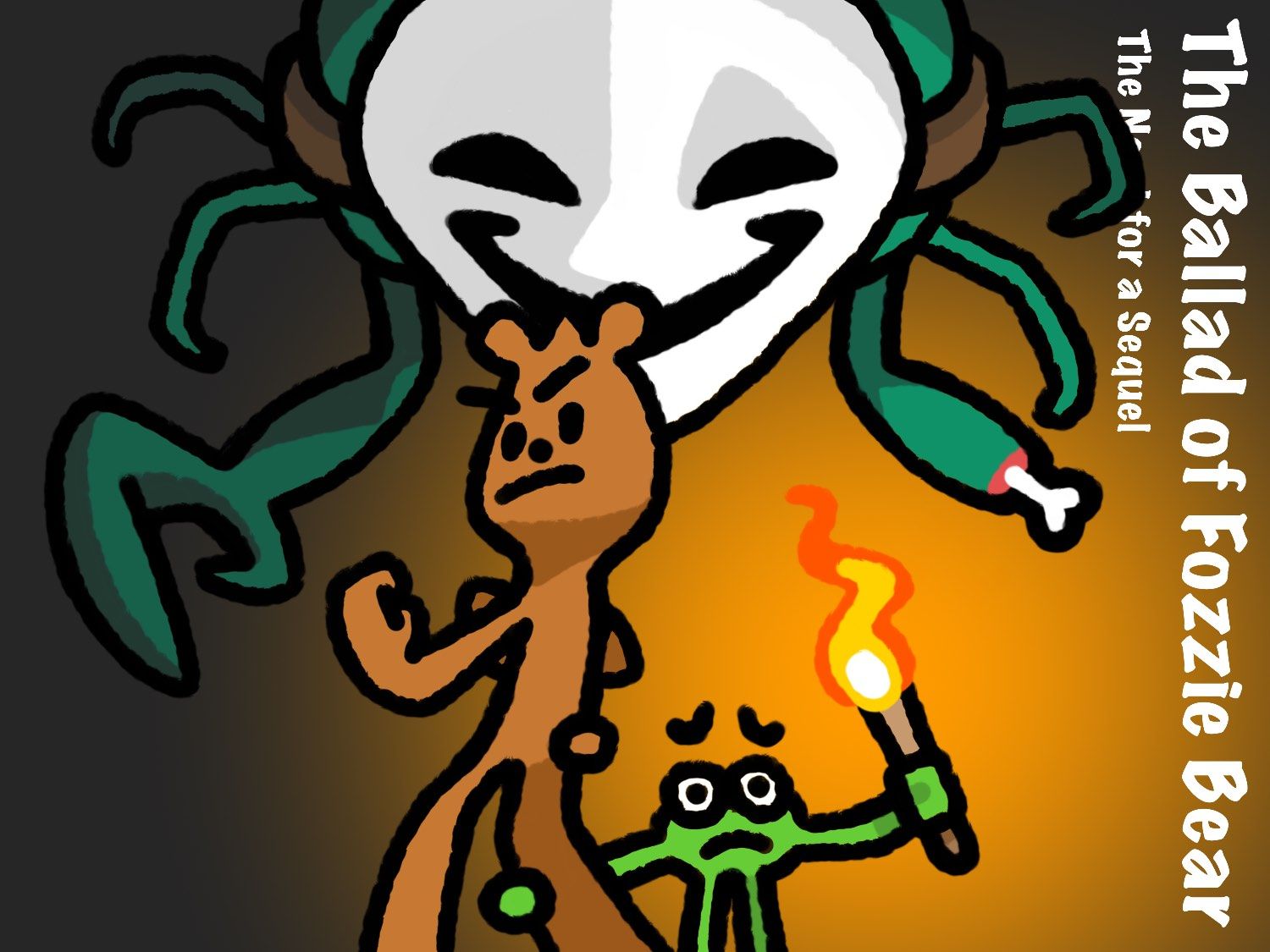
The creature emerged from the darkness with insectoid and crocodilian legs both plodding in sync as it circled the duo. It was gigantic, around the size of three elephants, with its whiptail five in length. It ended in a blood-stained stinger that was reminiscent of a hornet’s – only now a meter long. This would’ve been its most notable feature if it hadn’t been for the large white mask adorning it, visually-akin to that of a theatre’s stereotypical “happy” mask.

Its growl was like an overlay of a snake’s hiss and a child’s laughter, ominous as it was curious. The taunting sound continued as the adventurers finally regained their composure.

“U-Uncle Fozzie, is that th-!” Robin began, just as the monster launched its tail at them again. Fozzie launched himself at his nephew, knocking them both down. The tail crashed into the wall, sending small bits of rocky debris falling around it.

“Yeah, Robin. It’s …bigger than from when I last saw it!” They stood up again, the beast recoiling its tail back into a tight coil. It roared in rage at their dodge, and charged them again.

The pair split up, running left and right in an attempt to confuse their assailant. Focusing on the bear, the cryptid pounced towards him. Fozzie quickly threw a Hotshot at the beast before it was able to land on him, causing it to rear up and back. Robin let out a cheer as he too found his two pellets again, leading to a monkey-in-the-middle with the heroes trading explosions against their foe’s green hide.

But then Robin suddenly felt weird. The monster had begun to snarl and brace itself, a strange purple aura surrounding its mask. The soot and ash covering it disappeared while the light grew stronger. Buckled down, the beast was shaking in anticipation, while Robin and Fozzie, both clueless as to its intentions, could only watch in slight fear. Has the fight already been won?

Then, the beast screamed. The cave was lit in white light.

Robin screeched as he felt among the sharpest pains known to man erupt in his head. He flattened to the floor, curled into a ball as images were projected into his mind. He saw many things in what seemed like minutes, but was really only a split second.

Robin saw pictures of plants, animals, cities, and people. He saw wars, famine, love, hate, and emotion. He saw death, and life, castles and dragons, the young and old. He saw everything in the universe while his head spiraled. It was as if claws were scraping against his brain, a hand piercing through his back, up his throat, and into his head.

“Robin? Robin?!” Fozzie cried. The beast had vanished, leaving him and Robin alone in the room. His accomplice was shaking in the middle of the room, now attempting to stand. “Are you okay?”

The frog quickly stood stiffly upright. His hands were straight at his sides, like a puppet. He then relaxed a bit, though his knocked knees made Fozzie a little uneasy.

“Look, Robin – the creature’s gone, you don’t have to keep-.” He put a hand on his friend’s shoulder, turning him around.

Expecting his friend’s normal groggy face, Fozzie was startled and (literally) floored to see a demonic, contorted face in a perpetual scream. Purple light now shone from inside him, escaping through his eyes and mouth. He moved towards the now-grounded Fozzie, jerking his limbs around even more puppet-like than before.

His face now looked just like the skulls covering the den’s entrance.

“Robin? I-is that …you?” Fozzie’s mouth moved up and down some more, but no words came out. Robin’s face cracked and carved into a slit-mouthed smile. He simply screamed just like the beast had moments ago, unsheathed his glaive, and attempted to bring it down upon the bear’s head.

Fozzie rolled out of the way and quickly bounced back up, crossbow at the ready. Memories flood his mind of his mother, father, normal townsfolk, all under the same spectral influence. He now recognized the purple light; it was just like how those in his town looked that one fateful night.

“I know your tricks, demon,” Fozzie growled. “You came to my village, remember? Killed off half the population? Well, times have changed: I’m not going down without a fight.”

The demon laughed from inside Robin’s body. His demeanor quickly shifted as he flung a shuriken towards Fozzie. The bear blocked it, and the adversaries started trading blows.

Fozzie blocked a sudden slash from the glaive using a bone, then clubbed Robin’s body with it like a baseball bat. The demon was physically stunned, but twisted a webbed fist around the femur and flung it aside – Fozzie with it.

The bear leapt back up and charged towards Robin. They engaged in fist-to-fist combat, with Fozzie carefully making sure not to draw blood from his friend’s controlled body.

The demon was sent back a couple meters, feet sliding against the stone as dust kicked up around them. They sneered, head turning upside-down as he brandished Robin’s dagger. They launched themselves towards Fozzie, who met the blade with a knife of his own.

The two angrily pressed metal to metal for a moment. Fozzie scrunched his face while the demon made Robin’s cheeks stretch from cheek to cheek. Then, he maneuvered a swift side-sweep of Robin’s foot, buckling the bear before grabbing him by his fur. He giggled again, hissing like a serpent of death.

“YOU THINK I DON’T REMEMBER YOUR TOWN?” The demon spat, a mix of Robin’s voice and some deep rumble. He brought his mouth to Fozzie’s ear.

“I WATCHED YOUR PARENTS DIE RIGHT IN FRONT OF YOU.”

Fozzie screamed, and flung the demon off of him. It stumbled back, looking up only to see a roundhouse kick from the hero hit him dead in the face. It was launched to the floor again, ricocheting-off as Robin and the demon split apart once again. Robin rolled towards a corner of the den, while the demon quickly grew back into its titanic size.

But Fozzie was prepared. Letting loose a war cry he leaped up, grabbing onto the whiptail as it tried to slash at him. The cryptid attempted to flee, but Fozzie’s rage catapulted him to its neck.

Billowing with anger, Fozzie roared. He swiftly wiped away specks of dirt on the demon’s forehead and plunged the tail’s stinger through it: past the skin, through the skull, and out the other side.

“Do you remember anything? The fight, the rambling, being kicked in the head?” Fozzie questioned.

Robin bit into an apple, chewing methodically as he thought.

“Nah, not really. Mostly all just a blur: one minute I was curled up on the floor, the next I’m rolling on the ground.”

Fozzie sighed, shaking his head. He turned back to watch the parade floats inch by. Robin climbed up the small stone wall.

“Still though, Unca’ Fozzie. That all sounds scary, but …did it really happen?”

Fozzie kept watching the floats turn the corner by Beaker’s Beakers. He thought about his parents for a second.

“Yes.”

The pair continued munching on apples, happily chattering as confetti filled the vast blue sky around them.

Recipe review: Everything cookies (Family recipe)

By: Austin Bailey-Zimmerman

Ingredients:

  • 2 sticks butter
  • 1 cup brown sugar
  • 1/2 cup granulated sugar
  • 2 teaspoons vanilla
  • 2 eggs
  • 1 1/2 cups all purpose flour
  • 1 teaspoon baking soda
  • 1 teaspoon baking powder
  • 1 teaspoon salt
  • 3 cups QUICK oats
  • 1 bag chocolate chips
  • 1 bag white chocolate chips
  • 1 cup raisins
  • 1 cup chopped pecans or sunflower seeds

Instructions:

  1. Preheat the oven to 350ºF.
  2. Soften butter and in a medium mixing bowl, mix the butter, sugars, eggs, and vanilla until combined.
  3. In a separate bowl, mix all of the dry ingredients together.
  4. Combine both bowls into one.
  5. Fold in the chocolate chips, raisins, and pecans/sunflower seeds.
  6. Roll batter into golf ball sized balls and set on a baking sheet.
  7. Bake for 8-10 mins or until golden brown.
  8. Take out and let cool.
  9. Enjoy!

Review:

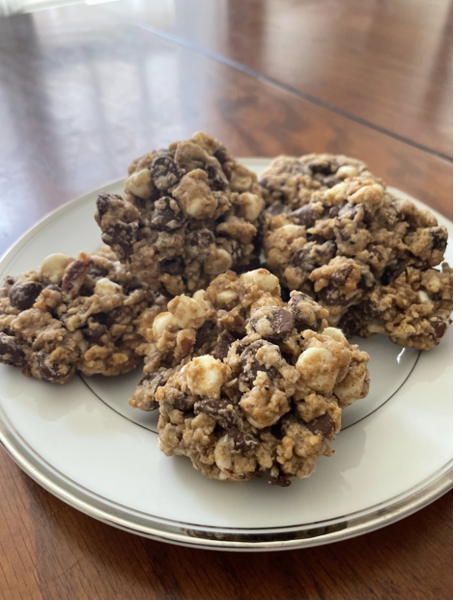
Have you ever tried to find the perfect cookie to bake? For me, this recipe is it. My family and I made this recipe and decided to name these cookies “everything cookies” because they have everything you could think of for a cookie.

I associate these cookies with my mother because I have always made these cookies with my mom and older brother ever since I was a little kid. Whenever we would make everything cookies we would always have extra so we would share them with our neighbors, my grandma, and I would bring a bag to school and share with my friends at lunch. I think these cookies really made me feel connected to the people around me, especially my mom.

I have a lot of great memories making these cookies with my family. When we put them in the oven, the whole house would fill with the sweet warm smell of cookies and it would stay for the rest of the day. When we finally took the cookies out, we would always put on a movie or show and sit down in the living room with a glass of cold milk and the cookies still warm. They were always perfectly gooey on the inside, but golden around the edge.

Sometimes the ingredients change. Sometimes we add new things or take away something, but they always taste nostalgic. These have always been my favorite dessert, and maybe they’ll be yours too! Try these out! Enjoy!

The tale and tour of Annabelle

By: Jooney Freddieson & Aalovely Lor

Image created by Starryai

In paranormal history, there are many haunted objects around the world, but Annabelle the doll is the most captivating worldwide. Her legend included real-life investigations, movies, and as of recently, public appearances.

Behind the movies of Annabelle lie a backstory rooted deeply into Ed and Lorraine Warren’s paranormal research.

Ed and Lorraine have investigated over 10,000 cases of paranormal activities and originally presented their findings in Catholic schools. Ed was a self-taught demonologist and Lorraine was a medium. Together, they founded the New England Society for Psychic Research (NESPR) in 1952.

Annabelle, originally an innocent Raggedy Ann doll, was gifted to a nursing student named Donna, by her mother in the 70s. Donna and her roommate started to mess with the doll, leaving it in different positions and even making it a tradition to scare each other.

However, their fun came to an end when they began noticing strange occurrences around her living area: the doll would change positions, move to different rooms, and leave notes behind, none of which Donna or her roommate had any knowledge of causing.

Donna and her roommate concluded that it was just their vivid imagination and dismissed the occurrences but questions started to arise when the doll’s movement became more pronounced—like shifting its arm entirely or relocating more often.

Donna, believing that she was targeted by demonic forces, flew to a renowned medium. They soon discovered that the doll was inhabited by the spirit of a young girl. Donna allowed the young girl to stay and even started to treat the doll like an actual child, often buying the doll clothes, toys, jewelry, and candy.

The haunting soon turned malevolent after attacking multiple times through paralyzations and scratches appearing over the chest.

After realizing the spirit was more than just an innocent child, Donna contacted Ed and Lorraine Warren—the paranormal investigators.

The Warren’s determined that the doll was in fact taken over by a demonic entity and its goal wasn’t to haunt people but to possess a human host.

They took Annabelle to their Occult Museum in Monroe, Connecticut, preventing further harm. She was placed in a glass case with warnings not to touch, and it quickly became one of the most dangerous items in their museum.

The story of Annabelle gained popularity after its feature in ‘The Conjuring’, leading it to have its own spin-off series that begins with ‘Annabelle’.

The movie versions featured a porcelain doll, but the real Annabelle is a soft stitched Raggedy Ann. Despite the difference in visuals, the legacy remains the same.

After Lorraine’s death, the museum closed, and Annabelle remained inside. But as of 2025, Annabelle has begun going on tour as part of the traveling exhibit called “Devil’s On The Run Tour”, visiting various cities throughout the U.S.

The tour began in May and is scheduled to be on tour throughout the summer, allowing horror movie enthusiasts to meet the real Annabelle.

According to NESPR, the Annabelle tour was created in response to those with questions and in hope of funding the museum.

The tour brought concern to religious figures saying they shouldn’t treat the doll like a “novelty”, stating that it was disrespectful to provoke the doll after knowing the risks. But organizers of the tour have claimed that all participants were careful and all events were handled with caution.

This tour brought attention to social media, especially Tik Tok and Instagram. Many videos and post made about the tour gained millions of views, with people sharing everything from selfies to behind the scenes.

For more information, please visit:

How our preconceived notion affects us!

By: Maeve Brady

Throughout our lives we may have heard of many notable experiments. With many notable experiments comes ones which were conducted very dangerously and are very controversial. Yet one that is still commonly debated and probably one of the most infamous psychology experiments is the Stanford Prison Experiment. In your life, you may have heard of this twisted experiment. And even if you haven’t, you may eventually. So, for those of you who would like a more in-depth explanation of the Stanford Prison Experiment and its procedures, stick around.

First of all we must understand what the Stanford Prison Experiment was even focused on studying; why it was even conducted. Dr. Phillip Zimbardo, a psychologist and professor at Stanford University which is located in Stanford, California, asked his students to examine what happens when someone is first imprisoned and the psychological effects of that. His students, as part of their independent study, came up with the intriguing idea of this sort of mock prison simulation.

Then, when Zimbardo started to question and have the desire to further investigate social roles and situational power dynamics, especially in prison, he decided to initiate this experiment. Or, in other words, he wanted to better understand and further research how ordinary people who are considered healthy and mentally “normal” can shift mentally in a matter of a couple of days under a prison simulated environment. So, in a newspaper ad they created advertisements for college students who would be willing to partake in a simulated prison experiment.

For the originally intended two week long experiment, they would be paid around fifteen dollars per day. Initially, there were around seventy participants, but after a series of psychological and physical tests, it was narrowed down to twenty-four participants. Contrary to the belief that the guards and the prisoners were chosen based on their height and size differences, the determination of whether you were a prisoner or a guard was completely random to ensure there was no biases-well at least that we know of. 

Once the roles were chosen, the experiment began. In Stanford University’s basement, a simple yet pretty secure ”jail” was constructed. According to the Stanford Prison Experiment’s official  website redesigned by Jeff Breil, Scott Plous, and David Jensenius in 2015, “Our prison was constructed by boarding up each end of a corridor in the basement of Stanford’s Psychology Department building. That corridor was “The Yard” and was the only outside place where prisoners were allowed to walk, eat, or exercise, except to go to the toilet down the hallway (which prisoners did blindfolded so as not to know the way out of the prison).” This demonstrates that the prison was intricately designed yet also had this easily comprehensible layout. And to create prison cells, they took the doors off some laboratory rooms and replaced them with doors made of steel bars and cell numbers where the prisoners would be held. An intercom system was also installed in order to listen in on the prisoner’s conversations as well as make announcements.

To fully understand the proceedings of the Stanford Prison experiment, we must understand the way, and fact, of how humiliation spread throughout this experiment. The experiment was split into three groups: the institution-which was composed of Dr. Zimbardo, who deemed himself as the superintendent, an ex-convict who played the role of the prison consultant because of his past experiences in a prison, as well as other people who helped operate the experiment-the guards, and the prisoners.

At first Dr. Zimbardo asked the Palo Alto Police Department to arrest the prisoners at their homes, in order to instill this sense of embarrassment as all their neighbors watched in shock. Then, when they arrived at the Palo Alto Police Department station, they were blindfolded, put in a cell, and forced to ponder their fate. Once they were transferred to their make-shift jail in the basement of Stanford University, they were then stripped naked and deloused in order to prevent “them from contaminating their jail”. But in reality, this was a method of increasing the humiliation upon the prisoners. The prisoners were then forced to wear a smock and given a number to diminish their pride and take away from their individuality.

It was also important to understand that the guards were really given no training on how to be a guard. They were only given instructions to use any method, besides physical violence, to assert authority over the prisoners and make them comply. The guards then devised a set of rules which involved some effective methods to make the prisoners listen. One of them was counts. These counts were an effective way of not only familiarizing the prisoners with their numbers, but it was also an effective way of establishing that the guards had the authority in that situation and the prisoners could only be another number that was “forced” to comply with what the guards were telling them to do. This also took away from the prisoner’s individuality and established this sense that all they could do was comply with the perceived authority figures. The other method was a large amount of push-ups whenever someone spoke out and/or behaved in a “bad” way.

Although everything went smoothly the first day, a prison rebellion then broke out the morning of the second. The prisoners removed their stocking caps, ripped off their numbers, and barricaded themselves inside the cells by putting their beds against the door. Because of the rebellion, the morning-shift guards were infuriated. When the morning-shift guards arrived at the “jail”, they were upset and believed that the night-shift guards must have been too strict on the prisoners. But, how the guards handled it was shocking to many. At the beginning of the rebellion, the guards insisted that reinforcements be called in. The three guards who were on stand-by call at home came in and the night-shift guards voluntarily remained on duty to help support the morning shift. The guards then decided to use force to dispatch the rebellion caused by the prisoners. The guards then got a fire extinguisher and shot a stream of skin-chilling carbon dioxide at them. They  used this mechanism to stun the prisoners and force them away from the doors. Once the guards managed to dispatch the rebellion, a new problem arose.

Although the guards were able to calm the rebellion down, the fact that it took nine guards using clubs to do so, obviously made the guards nervous. Nine guards couldn’t be on duty all the time, so instead of using physical methods, the guards decided to use more physiological methods to control the prisoners and force them in line. So, the guards devised something known as the “privilege cell”. The three prisoners least involved in the rebellion were given special privileges, and they were given their uniforms and bed backs, as well as being able to brush their teeth. The prisoners who were least involved in the rebellion also got to eat a special meal in the presence of the prisoners who temporarily lost their eating privileges.

Throughout the experiment, several prisoners had to leave due to the torture of the experiment; for example, Prisoner #8612 had a mental breakdown and went into this fit of rage, and others were tortured to their breaking points.

There were also many other significant events that occurred along the way. For example, a new prisoner was added to play with the already established social groups, as well as a family visiting hour, and a priest visiting the “jail”. Yet throughout these interactions, no one spoke out, and instead of questioning the morals of the experiment, many only gave advice on how to make their “case” less severe and tried to work within the system to help them out.

After six days of this experiment, it had to be shut down. This shutdown occurred after Dr. Zimbardo snapped back into reality, and realized how cruel it was after someone had told him that what he was doing was too cruel. Although this experiment ended short, the conclusion has been relevant for years and years. The Stanford Prison Experiment concluded that individuals readily conform to social roles, especially when those roles are strongly stereotyped and involve power dynamics. And, contrary to Dr. Zimbardo’s statement claiming that this experiment proved that everyone has a little bit of evil and violence in them just awaiting to be released under pressure packed situations, many psychologists believe that it demonstrates that we act how we think we are supposed to act, and act to our preconceived notions. Also, due to the fact that the guards were given an initiative to assert authority over the prisoners, this may have influenced the way the guards acted too.

Thank you for following me along as I explained the Stanford Prison Experiment. Although I covered a ton of different aspects of it, there is still so much to discuss. I hope you have learned a lot about the Stanford Prison Experiment and its proceedings.

For more information, please go to:

Review of copycat Crumbl red velvet white chocolate chip cookies

By: Grace Wright

Recipe-

Ingredients

▢ 1 1/2 cup butter, softened

▢ 1/2 cup granulated sugar

▢ 1 1/2 cup brown sugar

▢ 2 egg

▢ 1 1/2 tbsp vanilla extract

▢ 4 cups all purpose flour

▢ 1/2 cup cocoa powder

▢ 2 tsp baking soda

▢ 1 tsp salt

▢ red food coloring

▢ 2 cup white chocolate chips

Instructions-

Preheat the oven to 350°.

Cream together the butter, granulated sugar and brown sugar.

Add the egg and vanilla. Mix until light in color and creamy.

Add in the dry ingredients (flour, cocoa, baking soda and salt), mix into the dough. Mix until completely combined. The dough will be soft.

Mix in the red food coloring (add until it looks like the desired color), then fold in the white chocolate chips.

Use a 1/2 cup measuring cup to portion out the dough. Roll the dough and flatten them slightly. Arrange 6 cookies per cookie sheet. This will make 12 cookies.

Bake at 350° for 15-17 minutes – the cookies should spread slightly, crackle a little bit and the centers should not look shiny and wet anymore.

Allow the cookies to cool for at least 10 minutes on the pan before serving. Serve warm.

These cookies were pretty easy to make but there would be some modifications I would make. One, I would change when you add the food coloring. The dough is a thicker kind so when it said to add the food coloring last, I struggled. I couldn’t mix the coloring evenly throughout the dough, so it ended up streaky and not really red velvet. I would recommend adding the food coloring when you are mixing all the wet ingredients. This makes sure the food coloring mixes nicely and you can add some more in the middle of mixing the dry ingredients in if you want it more red.

I would also recommend mixing the chocolate chips by hand. Once again, because the dough is thicker my stand mixer struggled getting the mix evenly throughout the dough. This made some of my cookies to have no chocolate chips or some to have a lot.

Finally, I would recommend that if you don’t like huge cookies to make them smaller. I think they are good this big but for my family we just like smaller cookies so then you don’t have to break them apart if you don’t want that big of a cookie. My parents agreed that they would have enjoyed them more if they were smaller.

I would say these are pretty close to the ones from Crumbl, but Crumbl’s have a better texture and are more flavorfull. Overall, I really liked making these cookies and they were tasty. I think most people can bake them with ease with just a few adjustments.

Here is the link to the recipe I used:

Separating art from artist: When do we cross the line?

By: Hermekay Dehaney

American rapper Kanye West and socialite Kim Kardashian pose together at the red carpet of the Met Gala in 2019 by: Cosmopolitan UK via Wikimedia Commons

Separating art from the artist has become a controversial and recurrent topic over the past decade; its main belief is focusing on the work itself of that artist rather than the artist’s reputation and controversies at hand. Usually, when this topic gets brought up, it surrounds a celebrity getting “canceled” over various allegations and actions, which sometimes include severe repercussions such as criminal offenses.

These fallouts usually lead to a moral dilemma of people asking, “When should we separate, or is it okay to separate art from the artist?”

I believe that when the topic around a celebrity is about separating them from their art, then you know what they did was bad. Consider R. Kelly, a famous R&B singer whose crimes landed him in jail for 30 years, with the help of the documentary ‘Surviving R. Kelly’. Despite his sentencing, his music was still played on social media, at parties, and even sometimes at weddings. I would say nowadays people are starting to distance themselves from him, but there are a few outliers.

On the other hand, Kanye West is more of a complex case. He is considered one of the top artists of this generation with multiple platinum albums including, ‘The College Dropout’. and ‘Graduation’. In recent years, his crazy erratic behavior in public and online, especially his antisemitic views, have landed him in this topic.

Although people online do blame his mental health issues which potentially contributing to his sometimes outlandish behavior, there are others that don’t see his mental health as being the sole reason for his behavior. As someone once put it, “That’s an explanation, not an excuse“. So, even though I do believe it’s a factor, that doesn’t fully explain his weird behavior.

People have tried to draw a line on what is acceptable and unacceptable, but it’s not that easy. When someone as influential as Kanye uses their platform to spew hate and misinformation, especially to his impressionable younger fan base, that becomes dangerous.

The art that the artist puts out is sometimes a reflection of themselves. Their beliefs and values are sometimes mentioned in the lyrics, making it impossible to separate the two. Continuing to support such artists, even if you don’t agree with their actions, is still indirectly supporting them. They’re still making money from streams and maintaining cultural relevance despite their actions.

This topic is very subjective of when the line is crossed which leaves a gray area. Obviously, humans are not perfect, so when the opinion of canceling every artist who missteps comes about, that’s unreasonable. Some artists have committed serious and harmful acts that impact others while some have made non serious controversies. What one person sees as totally “cancellable”  others may not.

I saw a comment which stated, “Art is based on context. I don’t think the artist needs to be a moral example to appreciate their work. But as always, we have to remain conscious and educated. We can pretend art lives separate from reality,” and to add onto that, this topic is not very limited, it’s not a one-size-fits-all discussion, but the truth is that It gets to a point where if you’re asking the question, the answer is most likely no.