
By: Hermekay Dehaney
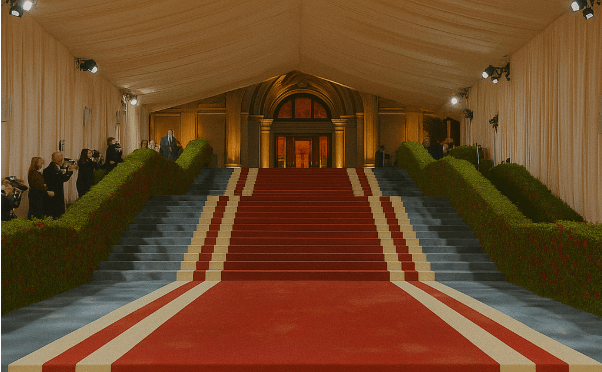
Often considered fashion’s biggest night, the Met Gala, also known as the Costume Institute Benefit, is an annual charity fundraiser held at the Metropolitan Museum of Art in New York City. It is held on the first Monday of May each year. Guests show up in extravagant outfits that resonate with that year’s dress code, which is inspired by the exhibit’s theme.
In honor of the annual Met Gala on May 5, I will be ranking the past themes from recent years (2014 – 2024).
2014:
Theme – Charles James: Beyond Fashion
Dress code – White tie and decoration
★★★☆☆
The exhibit paid tribute to the American Fashion designer, Charles James who inspired the dress code. He was known for his structural ball gowns. The guests were expected to wear full evening gowns, tailcoats, waistcoats, and bow ties. The most notable look for me was Karen Elson, a model, and singer-songwriter, who wore a dress designed by Zac Posen, and Blake Lively, an actress who wore a Gucci gown.
While this theme was beautiful, it was forgettable and safe. There was little room for uniqueness and innovation since everyone was expected to wear ball gowns, making it feel like just another red carpet event rather than the Met Gala, which is why I give it 3/5 stars.
2015:
Theme – China: Through the Looking Glass
Dress code – China: Through the Looking Glass (guests were expected to interpret the theme)
★★★★★
The theme was a way of celebrating the Chinese impact on Western fashion over the centuries. I give this theme a 5/5 because each attendee had a unique outfit on how they interpreted the theme. The theme was visually pleasing and there were a lot of cultural references.
My favorite look from that year was Rihanna’s. Her look was designed by Guo Pei, a Chinese fashion designer. The look featured a canary yellow coat dress with a large fur trim train, which took 2 years to complete, and it was worth it because Rihanna stole the whole night.
2016:
Theme – Manus x Machina: Fashion in an age of technology
Dresscode – Tech white tie
★★★★☆
Manus relates to creating with your hand while Machina means to use machines to create, the theme highlights how technology influences the creation of fashion, and the increasing impact it has on design and production. The dress code was inspired by the theme, which is meant to celebrate technical innovations.
The theme wasn’t bad itself, it’s just that everybody showed up in some sort of silver futuristic gown, my favorite being Kim Kardashian, who wore a metallic silver Balmain gown with a side slit on the dress that went up to her thigh. For my favorite more unique look, it was Emma Watson, who wore a custom Calvin Klein outfit, made out of a recycled plastic bottle which ties into the theme.
I give this theme an overall rating of 4-stars because there was some unique spin to the theme, such as Clare Danes wearing a light-up Zac Posen gown.
2017:
Theme: Rei Kawakubo/comme des Garçons: Art of the In-Between
Dress code: Avant-Garde
★★★☆☆
The theme for 2017 was honoring Rei Kawakubo, a Japanese fashion designer who is known for designing outfits that defy gender, form, and traditional beauty. The avant-garde definition is “new and unusual or experimental ideas, especially in the arts, or the people introducing them.”
My favorite look was by Rihanna, who wore an actual Rei Kawakubo design from her 2016 fall collection. The dress was an asymmetrical 3-D sculptural floral dress. This theme had a lot of potential, but most chose to play it safe by completely disregarding the theme which is why I give it 3 stars.
2018:
Theme – Heavenly Bodies: Fashion and the Catholic Imagination
Dress code – Sunday best
★★★★★
The themed exhibit was inspired by Catholicism, showing an intertwining of Religion and fashion, showing Pope garments, biblical artifacts, and religious symbolism. The outfits were stunning, everyone delivered which is why I gave it a 5 star mark. My favorite was Chadwick Boseman, who wore a custom Atelier Versace; he wore an all-white blazer and cape with gold crosses and a red tassel, the look went with the theme. My other favorites included Ariana Grande, Rihanna, Zendaya, and Blake Lively.
2019:
Theme – Camp: Notes on Fashion
Dress code – An expression of everything artificial
★☆☆☆☆
Camp is defined as “an aesthetic that is exaggerated, theatrical, and often intentionally ‘bad’ or ‘over the top’ in a way that is still enjoyable and playful.”
To be honest, I didn’t like the theme, it wasn’t good, which in a way makes sense. If I had to choose my favorite look, it would be Janelle Monae, who wore a custom Christian Soriano dress. The dress was a split design dress that included pink, and black, white, and red colors, the dress also included cutout designs and very “campy” details.
2021:
Theme – In America: A Lexicon of Fashion
Dress code – American Independence
★☆☆☆☆
When I think of the dress code, I imagine wearing designs popularized by American designers to honor the influence America has on fashion worldwide. The theme offered a very diverse styling since America is not a monolith, it’s a very diverse country.
Even though there is a vast majority of style influences that the guest could’ve chosen from, most still chose to dress in a more ’50s, ‘60’s old Hollywood fashion style, and if they didn’t dress up in old Hollywood, they just didn’t match the theme at all. The red carpet was all over the place, so with that being said, none of the looks from the ‘21 Met Gala really stuck out to me, so I rate this Met a 1 star.
2022:
Theme – In America: An Anthology of Fashion
Dress code – Gilded Glamour White Tie
★★☆☆☆
The theme and dress code was inspired by the Gilded Age era which ran from 1865 to 1902. When you look up gilded period outfits, you see skirts with a bustle, ribbons, hats, and corsets.
With the dress code being very specific, you would assume people would have an easier time following, but that was proven wrong; the majority of the outfits that guests wore didn’t follow the theme at all. With that being said, one look that did stick out to me was Billie Ellishe’s outfit, which fits the theme. She wore a Gucci gown that had a corset bodice. The gown also featured green and purple flower designs on the sleeve as well as on the bodice.
I rate the ‘22 Met Gala 2 stars, just because it didn’t live up to my standards of what I was expecting.
2023:
Theme – Karl Lagerfeld: A line of Beauty
Dress code – In honor of Karl
★★★☆☆
The theme honors Karl Lagerfeld, a German fashion designer who served in the fashion industry for 6 decades. He was best known for his work with Chanel, Fendi, Balmain, and Chloé as well as his own brand. His design characteristics were very structural, and black and white with sharp tailoring.
Pretty much everyone was on theme, Karl was a very influential designer that the majority of the guests had worked with in recent years, so I think that’s why they were easily able to interpret the theme in their own way. My favorite look being Anitta, she wore a Marc Jacobs gown that featured a long train, white opera gloves, and platform heels.
Even though everyone was on theme, the theme was a little boring, nothing special, so I rate it a 3 star.
2024:
Theme – Sleeping Beauties: Reawakening Fashion
Dress code – Garden of Time
★★★★★
The exhibit featured fragile, historically significant garments hence the theme “Sleeping Beauties.” This was honestly the best Met Gala they have had in recent years, and my ultimate favorite. My favorite looks included Harris Reed wearing his own design , Alia Bhatt wearing Sabyasachi, and Nicki Minaj wearing Marni.


 Plaid Line + PRIZM + Scottie News