*You can get Kataifi and pistachio paste online and at stores like Golden Nuts
*need a chocolate bar mold*
Instructions:
Roughly chop up the kataifi dough.
melt your butter in a nonstick skillet over medium-low heat, coating the pan.
Add in the chopped kataifi threads and stir occasionally until they become golden brown (about 5-10 mins) and remove from the skillet.
In a large bowl, mix the toasted kataifi with pistachio paste, then set aside.
Melt the milk chocolate in a double boiler.
Spread the melted chocolate on the inside of the chocolate bar mold until it covers the entire bottom.
Freeze for 10 mins.
Spoon the pistachio and kataifi mixture into the mold. Use a knife to flatten the filling and ensure it is spread to the sides of the mold.
Gently add a top layer of milk chocolate to the mold.
Freeze for another 10 mins or until the chocolate hardens.
Enjoy!
Background:
The Dubai chocolate bar is a viral chocolate bar filled with Kataifi, which is tiny shredded crunchy dough, and pistachio cream. It is originally a dessert from Dubai, and is from Fix Dessert Chocolatier, where the catchphrase is “Can’t get Knafeh of it”. The chocolate bar has become a viral dessert in 2024 particularly on TikTok.
Review:
I absolutely loved this recipe. I have been seeing Dubai chocolate all over the internet and I have wanted to try it for so long. I found this great recipe and got a chocolate mold and decided to try it out for myself. My friend and I followed this very easy step-by-step recipe, and the result was amazing!
The chocolate bar was so sweet and the filling was the perfect mixture of crunchy and creamy. The pistachio and chocolate went together perfectly, the flavors balancing each other out. The bar was very big and I could easily split it with my friend.
Cognitive dissonance, the beauty of the mind. It’s something we all undergo even if we are unaware of this factor. Now, you may have heard of this term before, but do you truly know what it is? If you do, then I hope this provides an even more in depth explanation of its properties. If you don’t, then buckle up, because understanding this is essential to understanding the way we humans think.
Cognitive dissonance is a basic principle in psychology, in which it is where you know you are doing something bad, yet you still do it anyway. That’s the simpler way to explain it, but in other words, it is when your thoughts of consistency and conformity don’t align with your seemingly inconsistent actions. For example: You are sneaking out at night, and in order to get to your needed destination, you steal your parents car. Now you may know deep down that it’s wrong, but your actions are contradicting your thoughts. Now, like many of our cognitive abilities and senses, cognitive dissonance is said to occur in the prefrontal cortex which is located in our frontal lobe. But it is said to occur not only in the prefrontal cortex, but also within the insula cortex.
Deep within the lateral sulcus, also described as a deep ridge and or groove that is located along the surface of our brain’s cerebral cortex, you will find the insula cortex which is responsible for the regulating and processing of our emotions. According to an article written by Thea Buckly, about a lecture given by Keise Izuma, at the University of York in England, “‘Additional studies have revealed that cognitive dissonance engages other brain regions, such as the insula and dorsolateral prefrontal cortex (DLPFC). The insula, which processes emotions, often becomes more active when people are upset or angry, and the DLPFC is strongly associated with cognitive control.’” This shows us that the insula, as well as the Dorsolateral prefrontal cortex, may have something to do with the feeling of cognitive dissonance.
Although more research concerning cognitive dissonance is only more recently coming out, the theory was invented a while ago. In 1957, Leon Festinger presented the theory of cognitive dissonance, in which he had claimed that the inconsistencies between cognitions may generate this uncomfortable and motivational feeling within you, also known as cognitive dissonance. This justified the outlandish feeling people got when they knew they were doing something bad, going against their thoughts of structure and doing what’s right.
Cognitive dissonance also plays a big role in the process of justification and over-explanation. The concept of dissonance, which is a clash between disharmonious principles, results in people feeling that they can justify their inconsistent behaviors. Or in other words, when cognitive dissonance creates this feeling of wrongfulness and guilt, people tend to cling on to the action of explaining themselves in order to lessen that uncomfortable feeling and satisfy themselves. When the intensity of the dissonance increases, many people become desperate to reduce it, finding obscure and desperate explanations in order to avoid confronting the uncomfortable truth.
In an experiment done by Leon Festinger and his colleague James M. Carlsmith in 1959, they tested the theory of cognitive dissonance. In this experiment, they lied to people saying the experiment was about the effects of a task on an individual’s perception, meaning how a task can affect the way one views a situation and environment. But in reality, they wanted to test if people would justify lying to another person about a task. He paid volunteers either one or around twenty dollars to lie about a boring task being fun. According to Jerry Suls, a professor at the University of Iowa, “The subjects who were paid $20 should not have experienced dissonance, because they were well-rewarded and had ample justification for lying, whereas those paid $1 had little justification for lying and should have experienced more cognitive dissonance. To reduce the dissonance, they reevaluated the boring task as interesting and enjoyable.” This was the accurate prediction of Leon Festinger which demonstrated human behavior when lying and just in general.
This proves that when people are put into uncomfortable situations and feel cognitive dissonance, they tend to find any sort of reason to justify their actions to relieve the feeling. But, when people have a plausible reason to hide behind their lies, then they may experience less dissonance because they have a “reason” not to. All this proves that people may be willing to justify even the worst of actions if it means keeping themselves and others satisfied.
Cognitive dissonance is a common theme in our society because everyone experiences it in their own life. Sometimes, it can be a spur of the moment thing and we may not even realize we are doing so until later evaluation. When we experience cognitive dissonance, some may have this immediate want to relieve the discomfort they are feeling within. This results in the person finding ways to justify their wrong action.
Thank you so much for following me along as I explained the basics of a major part of psychology, cognitive dissonance. I hope you gained more insight to what cognitive dissonance is and how it is a common theme in our society!
In competitive swimming, there are four basic strokes: freestyle, backstroke, breaststroke, and butterfly. In this article I will go over how to do these strokes, a few drills you can practice for each, and how they can benefit you.
Freestyle, or front stroke, is often the first stroke people learn. It is performed by floating on your front, kicking your feet, and making pulls forward with your arms. This stroke is good for practicing your speed in the water, as well as developing arm, shoulder, and leg muscles. To improve your freestyle stroke, try making fists as you do your arm pulls. This will allow you to practice using your whole arm to pull water, not just your hand, and result in a more powerful pull.
Backstroke is much like freestyle, but performed while floating on your back. Instead of pulling forward, your arms should rotate backwards, toward your head and along your side. This stroke is good to improve your floating, or if you aren’t comfortable with your face in the water. To improve your backstroke, try doing a one armed stroke: only pulling with one arm for a lap. As you rotate your arm, your body should rotate toward that side, allowing for a good strong pull.
Breaststroke is known as a recovery stroke, meaning it is typically less intense than freestyle or backstroke. However, many modifications can be made to this stroke to make it more or less intense depending on your preference and ability. Breaststroke is performed by floating on your front in streamline position (arms extended above the head, hands meeting and parallel to the floor), doing a single whip kick (bending the knees and pushing them out behind your body), and then pulling the arms from the streamline position downward and out to lift your head above the water. Once you take a breath above the water, dive back down into streamline and repeat. To improve your breaststroke, try placing a tennis ball or small, soft object under your chin while you swim. This will stop you from moving your head up as you make your pull, taking strain off your neck and adding height to your stroke.
Butterfly is often regarded as the hardest competitive stroke, but it can be easily developed with knowledge of breaststroke. To perform butterfly, begin in a streamline position. Do a dolphin kick (like a flutter kick, but with both feet together and core engaged), and then raise your arms out of the water, each arm extending out to either side like butterfly wings. Then bring your arms down and forward, pulling along your sides. To breathe, take your head above the water during your pull. To improve your butterfly, try executing your pull with a flutter kick rather than a dolphin kick. This will help you to isolate your pull so you can focus on executing it correctly.
Even in a state like Minnesota where it’s winter for half the year, swimming can still be a great activity. Whether you do it competitively, for fitness, or for fun, swimming exercises your whole body and won’t hurt your joints like other sports might. It is a lifelong sport, and can help you feel confident and strong.
There are many differences between a private and public school. Both schools aim to provide education, but sometimes it’s hard distinguishing how they’re any different besides the cost.
There are key differences in class size, curriculums, teacher quality, extracurriculars, funding, and education experience.
Funding and Cost
Public schools are funded by the government through taxes, allowing students to attend for free within a specific district. The government provides fundings based on the student enrollment number and district property taxes.
Private schools however are funded by tuition fees which are paid by attending students’ families. Tuition cost can range from a few thousands to as high as $50,000 per year, depending on what institution. A friend of mine (Jooney) went to a Catholic private school and she paid $25,000 per year.
Private school’s tuition costs make them less accessible to families with lower financial status but scholarships and financial aid are possible.
Because the students’ families are more involved, there’s more regular/comfortable communication between teachers and parents compared to public schools.
Requirements for Enrollment
Public schools require no entrance exams or interviews and are typically obligated to accept students within the school district.
Private schools have a selective admission process containing interviews, academic performances, and entrance exams.
Previous report cards, teacher recommendations, and test scores/records are often required in many interviews as a part of the application process.
Class size and student ratio
According to Usnews.com, private schools have smaller class sizes, typically having a class size of 12-20 students. Public schools have bigger classes, typically consisting of 25-30 students.
The average student to teacher ratio in public schools can typically be 20:1 or 30:1.
Larger classes can make it harder and challenging for teachers to give individualized attention to students.
Private schools are smaller with a student to teacher ratio as low as 10:1 or 15:1.
This allows teachers to allocate individualized attention to students. It also allows teachers to get to know their students’ learning ability/challenges better as well as build a better relationship.
Smaller classes also tend to help students achieve better academically and have greater engagement in class.
Diversity and Accessibility
According to Nces.ed.gov, another difference is diversity.
Public schools have a more diverse student body because they’re open to all students of the local community, leading to a greater diversity in ethnicity, race, learning ability, and social class.
Diversity helps students learn more about different cultures and social skills.
According to Foothillcds.org, public schools are required to provide services such as gifted and talented programs to meet student needs. They also have teachers who help with one-on-one support for students with disabilities.
Private schools have less diversity due to their tuition cost and selective admission process; they often select and only admit students with certain backgrounds of specific academic successes.
A huge difference between the schools are the dedicated special education teachers. Private schools typically do not provide these services because of their limited spots.
Curriculum and Educational Choices
Public schools use a regulated curriculum for all their students and they are obligated to follow curriculum guidelines set by the state or the educational institution board.
Public schools are also required to administer standardized tests which measure student’s academic performances.
The core subjects like Math, English, Science, and History are mandatory which limits the flexibility of curriculum.
According to Nca.school, private schools aren’t obligated to follow mandatory programming, funding, and services. This gives them the freedom to adopt curriculum that go beyond the standard public school.
Private schools may offer curriculum that focus on specific values, such as religion/belief, arts, or a foreign language.
Private school teachers are often stricter in terms of academic expectations. There are higher expectations for class participation, homework completion, and behaviors.
Dress codes also tend to be more strict; many private schools require a uniform and a student may face consequences for getting a dress code violation.
After acquiring knowledge about the difference between public and private schools, the right choice depends on a child’s individual needs and a family’s educational wants/values and financial capacity.
½ cup/8 tablespoons unsalted butter (at room temperature)
¾ cup light brown sugar
2 eggs (at room temperature)
½ cup sour cream (at room temperature)
¼ cup whole milk
1 tablespoon vanilla extract
Cinnamon Streusel Topping
½ cup all-purpose flour
¼ cup light brown sugar
1 teaspoon ground cinnamon
3 tablespoons unsalted butter (melted)
Directions:
Preheat the oven to 425 degrees. Line a 12 count muffin tin with cupcake liners or spray with non-stick cooking spray.
In a medium bowl add the flour, baking powder, baking soda, cinnamon and salt, combine together.
In the bowl of a stand mixer or in a large bowl with an electric mixer, cream together the butter and sugar, about 2-3 minutes.
Add in the 2 eggs, sour cream, milk, and vanilla. Beat on medium speed until just combined.
Add in the dry ingredients and use a spatula or spoon to combine just until there are no more dry flour patches remaining.
Make the streusel topping by melting the butter in a microwave safe bowl. Next add the sugar to the melted butter and mix until combined. Then add the flour and cinnamon and mix together until you have clumps of the mixture.
Put the batter into the muffin tin, making sure to fill the liners all the way to the top.
Sprinkle each muffin with the streusel topping.
Bake the muffins for 5 minutes at 425 degrees and immediately reduce the heat to 350 degrees and bake for an additional 12-15 minutes.
Once a toothpick can be inserted into the muffin and comes out clean, the muffins are done.
Allow the muffins to cool for 5 minutes in the muffin tin, then take them out and let them cool on a wire rack.
Lastly, Enjoy!
Review:
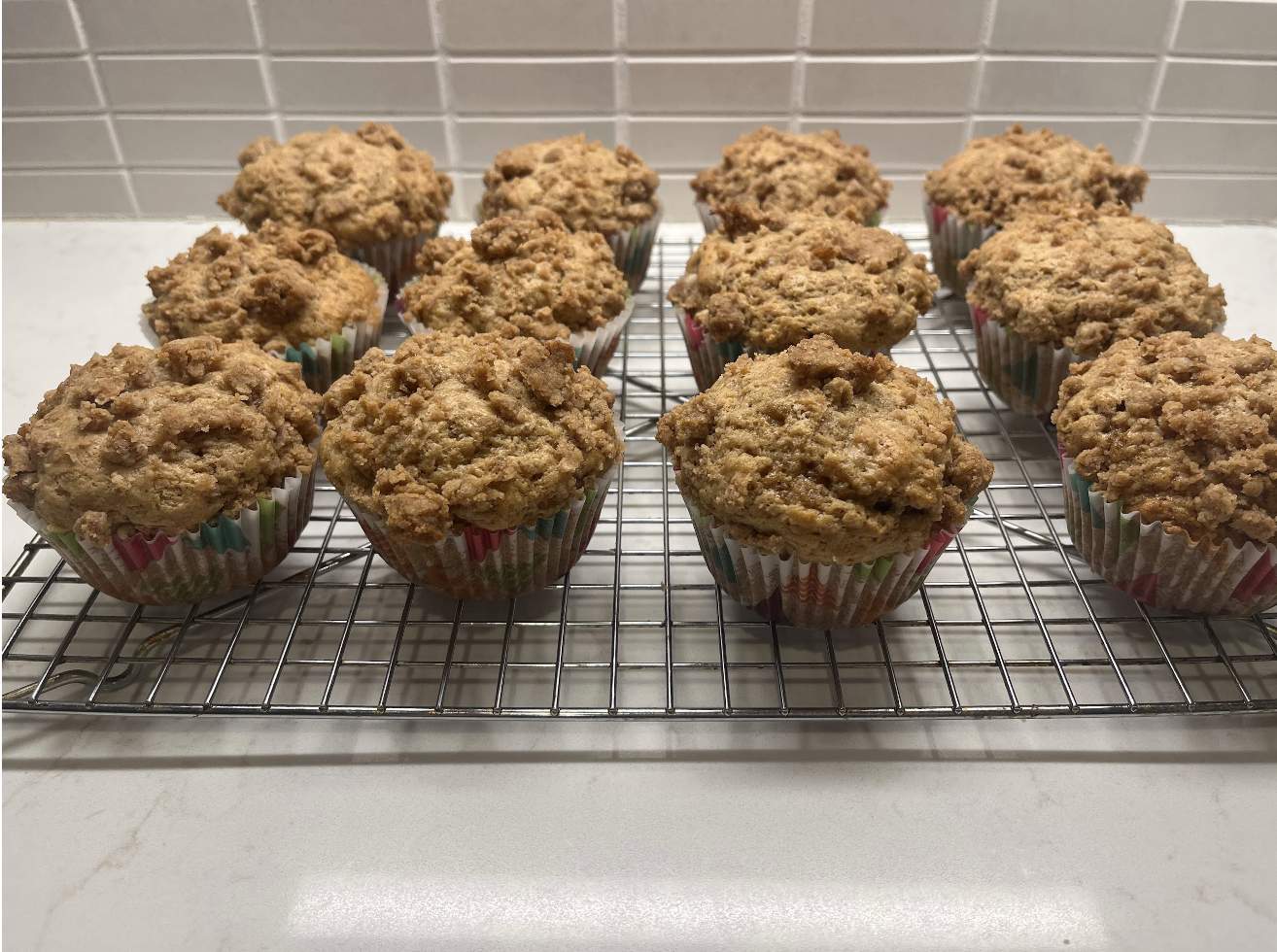
I thought that this recipe from Chisel & Fork was really good. Typically for baking recipes, I like to use Sally’s Baking addiction, but this time I wanted to try something new. I found this recipe for Cinnamon Streusel Muffins and wanted to give it a try. I thought that the recipe was easy to follow and understand. I followed the directions step by step, first measuring out my dry ingredients, and in a separate bowl my wet. I used a stand mixer to combine the wet ingredients, and I found that the end result is not as smooth as I thought it would be. There were small chunks of sour cream in the mixture even though I had mixed it for more than enough time. I was a little surprised at first, but once I added the dry ingredients into the wet, it all came together really nicely.
Once I divided the muffin batter into the tin, I topped each muffin with the streusel. I added too much on the first muffins, so I had to divide and sprinkle them onto other muffins to make sure there was enough for each one. Once they were baked, they filled my house with a warm cinnamon smell.
When I tried the muffin warm for the first time, it had a perfect texture, light, and fluffy. The streusel on top added a perfect crunch, that wasn’t too crunchy, it just added the perfect texture. The muffin itself had a nice cinnamon flavor, but I thought that the addition of the streusel was needed for extra cinnamon flavor. Everyone in my family tried them and two days later all the muffins were gone. They are the perfect sweet treat or easy on the go breakfast. Overall, I would definitely recommend this recipe if you’re looking for a quick, easy and delicious muffin recipe.
This summer, Kraus-Anderson Construction will be revamping Highland Park’s very own cafeteria. The project preparation is already underway and construction begins in April. The cafeteria renovation is one step of a complete update of the Highland school complex.
Kraus-Anderson Construction has a prolific portfolio including updates to the Minneapolis/St. Paul International Airport and is currently undertaking the Hidden River Middle School (formerly Ramsey Middle School) renovation project.
In 2024, Kraus-Anderson Construction began renovations on the Middle School which will include renovations of the special education suite, administrative offices and parking lot along with classroom upgrades and gender neutral restrooms.
These projects are part of the Saint Paul Public School District’s Five-Year Facilities Maintenance and Capital Implementation Plan. Together with the Facilities Master Plan (FMP), the Five-Year Plan aims to equitably modernize the 73 buildings within the SPPS district to evolve to the needs of teaching and learning in the 21st century.
Current design plans and renderings show that Highland Park students should expect new geometric floor designs, new cafeteria seating including booths, high-tops, and circular lunch tables. The high school and middle school sides of the cafeteria will also be joined together to resolve lunch time congestion.
Upgrades for the cafeteria and two-story link are well needed at Highland Park whose lunch room sees nearly 2,000 students each day, far surpassing any other lunch room in the SPPS district.
Project scope and timeline for the projects affecting both the Senior High and Middle School:
Spring 2025: Complete old administrative renovation (middle school); start renovation of kitchen and cafeteria space and new two-story link between middle school and senior high school.
Summer 2025: Begin interior renovation of special education suite; complete classroom technology upgrades; replace gym floor; finish flooring and lighting upgrades.
Fall 2025: Complete kitchen and cafeteria renovation and new two-story link; complete all earthwork and landscaping.
Union Latina is a club where it represents Latin culture and also does fun activities and has fun performances.
Currently Union Latina (ULA) is preparing one of the two events that they host every year called Fiesta Latina.
Fiesta Latina is where grades 10-12 Spanish immersion classes choreograph dances so they can be shown during the last period of the day for students at the high school and some classes from the middle school. They also perform after school for the families and friends of the students, so they can see all the hard work they have done and effort they put into the performance .
Fiesta Latina shows all the different Latin cultures/dances and fun activities that Union Latina does every Wednesday after school.
During clubs/after school the board members give time for students to practice the fun activities and dances that are going to be performed.
Even though Fiesta Latina is a month away, the Spanish teachers are already letting the students choreograph and practice the dances that they are going to perform at the show.
During my experience of practicing, it is stressful but it is also super fun knowing that I’m able to show my culture, and different cultures similar to mine, during practice. I’m also able to see my friends and classmates have fun dancing and see everyone laugh and talk to each other.
During the after school performance there will be food trucks serving the most delicious food, and the performance will be at 5:30. During this time you are able to get your food and be able to get to your seat to watch the performance.
Everyone is welcome to watch the amazing performance Union Latina (ULA) will be presenting!
Fiesta Latina is on: April 17, with performances during 4th period and after school at 5:30.
The term fashion icon is used quite a lot, but what actually makes someone a fashion icon? Surely, everybody has their own opinion on what makes someone a fashion icon, but Google defines it as “a person whose unique and recognized style has a significant impact on fashion trends and culture…”.
Going off of that definition, my mind immediately goes to Marylin Monroe, one of the most popular and classic fashion icons of her day. Marylin Monroe broke barriers back in the 1950s, where fashion for women was often very restricted and modest. She created a whole new world of opportunities for how women present themselves to the world.
I’m sure at the time, Marylyn’s style was critiqued for its boldness just as much as it was praised, but she truly did shift women’s fashion in such a powerful way. It was the start of women being able to embrace their own body and femininity in what they wear. She’s classic, and her fashion marks a turning point for women in history.
Another woman that comes to my mind when talking about fashion icons is Princess Diana. Diana’s fashion is known for being simple and modern, but there’s also a bit of rebellion to it. Being a part of the royal family, expectations were obviously set on how she dressed and presented herself, and she challenged that by wearing a pant-suit set once.
A lot of people still take inspiration from her looks, and admire her fashion for how she subtly gave messages through it. One of her most popular looks, known as the “Revenge Dress” is often labeled that way due to how her husband, Prince Charles, confessed his infidelity on national TV the same night she wore the dress.
Both of these icons have changed women’s fashion since their times, but what about modern fashion icons?
Zendaya Coleman is one of today’s most influential fashion icons, and beloved by many. Even though she started as a Disney Channel star, Zendaya has moved on to much bigger things in her career, and is often always wowing critics and fans alike with her looks.
Zendaya is always making a statement with her fashion, and has even won the Council of Fashion Designers of Americas Fashion Icon Award. Her fashion sense is constantly changing and evolving, but one thing that I think makes it stand out more is that she doesn’t label it. Zendaya herself has stated that she doesn’t have a personal style, and I think that’s what makes it so good. She doesn’t put herself in a box of what fits her style and her look, she just wears what she wants, and it’s always amazing.
We all know Girl Scout Cookies, and we all love them too. They’ve become a well known classic in the United States. They are available to be purchased in January through April every year, and without fail they are always in high demand. Every year, Girl Scouts sell approximately 200 million cookies to Americans, each box costing $6-7, and in total worth an estimated $800 million. It is the largest girl-led entrepreneurial program in the world.
Aside from how much everyone loves buying the cookies, being a part of Girl Scouts is such a great thing for young girls. As of today, Girl Scouts of the United States has over 2 million members. Being a part of Girl Scouts helps young girls develop so many skills, like community engagement, confidence, leadership, and more. Selling Girl Scout Cookies provides great opportunities for practicing communication skills, managing money, and being part of a community.
Girl Scout Cookies were originally home baked by members with their moms, simply volunteering to be involved in the community. It wasn’t until a few years later, in 1917, when the first box of Girl Scout Cookies was sold. Ten years later, it became normalized for Girl Scouts to go door to door throughout a neighborhood to sell the cookies.
Nowadays, if you go out to a local grocery store during the spring, you’ll often see a Girl Scout Cookie booth. Typically a few young girls will be standing behind the booth while a few adults will be around for supervision as they sell out of cookies quickly.
Girl Scout Cookies remain very consistent. Especially by maintaining the consumers favorite flavors every year, like Caramel deLites, Thin mints, Adventurefuls, and my personal favorite, the Lemonades. Typically, you don’t see new flavors getting introduced.
Overall, Girl Scouts have made a huge impact across the United States in the past 100 years, and in a way, the cookies have brought so many people together. If you haven’t already gone out and bought a box, I highly recommend that you do! Not only would you receive a nice treat, you’d also be supporting the opportunities of so many young girls.
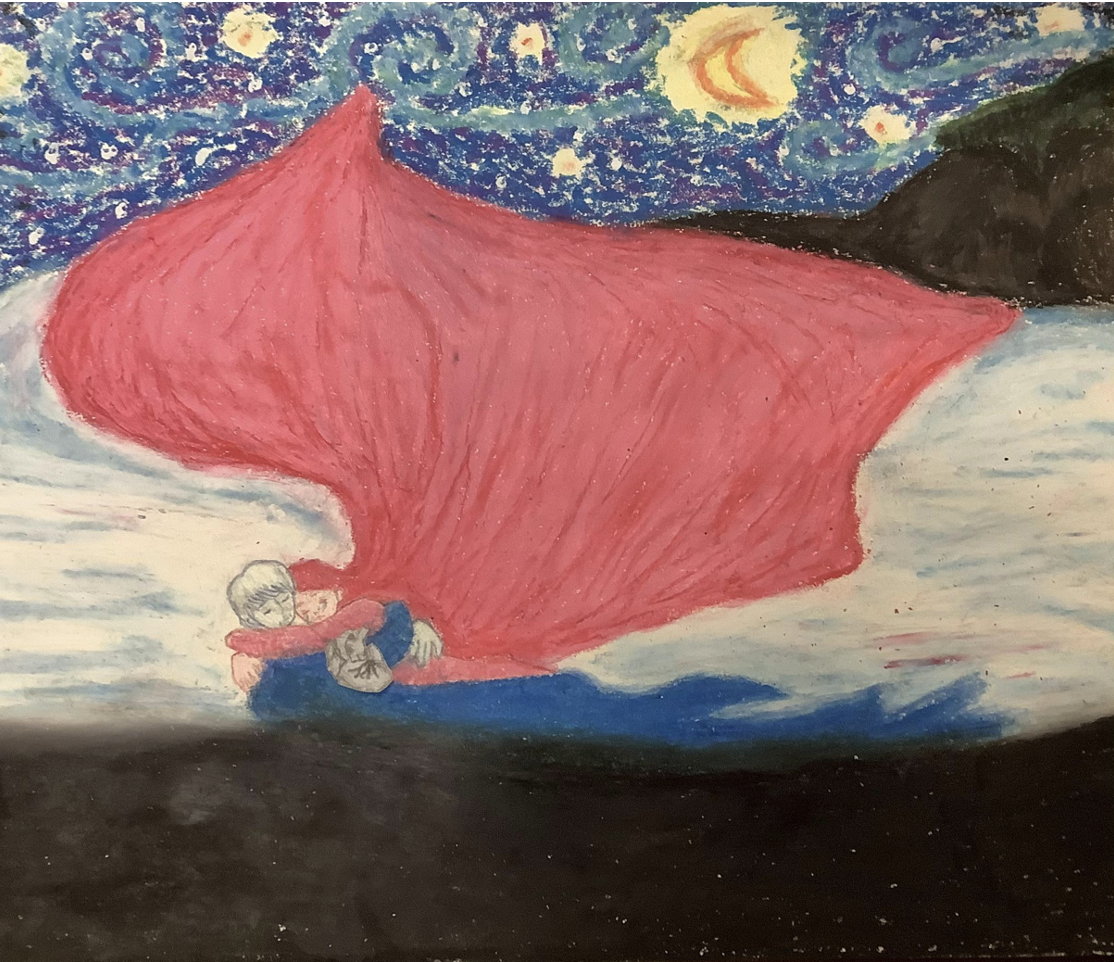
This artwork was made especially for a Personal Project. The artwork was created with the use of oil pastels, which I really enjoyed using and took me about 10 hours to finish.
I was really inspired by an oil paint artwork, “The Starry Night” by Vincent Van Gogh.
Even though I really want others to have their own interpretation of it, but for me, it’s about how a person you loved but they’re not in your life anymore, so you replay moments with them which makes you want to crave their presence. As you wait for them to return back into your life again, they’re slowly moving on, like fading away.
The Official Online Newspaper, Literary Magazine, and Video News of the Highland Park Scots











 Plaid Line + PRIZM + Scottie News