Tag Archives: worldbuilding

STATE OF THE WORLD | ARCERIUM RISING

By: Hoaseng Thao

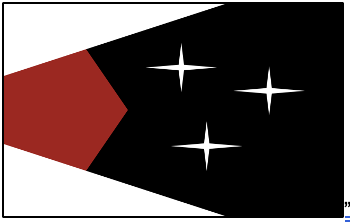
Much has changed since the First Continentals War (1948-1956). The dawn of the new millennium marked a new and haunting era for the world; a cold war began as soon as the time ticked to January 1, 2000, and the contenders were the Vaserian Federation and the Democratic Union of Kavara. Both nations wield the divine powers of Arcerium warheads, the same design of weapon used to end the First Continentals War.

“Vaserian Federation flag (left) and the Democratic Union of Kavara flag (right)”

Vaseria and Kavara began to amass their military might and collect new allies to compete for world dominance, and it all came to a head when Kavaran ally, Alakis, invaded the Vaserian ally, Krinia in 2023, marking the beginning of the Second Continentals War. It was a relatively short war that ended in a ceasefire, not because one side was faltering but because of an event so devastating it would change the course of the entire world.

The event was known as the Arcerium Rising.

On October 5th, arcerium fields within the Arcerian continent erupted abruptly across the entire continent, contaminating it with arcerium and arsoulium. The damage done was severe enough that two warring superpowers chose to end hostilities and clean up the disaster. All events following Arcerium Rising would shape the future of the world, whether it be for the best or worst.

The year is 2049, and this is the state of the world.

NOTABLE FACTIONS

It is clear that for a nation to survive in this new world, they would need more than just an army, they would need the help of other nations not only for security but to turn a bark into a roar on the international stage.

PATO (POLARIS ALLIANCE TREATY ORGANIZATION) 

PATO is a global organization led by the Vaserian Federation, their goal is to keep the Kavaran threat at bay while guaranteeing the security of the free world whether it be through peaceful means or by intervention. Some call them an alliance of self-righteous bullies.

CDP (CROATOKE DEFENSE PACT)
The CDP is a pact formed, and led by, Kavara, mainly to secure as many allied states around the world; its goal is to expand the influence of its member states by any means necessary. Despite having the word defense in its name, the alliance has been responsible for starting many conflicts including the Second Continentals War.

ON (ORGANIZATION OF NATIONS)

The ON is an intergovernmental organization that seeks to maintain international peace and security by all means possible. But if peace cannot be achieved peacefully, they can always rely on their peacekeepers who tend to keep the peace by force and force only.

ISAO (INDEPENDENT STATES OF ARCERIA ORGANIZATION)

When the Arcasian Civil War broke out following the Arcerium Rising event, an alliance of Arcasian states began to fight a war for independence. To many, they are terrorists taking advantage of a terrible situation, but to many, they are freedom fighters reclaiming lost land.

CONFLICTS IN MOTION

ARCASIAN CIVIL WAR (2023-present)

“Map of Arcasia”

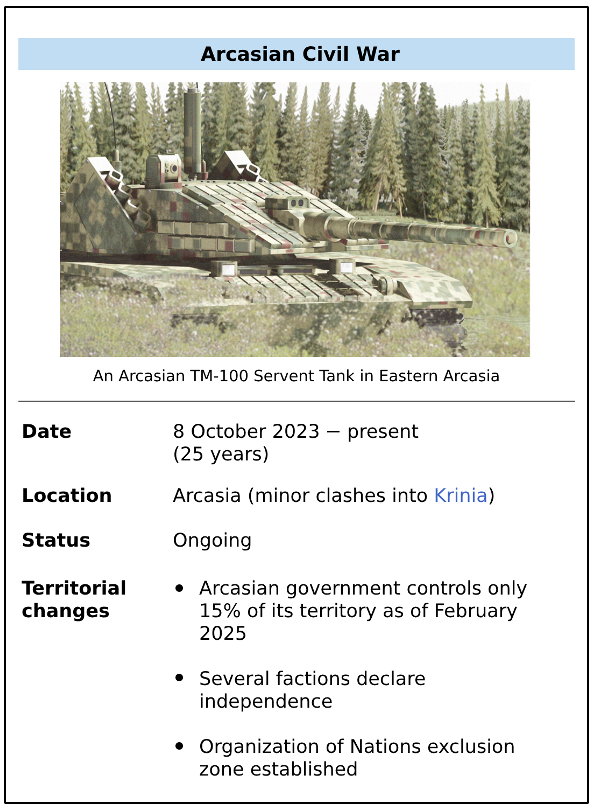
The Arcasian Civil War is the deadliest war to have ever occurred, when the Arcerium Rising event began, it sent the already unstable Federal States of Arcasia into turmoil, and the states within sought independence.
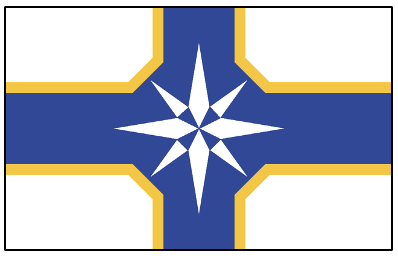
“The flag of the Federal States of Arcasia”

Not wanting to face embarrassment from the international community, the Arcasian government kept everything under wraps, isolating itself from the world and keeping the war and their failures to contain arcerium a secret until 2034, when they finally asked for international intervention.
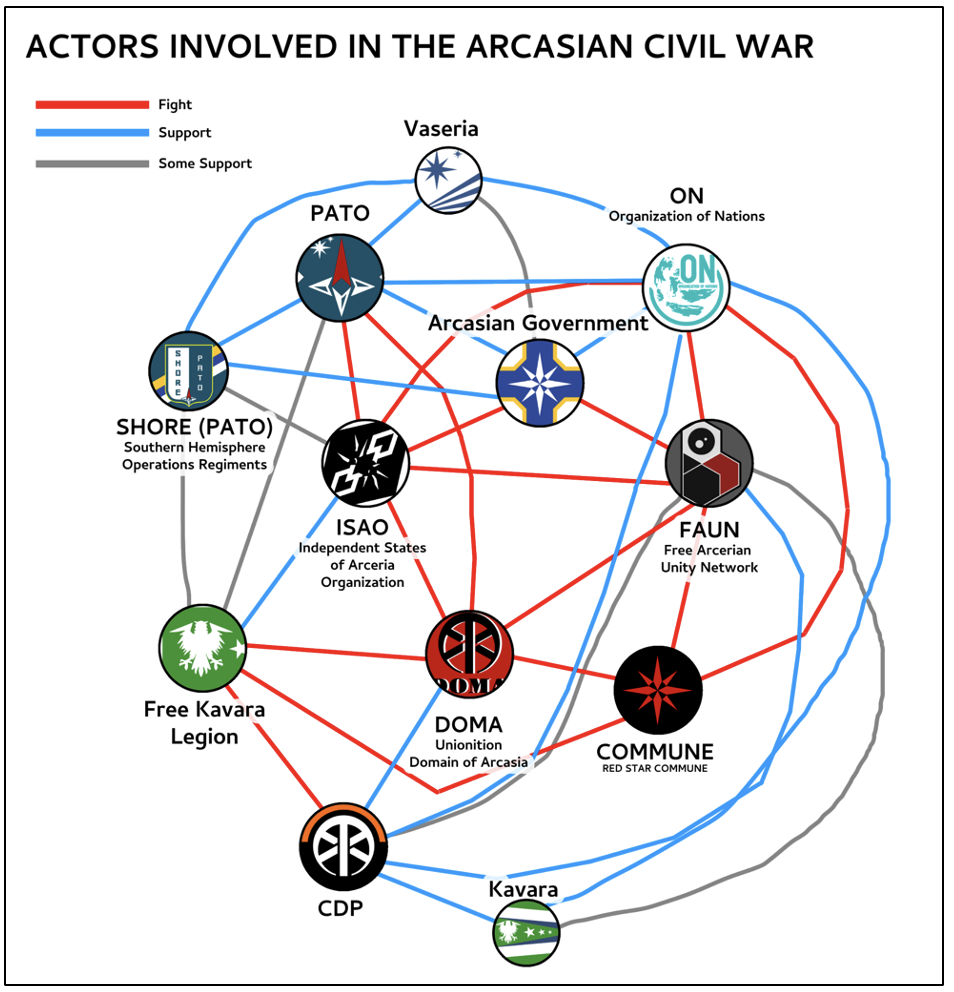
“Actors involved in the Arcasian Civil War, red = fight, blue = support, grey = some support”

What happened in those 11 years remains a mystery, but what is known is that a billion people used to live in what is now the Arcerium Rising Exclusion Zone, and their whereabouts remain a mystery. What is happening now in Arcasia is complicated, but what is certain is that this war is not going to end any time soon.

ORBESJKAN CIVIL WAR (2030-present)
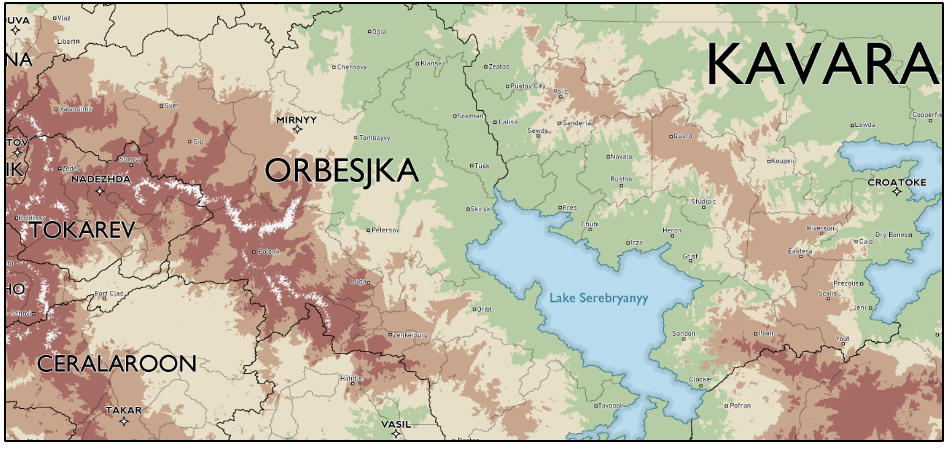
“Map of Orbesjka”

The Orbesjkan Civil War began when the government allowed some states autonomy over their regions before they could declare independence. This was done so that some regions could transition into independent nations peacefully, but only a few selected states were given this treatment.

“The national flag of the United Principalities of Orbesjka”

In 2030, states in the northern regions, feeling neglected by the government, declared independence with the support of the CDP, and began a war to free other states in the south, beginning the Orbesjkan Civil War.

HOSHIRAN CIVIL WAR (2046-present)

“Map of the Kingdom of Hoshira”

The Hoshiran Civil War began when the Suineng hydroelectric dam broke apart and killed nearly fifty thousand people. The dam was known to be in a dire state and yet the government refused to do anything about it. Fed up with the government, the citizenry began to revolt against the government and formed warlord states to solve what they believed were the issues that plague their kingdom.

EPREAU-INDO WAR (2043-present)
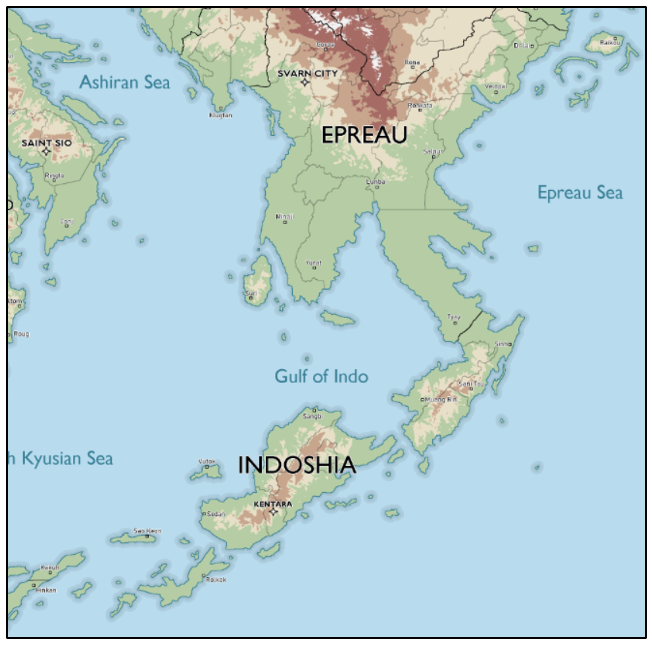
“Map of Epreau and Indoshia”
“Flags of Republic of Indoshia (left) and the Republic of Epreau (right)”

The Epreau-Indo War is a conflict between the Republic of Epreau and Republic of Indoshia that began after border clashes led to the deaths of several border troops from each side, which then spurred an all out war between the two nations. As of 2049, the war has hit a stalemate.

DRONGO-ZEHERA WAR (2048-present)

“Map of Zehera and Drongo”
“Zeheran Union flag (left) and the flag of the Republic of Drongo (right)”

In their attempt to regain lost territories, The Republic of Drongo, alongside their CDP allies, declared war on the Zehera Union. Although Zehera was no match for the full might of the CDP, the failures of the Drongon army in the first few weeks of their invasion saw the CDP pull out of the conflict and to merely advise the Drongon’s into “winning” the war.

WHAT LIES AHEAD

The future of this world hinges on the cool steady minds of its inhabitants, one fatal error could send every living being to have ever lived to their maker. If the world ignites in total war again as it did so long ago in Koldr and in Krinia, there will be no winners or losers, only survivors.

War is human nature, and we are doomed to repeat it.

SHOOTING STARS | CONTINENTALS WAR | ARCERIUM RISING 11: Part II

By: Hoaseng Thao

PICKING UP THE PACE

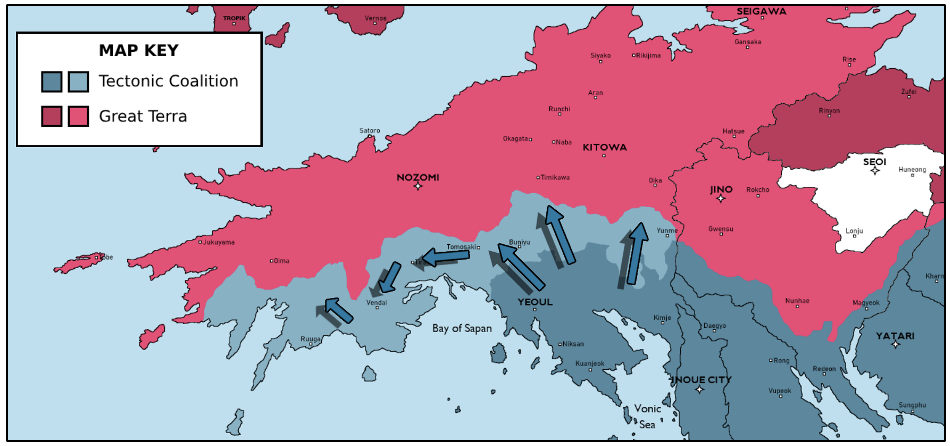
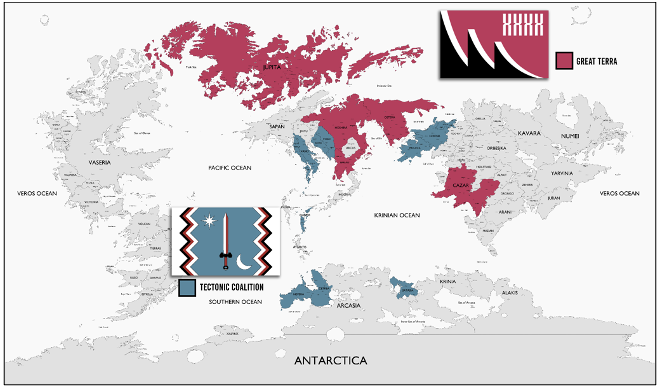
The Coalition was able to take the Hoshiran capital by August, but their forces couldn’t go much further. They too were just as outstretched as the Great Terrans. That would change when news arrived that a large naval force had just landed on the shores of the Lunarian continent.

The Vaserians had just landed on Oprica.

The Vaserians took over the shores of occupied Oprica on August 15th. With most of the Jupitan occupiers being sent to fight in Sapan, the Vaserians were able to take over the entire country in a matter of days with little resistance. The Vaserian entrance to the war was a surprise to many, and there would be further surprises as the Vaserian military continued to land on the shores of occupied Lunarian states.

The 20th of August saw the Vaserian Mage Corps and the Marines landed on Casikee, successfully returning the capital back to its Casikan people as the roars of VF-6s shook the skies above. With the arrival of the Vaserians, the occupied nations of Lunaria rose up against the Jupitans, overwhelming them as the Vaserians trekked more and more into the continent.

August 23rd, the Vaserians finally made the push to join the Coalition and with it, guaranteed the Coalition the needed victory to end the war. With Vaseria now officially a part of the Coalition, other nation states from the Vaserian continents joined and with their entry, saw a flow of new troops from the Vaseria sent to every front of the war.

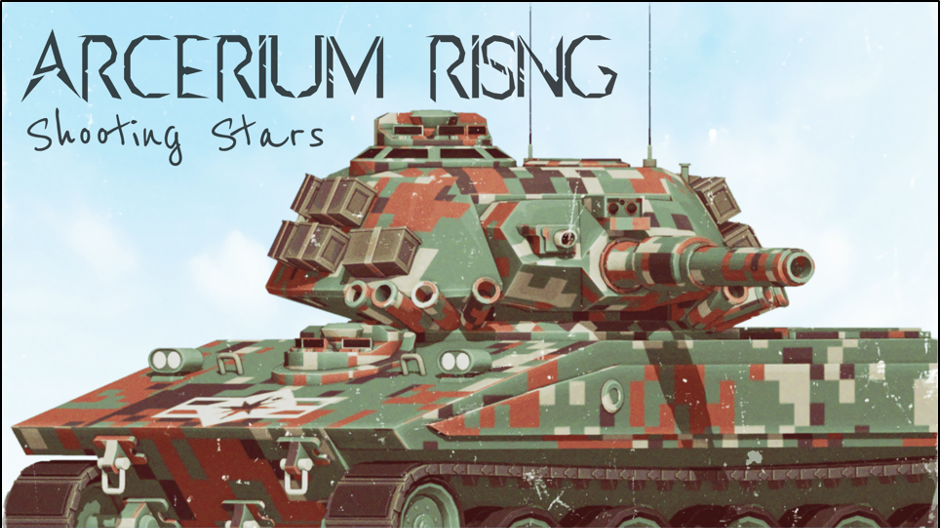
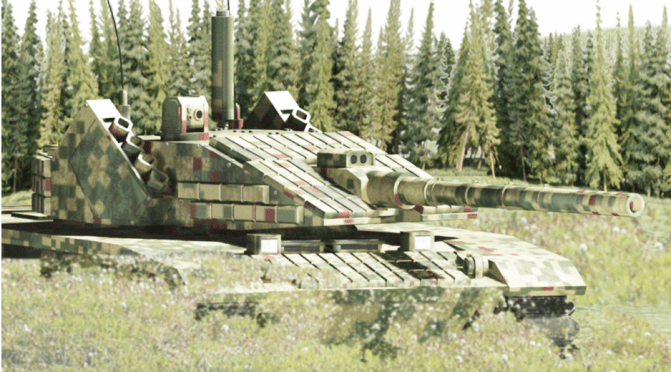
“Vaserian M2 Strucker tank during the Second Battle of Ulyse, Koldr c. June 9th, 1956”

By October of 1956, the war had completely changed, the Sapanese were able to retake its capital, and Koldr, the first to fall, regained its sovereignty, and the Jupitans were now fighting on the homefront. All that was needed to finally bring the world to peace again was something really big to happen, and that came with the arrival of shooting stars. Man made shooting stars.

SHOOTING STARS

In 1949, the Vaserian Federation, in secret, began the development of a new type of weapon that would harness the power of nuclear fission with arcerium to create an explosion never seen before. The weapon would be placed into a warhead, and transplanted onto newly developed intercontinental ballistic missiles for increased range.

In 1953, the first detonation of the weapon, now nicknamed as “Star” was conducted, an explosive yield of 10 million tons of TNT.

In 1954, ten stars were built and operational with more to follow.

In 1955, Anne Hall is advised by the Office of Secret Security (OSS) to not use the stars until they make land in Jupita.

November 5, 1956, Anne Hall is told by the OSS to use 10 of the 24 ICBMs at specific targets in Great Terra.

November 6, 1956, 10 stars were launched from their silos.

The following are the impacted targets:

Hellica, the capital of Jupita, was the first to be hit by the stars; it destroyed half of the city, and caught Emperor Treijon himself in the initial blast.

New Olapi City, Jupita

Veldpal, Epreau

Gunfang, Hoshira

Songfei, Hoshira

Sakunn, Jupita

Falei, Jupita

Lunbai, Epreau

Raikou, Epreau

Rinyan, Hoshira

THE NEW WORLD

On the eleventh hour, on the eleventh day of the eleventh month, in the capital city of the first nation to fall, was the signing of a treaty of peace between the Tectonic Coalition and Great Terra. The Treaty of Ulyse put an end to the deadliest war the world had ever seen, over 100 million souls were lost in eight years. Great Terra was no more, but the world before it came with it.

Jupita lost all of the territories it gained from the war, and had to pay reparations to the nations affected by its wrath. The Lunarian continent returned to peace as it was rebuilt with Vaserian loans.

In Kyusia, it was not Hoshira who saw the loss of land, but the Kingdom of Sapan. Princess Chiyo, now queen of Sapan, saw to reward her people, but more importantly, the ethnic minorities who remained loyal to the crown. Her reward was to allow them to choose to stay within the Sapanese realm, or be free.

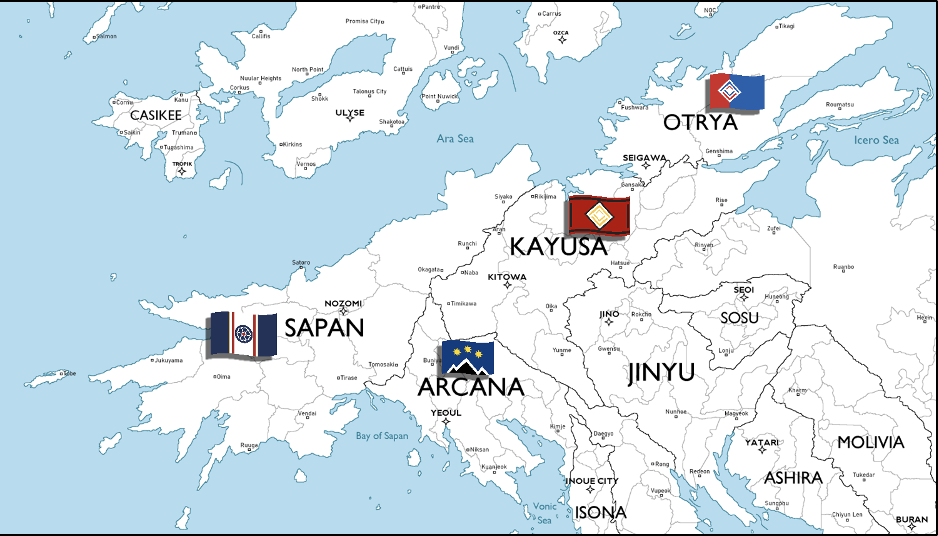
January 12th, 1957, the Kingdom of Arcana was formed, and on the following day, the Republic of Otrya. It wouldn’t be until March 27th, for the final state to secede from the realm, that being the Kingdom of Kayusa.

“Map of western Kyusia c. 2047”

Eusona, following the war, was not a pleasant sight. Because of how far the technological gap was for Eusonan nations, many could not bear the weight of post-war clean up. In 1957, the Kalavian civil war (1957-1962) began when the socialist government refused to return back to a democracy, and it split the nation into two; the eastern half belonged to the People’s Republic of Kalavia while the west belonged to the Republic of Kalavia.

“Map of West and East Kalavia”

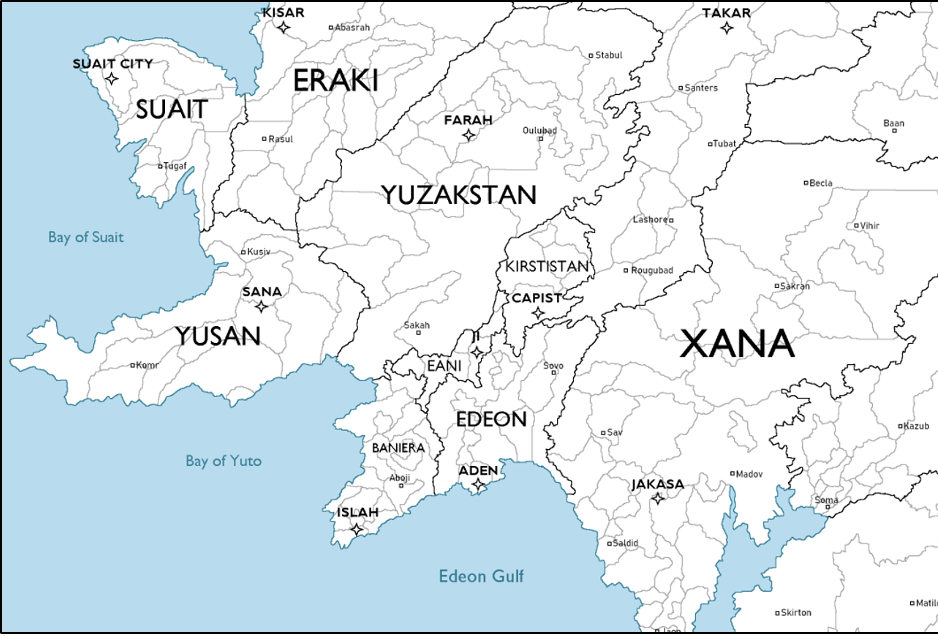
What remained of the Cazar Empire was split up into multiple nation states following its civil war that ended in the 70s, Eraki, Yuzakstan, Yusan, Baniera, Edeon, Eani, Kirstistan, and Xana.

The Kirston Empire, despite being victors of the war and liberators of the Valkyrie Peninsula, found itself with a destroyed nation. Millions of ethnic Nexens were wiped out at the hands of the Cazars. They were, for many generations, the backbone of Kirston society, and with their loss came the empire’s economic troubles.

In 1957, to cope with their economic struggles, the empire sold away parts of its territory as sovereign nations, Envoa and Litho. Although there was some peace for the Kirstons, the ambitions of many hardlined nationalists saw the nation at war again, this time as the invaders in The Grants War (1970-1973).

“An Envoan Special Forces operative posing for a camera crew during an extraction in the mountains of Kirsto, circa April 2nd, 1973.”

Vaseria soon cemented itself as one of few superpowers of the world with the use of its arcerium weapons, and soon enough the rest of the world appeared to have begun their own arcerium weapons program to compete for superpower status.

But the world was at relative peace now that the war, or the Continentals War as coined by the media, had ended, and that was all that mattered in the end.

WAR NEVER CHANGES BUT THE WORLD DOES

The start of the 21st century saw a Cold War begin between the Vaserian Federation and their PATO allies, against the Democratic Union of Kavara and their CDP puppet states. And in 2023, the Second Continentals War began between the two superpowers, but it ended as soon as it was declared, when the Arcerium Rising event occurred and a tense peace insured.

It is now 2049, the world is on the brink of total war between Vaseria and Kavara, and with the civil war in Arcasia becoming more worrisome, it is now up to the people of Earth to decide the fate of this world.

SHOOTING STARS | CONTINENTALS WAR | ARCERIUM RISING 11: Part I

By: Hoaseng Thao

LANDINGS ON OSTERA

July 5th, 1953, Coalition forces enacted Operation Lone Passage to invade Ostera through the Lapish channel, with a combined force of 150,000 strong. The Kirston airship Spirit of Eve is allowed to be used in the operation, using its ability to launch aircraft during flight to guarantee the Coalition air superiority over Ostera.

“Visual invasion of Ostera during Operation Lone Passage”

With the Coalition landing on the shores of Ostera, Emperor Treijon sends Army Group Aster, to reinforce the Osterans and halt the invasion in its tracks. Prior to the initial landings, the Coalition touched base with separatist groups in the region, who agreed to support their invasion if the Coalition guaranteed the independence of the Lapland regions. With their backing, the Coalition was able to move through the Lapland region with ease, allowing them to strike deep within Osteran territory.

By August 25th, Coalition forces were able to secure the southern coastline of Ostera, but the entry of Jupitan reinforcements led to the halt of their invasion. General Thor, the commander of the Jupitan invasion of Sapan, and the man in charge of Army Group Aster, was sent to the Osteran front to put an end to the Coalition invasion.

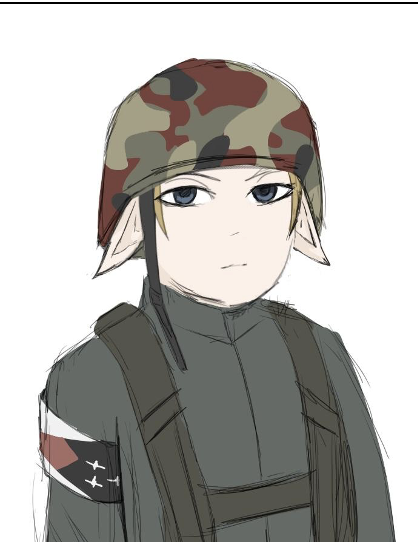
“Photo of a Kirston Soldier with their identification armband”

Fierce fighting between the seasoned Jupitan army and hardened Coalition forces ensued in the cities and forests of Ostera, but as the fighting prolonged into the winter of December, the seasoned Jupitan army began to show its cracks. After years of fighting, the Jupitans became overwhelmed by the extent of its forces, and the new front only caused it to stretch even further.

December 20, 1953, General Thor and his remaining army of 4,000 troops were encircled in the Silver Forest by an encircling Coalition force of 7,000, cutting them off from the nearest Terran stronghold in the region. When Treijon receives news of one of his greatest generals being encircled, he decides that it was time to reveal his newest weapon.

It was to be released on the night of the 24th of December.

SIDE BY SIDE

Gripping the stock of his rifle, the lone Jupitan marches alone in the darkness of the snow covered forest. His comrades had already passed not too long ago.

The sounds of distant gunfire are followed by a haunting roar that fills the forest. They were unlucky enough to encounter the beast of the forest.

Marching through the snow, the Jupitan halts in his tracks, looking back at the creeping darkness of the forest. His gaze met eye-to-eye with the creeping beast.

He closes his eyes as the beast lept from the snow, he tries as hard as he can to fetch a good memory before he can remember no more.

A quick snap of the rifle fells the beast to the snow. Opening his eyes, the Jupitan is met by a singular soldier, on their arm was the flag of Orbesjka. The two soldiers exchange looks, their uniforms may be different, but their goal of survival wasn’t.

The two trek through the forest together, hiding when the roars of another beast fill the night air and resting when needed. When the sun’s basking heat covered the forest, the two soldiers were found back to back against one another, sharing a sigh of relief as the horrors of the night faded away.

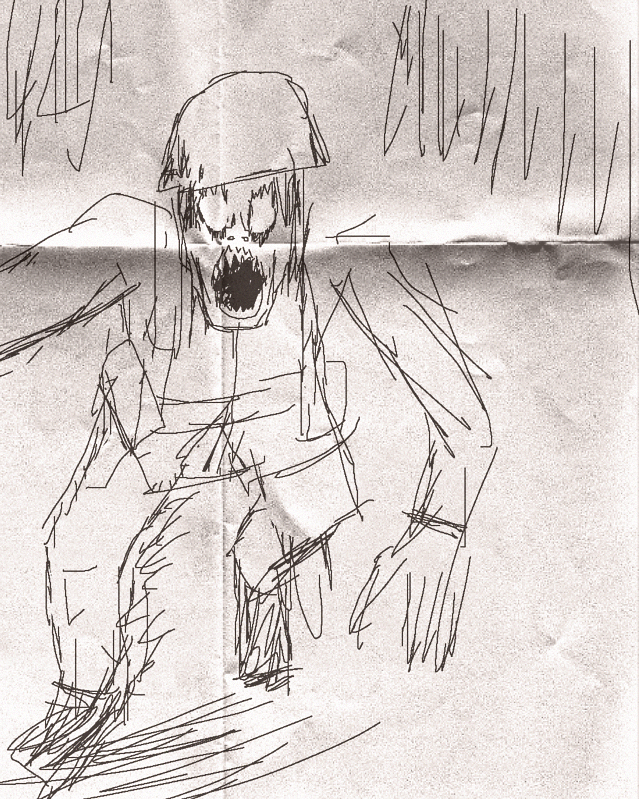
“A soldier’s sketch of the monster following the attack.” c.1953

MAN MADE HORRORS

Treijon green lights the use of a new chemical agent, spiritus, on the Coalition forces encircling General Thor. The chemical agent was designed to turn those affected by it into bloodthirsty monsters, by overstimulating the body with arsoulium.

Arsoulium is often used as a “miracle” drug to slow down the rate of cancer cells while giving its users quick access to their magic abilities, but it is dangerous in large doses. Individuals become unnaturally aggressive and aware of their surroundings, which would be exploited in Jupita’s new weapon.

On the night of December 24, 1953, Jupitan planes released spiritus over Coalition lines in the cover of a snowstorm to avoid the interception of Coalition aircrafts. However the harsh winds of the storm blew the chemical agent towards the encircled Jupitans, resulting in utter chaos on all sides.

The night turned into a bloody affair, as both Coalition and Jupitan forces banded together against their former friends and foes. When day broke, what remained of the two armies in the area were brittle, down to only a couple thousand. General Thor and what remained of his army retreated from the region, leaving only the Coalition being left to clean up the remaining monsters.

The use of such a weapon was horrific in nature, and caused a global outcry against Great Terra, but to Treijon, he saw it as a means to an end.

SIX YEARS OF WAR AND MORE TO COME

At the beginning of the war, it was Great Terra who were the victors of the battlefield, but now, after six years of constant warfare, it was the Tectonic Coalition that began to take their place.

On February 5, 1954, Coalition forces captured the Osteran capital city, Lindel, and established a provisional government as well as forming a Lapland republic on the following day. With the Osterans out of the way, the Coalition pushed eastward into the territories of Hoshira, besieging  its capital by June.

“The invasion of Hoshira visualized”

There was a small Coalition invasion of Epreau on the 2nd of May, the Molivians invaded to capture the Epreaun capital, Svarn City. This however was partially successful, the Molivians did take a lot of ground leading up to the capital, and were even able to take some sections of the city, but it all stagnated when both sides limited the use of artillery and aircraft in fear of civilian casualties.

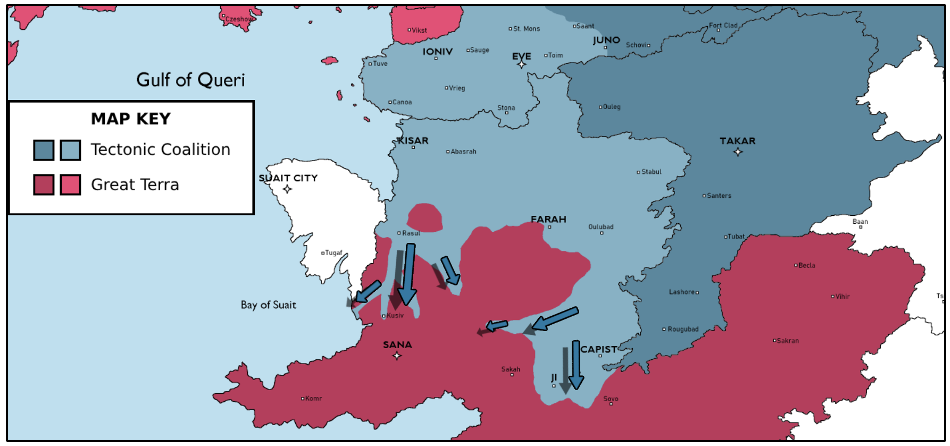
But on the bright side for the Great Terrans, the Jupitan Fall Offensive was successful in taking back the western coastline of Sapan, but this however was a double edged sword. The offensive cost them tons of vehicles, ammunition, and supplies that they couldn’t replenish, but Great Terra knew that the Coalition was also in the same predicament.

“The Fall Offensive”

The Great Terrans were on borrowed time, and that time was going to become way shorter due to a situation happening beyond the Pacific. 1954 was not only an important year of the war, but a very important one for a specific nation, the Vaserian Federation, due to it being election year.

THE NATION ACROSS THE POND

When the war first began, many Vaserians pondered on whether the Vaseria needed to intervene in a conflict so far away, but this has since gone away when Great Terra invaded the neutral states of the Eusonan continent, with many seeing it more of a reason to intervene before it comes close to home.

1954, was the election year for Vaseria, and the war across the pond became a hot issue for its candidates. There were two major candidates on the ballot, Anne Hall, a former decorated officer of the Vaserian Mage Corps during the Great Vaserian War and prominent supporter of the Tectonic Coalition, and Mariane Thoa, an actor turned politician who wanted to keep Vaseria’s ambitions within its borders.

When the votes were accounted for on November 10th, it would appear that Anne Hall had won the election with 56.4% of the votes, which was a huge victory for the Coalition as they now had the industrial powerhouse soon to be on their side, but this win would only embolden the already demoralized Jupitans.

January 30th, 1955, a date which will live in infamy. The Vaserian Federation was suddenly and deliberately attacked by chemical weapons, created by the terror state of Great Terra. The capital city, Sukuyo, and the newly elected queen was the target of these attacks, and although the queen did survive, it left the nation scarred and shying away from matters on the war. Or so it would seem.

THE ARCERIUM ERA | CONTINENTALS WAR: ARCERIUM RISING 10

By: Hoaseng Thao

THE TABLES HAVE TURNED

Starting January 15, 1951, the Kirston army made their counter offensive against the Cazars and the newly arrived Kirston expeditionary forces. The attack was successful, not because of the reorganization of forces in the mountains, but the introduction of a new weapon, the aerial carrier, KIAF Spirit of Eve, the world’s first operational aerial carrier.

The KIAF Spirit of Eve, was a revolutionary weapon that turned the tide of the war, it launched jets from a runway on the top and fired cannons from the bottom, and it was able to do this with its powerful arcerium reactor.

The aircraft had been built in collaboration with the Kirston government and the defense manufacturer, Shinka Industries, the premier defense manufacturer from the Vaserian Federation.

With this new weapon it was able to seize control over the skies of Kirsto, allowing the army to advance without worrying of enemy close air support. The Terrans retreated back into Cazar or occupied Icana by the end of January, the Kirston army was able to take back their country, and in their success was the hope of turning the war in favor of a Coalition victory.

REVITALIZED WAR

With the Terrans defeated in Kirsto, many Eusonan nations joined the war, such as the Orbesjkan Empire and the Holstaid dynasty, with the latter taking the opportunity to invade Cazar on March 10. With the Terrans driven out of Kirsto, Coalition forces in Kyusia seized the moment to enact their greatest feat of the war up to that point.

Coalition forces began their advance to regain control of Sapan on the 12th of July, codenamed “Cherry Landing”. The operation was to airdrop troops behind enemy lines, sabotaging logistical lines and preventing enemy reinforcements from reaching the advancing Coalition forces.

The fiercest fighting of the war began on that fateful day, but it was very well needed as the Coalition began to sweep through the southern plains of Sapan and even reaching to the western coastline. Their successes had to end at one point, and it ended as soon as they reached the mountains of Sapan that blocked the southern plains from reaching the north.

Many attempts were made to breach the mountains, few were successful, but most ended in disaster. The operation would end in early October, and despite suffering more losses than the Terrans, the Coalition were successful in regaining control of southern Sapan.

AN EYE FOR AN EYE

Happening around the same time was the invasion of Cazar on September 3rd. While having a large army of over ten million strong, the Cazars would have the majority stationed too far from home, and combined with the Kirstons new aerial warship and the entry of Orbesjka and Holstaid, the home guard of Cazar could barely fight the fight on its own.

The Cazars surrendered to the Coalition in large numbers, ranging from a hundred to ten thousand surrendering troops. But those who pleaded for mercy from the arriving Kirstons found none. It was ruthless, it was bloody, but it was undoubtedly revenge in its extreme form.

Sana, the capital of the Cazar Empire that for centuries held up the foundations of the aging empire, was burnt down on January 22, 1952. Had the advancing Orbesjkans and Hostaidi’s been there a few days earlier, they would have spared the city from the revenge of the Kirstons.

In the fall of their capital, many regions within the vast empire declared their independence and were willing to fight to keep it. Soon the entire empire was engulfed in chaos, with the coalition unwilling to spend more resources to quell the rebelling states across the now destroyed empire. The Cazar Civil War has begun, leading to decades of conflict.

As the Cazars left the conflict for good, Coalition forces in Eusona eyed the Valkyrie Peninsula and the occupying Osteran forces stationed there. If they were successful in retaking the peninsula, they would be able to launch an invasion of Ostera through the Lapish Channel and force the Great Terra to relieve their forces in Sapan to avoid a Coalition steamroll in Ostera.

A complete reversal of Cazar’s invasion of the Valkyrie Peninsula began on the 10th of June, 1952, with Coalition forces pushing the Osterans out of the peninsula by the end of September. The newly formed People’s Republic of Kalavia, which was created by Great Terra in the Coalition surrender the year before, quickly aligned themselves with the Coalition and turned its back on its creators.

TREIJON HAS GONE ILL

With the Valkyrie Peninsula returning to the Coalition, the Jupitan Premier, Alek Treijon, and the mastermind of the whole war and leading figure of Great Terra, cracked from the weight of it all. He slowly grew paranoid with power, and feared that his own generals were after him or worse, losing control of the Great Terra he created.

To avoid the many scenarios he created in his head, Treijon would secretly purge military officers, politicians, or anyone with a resemblance of power within Great Terra to labor camps or execution. December 12, 1952, Treijon announces himself as eternal emperor of Great Terra, hoping to guide it long after his passing.

As the summer of 1953 came along, Emperor Treijon was informed by his generals that his new weapon was finished and operational, all that was needed was his approval for it to be used on the battlefield.

WORLD IN FLAMES | CONTINENTALS WAR: ARCERIUM RISING 9

By: Hoaseng Thao

THE NEXENS OF GREAT TERRA

Nexens, or Homo Nexums, evolved from Humans like many other races, however unlike most of them that evolved to have animalistic body parts, Nexums retained nearly 99% of Human traits with the exception of being naturally taller with the average healthy Nexen growing up to, or even over, seven feet tall.

Their lack of animalistic traits and unusually tall stature, made the Nexens visually inferior to other humanoid races, who believed them to be a mistake in human evolution and were not worthy of having special traits like themselves. Because of this, Nexens were often forced into slavery, with them being the main labor force for Great Terra. That was until 32 BH.

In 32 BH, the slavery of Nexens in Great Terra gave birth to a Nexen boy in Triaag, a mining town for slaves. Growing up, the boy learned to read and write from the few books he stole, where he learned what life of being free was like, or at least from what few words he understood.

But when Great Terra’s economy collapsed in 16 BH and the empires within started to show their cracks, the boy seized the opportunity and fled from the small town, to embark on a journey across the world.

His journey across the known world as a Nexen on the run, would see the start of his radical ideas of a new world, one where freedom, liberty, and justice was the norm for all beings. By the time the Revolutionary War started in 18 BH, the boy, amongst the low ranks of the revolutionary army, stood above his fellow soldiers and preached his ideas of a new world.

His words enlightened those who listened, and they too would spread his words. As the Revolutionary War continued, the boy grew to become a prominent figure amongst the revolutionaries; historians still don’t know his real name but he is known by his moniker, Hero.

THE CONTINENT OF EUSONA

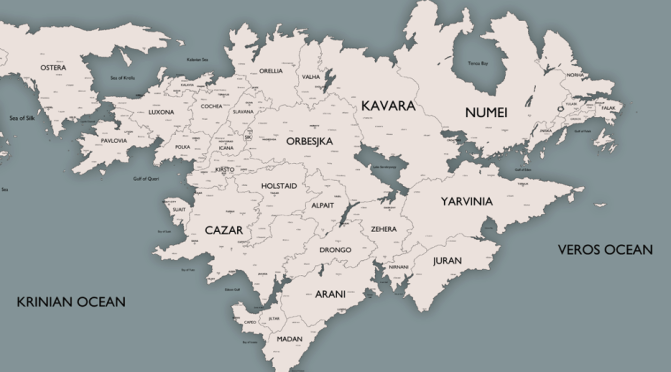
“Map of the Eusonan Continent, c. 1949”

After the failed Terran September offensive of 1949, Great Terra realized that they could not break Coalition forces in Kyusia. So their focus turned to Eusona, a continent known for its abundant arcerium fields, but one that had fallen behind most of the world in technology.

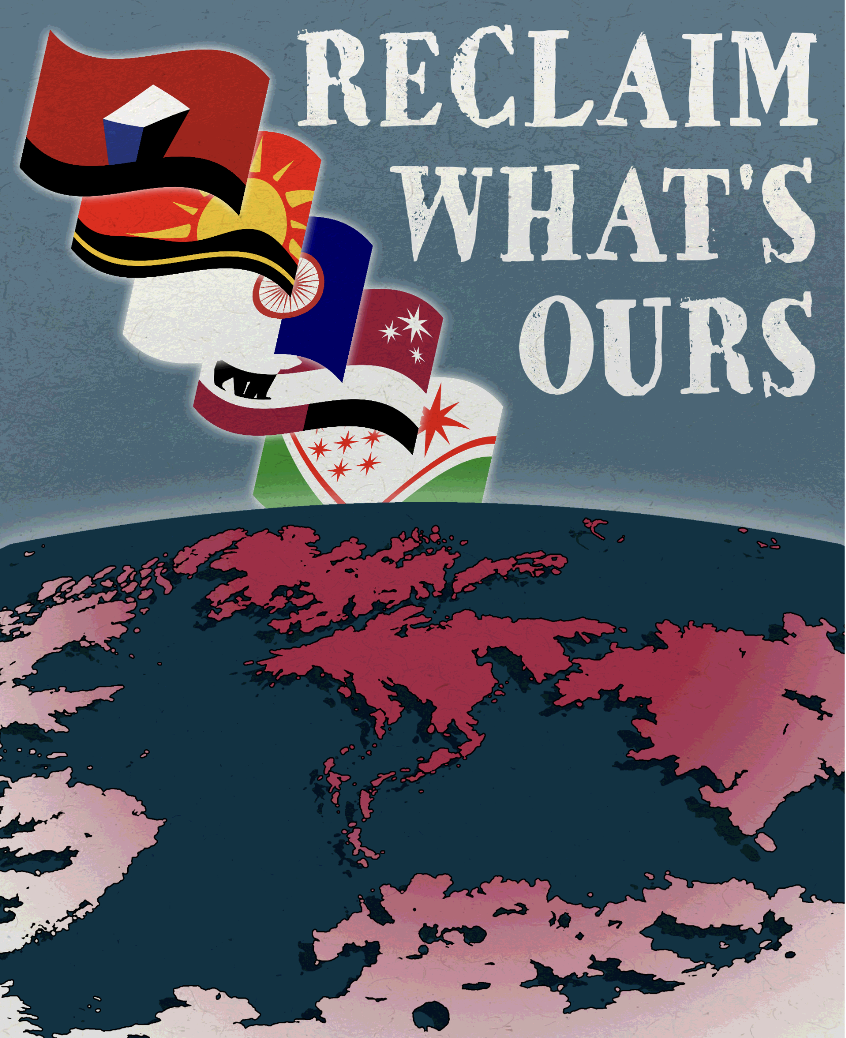
“Tectonic Coalition propaganda, c.1949”

Most Eusonan nations at the beginning of the 20th century, especially those in the south and east, lacked the industrial power to exploit its abundant arcerium fields. Many countries still relied on horse drawn carriages to travel from place to place, despite the car being made in the dawn of the century. But the few Eusonan nations that had the industry to exploit the abundant amounts of arcerium, became the dominant powers on the continent.

The wealth sustained by arcerium guaranteed the lucky few nations to rapidly modernize, such as the case of the Kirston Empire, who by the time of the war, had the largest arcerium deposit on the continent.

“Great Terran Propaganda, c.1949”

THE START OF THE EUSONAN THEATER

January 15th, 1950, The Cazar Empire invades Kirsto with an army of 500,000 strong. For the past eight months, the Cazars had steadily mobilized their army to the Kirston border without detection. The Cazars overwhelmed the unprepared Kirston army, and within four days, they had already conquered the Kirston capital, Eve. The Kirston army retreated to the Grai mountain range, a strategic range that is home to the tallest mountain in the world, Mount Torrest at around 32,000 feet tall.

With two thirds of their country under occupation by March 12th, and their abundant arcerium fields in the north now under Terran control, Kirsto’s civilian population found themselves the target of Cazar’s wrath.

At first the occupation plan was to relocate the civilian population from the country to central Cazar where they would be put into refugee camps, but when they discovered that most Kirstons in occupied territories were Nexens, the plans changed. The Cazars would still relocate Kirstons, but with the exception of those who were of Nexen origin.

Believing that the inferior Nexen race was the cause for the downfall of Great Terra in the past and for their part in the creation of the “false” Hero, the Cazars in their fit for glory, rounded up the Nexens population en masse, prolonging them to harsh conditions for days before executing them. The numbers vary, but historians believe over 9 million Nexens were killed. A new word would sprout from this mass murder campaign, they call it genocide.

“‘A Nexen painted Red’ by Jon Reese, c.1960. Was once believed to be destroyed in a bombing during The Grants War”

THE WRATH OF GREAT TERRA

As refugees from Kirsto fled into neighboring nations, they brought with them tales of the horrors committed by the Cazars, their illegal removal of Kirston natives and their mass executions of Nexens would only spread fear across the continent.

Before the Coalition could even respond to the invasion of Kirsto, the Cazars in an ambitious operation, invaded its way to Coalition member states on the Valkyrie peninsula. Countries like Icana and Polka fell to Cazar within the first week of April, as their armies were no match to Cazars due to the large technological gap between them.

Coalition member states on the Valkyrie peninsula, Pavlovia, Luxona and Kalavia, panicked as not only was Cazar already within Luxonan territory, but another Great Terran state, The Osteran Socialist Union, was now invading through the Lapish Channel and were now threatening to take Luxona’s capital.

The quick advancements of Great Terra in April saw the Coalition states in Eusona caught off guard, and by June 2nd, the peninsula was cut in half as Cazar and Osteran forces met one another at the Battle for Tattburg.

Although being important Coalition member states, the Coalition did not have the logistical capabilities to send troops and supplies to support their allies in Eusona, as Great Terran states such as Epreau and Hoshira, controlled the Krinian ocean with their superior fleets. With no support, the Coalition in Eusona had only one choice to protect their people.

August 20th, 1950, the Federal Republic of Luxona, the Kingdom of Pavlovia, and the Grand Duchy of Kalavia, issued their terms of surrender to Great Terra, which was accepted immediately. The Coalition was hit with their worst loss of the war, as they now lost three of their founding members to Great Terra. It appeared that soon enough the war was going to be a Great Terran victory.

THE RISE OF GREAT TERRA | CONTINENTALS WAR: ARCERIUM RISING 8

By: Hoaseng Thao

PROLOGUE

On the early dusk of August 29th, 1948, General Calor Thor, age 31, of the Jupitan Imperial Army and commander of Army Group Caster, stood on the tarmac of a makeshift airfield and stared at the sky. His gaze on the starry skies kept still until the sounds of roaring fighter jets slowly approached the runway that his gaze finally returned down to the ground. The invasion of Sapan lies in his hands, and failure is not an option.

TROUBLED TIMES IN SAPAN

“Map of the Kingdom of Sapan, c.1942”
”Flag of the Kingdom of Sapan”

The Kingdom of Sapan resides on the Kyusian continent, and for most of its history, was the strongest nation on the planet. That was until the Great Vaserian War of 1920, when their invasion of the Vaserian Federation led to a devastating four year war that cost the lives of over three million Sapanese soldiers, and a resounding victory for Vaseria.

Three million young men and women died overseas in a failed invasion, an entire generation was lost, and those who lost loved ones blamed the war hungry government. In 1926, King Genta III, who had started the war, was forced to abdicate the throne when it appeared that the entire country was rioting against him.

On November 20th, 1940, the king’s nephew, Lord Daiki, was crowned king due to his vocal support against the war with Vaseria. His policies as king saw the nation turn away from its militaristic past in favor of improving the lives of its people, however he would pass away three years in his reign before he could fully implement his policies.

King Daiki’s brother, Lord Jiro, was crowned the next king of Sapan, but his rule led to rampant corruption within his government and a rise of independence movements by many ethnic groups in the far east and south, who felt that his rule was the final straw of staying under Sapanese rule.

OPERATION FORWARD HIKE

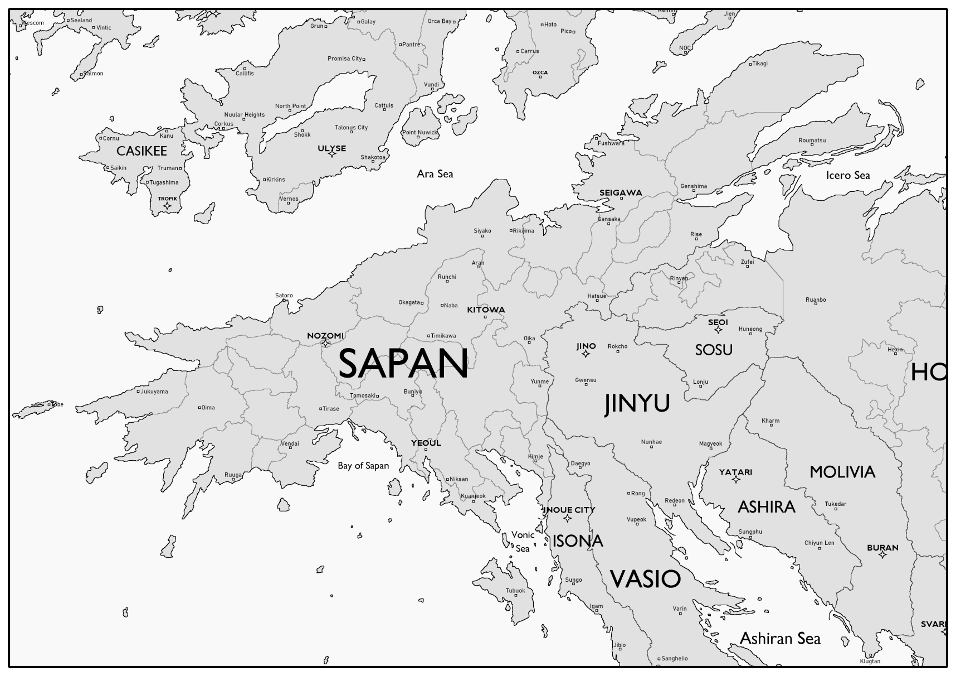
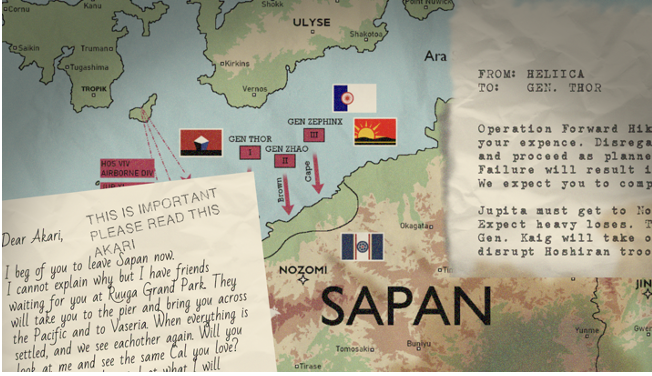
With the help of corrupt Sapanese officials, Great Terran forces were able plan an invasion of Sapan, with the main force invading from the northern coastline to make a mad dash to the capital, Nozomi, while the Hoshiran army would invade from their shared border to liberate the ethnic groups in eastern Sapan.

Under the command of General Thor, Over 50,000 soldiers were airdropped on the Sapanese northern plains and another 50,000 landed via the Ara Sea on August 29th, 1948. Their mission was to quickly reach the Sapanese capital, Nozomi, and occupy important government buildings and install a pro-Terran government with the help of corrupt military officials.

Despite having the advantage, General Thor cautiously moved his forces, but many of his field officers refused his orders in order to claim the glory of taking the Sapanese capital. Those who stood by Thor’s orders were lucky, as the ambitious officers were soon wiped out by the supposed “corrupt” Sapanese army.

The supposedly corrupt Sapanese army they had confronted in their invasion was being led by the king’s daughter, Princess Chiyo. Prior to the invasion, The princess, as well as members of the Ministry of Defense, learned of the Terran invasion plot after receiving coded messages from a mole within Jupita’s high command, and quickly formed a force of 100,000 loyal followers to combat the invasion.

Fierce fighting began as the sun broke the horizon. When news broke out about the invasions from the north and east, thousands armed themselves to combat the invaders. In the east, the Hoshiran armies met fierce resistance by the ethnic groups they were supposed to be “liberating”. Despite being under Sapanese rule for centuries, these groups were still loyal to the crown or at least the ever more heroic Princess.

Upon hearing that the invasion of Sapan started, the King tried to flee the royal palace but was immediately reprimanded by the Princess and the Royal Guard, and forced him to abdicate the throne in favor of putting the Princess in charge. The princess immediately called upon full mobilization of the Army, and by September 3rd, the army was fully mobilized and ready to combat the invaders.

The Terrans, despite not achieving their goal of capturing the capital, quickly gained land during the Sapanese mobilization, taking most of the northern coastline as well as the Otryan peninsula in the far east. By September 10th, the entire eastern regions of Sapan capitulated to the Terrans, but there were still many waging guerilla campaigns against the Terrans.

On September 13th, Coalition forces were allowed to enter Sapan, over 300,000 Coalition troops were transported to the Sapanese front. Despite the aid of Coalition troops, Terran forces were able to push south and capture the capital by the end of October, but at the cost of using most of their stocks of chemical weapons.

Over 80% of Sapanese territory was occupied with the southern regions, as well as holdouts in the mountains, remaining under Coalition control. By the new year Princess Chiyo had ordered the army to hold their ground no matter the cost, and it led to the Sapanese front becoming a meat grinder.

“Photograph of an abandoned Jupitan T-IX Piercer tank in the Kingdom of Kayusa, c. June 9th, 1969”

EVER EXPANDING WAR

By April 15th, 1949, Hoshiran forces invaded the neighboring Federal Republic of Jinyu to maneuver around Coalition forces in Sapan. Despite capitulating the Jinyun government within hours, they were unable to flank the Coalition, as they too would invade Jinyun to out flank them. The war had now spanned across the entire Kyusian continent, from Sapan in the east to Molivia in the south.

“Sample from the Valonan History Channel’s “The Return of Great Terra” documentary”

As the war ravaged the Kyusian continent, it was only inevitable that it would spread to another continent. By May of 1949, The Cazar Empire, a member state of Great Terra, was secretly notified by Jupita that it would fully support their territorial ambitions on the Eusonan continent if they invaded their neighboring country, the Kirston empire, and gave Jupita access to its rich Arcerium fields.

”Flag of the Cazar Empire”
”Flag of the Kirston Empire”

Not wanting to be left out of the glory of war, the Cazar empire agreed to their secret deal, and their army would slowly grow in size on the Kirston border. The Cazars shall seek their glory of war, and their flag shall be raised over the Kirston capital. But the Kirstons, who had endured multiple invasion attempts by the Cazars in the past, shall endure it once again for the final time.

THE INVASION OF KOLDR | CONTINENTALS WAR: ARCERIUM RISING 7

By: Hoaseng Thao

BACKGROUND

When the hero defeated the Grand Emperor of Great Terra and his forces at the Battle of Veldpal in 1 BH (Before Hero), it led to the dissolution of the empires that once made up Great Terra. The Lunari Empire, or the 11th empire, of Great Terra dissolved peacefully into many nation states, but it also saw the creation of two prominent states, Koldr and Jupita.

In the 1920’s, two new resources were found in the Arcerian continent, known as Arcerium and Arsoulium, and soon enough they were found throughout the world. In 1936, Koldr, now the Koldr Confederation of States, discovered Arcerium fields in its eastern states bordering Jupita, known back then as the Imperial Jupitan Union.

”Flag of the Imperial Jupitan Union”
”Flag of the Koldr Confederation of States”

When news broke out about the newly discovered Arcerium fields in eastern Koldr, the Jupitan premier, Alek Treijon, offered a joint venture between the two nations that would greatly benefit the Lunarin continent. But In reality, Treijon and his council knew that Koldr would deny their offer, and that their denial would lead to public support for a war against Koldr.

And when Koldr did officially decline their offer, Treijon would publicly announce to the people that the idea of a Koldr state, was a harbinger of greed that has only now shown its true self when given the chance to share a resource that can benefit the whole continent. The people, having believed that they had been wronged, cried out for war.

INVASION

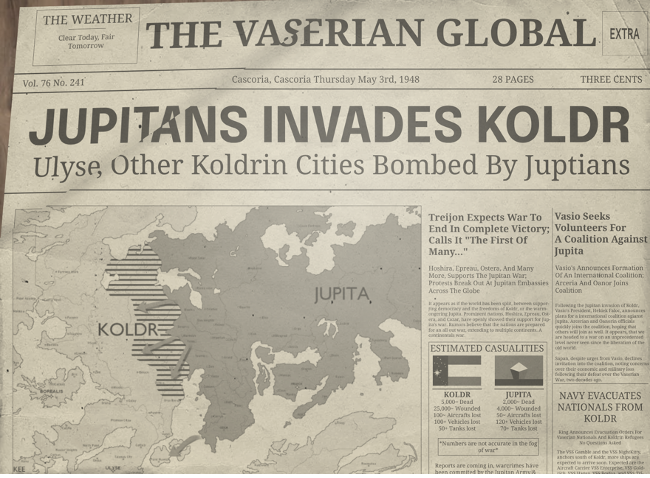
On the night of May 2nd, 1948, Jupitan aircraft launched from their airfields and penetrated Koldrin airspace without any resistance. Jupitan paratroopers were dropped from their aircrafts deep into Koldr Territory, securing major highways and allowing the main invasion force to enter the country quickly. Jupitan bombers soon began to drop their payloads on key military installations as well as bombing cities indiscriminately, with the goal of spreading chaos.

Koldr radar at the time were undergoing tests and were not able to accurately confirm the incoming aircrafts as friendly or bugs in the system. When news of the invasion reached the Koldrin military command, a coded message was broadcasted immediately on all secured frequencies. “JUPITAN INVASION, HOLD OUT FOR FURTHER INSTRUCTIONS”

Despite how successful the aerial invasion force was, the same cannot be said about the main invasion force. The main invasion force consisted of two groups, the first were the professional army known as the Vimact (“Active Force”), the second were the ill-trained Conze (“Conscripted Army”), and consisted of conscripts and penal soldiers.

The Conze were designed to be used as cannon fodder to tire out the enemy before the Vimact arrived on scene. For the first few hours of the invasion, the poorly trained Conze became sitting ducks for the more professional Koldrin army, resulting in high casualties within the Conze and complete disorganization amongst the Conze command. When the Vimact did arrive, the battle on the ground turned in favor of Jupita as the Koldrin army were forced to consolidate their forces southward and to abandon the northern territories.

Within the first week of the invasion, Koldr was split in half, the Northern army command was cut off from the rest of the army as the Jupitan army stretched from its border to the Voreal strait. The forces that remained in the southern states quickly began to evacuate all civilians from the frontlines and into the southern sea ports, where ships from the international community were waiting.

Jupitan forces, despite gaining the upper hand in the first week, struggled to push the Koldrin army farther south. To solve this, Jupitan aircraft began to fly over the enemy positions while releasing chemical weapons down below. The results were horrific as Jupitan pilots were told to be indiscriminate in their targets, and to prioritize terror tactics.

“A pair of Jupitan JFI-10 Fighter Jet patrolling the skies above koldr c. May 9th, 1948”

One incident saw a Jupitan pilot release chemical agents above a crowd fleeing into an underground subway system in Promisa city. When the Conze took over the city the following day, one Conze soldier, Geran Halte who testified in the 1960 Oshington trials, described the incident as “horror beyond comprehension to any sane being other than a Jupitan”.

In the second week of the war, Jupitan forces had taken around 80% of the country. Koldrin forces in the North remained to defy all odds, using the northern terrain to their advantage as Jupitan aircraft could not handle the harsh conditions that is Northern Koldr. In the south, nearly 60% of the southern states population (~160,000) had evacuated, but the southern front saw heavy losses for the Koldrin army.

INTERNATIONAL CAUSE

When news broke out that a war between Jupita and Koldr started, nations across the world grew weary of the rising Jupitan state and their ever ambitious leader, Treijon. Not wanting to see the Lunarian continent or even the world under a Jupitan flag, Vasio’s standing president Leon Fazichi, publicly announced his support for not only Koldr, but for an international coalition against Jupita. With the support of other nations, the Tectonic Coalition was formed and with it brought the war to the international stage.

As Koldr’s capital was besieged by Jupitan forces, the Tectonic Coalition sent a naval task force of 52 ships to the Ara Sea to support the remaining Koldrin army. On May 23rd, the naval task force had made its way to the Ara Sea, and was immediately intercepted by the much larger Jupitan navy.

The Battle of the Ara Sea begins, and it ends in a humiliating defeat for the Tectonic Coalition. 33 ships sunk, including two aircraft carriers, the Vasion RVS Victory and the Ashiran RAS Ravage. The Jupitans would only lose 12 ships, including the battleship, JIS Logan IV. The remaining ships that survived were hunted down by submarines with only nine of the nineteen escaped ships, making it back to friendly waters.

DEFEAT

May 26th, with their capital captured, and their allies in retreat, the remaining Koldrin leadership surrendered to the Jupitans. Those that continued the fight fled into neighboring nations, but they too, would see the same fate as Koldr. The Kingdom of Casikee fell in 36 hours, the Republic of Borea 12 hours, and finally, the Republic of Oprica would submit to Jupitan rule.

On June 6th, 1948, the Jupitan flag was flown throughout the Lunarian continent, and in the capital city of Jupita, Heliica, Treijon stood in front of a large crowd, and announced to the people his vision for the future. He proclaimed that the unification of the continent was only a stepping stone for what he called “Total Salvation”, as he sought to bring back Great Terra and restore the empire to its former glory. Ending his speech, Treijon asked the crowd, “Do you want war? Do you want total victory?” and the crowd, having seen their nation conquer the entire continent, roared in support.

Great Terra has returned, and brought with it allies. The Empires of Hoshira, Epreau, Ostera, and Cazar would align themselves with Jupita, with the shared belief that the war was in their favor.

The Tectonic Coalition, despite suffering a humiliating defeat, stood alone against the return of Great Terra. Its leadership knew that an imminent attack was near, but where would it be? General Beck Vernard of the Molivian Army, believed that there would be an imminent invasion of Moliva from Hoshira, Oanoran Admiral Fefa Kemit, believed that a naval invasion was imminent for Pavlovia and Luxona, and others would follow the same idea.

The idea that the impending invasion had to be on allied territory, since it was the only logical decision they would make, was all they could come up with, but they failed to realize one important thing about Great Terra. Great Terra sought the whole world.