

By: Hannan Mohammed

What are comets?
Comets are bodies made of ice covered in dark organic material, including dust. These comets are leftover from the dawn of our solar system about 4.6 billion years ago, and it’s speculated that comets may have brought water and organic compounds to Earth and other planets.
There’s a belt of icy bodies beyond Neptune where dark comets orbit the Sun around Pluto. Some of these comets are pushed closer to the Sun from gravity in other orbits, and they take around 200 years to orbit the Sun. These are called short-period comets, and their appearances are easier to predict. However, there are also long-period comets; these comets come from a region called the Oort Cloud about 100,000 AU (astronomical units) away from the Sun. Long-period comets can take about 30 million years to complete just one orbit around the Sun.
But how are comets structured? Each comet has a nucleus that’s a few miles wide; this part contains ice, frozen gases, and some embedded dust. As a comet orbits around the Sun and gets closer to it, the comet heats up and develops its own atmosphere, which is called a coma. As the comet heats up, the ice in the nucleus becomes a gas and makes the coma grow in size, and the coma can extend to thousands of kilometers. Pressure from sunlight and solar winds can also blow gas from the coma and dust away, creating a trail or a ‘tail’ on the comet.
Notable Comets

A particularly famous comet is known as Halley’s Comet, which has been observed for around 2,000 years. It’s named after English astronomer Edmond Halley, who accurately predicted that the comet would return in 1758, thus proving that comets orbit around the Sun and don’t pass through the solar system once, which was a popular belief beforehand. Halley’s Comet takes 76 years on average to orbit the Sun, which makes it a short-period comet. It was last seen from Earth in 1986, and it will likely be next seen in 2061.
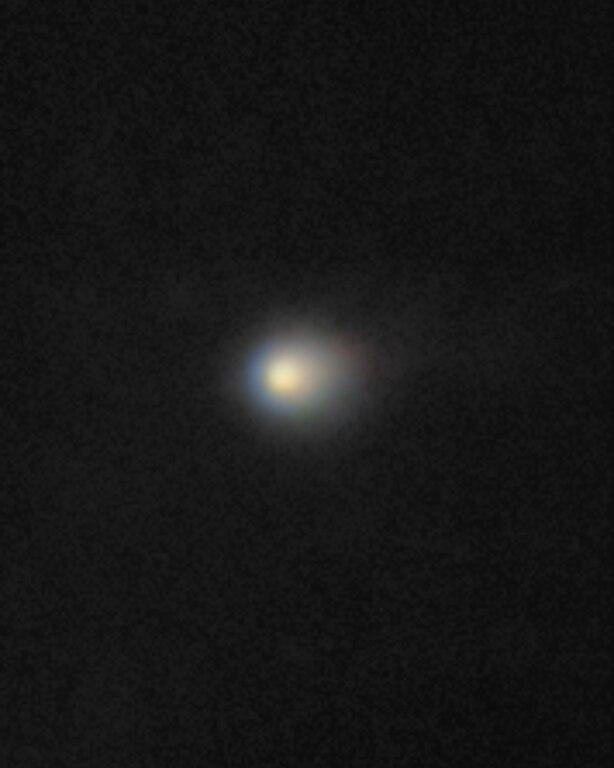
One notable comet right now is the 3I/ATLAS comet, which NASA first made observations on in July 2025. It is named after the ATLAS (Asteroid Terrestrial-impact Last Alert System) telescope that first recorded the sight of the comet. It doesn’t follow a closed orbit around the Sun, and its origins are outside the solar system, making the comet interstellar. The 3I/ATLAS comet reached its closest point to the Sun on October 30, 2025, at which point it became too close to the Sun to observe. However, it’s expected to reappear on the other side of the Sun in early December 2025, and it will be able to be observed again.
For more information, please visit:



 Plaid Line + PRIZM + Scottie News

