Tag Archives: psychology

Does it bring harmony or destruction?

By: Maeve Brady

Lying. It is something we all do despite whether you’re aware of it or not. Lying is the substance that is used as a tool in order to avoid getting yourself and/or others in trouble, as well as being used for people’s own personal benefit. For years and years one big question has been asked: Is lying a good thing?

Well, many may consider the adverse effects of lying and disagree. And, besides lying in general, there is also something known as white lying. In our society, people also passionately debate upon whether white lying is ethical or not. Today, I will be giving you both sides of the argument and give you some insight on how it relates to psychology.

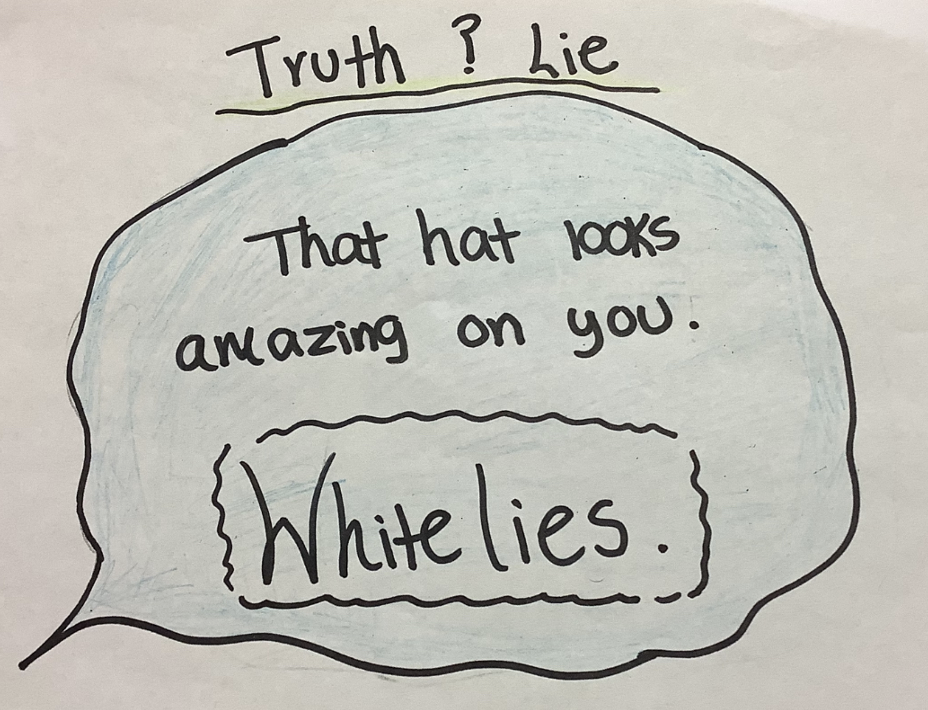
To be more specific, white lies are defined as small and trivial lies which people use in order to avoid hurting someone. For example: Imagine your friend comes up to you and asks you if you like their haircut. Let’s say that you indeed do not like it, yet in order to avoid hurting your friends feelings and make them self conscious about it, you just tell them that you love it, despite thinking otherwise. This demonstrates the act of you white lying in order to protect your friend from receiving any sort of mental hurt. But, many would argue otherwise.

There are many people who believe that a white lie does not “protect” someone from hurt, and in fact, that contradicts itself. Many argue that a white lie causes more harm than good, and instead of shielding someone from the dreadful grasp of truth, it only exposes them to more pain.  And, despite it being in “good nature”, many consider that lying is still lying, and will only generate more distrust and hurt to the person who thought you were being sincere.

As well as this, because white lying is a form of lying, there is a possibility that it could become a bad habit. And, when more serious situations come about, this habit may have dire results. According to an article written by researchers Elena Svetieva and Leanne Ten Brinke, “Each time someone chooses to lie, no matter how small or seemingly inconsequential, a thread unravels. No big reveal that deception has occurred is necessary, no treachery named, no betrayal felt, no punishment to the deceiver doled out – it is the act itself that harms.” This demonstrates that although white lies have the intention of being “harmless”, the action of white lying will only ignite the fire of chaos.

But, on the other hand of the spectrum, there are many people who think otherwise. Like I have mentioned before, white lying has the intention of being “good natured”, and despite the adverse effects of it, many consider that white lying can improve relationships and in some cases, save people’s lives.

While although white lying can create this sense of distrust, it is also a way to maintain a sort of social harmony and always telling the truth can be more hurtful. They say that white lying does have the word “lying” in the term, yet it is far different from that. It has the intention of helping people avoid hurt, not steer them towards it.

In fact, under certain circumstances, white lies are just supposed to just overall bring peace and ease to someone. For example: Imagine your kid has cancer, and they are due to die soon, and they ask you one simple question, “Am I going to heaven?” Whether you believe in it or not, many would white lie and say yes. This overall brings ease to the child rather than telling them that you don’t know and or they are not. This sort of response may only drive them deeper down into the rabbit hole of depression, leaving them fearful for the rest of their days.

Now, to talk about how white lying relates to psychology. First of all, psychologists believe that besides some other factors that cause white lying, white lying may stem from a person’s own self-consciousness. In fact, it is derived from the factor of justifying oneself, also known as “Deceiver’s distrust”. According to the APA Dictionary of Psychology, “Deceiver’s distrust presumably reflects the assumption that interaction partners are similar to oneself; thus, one’s own deceitfulness leads to the inference that the other is, has been, or will be similarly deceitful. By assuming that others are also untruthful, deceivers can feel less guilt about having lied to them.” This demonstrates that someone may tell a white lie because they believe that others may also be telling lies, therefore justifying their actions of being unhonest to someone.

And, like many other crucial cognitive functions, whenever someone white lies, it is said that this may occur in the prefrontal cortex. More specifically, the medial prefrontal cortex (MPFC). According to JuYoung Kim and Hackjin Kim, researchers for the National Library of Medicine, “An increase in selfish motivation for Pareto lies was associated with higher mean-level activity in both ventral and rostral MPFC. The former showed an increased pattern similarity to selfish lies, and the latter showed a decreased pattern similarity to altruistic lies.” This suggests that the MPFC, which is responsible for processing emotions, values of behaviors,  and  lying, may have something to do with white lies of selfish intentions.

Thank you so much for following me along as I explain white lies! I hope you learned valuable information about what are white lies and a further analysis of the debate of whether they are good or not. What do you think, should white lies be allowed?

For more information, please go to:

The excellence of this cognitive phenomenon!

By: Maeve Brady

Cognitive dissonance, the beauty of the mind. It’s something we all undergo even if we are unaware of this factor. Now, you may have heard of this term before, but do you truly know what it is? If you do, then I hope this provides an even more in depth explanation of its properties. If you don’t, then buckle up, because understanding this is essential to understanding the way we humans think.

Cognitive dissonance is a basic principle in psychology, in which it is where you know you are doing something bad, yet you still do it anyway. That’s the simpler way to explain it, but in other words, it is when your thoughts of consistency and conformity don’t align with your seemingly inconsistent actions. For example: You are sneaking out at night, and in order to get to your needed destination, you steal your parents car. Now you may know deep down that it’s wrong, but your actions are contradicting your thoughts. Now, like many of our cognitive abilities and senses, cognitive dissonance is said to occur in the prefrontal cortex which is located in our frontal lobe. But it is said to occur not only in the prefrontal cortex, but also within the insula cortex.

Deep within the lateral sulcus, also described as a deep ridge and or groove that is located along the surface of our brain’s cerebral cortex, you will find the insula cortex which is responsible for the regulating and processing of our emotions. According to an article written by Thea Buckly, about a lecture given by Keise Izuma, at the University of York in England, “‘Additional studies have revealed that cognitive dissonance engages other brain regions, such as the insula and dorsolateral prefrontal cortex (DLPFC). The insula, which processes emotions, often becomes more active when people are upset or angry, and the DLPFC is strongly associated with cognitive control.’” This shows us that the insula, as well as the Dorsolateral prefrontal cortex, may have something to do with the feeling of cognitive dissonance.

Although more research concerning cognitive dissonance is only more recently coming out, the theory was invented a while ago. In 1957, Leon Festinger presented the theory of cognitive dissonance, in which he had claimed that the inconsistencies between cognitions may generate this uncomfortable and motivational feeling within you, also known as cognitive dissonance. This justified the outlandish feeling people got when they knew they were doing something bad, going against their thoughts of structure and doing what’s right.

Cognitive dissonance also plays a big role in the process of justification and over-explanation. The concept of dissonance, which is a clash between disharmonious principles, results in people feeling that they can justify their inconsistent behaviors. Or in other words, when cognitive dissonance creates this feeling of wrongfulness and guilt, people tend to cling on to the action of explaining themselves in order to lessen that uncomfortable feeling and satisfy themselves. When the intensity of the dissonance increases, many people become desperate to reduce it, finding obscure and desperate explanations in order to avoid confronting the uncomfortable truth.

In an experiment done by Leon Festinger and his colleague James M. Carlsmith in 1959, they tested the theory of cognitive dissonance. In this experiment, they lied to people saying the experiment was about the effects of a task on an individual’s perception, meaning how a task can affect the way one views a situation and environment. But in reality, they wanted to test if people would justify lying to another person about a task. He paid volunteers either one or around twenty dollars to lie about a boring task being fun. According to Jerry Suls, a professor at the University of Iowa, “The subjects who were paid $20 should not have experienced dissonance, because they were well-rewarded and had ample justification for lying, whereas those paid $1 had little justification for lying and should have experienced more cognitive dissonance. To reduce the dissonance, they reevaluated the boring task as interesting and enjoyable.” This was the accurate prediction of Leon Festinger which demonstrated human behavior when lying and just in general.

This proves that when people are put into uncomfortable situations and feel cognitive dissonance, they tend to find any sort of reason to justify their actions to relieve the feeling. But, when people have a plausible reason to hide behind their lies, then they may experience less dissonance because they have a “reason” not to. All this proves that people may be willing to justify even the worst of actions if it means keeping themselves and others satisfied.

Cognitive dissonance is a common theme in our society because everyone experiences it in their own life. Sometimes, it can be a spur of the moment thing and we may not even realize we are doing so until later evaluation. When we experience cognitive dissonance, some may have this immediate want to relieve the discomfort they are feeling within. This results in the person finding ways to justify their wrong action.

Thank you so much for following me along as I explained the basics of a major part of psychology, cognitive dissonance. I hope you gained more insight to what cognitive dissonance is and how it is a common theme in our society!

For more information, please visit:

The paradox of tragedy: Are crime junkies ‘sadists’ or is there something more?

By: Maya Vossen-Nelson

In 2024, crime podcasts consistently occupied spots in both Apple Podcasts and Spotify’s Top Charts and IMDb announced that over 58 new TV documentary series were released in 2024.

On the surface, individuals who enjoy crime podcasts, crime TV and crime novels seem like sadists; they seek out media recalling the pain and suffering of others. But there is actually a deeper psychological component.

Individuals are attracted to tragedy because it is human nature to be highly attuned to threatening behavior. Humans want to discover the patterns, causes and outcomes of harmful situations to protect themselves and loved ones. This is a survival instinct ingrained in the human psyche since before homo sapiens emerged.

This draw is similar to the desire to know what is happening when an ambulance goes by or being unable to look away from a highway crash. Most people don’t wish harm on others, so why has an entire industry been built on this fascination?

Although the TV is relatively new, this question has puzzled philosophers for centuries. Aristotle first explored this topic and observed that “[W]e enjoy looking at the most exact portrayals of things whose actual sight is painful to us”. A Stanford Philosophy article reflects on Aristotle’s quote and reasons that there is “pleasure as arising from the knowledge acquired in viewing such representations”.

This can be further explained by brain research that shows human brains experience danger and passion in strikingly similar ways: both causing arousal, both releasing dopamine. Dopamine is often described as the brain’s ”pleasure chemical” and is responsible for actions relating to cognition and reward. Dopamine can be released during pleasurable activities (such as eating and social interaction), during the anticipation of rewards, foreseeing favorable outcomes and while achieving goals. The dopamine released while watching crime TV is produced from anticipation and from experiencing intense emotions regardless of if it is repulsion or fascination.

Studies show that women are more likely than men to seek out content that analyzes the killer’s motive, contains information on how victims escaped and what actions increase the risk of becoming a target for killers.

Female fascination with crimes is not because they are more likely to become murderers, it is actually quite the opposite. Women make up fewer than 20% of murders, are approximately 60% more likely to be victims of kidnapping and 90% more likely than men to be victims of rape.

So, the next time you see someone watching a crime documentary don’t be so quick to judge.