Tag Archives: painting

Vincent Van Gogh

By: Sylvia Yannsdottir

Self-Portrait by Vincent Van Gogh

Vincent Van Gogh is one of the most well known artists, with countless world renowned pieces of art. His work was very imaginative. It challenged the way that people thought about art at the time, and heavily influenced the way that people expressed themselves through art later on.

There are a lot of things that make Van Gogh’s art so unique. At the time, it was not very typical to see art like his. His style, color schemes, attention to detail, brushwork, and his appreciation for natural landscapes were all factors that set him apart from other artists.

He was born in 1853, in the Netherlands, and he passed away in 1890, in France. As he grew up, he always had an appreciation for art, and he spent a lot of time trying to make a career out of it, although he was not successful with that. Over his lifetime, he created more than 1500 pieces, yet he only sold one. His art went by unappreciated, as he never really gained any attention for his art until after he had passed away.

A major contribution to his unsuccessful career was the fact that people were not able to appreciate his art at the time. It was very common for artists to paint extremely realistic portraits, or landscapes, rather than to experiment with abstract art. While Van Gogh still made realistic paintings, the techniques he used had set him aside from the typical style of art that people were interested in, so he was never able to profit from his passion.

Near the end of Van Gogh’s life, he unfortunately began to suffer from mental illness. He started to lose a grasp of reality, and he was very sad with his life. Although he tried to recover through medical attention, he ultimately shot himself, which led to his death at 37 years old.

It is important to recognize how much of an impact Van Gogh has made. Although his story contains isolation, and struggle, he still managed to create such an intriguing and beautifully creative legacy. Overall, his work has been able to bring together wide and diverse groups of people to appreciate his art, and he has forever changed the way people have gone about making art.

The 10 minute art challenge

By: Maggie Hong

The 10 minute art challenge, popularized by the New York Times, asks you to spend 10 minutes with one painting, uninterrupted. Usually, people only look at paintings for a minute or so, if that. Even if you study a painting repeatedly, spending uninterrupted time with it gives you a whole new perspective. As you look at the painting for ten whole minutes, you will probably find your eyes drawn to details you didn’t see at first. You may also find you see the painting differently; with changing focal points, colors, and even movement within it. Spending this time with a piece of art not only helps you to learn about art and expand your attention span, but to relax and ground yourself.

I tried this challenge at a common starting point: ‘The Starry Night’ by Vincent van Gogh. I love van Gogh’s style, and this painting has always been a favorite of mine.

When I started the challenge, I was a bit worried I’d get bored. My eyes didn’t really focus on a specific spot, instead they wandered around the canvas. But as I stuck with it, things started to jump out at me. I noticed the texture of the paint, and that colors I’d once thought were blues were actually shades of green and brown. I also felt my breathing slow down, and my body relax. Because I was focused on this one task, my mind had a clear directive: only think about this painting. It didn’t have time to wander to other worries or annoying thoughts, or even to get bored.

Overall, I think this is a great challenge for everyone to try. I was surprised by how calming and centering it was, and I noticed lots of new things about a great piece of art. You can try this with any piece, whether it has a lot of things to look at, like ‘The Starry Night’, or not very many. You can also adjust the timing; sit for only 5 minutes, or as long as you want. Find an art piece and give it a try!

History of Impressionism

By: Fletcher Pike

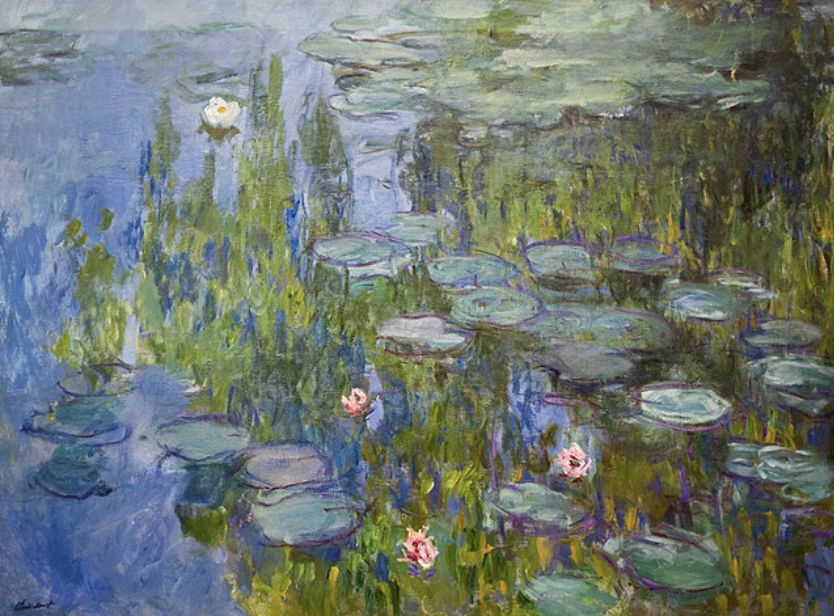
Monet’s ‘Water Lilies’ Image via Wikimedia Commons https://commons.wikimedia.org/wiki/File:Claude_Monet_-_Seerosen.jpg

Art comes in several different forms, many of which you have likely seen today. You might think of paintings from the Renaissance period like the ‘Mona Lisa’ or ‘The Girl With The Pearl Earring’, or maybe more abstract, modern paintings. But one art style in particular was formed as a result of one of the most popular movements in art history. That art style would be Impressionism.

Impressionism itself is a very recognizable style of painting, as the paintings featured bright, chromatic colors rather than the more dull palettes that were used for previous styles of painting. The colors also emphasized the contrast between light and shadows. These paintings very often depicted a mundane or realistic setting, rather than dramaticized historical scenes.

In 1874, a group of artists formed the ‘Anonymous Society of Painters, Sculptors, Printmakers, etc.’. Its founding members included popular artists such as Claude Monet, Camille Pissarro, Edgar Degas, Berthe Morisot, and several others. They created an art installation in Paris, France, where many unique paintings were displayed. 

However, these paintings were a bit different from other paintings at the time. These paintings included loose brush strokes, vivid colors, and featured scenes primarily of nature or the simple, everyday life. These were different from the grand, historical story-based paintings that were made during this time. This new abstract style brought a sense of realism in contrast to the art featured in this time period.

Claude Monet was a significant figure throughout this movement, as he was one of the trailblazers that popularized the style of Impressionism. In one of his exhibits, critic Louis Leroy gave Impressionism its name by stating Monet’s paintings were more of an uncompleted sketch, “an impression”.

The final independent exhibition of Impressionism was held in 1886, but the painters had begun shifting towards a new direction for the movement, which was Neo-Impressionism. This was an art movement characterized by small intricate dots, distinct brushstrokes, and bright colors. 

Though the final exhibition was so long ago, the Impressionist movement had a large impact on the art community by adapting to new art styles, and allowed artists to freely express themselves through their artwork.

For more information, please visit: