Tag Archives: nasa

About comets

By: Hannan Mohammed

Image by Philipp Salzberger via Wikimedia Commons

What are comets?

Comets are bodies made of ice covered in dark organic material, including dust. These comets are leftover from the dawn of our solar system about 4.6 billion years ago, and it’s speculated that comets may have brought water and organic compounds to Earth and other planets.

There’s a belt of icy bodies beyond Neptune where dark comets orbit the Sun around Pluto. Some of these comets are pushed closer to the Sun from gravity in other orbits, and they take around 200 years to orbit the Sun. These are called short-period comets, and their appearances are easier to predict. However, there are also long-period comets; these comets come from a region called the Oort Cloud about 100,000 AU (astronomical units) away from the Sun. Long-period comets can take about 30 million years to complete just one orbit around the Sun.

But how are comets structured? Each comet has a nucleus that’s a few miles wide; this part contains ice, frozen gases, and some embedded dust. As a comet orbits around the Sun and gets closer to it, the comet heats up and develops its own atmosphere, which is called a coma. As the comet heats up, the ice in the nucleus becomes a gas and makes the coma grow in size, and the coma can extend to thousands of kilometers. Pressure from sunlight and solar winds can also blow gas from the coma and dust away, creating a trail or a ‘tail’ on the comet.

Notable Comets

Image by NASA/Kuiper Airborne Observatory via Wikimedia Commons

A particularly famous comet is known as Halley’s Comet, which has been observed for around 2,000 years. It’s named after English astronomer Edmond Halley, who accurately predicted that the comet would return in 1758, thus proving that comets orbit around the Sun and don’t pass through the solar system once, which was a popular belief beforehand. Halley’s Comet takes 76 years on average to orbit the Sun, which makes it a short-period comet. It was last seen from Earth in 1986, and it will likely be next seen in 2061.
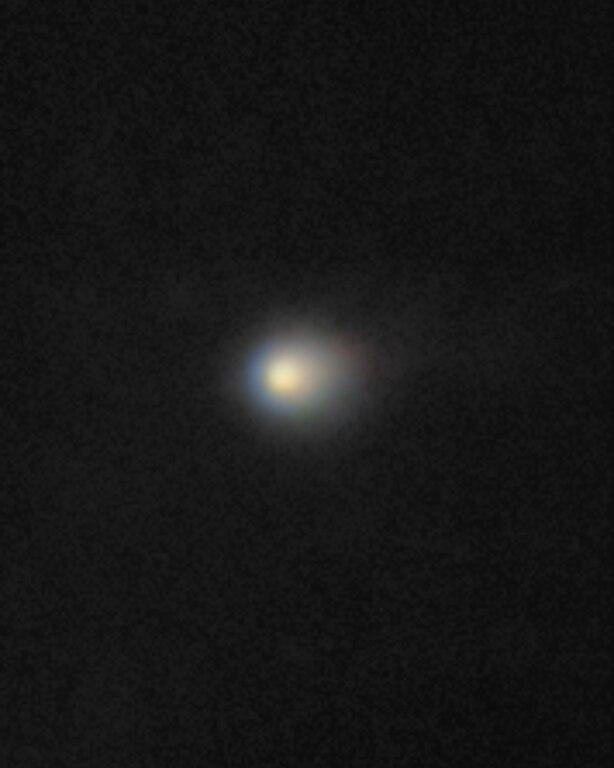
Image by International Gemini Observatory via Wikimedia Commons

One notable comet right now is the 3I/ATLAS comet, which NASA first made observations on in July 2025. It is named after the ATLAS (Asteroid Terrestrial-impact Last Alert System) telescope that first recorded the sight of the comet. It doesn’t follow a closed orbit around the Sun, and its origins are outside the solar system, making the comet interstellar. The 3I/ATLAS comet reached its closest point to the Sun on October 30, 2025, at which point it became too close to the Sun to observe. However, it’s expected to reappear on the other side of the Sun in early December 2025, and it will be able to be observed again.

For more information, please visit:

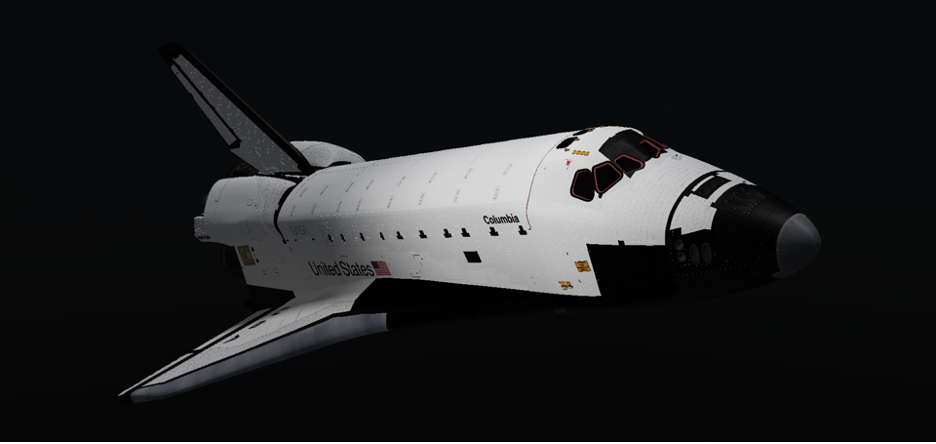
Space shuttle equipment

By: Yohan Lee

What is the space shuttle? The space shuttle was the first reusable spacecraft and since it could be flown again it helped reduce the cost of each launch. It could take off in a vertical take off and could land like a plane.

The space shuttle was built by NASA and during earlier space missions such as the Apollo program, NASA had to build 15 different Saturn V rockets. But for the space shuttle, NASA only had to build 5.

The first space shuttle launch was on April 12, 1981 and the final landing was on July 21, 2011. The space shuttle fleet flew over 135 missions. Some of the space shuttles are in museums in California, New York, Florida, and Washington D.C.

In early 2011 you could see the space shuttle on top of a 747 before it was retired.

Here are some of the technical specifics of the space shuttle.

COMPONENTS

Orbiter:

In the cabin it contained living quarters, workstations, and controls for up to seven astronauts. The space shuttle had a payload bay for carrying satellites, scientific equipment, and components for the International Space Station. The payload could be found on top of the space shuttle. There were three powerful engines used during liftoff, fueled by the external tank.

Thermal Protection System:

The Thermal Protection System was made of heat resistant tiles and blankets that protected the orbiter from the heat during reentry.

Canadarm:

A Canadarm is a long robot arm and it was used for manipulating payloads, assembling structures in orbit, and capturing satellites.

External Tank:

The External Tank was the huge orange fuel tank located at the bottom of the space shuttle. It was made out of an aluminum-lithium alloy to minimize weight. It was used to fuel the space shuttle during its launch into space, then it would detach from the space shuttle and burn up in the atmosphere.

Solid Rocket Boosters:

The Solid Rocket Boosters are the long white rockets that were attached to the fuel tanks. They were used for an additional set of thrust for takeoff before they detached. They were made out of aluminum and ammonium perchlorate. They were also fitted with a parachute for an ocean landing so NASA could reuse that rocket.

Orbital Maneuvering Systems:

The Orbital Maneuvering Systems was a small engine that allowed the space shuttle to make small adjustments in space. 2 of them could be found at the back of the space shuttle.

Image created with Blender

NASA’s Artemis program

By: Karl Salkowski

(Image credit: freerangestock)

NASA is the National Aeronautics and Space Administration. NASA was created on October 1st, 1958 after president Eisenhower signed the National Aeronautics and Space Act. NASA is a government agency of the United States, and it is responsible for U.S. space exploration, space technology, Earth and space science, and aeronautics research.

In total, 24 astronauts have made the journey from earth to the moon. Half of those astronauts only orbited the moon while the other half landed on it. Neil Armstrong and Edwin “Buzz” Aldrin were the first two people to walk on the moon. It’s been over 50 years since anyone has walked on the moon, but why is that?

The main reason is money. Building these rockets was incredibly expensive and NASA relied heavily on funding from the government. Once the Apollo 11 mission in 1969 was a success and the U.S. had won the space race, NASA faced major funding cuts. Originally, there were 20 Apollo missions, but due to a lack of funds the last 3 were canceled.

Since then NASA has focused on other projects. One notable example being the International Space Station. However, one of NASA’s new projects aims to land humans back on the moon.

NASA’s Artemis program consists of 4 main parts: an uncrewed flight test around the moon, a crewed flight test around the moon, sending humans to explore the region near the lunar south pole, and finally establishing a scientific base on the moon. These missions will aptly be named Artemis I, II, III, and IV respectively. With these missions, NASA’s goal is both to “explore the moon for scientific discovery and to inspire a new generation of explorers” according to Nasa.gov.

Artemis I launched 2 years ago and was a huge success for NASA and its partners. However, the crewed mission (Artemis II) which was slated to launch in late 2025 has now been delayed to April 2026. Artemis III also suffered delays and is currently being projected to launch no-earlier than mid 2027.

If you want to learn more about the Artemis missions, please go to:

What is the X-59?

By: Yohan Lee

Imagine flying at the speed of sound and cruising over public places whilst not hearing the sound barrier over you. Well, today I’m going to talk about the X-59 and the history of it.

The X-59 was built by NASA and Lockheed Martin. They both came together to try to build a supersonic aircraft that is quiet when flying over you. The X-59 development began in 2016 and the first machined part was made in 2018, then was revealed to the public on January 12, 2024. The X-59 was built in Lockheed Martin’s Skunk Works facility in Palmdale, California.

What is supersonic? Supersonic is a loud sound of an object going over 700 miles per hour. Think of a whip and whipping it. That crackle is exceeding over 700 miles per hour. That crackle is a mini sonic boom. But the X-59 just can’t fly at 700 miles per hour or Mach 1. The X-59 can fly at Mach 1.42 or 940 miles per hour. When the X-59 flies over you at Mach 1 you would only hear a tiny thud. That little thud is about 75 db or just below a jet flying over you at 1000 feet which is about 106 db.

The reason why NASA and Lockheed Martin are trying to quiet the sonic boom is because it’s illegal to fly supersonic over the public for 3 main reasons. They don’t want to startle people thinking we’re going to war, it might kill someone or an animal (out of shock or knocking them over), and it can cause property damage as in breaking windows.

So, how can the X-59 achieve going over Mach 1 while barely hearing the sonic boom? Well, it starts with the nose of the aircraft. The X-59 has a sharp nose that cuts through the air making the aerodynamics much better and thus making the X-59 fly faster. The same goes for the delta wings. The reason why the X-59 has delta wings is because it reduces the effects of the shock waves and makes the sonic boom a quieter sonic boom thump.

The X-59 engines are the f414-GE-100 which are the same engines that are used for the F/A-18E/F/G. But the gears are the same gears that the F-16 uses.

The X-59 comes about 100 feet in length and 30 feet in width. The nose takes up half of the size and since the X-59 nose is long you can’t see much throughout the window. So, that’s why the X-59 is equipped with a camera at the end of the nose to see in front of the nose and to see the other side. The X-59 is equipped with 3 screens, one of them is the camera and the other two are for your basic flight instruments which tell what your plane is doing. Since the X-59 just came out, a lot of stuff is still classified.

So, how can it change aviation? Well, NASA and Lockheed Martin are planning to make a quiet supersonic plane and redesign it to be a commercial plane so we civilians can fly over Mach 1 at 700 miles per hour. For a regular flight from a 737, it takes 5 hours to get to California to Florida flying at a speed of 587 miles per hour. But when you’re flying the X-59 it would only take 3 hours flying at 700 miles per hour.

Why are NASA and Lockheed Martin working together to make the X-59? NASA has its team called QUESST which brings Lockheed Martin and NASA together, and under QUESST is The Quiet Crew. The Quiet Crew is a group assigned specifically to design and fly the X-59. Lockheed Martin collects data and helps build the X-59 since NASA doesn’t own many F-16s and F-18s, and again, the X-59 uses the F-18’s engines and F-16’s gears.

Before NASA had an idea to make the X-59 and convert it to a commercial airplane, the Concorde was the first ever super sonic commercial airliner. The United Kingdom and France made the Concorde in 1969. There were only two airliners who flew the Concorde and it was British Airways and Air France. The Concorde unfortunately retired on November 26, 2003, due to high maintenance and fewer people flying the Concorde since each ticket cost $10,000. Plus, the Concorde was super loud which caused many people to not like the Concorde. The Concorde could fly 2 times faster than the speed of sound or 1,354 miles per hour due to the Concorde having 4 Rolls-Royce/Snecma Olympus 593 engines. Something interesting is that the X-59 and the Concorde had some similarities. They both had a long and sharp nose, delta wings and had stabilizers.

NASA said that the X-59 is going to come out in mid-2030 and hopefully in the future we will have a supersonic commercial airplane. And this is why the X-59 is going to change aviation.

For more information, please visit: