Tag Archives: History

What is the E/A-18G Growler?

By: Yohan Lee

Photo by Jack Sequeira. Used with permission.

What is the E/A-18G Growler? The E/A-18G Growler is an Electronic Attack which means it can disrupt enemies radars and communications. The E/A-18G Growler was an F/A-18F Super Hornet that was built by Boeing for the U.S. Navy. The E/A-18G Growler is fitted with electronic warfare avionics. The avionics are the ALQ-218, CCS Antennas, Long Baseline Interferometer Antennas, Datalink and the AESA radar. The AESA radar replaces the gatling gun so the weight load can be less.

Its history. Development began in 2003 and the first prototype to ever be flown was in 2006. Each flight they worked to improve the avionics and reduce its air to air armament to accomplish its suppression of Enemy Air Defense or SEAD. Once the E/A-18G Growler was ready, it replaced the E/A-6B Prowler which was the Electronic Attack of the A-6B Intruder.

The first deployable squadron was the VAQ-132 “Scorpions”. There are about 9 deployable squadrons and one non-deployable squadron that holds the E/A-18G Grower. The E/A-18G Growler has its own Naval Air Station based at NAS Whidbey Island which is home of the Electronic Attack. The U.S. Navy gave 12 Growlers to the Royal Australian Air Force which is operated in No. 6 squadron at RAAF Base Amberley. But the U.S. Navy will not give any more Growlers out since it’s the U.S.’s Secret weapon.

Its Payload. The E/A-18G Growler can hold the AGM-88 HARM which means Air to Ground Missile 88 High-speed anti Radiation Missile which fires at a ground target. It also carries the ALQ-218 which receives radar warning. ALQ-99 which jams enemy radio and an AIM-120 which is an air to air missile.

The E/A-18G Growler has 2 crews. One is a pilot who flies the aircraft and one is the Electronic Warfare Officer or EWO. The EWO is responsible for some of the E/A-18G Growler’s most important duties. The EWO jams enemy radar and chaffs flares which is a bright and hot material that tricks the missile into thinking it’s the aircraft.

What makes it important to the U.S? The E/A-18G Growler is one of the best Electronic Attack aircraft. For one, it really doesn’t need to be stealth. The only stealth it has is jamming the enemy radio and radar and a special coating that makes enemy radar bounce off making it difficult to track the Growler. The Growler is also a 4.5 generation aircraft so it’s very modern. And if other branches or squadrons need help trying to be more stealthy they can get the E/A-18G Growler for support. The Growler is always first in the battle field so it can quickly jam before the enemy can see any other non jamming planes. Many other countries tried to replicate the Growler but can’t because the Grower is far more advanced than what they have. So, this is why the E/A-18G Growler is important to the U.S. Navy.

For more information, please visit:

Minnesota’s oldest unsolved murder

By: Karl Salkowski

Fort Snelling

Two soldiers met at Fort Snelling in the late 1830s. One of which was Edward Phalen. He wasn’t known to be trustworthy and had a criminal past, but he was going to be discharged at the perfect time. The United States had just signed a treaty in 1837 allowing White settlers to occupy lands on the Mississippi River across from Fort Snelling. Phalen saw this opportunity, but was short on cash, so he enlisted his friend Hays.

Hays was the polar opposite of Phalen: affable, trustworthy, cordial. Hays however was slated to be discharged much later, and by that time all the best land would be taken. Thus, the two of them decided to work together. According to Minnpost.com “Phalen left the army on June 8, 1838. He then rushed to claim two land parcels in what later became downtown St. Paul, along the Mississippi from the foot of Eagle Street to the Robert Street Bridge.”

Once Hays was discharged on April 25th, 1839, he and Phalen decided to begin farming. Allegedly, multiple neighbors heard them get into many heated arguments throughout the next few months. Hays later disappeared in September of 1839. According to Phalen, he had left to find a lost calf. However, Hays was found dead, floating on the Mississippi River three weeks later.

According to Mprnews.org, Henry Sibley, who would later become the first governor of Minnesota, was tasked with investigating the case. Soon he came to the conclusion that Phalen was behind it. Phalen was soon arrested and tried for the murder, making it the first murder in Minnesota to make it to the US courts. Phalen lied in his testimony and his story contradicted what had happened, but against all odds he was found not-guilty due to a lack of evidence.

According to Mprnews.org, it was reported that a Native American had made a deathbed confession admitting to the murder of Hays a couple years later, but most people still believe Phalen was behind it.

Although Phalen was almost certainly a murderer, many things in the Saint Paul area were named after him due to his early land claims. Some of these being: St. Paul’s Lake Phalen, Phalen Creek, Phalen Boulevard, and the Payne-Phalen neighborhood. People have objected to these names since as early as 1876. Williams, the 19th century historian, wrote, “It is a disgrace that the name of this brutal murderer has been affixed to one of our most beautiful lakes.”

For more information, please go to:

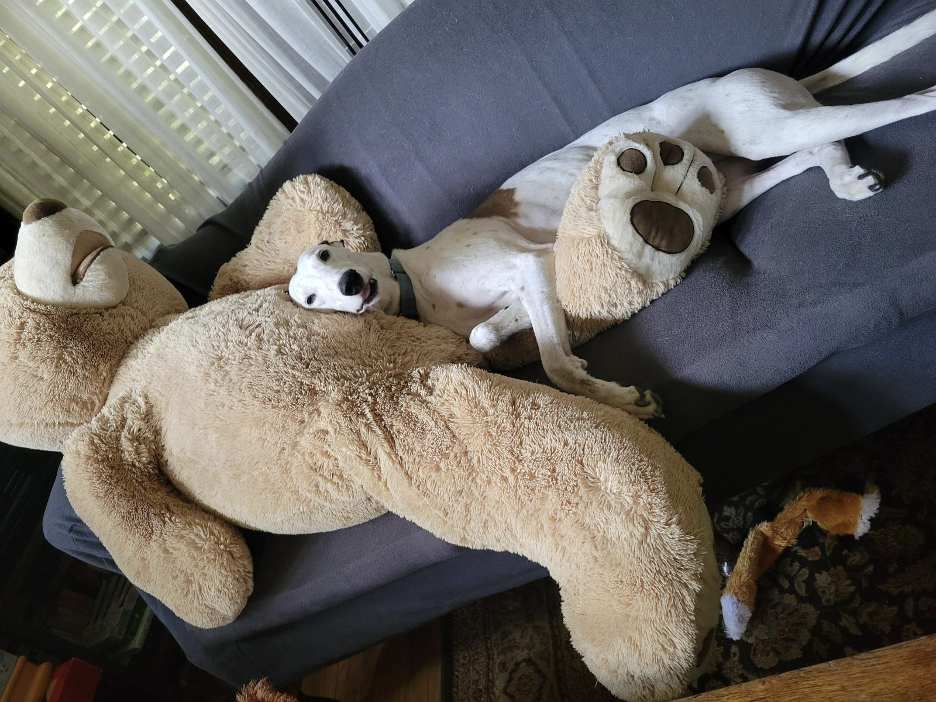
History of Greyhounds

By: Cleo Newton

Greyhounds have been around for a very long time. They have around 8000 years worth of history.

According to Gapsa.org.au, Greyhounds are the oldest purebred dog breed dating back to the time of Pharaohs. They have shown up in the ‘Bible’, and in Greek and Roman mythology. This breed was very much admired and respected, and only royalty and people of noble status were allowed to have them.

Many famous historical people have owned this breed of dog such as Queen Elizabeth I and Christopher Columbus. Even Shakespeare wrote about them in ‘Henry V’.

Greyhounds almost went extinct in the Middle Ages during times of famine. Luckily, they were protected and saved by clergymen who bred them for nobility. King Howel of Wales made killing a Greyhound punishable by death in the 10th century. If commoners were found owning a Greyhound, they would be severely punished and unfortunately for the dog, it would get its toes lawed, which would include removing the middle toes, to stop it from hunting.

Greyhounds have a high prey drive which is why people use them hunting (unfortunately even today). Greyhounds are the fastest domesticated dog and based on Dailypaws.com, they can run at speeds up to 40-45 mph. Those who hunt with Greyhounds prefer to own ones with brindle, fawn, red, or black fur.

It’s the complete opposite for nobles though. They favored the ones with white and spotted fur. This was so that if their dog was to ever escape, it would be easier to spot it in a forest.

It wasn’t until around the 1700s that Greyhounds became a dog that not only nobility were allowed to own. Did you know that every purebred greyhound can be traced back to just one dog back in the late 1930s, King Cob? King Cob was born in England in 1839. He was the first dog available for public stud service as stated by Racecourse.co.uk.

According to Ngap.org, Greyhounds started being used for racing in 1919. I think that Greyhound racing is not a sport that should be supported, many of them die in the process.

After reading this article, I hope you’ve learned a few things about my favorite breed of dog and maybe even considered adopting one yourself.

The Plaid (On)Line?

A few weeks ago, a mysterious box was anonymously dropped off at the office of Highland Park. Within it, a hodgepodge of peculiar papers. Some were carefully sorted in chronological order, others waiting to be unearthed and dusted off like fossils. Some yellowed and faded by time, others more boisterous and flashy in style. But mainly, there was words. All full of them, so many. Words. The box was lugged up to room 2205, where Ms. Hanson deposited it in the hands of Ms. Lingofelt, the newly-appointed school newspaper adviser.

Numerous, forgotten editions of The Plaid Line had come home.

I had walked into Ms. Lingofelt’s room last month for the second meeting of the school newspaper with a renewed sense of hope. Despite a limited number of people showing up for the last meeting, I could see the potential. The potential of The Plaid Line actually being something other than a complete and utter flop, like the previous year. The possibility of The Plaid Line actually mattering to the student body, of making a difference. I was excited by talk of finding a place in cyberspace; the establishment of a website that could and would reach further. “Starting from scratch!” I had dreamt.

I hadn’t known, I never knew of what had been, until I was introduced to the archives of The Plaid Line. With the first edition being printed in 1964, The Plaid Line strived to bring the Highland Park Senior High community closer. Of course, the newspaper staff members and advisers changed systematically. Inevitably, The Plaid Line evolved. I saw this evolution first hand, taking some time to page through the hundreds of articles.It was hard not to smile at an article from 1965 by Claudia Winters, “Senior’s Hives Buzz With Much Activity”, highlighting a student whose hobby was beekeeping. I was astonished by how that pyramid I pass every morning after getting off the bus meant so much to the students of 1994, who were upset at its almost abolishment. Their protest was documented in “No More Pyramid?” by Elizabeth Geery. I couldn’t help but laugh at an article from 2002, “Movement to DVD” by Garrett Tiedemann, which observed the transition happening in video stores from VHS tapes to DVDs. As I read more and more, I couldn’t help but wonder why this fascinating testament of Highland’s history fell apart. These articles transcend time, and define what should be: a school newspaper enrichment of the high school experience. I became determined to restore The Plaid Line to its original glory, because we as students deserve as much.

However, I cannot do it all on my own. We need you. If you don’t think you could help out, you’re wrong. At The Plaid Line, we are going to strive to provide a little bit of everything, so if you are interested in anything, that means you can help out. As much as it would be great to get more people on The Plaid Line, there is something we need from you even more: your support. Please check out our website often for new, exciting content, follow our Twitter, or receive notifications by email. The Plaid Line wants to serve all Highland Park Senior High students, staff, parents, and alumni. This is possible, but only with your endorsement of the new, online Plaid Line. Please tell your friends, and have those friends tell their friends, and so on and so forth. Spread the word: The Plaid Line is back. And just in time for its 49th volume.

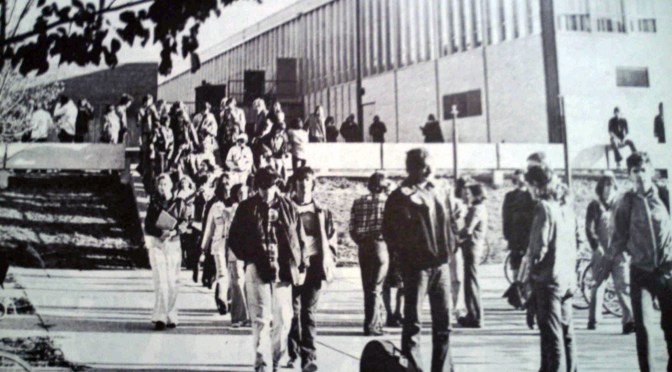
Look familiar? This is a photo pulled from the 1974 October edition of The Plaid Line, showing students milling about the courtyard before school starts.