Tag Archives: animals

Bunnies

By: Sylvia Yannsdottir

Image taken by Josh Backflip via Wikimedia Commons

Bunnies are a very common animal, and oftentimes in the city you will see a few casually around your neighborhood. In the United States, the bunny population is an estimated 6.5 million, 4.3 million of which are wild bunnies, while 2.2 million of them are household pets. This number may seem high, but their population has been decreasing slowly over the past few years. This is because of multiple factors: like habitat loss, changes in available food and shelter, diseases, and increasing predators.

Typically, wild bunnies live up to 8-12 years. They are very small, and cute. They have excellent eyesight, digestion, and hearing. They have a wide variety of colored fur too, some of which are just one solid color, like brown, white, black, or grey, but sometimes they have a mixture of colors of fur.

Bunnies can have multiple litters per year, usually 3-5 every year. Each litter can contain anywhere between 4-12 babies. In the cities, it’s not too uncommon to find a nest of baby bunnies in your backyard.

Bunnies are very social and expressive animals that thrive in groups. Research has actually shown that they are very good at communicating, and they are excellent at forming strong bonds and friendships with each other. Bunnies can actually become very sad if they are deprived of being social with others.

Another thing that really shows how expressive bunnies can be are their binkies. A bunny can express its happiness through a leaping, spinning, kicking behavior called a “binky.” These are a very fun aspect of their behavior.

For the most part, wild bunnies are very calm, and unproblematic to their surrounding environment, although in some cases in the city it can be a struggle to maintain a garden if there are constantly bunnies eating the plants you may be trying to grow.
Capybaras

By: Maya Song

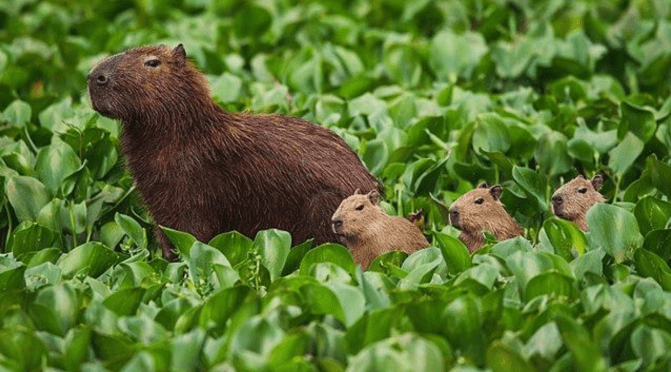
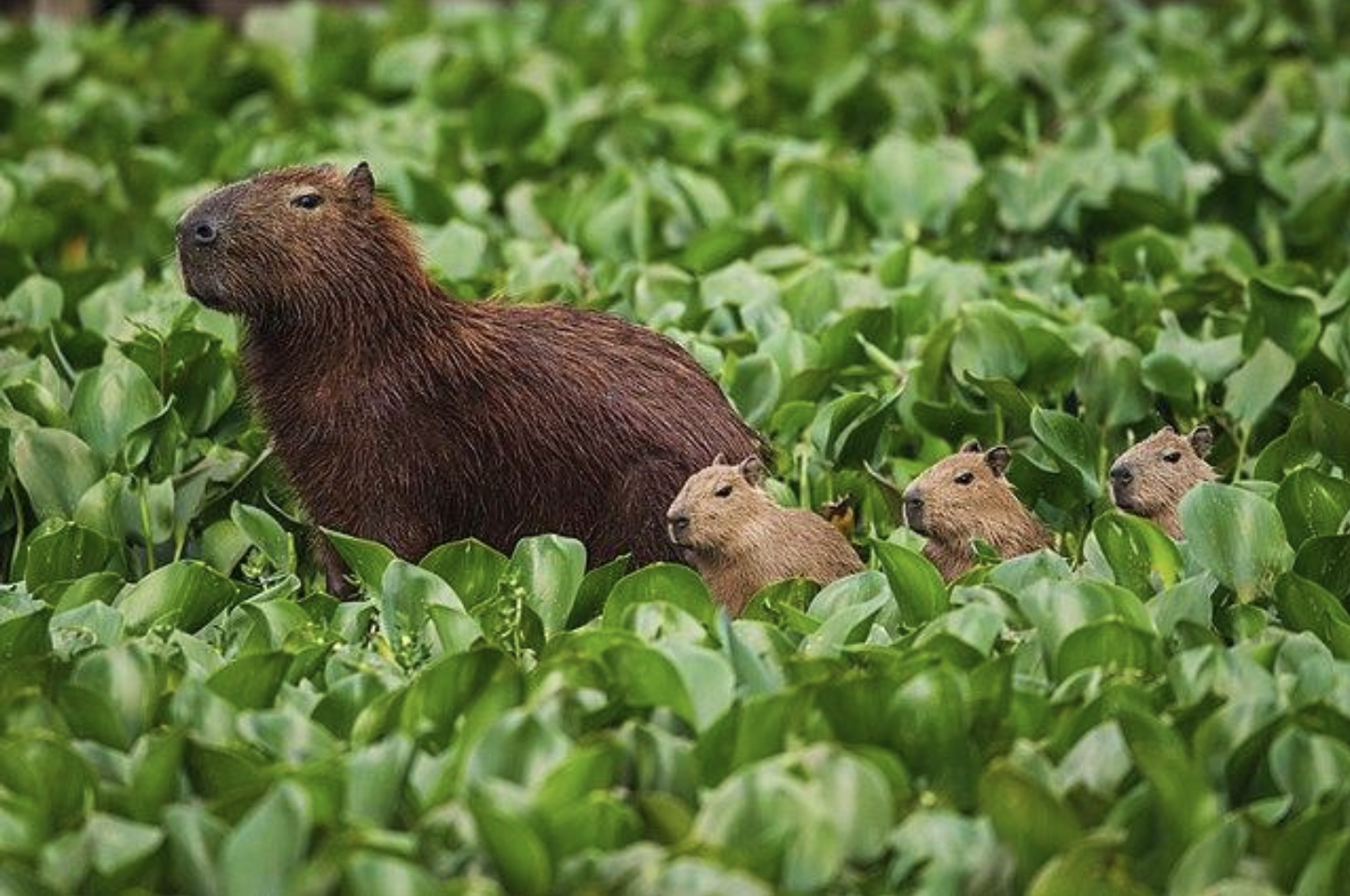
Image by Clodomiro Esteves Junior via Wikimedia Commons

Capybaras are in the rodent family, some cousins of the capybara would be guinea pigs, and rock cavies. The capybara is the largest living rodent with a height of about 2 feet and a length that ranges from 3 to 4 feet. They can weigh between 60 and 174 pounds with most of the weight being fat.

The capybara is native to South America; their habitat is in areas with dense vegetation and plenty of water bodies. They also are semi-aquatic and enjoy spending their time in water.

Capybaras are also mammals and are pregnant for about 130 to 150 days. Which means they are pregnant for about 4 ½ to 5 months. The capybaras litter usually consists of four to five pups but there can be up to eight. After a week of being born the pups can start to eat grass but continue to drink milk. The pups stay with their mothers for 16 weeks while still drinking from the females in the group.

The capybaras diet mainly consists of vegetation as they are herbivores. 80% of the capybara’s diet is different types of grasses; they also eat water plants such as reeds, water hyacinths, and water lilies. The adult capybara could eat 6 to 8 pounds per day. While the capybara’s main diet is grasses and water plants the capybara also eats fruits and grains like melons, bananas, squashes, rice, and corn.

Capybaras tend to travel in groups as they are very social animals. These groups of Capybaras are referred to as bands or herds. These bands will usually range from having 10 to 20 individuals. The bands have one dominant male Capybara, several females, and their babies. During the dry season the bands tend to get much larger as the capybaras gather around water sources such as rivers, ponds, lakes, etc.

For more information, please visit:

Rebecca, the White House Racoon

By: Munira Ahmadad

First Lady Grace Coolidge takes Rebecca for a walk during the annual White House Egg Roll on April 18, 1927.
National Photo Company Collection/Library of Congress

Two things U.S. President Calvin “Silent Cal” Coolidge is known for is being straightforward and quiet, and having a pet Racoon named Rebecca.

Rebecca was initially a Thanksgiving meal gift. Coolidge had been gifted Thanksgiving meal gifts from farmers against his permission, his opposition to the tradition made news in 1923, in the New York Times article “Coolidge Refuses Gift Turkey; Wants to Discourage Custom”.

One of the unwanted gifts he received was a female Racoon. Rather than eating her, Calvin Coolidge chose to keep her as a pet and give her the name Rebecca.

Rebecca was given the title of White House Raccoon and had her own little house. She was given a collar for Christmas with her title on it, and was given free range in the White House.

The raccoon would go on to do whatever she pleased. First Lady Grace described Rebecca as a pet that lived with liberty and had a mischievous personality.

As Rebecca gained American popularity, the public began wanting her to have a partner. After being captured by a White House officer, a male raccoon was introduced to the White House to be Rebecca’s boyfriend. He was named Horace but Coolidge didn’t like that name and swapped it to Rueben.

Rueben was not very interested in being Rebecca’s boyfriend as he escaped several times and eventually when he could not be found after running away again, Rebecca’s life as the only White House Raccoon returned to usual.

After Coolidge’s departure from presidency, Rebecca was sent to live with other raccoons at Rock Creek Zoo.

For more information, please visit:

Benefits of owning an aquatic animal

By: Bailey Glime

Photo by MART PRODUCTION on Pexels.com

Aquatic pets are very popular for lots of families but did you know all the benefits it holds as well? Aquatic animals can be very therapeutic for lots of people. This helps regulate mood and stress even if just a little. Examples of all the ways an aquatic animal can be therapeutic are listed below:

  • Improving mood: By owning an aquatic animal our mood is overall happier.
  • Relaxation: Relaxation is another big factor fish contribute to humans. By watching your aquatic animal it brings you to a relaxed state.
  • Productivity: In some cases your aquatic animal might make you feel like you should be more productive and do more activities.
  • Blood Pressure: Aquatic animals can help reduce blood pressure just by watching them.
  • Mental health: Overall all these help to contribute to your mental health and having a good mental health is important to have every day.

Other benefits of aquatic animals are that they don’t need to be as tended to as mammals; this would give some people the feeling of having more time and still having a pet.

Aquatic animals are not a necessary pet to have in your home but they do provide benefits of relaxation and positive mental health.

For more information, please visit: