
By: Maeve Brady
In life, our DNA is vital to who we are as people by making up our genetic coding. Now, you may know about DNA and its properties, but what happens if there is a mutation in your DNA sequence? What would that mean for your genetic traits? Today, I will be giving you a more in depth explanation as to what a genetic mutation is and how it occurs whilst also explaining the basics for those who don’t know. Understanding what genetic mutations are is vital to humans because they are not only the foundation of evolution, but they also drive genetic diversity, along with many other factors.
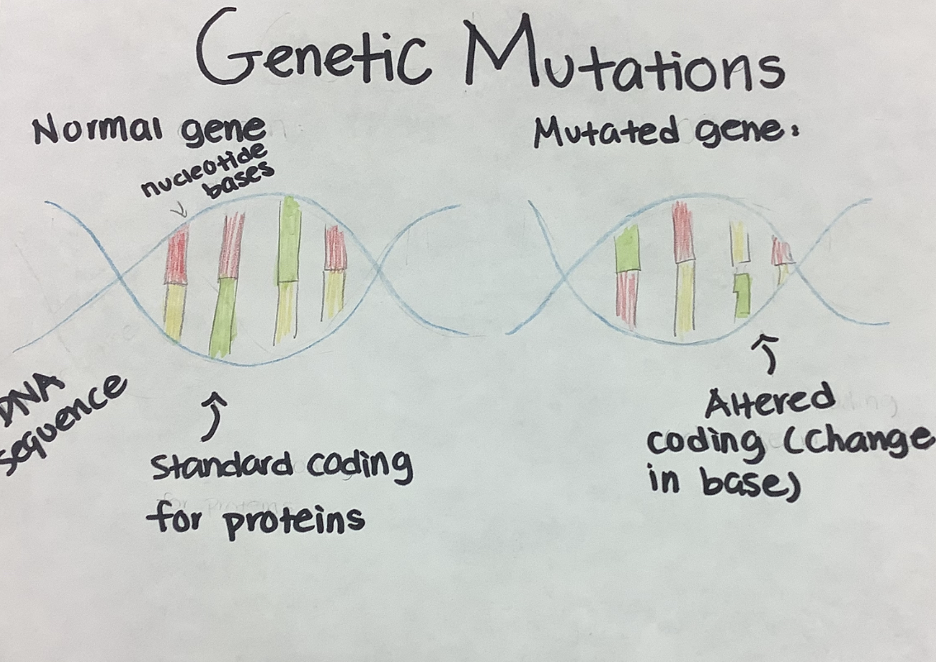
First, to better understand what a genetic mutation is, we have to review the basics. DNA, which is also known as deoxyribonucleic acid, is a molecule which carries out all of our genetic coding and just information in general. DNA is in the shape of this sort of double-helix structure, has a sugar-phosphate backbone, and has four nucleotide bases, also known as the “rungs” of this ladder shape of a structure. These bases include adenine (A) with thymine (T), and cytosine (C) with guanine (G), and, the order of these four bases ultimately determines the genetic information of a being.
RNA is essentially described as the modified variant of DNA, with many hypothesizing that DNA stemmed from it. Chromosomes are a structure which are compact with strands of DNA, and it is located in the nucleus of a cell. Within the DNA strands, which make up a chromosome, that’s where genes are found.
Now to describe genes, they are a segment of DNA that are described as the building blocks for heredity. They contain the instructions – amino acids – for building proteins, and these proteins help determine our physical traits and other bodily functions. And, this is where genetic mutations come in.
To fully comprehend why a genetic mutation occurs, we must understand what exactly a genetic mutation is. Genetic mutations are changes to your DNA sequence that happen during cell division, and in terms of evolution, it refers to when the genetic sequence has an error when it’s being passed down. According to Ruth Jessen Hickman, a health and medical writer, “Genes contain the information, or ‘code’, needed so your body can make the many proteins it needs to function. A genetic mutation is an alteration in the genetic code found in DNA. A mutation changes the specific instructions of the gene, coded through small components of DNA. Because a genetic mutation changes the genetic coding, the resulting protein might not work the way it was initially supposed to, which can lead to disease.” This demonstrates that a mutation is usually defined as an alteration in genetic coding and can have dire results.
Proteins are typically located outside of the nucleus, where DNA resides. So, in order for the gene’s instructions to reach the proteins, which are located in ribosomes outside of the nucleus, DNA must be transcribed into RNA, since RNA can act as a messenger and bring the instructions outside of the nucleus. In order for the RNA to get to the regions where proteins are produced, DNA must change into a messenger RNA. Now, how it does this is by an enzyme called an RNA polymerase attaching itself to a segment of DNA, also known as a gene. And, each group that helps code for the amino acids which will make up a protein are called codons, and in this process of transcription, the enzyme causes the double helix structure to unwind. After the DNA is unwound, it is split into two halves, and the half that stays the same is called the non-template strand, and the strand that then becomes the RNA strand is the template half. The template half does this by using the existing genetic sequence of that half as a guide to building a complementary one to the original DNA strand. How this relates to mutations is because when a mutation action occurs, this process endures alterations.
Now, like any scientific property, there are different variations, and, for genetic mutations, there are a couple. First of all, point mutations. Point mutations occur when a DNA sequencing has a nucleotide base change because of various factors, and this overall influences the RNA sequence and then the protein coded from it.
Next, frame-shift mutations. These mutations are caused when a base is not changed but instead added, and because RNA reads the coding in codons, also known as groups of three, this changes one of the sequences, and overall alters the protein’s sequence too. Now, in general, frame-shift mutations usually have a larger impact on the protein coding since adding a base can alter around two of the proteins final coding while point mutations only change a base meaning it has less of an impact.
Continuing on, there are also nonsense mutations. Nonsense mutations usually disrupt the normal reading of the genetic code, causing the protein to be prematurely terminated, causing a huge cut off in a protein sequence.
]And finally, missense mutations. Missense mutations occur when a change in a codon leads to a different amino acid being inputted. The protein will then have a different amino acid at the position where the mutation originally occurred. But, if the new amino acid has similar properties to the old one, then there may be a neutral effect on the protein.
Now, there are many reasons for genetic mutations. Some reasons may be because of being exposed to harmful chemicals and radiation, though many identify that many mutations occur because of internal issues within the DNA’s replication processes, and are without too heavy of influence from the outside.
Although I gave you a more in depth explanation of what genetic mutations are, there is still so much to cover. I hope this gave you a better understanding of genetic mutations, and maybe just how a protein is coded in general!
For more information, please go to:
- https://www.technologynetworks.com/genomics/articles/missense-nonsense-and-frameshift-mutations-a-genetic-guide-329274
- https://www.ncbi.nlm.nih.gov/books/NBK21114/?scrlybrkr=81bf5a75
- https://www.nature.com/scitable/topicpage/translation-dna-to-mrna-to-protein-393/#:~:text=During%20transcription%2C%20the%20enzyme%20RNA,encoded%20by%20the%20original%20gene.

 Plaid Line + PRIZM + Scottie News