
By: Hoaseng Thao
THE NEXENS OF GREAT TERRA
Nexens, or Homo Nexums, evolved from Humans like many other races, however unlike most of them that evolved to have animalistic body parts, Nexums retained nearly 99% of Human traits with the exception of being naturally taller with the average healthy Nexen growing up to, or even over, seven feet tall.
Their lack of animalistic traits and unusually tall stature, made the Nexens visually inferior to other humanoid races, who believed them to be a mistake in human evolution and were not worthy of having special traits like themselves. Because of this, Nexens were often forced into slavery, with them being the main labor force for Great Terra. That was until 32 BH.
In 32 BH, the slavery of Nexens in Great Terra gave birth to a Nexen boy in Triaag, a mining town for slaves. Growing up, the boy learned to read and write from the few books he stole, where he learned what life of being free was like, or at least from what few words he understood.
But when Great Terra’s economy collapsed in 16 BH and the empires within started to show their cracks, the boy seized the opportunity and fled from the small town, to embark on a journey across the world.
His journey across the known world as a Nexen on the run, would see the start of his radical ideas of a new world, one where freedom, liberty, and justice was the norm for all beings. By the time the Revolutionary War started in 18 BH, the boy, amongst the low ranks of the revolutionary army, stood above his fellow soldiers and preached his ideas of a new world.
His words enlightened those who listened, and they too would spread his words. As the Revolutionary War continued, the boy grew to become a prominent figure amongst the revolutionaries; historians still don’t know his real name but he is known by his moniker, Hero.
THE CONTINENT OF EUSONA

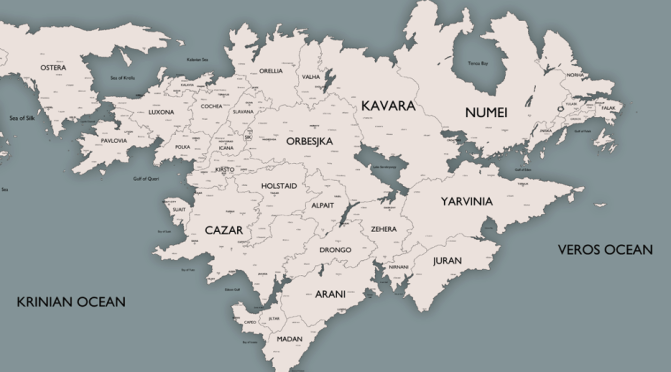
After the failed Terran September offensive of 1949, Great Terra realized that they could not break Coalition forces in Kyusia. So their focus turned to Eusona, a continent known for its abundant arcerium fields, but one that had fallen behind most of the world in technology.

Most Eusonan nations at the beginning of the 20th century, especially those in the south and east, lacked the industrial power to exploit its abundant arcerium fields. Many countries still relied on horse drawn carriages to travel from place to place, despite the car being made in the dawn of the century. But the few Eusonan nations that had the industry to exploit the abundant amounts of arcerium, became the dominant powers on the continent.
The wealth sustained by arcerium guaranteed the lucky few nations to rapidly modernize, such as the case of the Kirston Empire, who by the time of the war, had the largest arcerium deposit on the continent.
THE START OF THE EUSONAN THEATER
January 15th, 1950, The Cazar Empire invades Kirsto with an army of 500,000 strong. For the past eight months, the Cazars had steadily mobilized their army to the Kirston border without detection. The Cazars overwhelmed the unprepared Kirston army, and within four days, they had already conquered the Kirston capital, Eve. The Kirston army retreated to the Grai mountain range, a strategic range that is home to the tallest mountain in the world, Mount Torrest at around 32,000 feet tall.
With two thirds of their country under occupation by March 12th, and their abundant arcerium fields in the north now under Terran control, Kirsto’s civilian population found themselves the target of Cazar’s wrath.

At first the occupation plan was to relocate the civilian population from the country to central Cazar where they would be put into refugee camps, but when they discovered that most Kirstons in occupied territories were Nexens, the plans changed. The Cazars would still relocate Kirstons, but with the exception of those who were of Nexen origin.
Believing that the inferior Nexen race was the cause for the downfall of Great Terra in the past and for their part in the creation of the “false” Hero, the Cazars in their fit for glory, rounded up the Nexens population en masse, prolonging them to harsh conditions for days before executing them. The numbers vary, but historians believe over 9 million Nexens were killed. A new word would sprout from this mass murder campaign, they call it genocide.
THE WRATH OF GREAT TERRA
As refugees from Kirsto fled into neighboring nations, they brought with them tales of the horrors committed by the Cazars, their illegal removal of Kirston natives and their mass executions of Nexens would only spread fear across the continent.
Before the Coalition could even respond to the invasion of Kirsto, the Cazars in an ambitious operation, invaded its way to Coalition member states on the Valkyrie peninsula. Countries like Icana and Polka fell to Cazar within the first week of April, as their armies were no match to Cazars due to the large technological gap between them.
Coalition member states on the Valkyrie peninsula, Pavlovia, Luxona and Kalavia, panicked as not only was Cazar already within Luxonan territory, but another Great Terran state, The Osteran Socialist Union, was now invading through the Lapish Channel and were now threatening to take Luxona’s capital.

The quick advancements of Great Terra in April saw the Coalition states in Eusona caught off guard, and by June 2nd, the peninsula was cut in half as Cazar and Osteran forces met one another at the Battle for Tattburg.
Although being important Coalition member states, the Coalition did not have the logistical capabilities to send troops and supplies to support their allies in Eusona, as Great Terran states such as Epreau and Hoshira, controlled the Krinian ocean with their superior fleets. With no support, the Coalition in Eusona had only one choice to protect their people.

August 20th, 1950, the Federal Republic of Luxona, the Kingdom of Pavlovia, and the Grand Duchy of Kalavia, issued their terms of surrender to Great Terra, which was accepted immediately. The Coalition was hit with their worst loss of the war, as they now lost three of their founding members to Great Terra. It appeared that soon enough the war was going to be a Great Terran victory.

 Plaid Line + PRIZM + Scottie News