

By: Hoaseng Thao
BACKGROUND

When the hero defeated the Grand Emperor of Great Terra and his forces at the Battle of Veldpal in 1 BH (Before Hero), it led to the dissolution of the empires that once made up Great Terra. The Lunari Empire, or the 11th empire, of Great Terra dissolved peacefully into many nation states, but it also saw the creation of two prominent states, Koldr and Jupita.
In the 1920’s, two new resources were found in the Arcerian continent, known as Arcerium and Arsoulium, and soon enough they were found throughout the world. In 1936, Koldr, now the Koldr Confederation of States, discovered Arcerium fields in its eastern states bordering Jupita, known back then as the Imperial Jupitan Union.


When news broke out about the newly discovered Arcerium fields in eastern Koldr, the Jupitan premier, Alek Treijon, offered a joint venture between the two nations that would greatly benefit the Lunarin continent. But In reality, Treijon and his council knew that Koldr would deny their offer, and that their denial would lead to public support for a war against Koldr.
And when Koldr did officially decline their offer, Treijon would publicly announce to the people that the idea of a Koldr state, was a harbinger of greed that has only now shown its true self when given the chance to share a resource that can benefit the whole continent. The people, having believed that they had been wronged, cried out for war.
INVASION
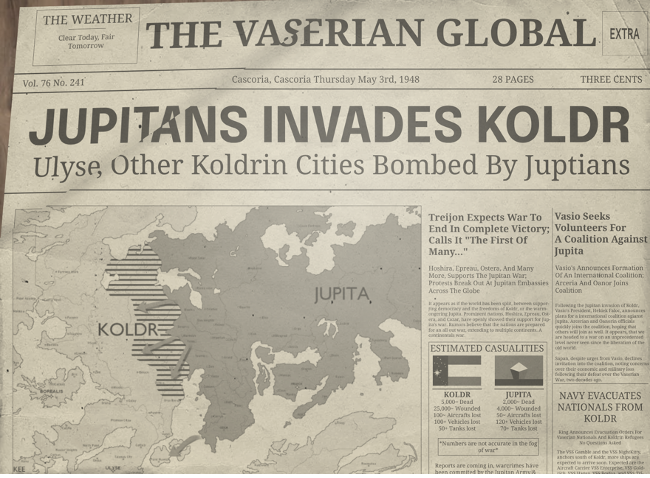
On the night of May 2nd, 1948, Jupitan aircraft launched from their airfields and penetrated Koldrin airspace without any resistance. Jupitan paratroopers were dropped from their aircrafts deep into Koldr Territory, securing major highways and allowing the main invasion force to enter the country quickly. Jupitan bombers soon began to drop their payloads on key military installations as well as bombing cities indiscriminately, with the goal of spreading chaos.
Koldr radar at the time were undergoing tests and were not able to accurately confirm the incoming aircrafts as friendly or bugs in the system. When news of the invasion reached the Koldrin military command, a coded message was broadcasted immediately on all secured frequencies. “JUPITAN INVASION, HOLD OUT FOR FURTHER INSTRUCTIONS”
Despite how successful the aerial invasion force was, the same cannot be said about the main invasion force. The main invasion force consisted of two groups, the first were the professional army known as the Vimact (“Active Force”), the second were the ill-trained Conze (“Conscripted Army”), and consisted of conscripts and penal soldiers.
The Conze were designed to be used as cannon fodder to tire out the enemy before the Vimact arrived on scene. For the first few hours of the invasion, the poorly trained Conze became sitting ducks for the more professional Koldrin army, resulting in high casualties within the Conze and complete disorganization amongst the Conze command. When the Vimact did arrive, the battle on the ground turned in favor of Jupita as the Koldrin army were forced to consolidate their forces southward and to abandon the northern territories.
Within the first week of the invasion, Koldr was split in half, the Northern army command was cut off from the rest of the army as the Jupitan army stretched from its border to the Voreal strait. The forces that remained in the southern states quickly began to evacuate all civilians from the frontlines and into the southern sea ports, where ships from the international community were waiting.
Jupitan forces, despite gaining the upper hand in the first week, struggled to push the Koldrin army farther south. To solve this, Jupitan aircraft began to fly over the enemy positions while releasing chemical weapons down below. The results were horrific as Jupitan pilots were told to be indiscriminate in their targets, and to prioritize terror tactics.
One incident saw a Jupitan pilot release chemical agents above a crowd fleeing into an underground subway system in Promisa city. When the Conze took over the city the following day, one Conze soldier, Geran Halte who testified in the 1960 Oshington trials, described the incident as “horror beyond comprehension to any sane being other than a Jupitan”.
In the second week of the war, Jupitan forces had taken around 80% of the country. Koldrin forces in the North remained to defy all odds, using the northern terrain to their advantage as Jupitan aircraft could not handle the harsh conditions that is Northern Koldr. In the south, nearly 60% of the southern states population (~160,000) had evacuated, but the southern front saw heavy losses for the Koldrin army.
INTERNATIONAL CAUSE
When news broke out that a war between Jupita and Koldr started, nations across the world grew weary of the rising Jupitan state and their ever ambitious leader, Treijon. Not wanting to see the Lunarian continent or even the world under a Jupitan flag, Vasio’s standing president Leon Fazichi, publicly announced his support for not only Koldr, but for an international coalition against Jupita. With the support of other nations, the Tectonic Coalition was formed and with it brought the war to the international stage.
As Koldr’s capital was besieged by Jupitan forces, the Tectonic Coalition sent a naval task force of 52 ships to the Ara Sea to support the remaining Koldrin army. On May 23rd, the naval task force had made its way to the Ara Sea, and was immediately intercepted by the much larger Jupitan navy.
The Battle of the Ara Sea begins, and it ends in a humiliating defeat for the Tectonic Coalition. 33 ships sunk, including two aircraft carriers, the Vasion RVS Victory and the Ashiran RAS Ravage. The Jupitans would only lose 12 ships, including the battleship, JIS Logan IV. The remaining ships that survived were hunted down by submarines with only nine of the nineteen escaped ships, making it back to friendly waters.
DEFEAT
May 26th, with their capital captured, and their allies in retreat, the remaining Koldrin leadership surrendered to the Jupitans. Those that continued the fight fled into neighboring nations, but they too, would see the same fate as Koldr. The Kingdom of Casikee fell in 36 hours, the Republic of Borea 12 hours, and finally, the Republic of Oprica would submit to Jupitan rule.
On June 6th, 1948, the Jupitan flag was flown throughout the Lunarian continent, and in the capital city of Jupita, Heliica, Treijon stood in front of a large crowd, and announced to the people his vision for the future. He proclaimed that the unification of the continent was only a stepping stone for what he called “Total Salvation”, as he sought to bring back Great Terra and restore the empire to its former glory. Ending his speech, Treijon asked the crowd, “Do you want war? Do you want total victory?” and the crowd, having seen their nation conquer the entire continent, roared in support.
Great Terra has returned, and brought with it allies. The Empires of Hoshira, Epreau, Ostera, and Cazar would align themselves with Jupita, with the shared belief that the war was in their favor.
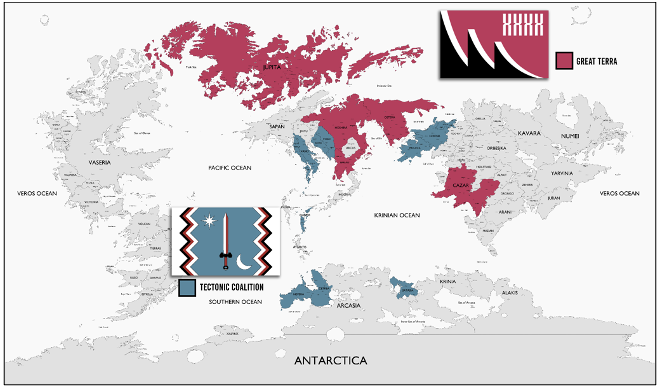
The Tectonic Coalition, despite suffering a humiliating defeat, stood alone against the return of Great Terra. Its leadership knew that an imminent attack was near, but where would it be? General Beck Vernard of the Molivian Army, believed that there would be an imminent invasion of Moliva from Hoshira, Oanoran Admiral Fefa Kemit, believed that a naval invasion was imminent for Pavlovia and Luxona, and others would follow the same idea.
The idea that the impending invasion had to be on allied territory, since it was the only logical decision they would make, was all they could come up with, but they failed to realize one important thing about Great Terra. Great Terra sought the whole world.


 Plaid Line + PRIZM + Scottie News