

By Trump Vang
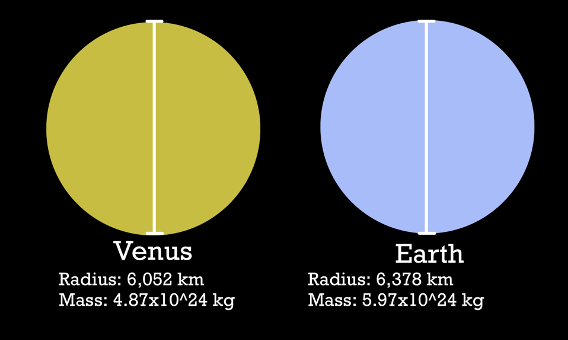
Venus is the second planet from the Sun, neighboring both Mercury and the Earth in its orbit. For the second planet in the solar system, Venus is quite the large terrestrial planet in our system. Its size and mass are roughly the same as the Earth’s and many call the planet the “Earth’s Twin” due to these physical aspects. Though looking deeper, it’s easy to see the differences between the two celestial bodies.
As of today, and even in ancient times, Venus is the second brightest object in the night sky, after the moon. In the past, many astronomers and scientists believed that Venus was a good candidate for life, though their assumptions were wrong. If you didn’t know, Venus has a thick atmosphere that obscures its surface and conditions. With their limited technology at the time, Venus’s atmosphere was able to conceal the planet’s secrets, and make astronomers believe that it could be like the Earth.
All of these thoughts changed when a space probe was first sent to the planet though. In 1970, Russia rocketed a space probe, by the name, Venera 7, to Venus to gather more data on the secretive planet. Despite many people’s beliefs, photos were captured, showing a yellow and orange wasteland covering the planet, disproving any hopes for life. The probe would only last 23 minutes before it was ultimately destroyed by these harsh conditions.
Upon first view, Venus is a yellow planet, covered by a thick atmosphere. Many may think that the planet is a paradise, though the reality is much harsher than most people’s imaginations. Below the thick atmosphere is a hellish landscape and environment. Temperatures can reach, on average, 867 degrees Fahrenheit, or 464 degrees Celsius; it’s enough to melt lead. Moreover, the atmospheric pressure on Venus is 90 times greater than the Earth’s. These conditions on Venus make it much harder to imagine that life actually lives on its surface. With the oppressive heat and pressure, it is impossible for components for life to exist.
Looking at the history of Venus, the planet had possibilities in hosting life itself. Just like the Earth, it had the proper conditions for sustaining life: Good Temperature, Size & Mass, and Organic Material. As the sun grew in its infancy, it became much wilder and much hotter in the process. Since Venus is 30% closer to the Sun than the Earth, its temperatures are higher than on the Earth. Through this and some greenhouse gasses on Venus, the planet exploded in temperature, leaving it to what it is today.
As of today, the planet is still the same with its temperatures and its deathly environment. Though further research has suggested that life may still exist on the planet, just not on its surface. The possibility of life expands, when Venus’s atmosphere is brought into the conversation. There is a specific area within Venus’s atmosphere that provides a warm and prosperous environment for life to flourish within, though no confirmed life has actually been stated to have been found there.
The future looks bright for Venus exploration, especially as many missions have been planned to go there, NASA plans to send two space probes there in the next decade, and ESA is planning to send another one to the planet.
On the surface, Venus is Earth’s Twin in many aspects, though looking deeper both of the planets are highly different in their own ways. Venus is a hellish landscape with high temperatures, while the Earth is a place of flourishing life and comfortable temperatures. As we continue to learn more about the planet and its conditions, we can learn more about its possibilities for life and the future of our own planet.
For more information, please visit:


 Plaid Line + PRIZM + Scottie News