Sections track meet

By: Ellie Moore

Highland Park had an eventful section meet last week.

Wednesday was the first day of the meet when all the prelims would occur. Friday was finals where only the top 9 from prelims in each event raced. In the finals, the top 2 would advance to the state meet.

Wednesday had only 1 final race, the 3200. The boys and girls both raced the 3200, and they were both exciting races.

The girls raced first. Grace Lewis-Mosher, Chloe Koch, and Alice Rapacz were the Highland Park girls in the race. Lewis-Mosher got 4th, Koch got 5th, and Rapacz got 9th, all running strong and fast races.

The boys 3200 was the next race. Gavin Roberts, Ben Martin, and Tim Tzeutschler were the Highland Park boys in the race. Roberts ran a strong race, getting 2nd and qualifying for state. Martin close behind taking 3rd, and Tzeutschler got 11th.

The next race was the girls 100m hurdles prelim race. Yao Buchl got 10th, Austin Bailey-Zimmerman got 15th, and Nuria Rodriguez-Foster got 16th.

The boys 110m hurdles was next. Wesley Norquist and Emmett Riemenschneider got 7th and 8th, qualifying for finals. Johnny Xiong got 13th.

8th graders Harper Frank and Norah Hoglund did the 100m dash, getting 29th and 33rd.

For the boys, Brouke Brookins got 2nd, qualifying for finals. Terez McDaniel-Vaughn and Jvion Giles were the other boys in the 100 for Highland Park, getting 14th and 18th.

The girls in the 400m dash were Ellie Moore, Ellie Pundsack, and Evelyn Beaumaster. Moore made it to finals, and Pundsack and Beaumaster got 15th and 20th.

In the boys 400m dash there were only 2 boys. Sam Cocchiarella and Monaire Vaughn, placing 13th and 16th.

Austin Bailey-Zimmerman and Yao Buchl did the 300 hurdles, placing 10th and 12th just barely missing finals.

For the boys, Emmett Riemenschneider got 4th making it to finals. Wesley Norquist and Johnny Xiong got 19th and 24th.

Delia Johnson and Madeline Klevay ran the 800 and qualified for finals. Eleanor Osmond got 16th.

Jack Douglas, Lance Georgeson, and Pierce Baum ran the 800 for the boys. They placed 11th, 13th, and 16th.

The last event on Wednesday was the 200m dash. Ellery Merrimack and Alexa Ramirez ran it for the girls, placing 15th and 22nd.

Jvion Giles, Sam Schlukebier, and Shawon Easley ran the 200 for the boys and got 12th, 18th, and 22nd.

Friday started with the 4×800 relay. Where the Highland Park girls placed 3rd barely missing making it to state. The boys got 4th in a fast race.

The next race with Highland Park athletes was the 110 high hurdle race. Emmett Riemenschneider and Wesley Norquist got 7th and 9th in the final.

Next was the boys 100m dash where Brouke Brookins ran a 10.95 To get second and qualify for state.

In the 400 finals, Ellie Moore got 2nd to qualify for state.
In the 300m hurdles finals, Emmett Riemenschneider got 9th place, with a PR. Delia Johnson won the 800 and qualified for state.

The last race was the 4×400 meter relay. Both the boys and girls team made it to state. The girls getting 1st and the boys getting 2nd.

Paganism vs Satanism

By: Ren K. and Violet H.

Image created with Wonder

Right off the bat, we want to say that these two are not the same. In the past, ANYTHING other than Christianity was labeled as satanic or evil. Today however, we’re able to differentiate between the two with an open mind.

Now, most people associate the pentagram or pentacle (it goes by a couple names) with the devil and the occult. But if one were to look into its past, they’d discover that it has an entirely different meaning: it symbolizes a deeper connection between spiritual levels of oneself and/ or with nature. Satan’s cross is actually entirely different (it’s also not just an upside-down cross; the movies lied to you). Look it up once and there’s definitely a difference.

Looking more specifically at paganism, the practice has evolved over time, although its base values remain the same: it is a practice rooted in nature and the natural world. In the past, it was more commonly practiced as Wicca. The two separated a little more over the years, with Wicca now recognized as an official religion. It’s a practice that is heavily influenced by nature and especially apothecary, whereas paganism is more about the mind and finding yourself.

Moving back to the idea of satanism’s relationship to paganism, there is none.

Yes, paganism can involve “witchcraft”, but not always. That stereotype is what links the practice to satanism, and it’s entirely unfair. Many pagans do practice some version of the craft, but it is primarily about finding yourself and achieving a higher state of being.

And the thing about paganism is that it’s so moldeable. You can believe in whichever gods you want to (as well as however many you want to), or you can not believe in any gods. Many people believe in mother nature as a force of guidance, and some believe in the universe as a conscious entity. Some believe both. Others don’t believe in either. It’s a practice that you can truly personalize to fit your needs and beliefs, and overall is just another way of finding yourself.

Even then, satanism is less of worshiping Satan over the Christian God, but more of a symbolization of individualism.

The biggest problem we have today as a society of free religion, is that some practices have become trendy or considered cool and fashionable. Some treat them simply as aesthetics and publicly present only the superficial information they consider interesting. This leads to a lot of misconceptions and misinterpretations of religions that many people practice seriously. It can also disrespect religions and surround them with new stigmas or stereotypes, which help no one at all.

Satanism is the renegade Christian’s acceptance of the religion’s duality of good and evil. They choose to worship the anti-God, representing evil in the world, but still take on Christian worldviews.

Neo-paganism is the modern version and revival of the past pagan practices, which don’t exactly see the world in black and white, or as good and evil. The religion is more centered on the sacredness of all living thing as well as nature, as was mentioned previously.

Another branch off of paganism and related practices is Shamanism, commonly known as witch doctors or simply witches and warlocks. They’re similar to Wiccan practices as they focus their energies on learning to heal themselves and others through the powers of nature, herbal medicine, midwifery, spell casting, etc. They were most often (although not exclusively) women, leading to the portrayal of witches as old hags.

The way people were “proven” guilty of witchcraft back during England’s witch hunts was frankly very unfair and somewhat paradoxical. Aka: you couldn’t survive either way.

When someone (almost always a woman) was accused of witchcraft and worshiping the Devil, they would be bound at the wrists and ankles and tossed into a deep body of water. If they sank (which inevitably they would. Most women of the time were in fact incapable of swimming while tied up), then they were innocent. But then they’d drown, so it was never of any use to them. If they somehow managed to stay afloat (perhaps by holding their breath), then they were proclaimed a witch and burned at the stake.

The point of this information is to help others realize you can’t just accept the dominant narrative of any religion (or any other aspect of life) without having some part left out. Do your research, and learn to question everything around you.

For more information, check out these websites:
https://dailyiowan.com/2017/07/19/coltrain-satanism-and-paganism-are-not-the-same-thing/
https://www.sacred-texts.com/bos/bos574.htm

A brief history of axolotls

By: Isabelle Baidoo

Image created with Wonder

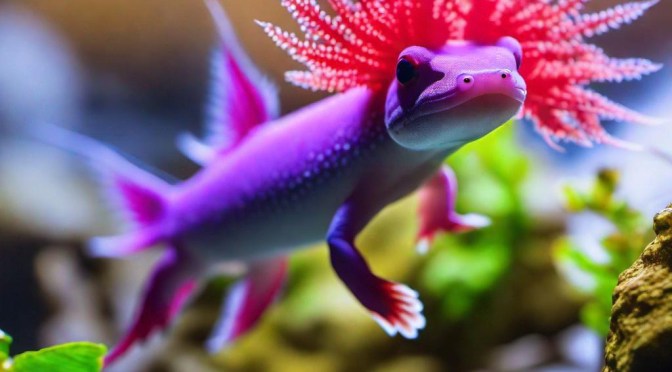
Axolotls have been on earth for roughly the last 10,000 years, inhabiting central Mexico. Much of their suitable habitat has been drained or dried up, so there are only two spring-fed lakes left that they can inhabit wildly. Axolotls breed very easily in captivity and quickly develop new colors and sizes.

They have feathery gills spouting from either side of their heads, webbed feet, a dorsal fin that runs down their body, and a tail. Although axolotls have gills, adult axolotls have functional lungs and can breathe through their skin. Axolotls are unique compared to other salamanders because they reach adulthood without going through metamorphosis. Instead of going to land once they’re fully developed, they remain aquatic and keep their gills.

These creatures have the ability to completely regenerate their limbs. Regeneration is initiated by injuries or wounds, but not all injuries result in limb regeneration. Small cuts, scrapes, or bruises wouldn’t result in complete regeneration but their healing time is much faster than humans.

Axolotls suck in their prey through their small smiling mouths, they eat crustaceans, mollusks, insect eggs, and small fish.

The pet trade of axolotls started from Paris, France in 1864 when Mexican traders brought axolotls to Europe, Europeans across the continent were intrigued by the exotic creatures. This led to the excessive breeding of axolotls in captivity.

The pink axolotls you commonly see as pets have been bred to be those colors; wild axolotls are mostly gray, brown, or black. Pink axolotls are extremely rare in the wild since they can’t camouflage well.

When keeping an Axolotl as a pet you must take into consideration that they prefer cool water. Their water temperature should be less than 70 degrees F. When feeding your pet, experts recommend you attempt to replicate its natural diet as closely as possible. You can do this by feeding them a combination of earthworms, brine shrimp, and daphnia. Daphnias are a small aquatic crustacean.