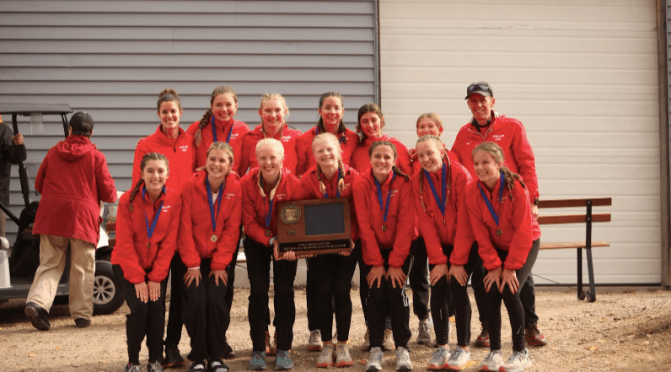
Highland Park punches two tickets to the MN state meet

By: Abby Altman

Photos courtesy of Jen Rusch 

A lot was riding on the Highland Parks Scots’ performance at the 2022 section 3AA meet. In the last 5 years, the boys and girls cross country teams at Highland have made several state appearances each. 2021 was perhaps the most successful state meet in Highland history. The girls team won the state meet, while the boys team came in third. 

2 years ago, Highland Park was moved down a section due to their school size, placing them into competition with teams slower than their previous section. Last year, this helped the team secure their spots at state with much less anxiety and stress. This year, the competition has increased, especially on the boys side. 

This year, Two Rivers, Highland Park, and St. Thomas Academy all finished the section meet within 10 points of each other. Two Rivers took 1st place, taking the first spot at the state meet, with 49 points. Highland was very close behind, taking 2nd place, and the final spot at state, with 51 points. St. Thomas Academy finished in 3rd place, just missing out on state, with 58 points. To put emphasis on how close these point totals are, the 4th place team finished with 130 points. 

In the boys 5K race, Highland had runners place 1st and 2nd, finishing just 4 seconds apart. Gavin Roberts cruised to the finish line in 1st place, with a time of 16:16. His teammate, Davis Isom, kicked hard right behind him, trying to ensure he beat the runner from Two Rivers, who finished 2 seconds behind Isom. 

Highland then had runners finish in places 12, 13, 23, 27, and 30. 

The boys team is ranked 4th overall in class AA. 

“There is only excitement going into state”, said senior Ben Martin. “We don’t have any expectations other than to have our best race of the season”. 

The boys team believes there are around 6 teams with a chance of winning, and they are one of them. “We know the race will be super close, and that just makes it more fun”, said Martin. 

Photo courtesy of Jen Rusch 

On the girls side of the race, the pressure wasn’t quite as high. The girls team has been ranked number 1 in class AA all season, and for good reason. They’re fast. 

The Highland Park girls took 1st place at sections this year, beating 2nd place Two Rivers 26-60. Luna Scorzelli finished 1st, 38 seconds ahead of 2nd place, with a time of 18:11. Delia Johnson, also from Highland, finished 2nd with a time of 18:49. 

Highland finishers took places 4, 9, 10, 16, and 24. 

Looking ahead to the state meet, Luna Scorzelli is ranked #1 in class AA, and Delia Johnson is ranked #8. Highland is the only girls team with more than 1 runner ranked in the top 12.

“There is definitely some pressure to repeat previous results this year. This can be super stressful, but it’s also super exciting”, said senior Delia Johnson. “I’m grateful to be on such a hard working and high performing team and I’m looking forward to showing everyone what we’re capable of”. 

Photo courtesy of Jen Rusch 

The state meet is on Saturday, November 5th, at St. Olaf college.   

MNUFC vs Dallas recap of playoff game, plus offseason preview

By: Aeden Evenson-McDermott

Following the last regular season game against Vancouver, the Loons were able to find momentum going into the Dallas game. The Loons would be asking themselves for more as it was a tough ask to win against FC Dallas. The first half started with the teams feeling each other out.

Both sides were evenly matched with Dallas and Minnesota each exchanging shots on net. Dallas maintained 60% of the possession but the Loons were able to hold their own thanks to a strong back line presence and incredible saves by goalkeeper Dayne St. Clair.

The first half ended in a 0-0 draw with both teams asking for more. It was certainly an entertainer for fans to take in.

In the second half, both teams would exchange chances near the goal. The combination of higher intensity and aggressiveness would be key to the rest of the match. This would lead to the greatest opportunity of the game in the 53rd minute when Bongi Hlongwane dribbled into the box and dished the ball off to Emanuel Reynoso for an incredible left foot finish into the bottom of the net.

But in the 64th minute, Dallas was able to get a goal of their own off the corner kick from Matt Hedges to be headed into the goal by Facundo Quignon, 1-1.

Goalkeeper Dayne St. Clair played quite well and made numerous saves throughout the game. After the 90 minutes of full time, the match would head to 30 minutes of extra time. Both sides did a few substitutions in order to get fresh legs into the game. Both teams went back and forth and none could break the deadlock.

With the end of the additional 30 minutes of extra time, the game would be decided by penalty kicks. This would ultimately determine the fate of the Loons 2022 season. Dallas converted all five of their penalties while the Loons got four out of the five and Captain Will Trapp missed his shot.

Another disappointing end to the season as the Loons appeared to have fallen short again. Hopefully next year will be better!

As for the postseason, the guys are off for a short period of time and will resume training in early January before the season starts in late February or early March.

With the FIFA World Cup coming up in late November, Dayne St. Clair will be with the Canadian national team but it remains to be seen if he will actually get any playing time.

As for the Loons, The off-season will come with new changes to the team personnel. A decent amount of players that were on the bench predominately will leave and begin new chapters. Many of the top players with the likes of Reynoso, Lod, and St. Clair will stay.

The new changes I expect to see will be a younger center back, more strikers as we need attacking ability, and more strength in depth for midfield as well, possible goalkeeper changes if Tyler Miller leaves the club too.

Looking forward to the next season and seeing how the club makes changes to further improve our team as we once again start over to make our playoff push.

Why I don’t like the reputation of Ivy institutions

By: Irene Cohen

Ivy league universities are apart of an athletic conference which consists of eight institutions: Brown University, Columbia University, Cornell University, Dartmouth College, Harvard University, the University of Pennsylvania, Princeton University, and Yale University. They are considered the most prestigious colleges that one can attend in the US, with the highest acceptance rate being 8.7% and the lowest 3.9%.

The Ivy league produces some of the most influential people in the world, such as Supreme Court Justices, whose members all attended either Harvard or Yale.

However, for the majority of the people who get into these Ivies, they did not get there solely out of merit. Many of those who get into the undergraduate programs attended preparatory schools, or boarding schools, that cost a small fortune. These schools are a sort of feeder school, helping students specifically to get into these schools and helping them with connections, something the average American high school doesn’t have access to.

With the Ivies and their feeder schools costing so much, you may be wondering how families afford this. The answer is, because they’re rich. The median family income for undergraduate families of Harvard students was 3 times the median US household income. Dartmouth disproportionately accepts wealthy applicants, with one fifth of their student body coming from the top 1% in the country. The top 1% are households that make $630,000 or more a year. They are one of the few schools in the nation that has more undergraduates from the top 1% than the entire bottom 60%.

As if that wasn’t enough, they accept legacies at a much greater rate than non legacy students. Those who are legacies, which is anyone with family members who attended these schools in the past, have up to a 5 times greater chance of getting into the school.

All these components of privilege leave a sour taste in my mouth. I think it’s extremely inequitable to consider these schools the peak of education when most US high schoolers have a very slim chance of getting accepted, regardless of how well they perform in school, their intelligence, or their work-ethic. This country needs to stop putting these schools on such a high pedestal.

For more information, please visit:

We should be using Chromebooks, not iPads

By: Ava Bird

For us students, using iPads for school every day is what we’re used to. And many of us are perfectly okay with it. But there are also those who recognize the downsides that come along with using iPads for our learning – and there are a lot of downsides. 

First of all, almost every mobile application is different from its desktop counterpart, and when on a Chromebook, this is usually beneficial to the user.

For example, on the desktop version of Duolingo, you don’t have a limited amount of hearts; in fact, hearts aren’t even a thing, meaning that you can make as many mistakes as you need to without purchasing a “Super” membership (previously known as “Plus”). 

Another example is Schoology. On Chromebooks, students have a better, somewhat more advanced version of Schoology that is more organized and has more functions than the iPad version. One of these functions is how you can edit Google Doc assignments without even leaving the schoology app. There is a “My Document” button, which allows you to view and edit a teacher-created Doc, whether it be open-ended writing or a fill-in-the-blanks study guide, directly from Schoology. If you wanted to open the document from the Google Docs website instead, there’s an “Edit” button which allows you to do so. Any document opened via Schoology automatically saves under your Google account. 

On the iPad version of Schoology, on the other hand, there’s a button which allows you to create a written submission, but you can’t see the directions for the assignment while editing it, and you can’t easily go back and forth between the directions and your writing. And this isn’t the only part of Schoology where iPads don’t compare; there’s so much more, but it’s best to just leave it here.

Another thing that makes Chromebook usage much simpler than iPad usage is how, in most cases, everything you need to do can be done from your browser. This means that everything is right in front of you, and nothing will get lost behind layers and layers of forgotten apps and websites. If you’ve never used a Chromebook, it may seem like having too many tabs open at once would result in confusion and lack of organization, but there’s actually a very simple way to group tabs into different subjects or categories. 

Grouping tabs compresses the selected tabs into a folder of sorts, which you can then name and color code to your liking. For example, you can have a yellow tab group labeled “History,” in which you can store all of your tabs from that class; a blue tab group labeled “English;” and a green tab group labeled “Science.” The tab groups don’t even have to contain class materials – you could also have, say, a purple tab group labeled “other,” which might contain random things such as a Google search, a Netflix show, and the daily sudoku. For many people, however, grouping tabs isn’t even necessary, since there is a large enough view to contain a good amount of tabs.

If you’re worried about not being able to draw or take handwritten notes on apps such as Notability, or if you simply like having a touchscreen, that’s no reason to keep using an iPad; there are Chromebooks with touchscreens. And, unlike iPads, use of the touchscreen isn’t even necessary to perform the functions that your flimsy iPad keyboard/case can’t. Plus, it’s really nice to have a built-in keyboard mouse. 

There are some iPad apps that don’t have web versions, like Notability, but you’ll soon find that apps like that are easily replaceable. Notes can be printed and handed out to students, taken on paper or in a notebook, or shared via Schoology or through a Google Document. The same can be done for worksheets, and many people appreciate the occasional hard copy, as it helps maintain the handwriting skills that are vital to everyday life. There are also apps that are similar to Notability, such as Google Keep, which allows you to take notes in a way that is similar to Notability. But even so, once Notability and similar apps are taken out of the equation, many will find that they are easily replaceable or not even a necessity in the first place.

There are so many more reasons why we should be using Chromebooks instead of iPads, and I could go on and on about this, but here’s the bottom line: It’s time to stop pretending that iPads are the best option for our education. They’re not.

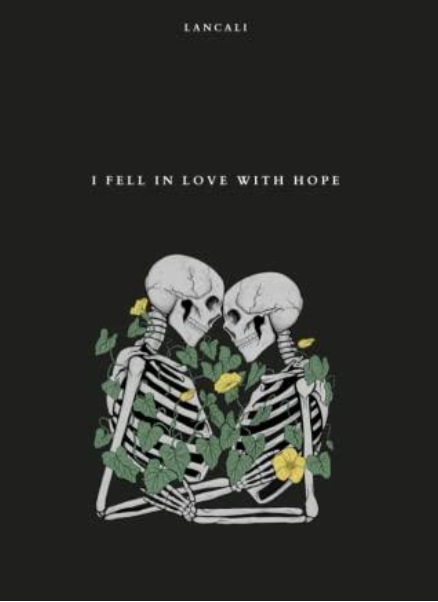
A review of ‘I Fell In Love With Hope’

By: McKenzie Welch

‘I Fell in Love With Hope’ by Lancali, which is a pen name that the author writes and promotes under, is a book about learning how to hope again in a setting clouded with doubt and despair. It is a realistic fiction novel with moments of magical realism tied in. The novel itself is representative of many different types of people, such as disabled people, gay people, and non-binary people, to an extent.

The book takes place in a hospital, and the five main characters are either always in and out of the hospital, or have lived there for the majority of their lives. They all have differing chronic illnesses that affect their way of life, but they find the strength to make it through difficult situations by sticking together. Their names are Sam, Neo, Sony, Hikari, and Coeur, and their personalities are very unique, which makes it so many different readers can see themselves reflected in different characters.

The novel itself is very character-driven, and does not have a plot that is substantially controlled by climactic events. Because of this, the words have to be laid on the page in a way that is captivating to the reader. The sentences themselves are beautifully written, shown in the line, “Our words fold over each other, dance together as our hands mimic them, act them out, that comfortable, ruinous distance the only thing keeping her mine, ghostly, unreal” (Lancali 64). However, nearly every sentence is written in this style, which inevitably takes away from the impact a line like this should have had.

Also, because the plot is so character driven, you would imagine that the characters would be easy to connect to. I imagined that, and I was proven wrong. I had difficulty connecting to any of the characters in the novel, which made the novel pass incredibly slow at times. The characters do not have much depth, or if they do, the depths of their personalities are not well explored.

Next, the representation within the novel is done well for the most part. Four of the main characters have disabilities that affect their quality of life, and Lancali writes about both the good days and the bad. The author does not make an attempt to sugar coat something that shouldn’t be sugar coated. There is also a relationship between two male characters, and a relationship between a female character and a non-binary character.

The only thing in the novel that lacks in representation is the non-binary aspect. As I was reading, I did not know that the narrator was non-binary until the last quarter of the book. They are never referred to in the third person until that point. Because the book is largely advertised as being representative of non-binary people, I think that aspect could have been better executed.

All in all, I give ‘I Fell in Love With Hope’ 3⁄5 stars. The novel has a very good concept, and even an unexpected plot twist at the end, but the base of the story. and the story itself. could have been structured differently in order to make it easier to read. I also believe that the writing could have been less extravagant at times in order to make the well-thought out sentences more impactful to the story. However, I do believe that if you value representation in novels and enjoy character-driven stories, you should give this novel a try.

JOYSTiCK Ep. 2: ‘Cuphead’: Hand-drawn dominance

By: Daniel Kendle

When ‘Contra’ meets Oswald the Lucky Rabbit, I guess.

Hello, and welcome to JOYSTiCK, the HPSH serial that enjoys reviewing and exploring video games. This episode is of ‘Cuphead’, a 2017 indie game that has become one of the most popular of it’s category in the last half-decade, partially being that it’s the only known video game to be entirely made up of hand-drawn cell animation, rather than digitally-drawn, CGI or other forms. But is ‘Cuphead’ a shining example of gaming? Let’s take a look.

‘Cuphead’ was created by brothers Chad and Jared Moldenhauer, who were not video game developers at first, but then jumped to making the game after their recollections of games as kids. Reportedly, the first iterations of ‘Cuphead’ were based around a “school grade” aesthetic, with the game progression also having you move up in grades and art style. Eventually they went with a “rubber-hose” style after their friends saw them use an old 1930’s cartoon character as a stand-in for an actual game model. And then after that, they created Studio MDHR.

To talk about rubber-hose animation, it defines cartoons such as Betty Boop, Popeye, Oswald the Lucky Rabbit and other Disney and Fleischer Studios work. It gets its name from the rubbery, unrealistic animation in most shorts. These are some of ‘Cupheads’s’ main influences, but the other prominent one is of “Run n’ Gun” games from the 80’s and 90’s, like ‘Super Ghouls n’ Ghosts’ and ‘Megaman’. These titles were normally difficult, grind-centric games that had players face off against bosses and enemies, focused around dodging attacks first and dealing damage second. They rewarded muscle memory and quick reflexes, as players would normally spend a good amount of time learning bosses’ movement and attacks in order to win.

‘Cuphead’ was first introduced in E3 2014, in a short trailer that didn’t feature much, except the art style chosen. Even with the relatively-small amount of info, the game was a highlight of the Xbox press showcase. The game had periodic updates shown until eventually releasing September 29, 2017. It was very well received, with over 1 million copies being sold within its first 2 weeks on the market. Its art style, difficulty, and gameplay were praised, and the game has been running smoothly ever since, selling 6 million copies by July 2020.

PART ONE: GAMEPLAY

‘Cuphead’ is, as stated previously, a Run n’ Gun game, where the player has to shoot targets and enemies whilst dodging attacks. ‘Cuphead’ is divided into 2 different types of levels: boss levels and platform levels.

The main focus of ‘Cuphead’ are the bosses. The game is one big Boss Rush, with most levels being where you have to fight a powerful enemy with multiple stages. The game is a VERY challenging game, reminiscent of other games in the genre. Most of the game is you reattempting bosses and stages, though it’s not annoying most of the time. In fact, defeating a level is incredibly satisfying!

The game’s moral of “tough but fair” lets the game designers not have to create bosses that scale with difficulty, if by only a little bit. They instead mold them around the idea of muscle memory and skill, the way a player proceeds through their journey being of their might rather than of a scaling difficulty. This is something other famously-hard games practice, like ‘Dark Souls’.

But diving into actual play, ‘Cuphead’ has someone shooting projectiles out of their fingertips (More on this in the Story section). There are 9 different types, each with different values and properties.

  • The Peashooter is your basic shot, the one given to you at the start of the game.
  • The Chaser is the weakest, but can track a target around and hit them without needing the player to aim.
  • The Spread has great damage in a small radius in front of the user, so it’s good for close-quarters combat.
  • The Lobber shoots gravity-affected balls that bounce on the ground.
  • The Roundabout is like a boomerang in that it loops back after firing it, so you’re able to hit something even when your back is turned.
  • The Charge has a short charging time (duh) between shots, but does the most damage out of any weapon. It’s also the only shot where you’re able to hold it without having to auto-fire.
  • The Crackshot is arguably the best shot. Like the Chaser it follows targets, but also does a lot more damage and will do more damage by shooting an enemy before the shots break away to track and hit the target.
  • The Converge is a 3-way shot that narrows its flight path when the player is locked into shooting. (I’ll explain this later as well.)
  • Finally, the Twist-Up is the opposite of the Lobber, flying upwards instead of down.

Along with these shots are things known as Charms, little abilities that give Cuphead extra perks. These can range from extra hearts to a smoke bomb, from axe-parries to even more hearts! They mix up gameplay just enough that, like shots, can dramatically change how a boss fight plays out depending on what loadout you use.

While 2 shots can be equipped at a time, only one Charm is able to be.

But where do you get shots and Charms from? The shop, of course! The game has a traveling shop that can be found on 4 of the isles of which the game is played. Each item costs coins, which can be found in the platform levels, each with 5 coins each. I enjoy having to buy your power ups; ‘Cuphead’ isn’t exactly the type of game to have power ups within the levels, there’s only 6 platform levels along with the 34 boss fights, so there just wouldn’t be enough space to level out the progression if shots and power ups were inside the levels themselves.

Speaking of which, let’s talk about the platform levels. Each has unique theming and gameplay, with some focusing on different mechanics entirely. While the bosses have you shooting them up until they eventually run out of health, platform levels have you reaching an end goal. And honestly… they’re fine.

We’ll get to the bosses soon, but with the 6 platform levels, they feel like they have less of that “grandness” of the rest of ‘Cuphead’. While fine in their own right they feel more like afterthought than a mainstay of the game. They follow a linear progression, with you more or less traveling right while shooting enemies. No big baddies, no interesting concepts and ideas, just… eh. They’re alright, but “alright” isn’t cutting it for a game like this.

The main characters Cuphead and Mugman also are okay to control. Since the main game revolves around shooting, having the player be able to shoot in multiple directions is an obvious addition. However, hand-drawn animation is extremely time consuming, so animating hundreds, maybe even THOUSANDS of different poses would’ve taken forever. Instead, it was decided to only have players shoot in 8 different directions: forward, backward, up, down, and diagonal versions of all of them. This is VERY janky; I found myself more often than not shooting forward only, elevating and de-elevating if needing to shoot up or down respectively. This is very awkward, and doesn’t work very well. It’s a moment where it feels like the art direction and game design clash, making a worse experience.

‘Cuphead’ has a ‘lock-in’ mechanic that lets you access this 8-way shooting. When holding down the respective button, you’ll be locked into place, allowing you to aim as you fire using what you would normally use to run. This is also bad to control, as ‘Cuphead’ is a game where you need to be constantly moving around in order to dodge attacks, and having a button lock you in place is disorienting to the rest of the game, sorry.

PART TWO: BOSSES

‘Cuphead’s’ bosses are arguably some of the best in the business, in my opinion. They ALL have some of the best quality in gaming, with snappy combat and powerful attacks that combine with their incredibly creative concepts. There’s too many to list like from my last review on ‘Metroid Dread’, so I’ll simply mention some of the best and most interesting of the bunch.

Bosses in the game all have generally whimsical and fun ideas, just like how the 1930’s style of animation had very crazy and loony settings and characters. I feel like this gives them a distinct appearance when compared to another game’s enemies. Overall, I love this game’s bosses, for they feel like creations that remove themselves from the mold of the rest of the gaming industry’s blueprints.

There are 2 bosses that I’ll consider “Tutorial” matter, though I’ll only be talking about one: The Root Pack. Made up of 3 mean vegetables, they’re essential in teaching the player the 3 main ways attacks try to hit you, and how to dodge: jumping up and down, moving left and right, and a combination of the two. And the fights are fun too! I’m glad that they made the first bosses to the same standards as further fights, showing the complex polish of the bosses.

Another is Cagney Carnation, one of the most iconic characters in ‘Cuphead’. The flower’s fight is also great fun, with raised platforms and more challenging attacks to avoid. They also introduce the idea of bosses changing form, with him eventually turning into a tangle of weeds and barbs by the end of the battle. A fantastic fight; one of my personal favorites.

Moving farther up the ladder is my favorite boss in the game, Werner Werman, this German tank pilot who controls a giant mechanical cat in his fight. I don’t know why, but this fight is just so fun. I like the idea of having a smaller scale fight (literally) and have the two be the size of actual mice. I don’t know if this is controversial, but this is my favorite boss in the game, personally.

Finally, let’s talk about the final boss: the Devil. He’s one of ‘Cuphead’s’ hardest fights, and for good reason. You’ve made your way all the way to Hell, and he’s certainly fit for his kingdom. The fight’s chaotic and eerie, but man, defeating him is satisfying as all heck, and comes to make you realize what you’ve just done: beaten the game. While I do think that some of his attacks feel a bit RNG-based, the Devil’s a great way to end the main game. And speaking of the Devil…

PART THREE: STORY

I didn’t touch on ‘Metroid Dread’s’ story due to it being the final entry in the main Metroid saga, and I didn’t want to spoil anything. ‘Cuphead’s’ story is much more simple, and pretty easy to figure out. It’s not a detriment to the game though; I like having a more basic plot compared to other games having complex, moving narratives.

Cuphead and his brother Mugman are two kids who one day come across the Devil’s Casino. After gambling for a while they find themselves on a winning streak, to which the Devil notices and gives them a wager: if they can win their next roll, they get all the casino’s riches. If not, the Devil gets their souls.

Mugman doesn’t want to spread his luck dry, but Cuphead blindly rolls again. Of course, he gets snake eyes, and the Devil now gets their lives. The boys beg for mercy, and the Devil admits he’s gone too far… before tasking the 2 to go out and bring back the souls of those who owe him theirs.

Not knowing how to get others’ souls, they go to their grandfather Elder Kettle, who gives them a magical potion to let them shoot lasers out of their fingers. Eventually, after using their powers to defeat all the bosses (debtors) Cuphead and Mugman storm into the Devil’s casino again, and after beating his lackey King Dice, defeat the Devil as well, and free the debtors from the demon’s grasp, ending the story in a happy light.

Like I said, the story’s not very complex, instead feeling like something an actual Disney short would be about. I like it, though I do feel like we don’t see the bosses outside of battle, and now knowing them to be the debtors the boys have to beat it would’ve been pretty cool to see them after the main game is done, and maybe be able to talk to them and stuff.

PART FOUR: GRAPHICS

I mean, what is there to say?

‘Cuphead’ is arguably one of the best looking video games of the past few years, and possibly even of all time. Its unique hand-drawn animation style lends itself to some gorgeous graphics and fidelity beyond anything of recent memory.

One thing I noticed is that it feels like something straight out of a Disney cartoon. The backgrounds have such a warm feeling, I wish that I could look at them without having to be constantly sweating through the boss battles!

Oh, and the animation! It’s SO good. Studio MDHR used a type of animation called “Squash n’ Stretch” to animate moving objects, which basically means that a lot of frames exaggerate and contort frames of things to feel more fluid-like, which gives everything such a fascinating appearance that hasn’t been seen in many other games. It was practically eye-candy to myself, someone who loves animation in movies and cartoons. Great work all around.

There are some blips in quality here and there. Some bosses feel a little more constrained and bland compared to the animation of others, the same going for standard enemies and other sprites. Occasionally there’s some landscapes in the game without the polish seen in others. What I’m getting at here is that the few problems I have in the graphics department mostly come down to fluctuating art and standards seen in it. I’ll admit it, some places in the game look better than others. Whether that’s the art direction’s fault or the area’s theming, it’s still an issue nonetheless. But still, this game looks like some kind of blessed artifact from the 1930’s that ironically holds up greatly 5 years later.

PART FIVE: CONCLUSION

‘Cuphead’ is a great game. It’s snappy combat, beautiful visuals and – while not mentioned – great music makes it an awesome game to explore and play. However, some issues do arise, like boring platforming levels, semi-inconsistent graphical quality and clunky controls. For this, I think ‘Cuphead’ is a solid 8/10. While it does flub in some areas other games don’t, this is a great package, and deserves the recognition it has received, and hopefully will continue to gain.

That’s all for this episode of JOYSTiCK, and I hope you’ve enjoyed it! I plan on doing other indie games soon, so if you’re into that, make sure you stick around and not only check out my work, but other people’s as well.

Rating Halloween costumes

By: Stephanie Caballero

Candy, spooky decorations, and scary movies! Who doesn’t love Halloween?

Don’t forget the costumes, the best part about Halloween is dressing up! Dressing up gives people the opportunity to bring out their creative side. Some people choose to become something that interests them, others choose to go all out on the spooky theme. The most important part is that everyone has fun coming up with the costumes. Here are some of the costumes this year and that I will be rating.

Maitreyi Ramakrishnan

Maltreyi is known best for her role as Devi in the Netflix series ‘Never Have I Ever’. Maitreyi’s costume this year was very original as she chose to be the Energizer Bunny from the Energizer battery brand. Her creativity and originality with this costume is very unique as you can tell it was probably put together by herself, I however enjoy costumes that have lots of details. I would give this costume a 6/10. 

Camila Mendes, Lili Reinhardt and Madelaine Petsch

These actors are known for their roles in Netflix series ‘Riverdale’; Betty, Veronica, and Cheryl. For their costumes they chose to come together and follow one theme. Their theme was the famous movie ‘Hocus Pocus’ which came out in 1993. Dressed as the three Sanderson sisters. They went for the spooky theme this year. I would give their costumes a 8/10.

Paris Hilton  

The star Paris Hilton is known for her family’s reputation and music. This year Paris dressed as Sailor Moon. The character Sailor Moon is from an anime popular amongst anime fans. I think that her costume is not as original as the others but it’s definitely unique as she is one of so many to do something from an anime. I would give this a 7/10.

Heidi Klum

Heidi Klum, a judge from one of the biggest shows ‘America’s got talent decided to do something very different this year. Heidi dressed up as a giant worm, and not those cute worms, no. This worm shocked and spooked most, she was a very realistic and detailed 6 foot worm. I would give this costume a 10/10. It was unexpected and very scary.

Overall, there were some really new and unique costumes this year, but there really wasn’t much of the spooky theme.

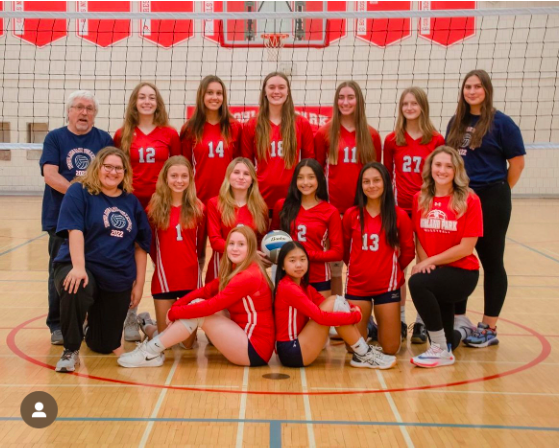
Highland Park vs Central volleyball

By: Grace Blumer-LaMotte

Image taken from: HPSH Volleyball Instagram

Highland Park High School went against Central High School in volleyball on Thursday, October 6th, 2022. C-Squad and Junior Varsity played at 5:30 pm, while Varsity played at 7 pm.

All 3 teams of Highland won against Central that night. 

Varsity formally goes to 5 sets, if needed. The first team to win 3 sets wins the match. Highland lost the first set but came back strong and won the next three sets, leading them to victory. Almost all of the sets were very close, only having a few point differences.

Varsity consists of these players: Grace Blumer-LaMotte (Senior), Grace Adrian (Senior), Sunshine Vang (Senior), Bella Kottke (Senior), Ayana Bougie (Senior), Leila Hagedorn (Senior), Kate Reubish (Junior), Alyssa Ramos (Junior), Molly Hanley (Junior), Ella Johnson (Junior), Mary Kock (Sophomore), Ella Sutherland (Sophomore). 

Bella Kottke, the middle hitter of HPSH, had a huge thirteen kills. Mary Koch, another middle hitter of HPSH, had hit .500. Molly Hanley, an outside hitter, led the team with four aces, with three in a row in the third set. Ayana Bougie, the setter, had seventeen digs. Molly Hanley and Alyssa Ramos, the HPSH libero, both had fourteen digs each. Kate Reubish, a hitter of HPSH, and Ayana Bougie had zero service errors. Bella Kottke also led with five big blocks at the net.

The whole team served with amazing accuracy of 92.3%. The team also had a hitting percentage of .210. 

The student section was growing as the game went on. There were a good hundred students in the bleachers. The theme for the game was “White Out” due to the school colors of Highland Park Senior High, red and white. The student section shouted and cheered for all of the small victories during the game such as kills, digs, blocks, etc. They would chant various different things like “We Are The Scotties, The Mighty Mighty Scotties”, “Scoreboard”, and just overall cheering for certain players. Once the Scots won against Central the student section swarmed the court and cheered on the whole team. 

Image taken from: https://www.ablphoto.com/

On Thursday, October 13th, 2022, Highland Park Senior High took on Central High school at Central for a second time. C-Squad and Junior Varsity played at 5:30 pm, while Varsity played at 7 pm.

All 3 teams of Highland won against Central that night. 

Varsity formally goes to 5 sets, if needed. The first team to win 3 sets wins the match. Highland lost the first set (21-25) but came back strong and won the second set (25-18). It went on for another 3 sets, Central winning the fourth set (21-25) and Highland winning the final set (15-12), leading them to victory. Almost all of the sets were very close, only having a few point differences.

Varsity consists of these players: Grace Blumer-LaMotte (Senior, #10), Grace Adrian (Senior #12), Sunshine Vang (Senior #3)), Bella Kottke (Senior #18), Ayana Bougie (Senior #13), Leila Hagedorn (Senior #27), Kate Reubish (Junior #11), Alyssa Ramos (Junior #2), Molly Hanley (Junior #9), Ella Johnson (Junior 1), Mary Koch (Sophomore #14), Ella Sutherland (Sophomore #6). Varsity is coached by Sonje Odegard (Head).

Kill Stats: Bella Kottke, the middle hitter, led the team with 22 kills. Kills are when the ball hits the ground without anyone touching it. She also had a hitting percentage of .326. Kate Reubish, a right-side hitter, had 15 kills. Mary Koch, another middle hitter, had 11 kills. Molly Hanley, a right-side hitter, had 7 kills. Ayana Bougie-Martinez, the setter, had 5 kills. Finally, Ella Sutherland, an outside, had 3 kills. Overall the team had 63 total kills.

Serve Stats: Alyssa Ramos, the libero, had 8 serve aces. Serve aces are when either none of the players touch the ball when it goes over the net, or if someone shanks the ball off of first contact. Ayana Bougie-Martinez had 4 serve aces. Molly Hanley had 3 serve aces. Sunshine Vang, a defensive specialist, had 2 serve aces. Overall the team had 18 serve-aces.

Defense Stats: Alyssa Ramos led the team with 22 digs. Bella Kottke had 18 digs. Molly Hanley had 12 digs. Ayana Bougie-Martinez had 8 digs. Sunshine Vang had 7 digs. Kate Reubish had 4 digs. Ella Sutherland and Mary Koch both had 2 digs. Overall the team had 75 digs total.

Overall, volleyball team dominated Central this year.

iPhone VS Android

By: Semaj Carter & Jhari Boayla

Android:

So, we all know about the debate about whether iPhone or Android is better. This debate has been going on for almost a decade and I’m going to show the good qualities of Android.

Firstly, the phones have more storage and the battery life lasts a lot longer than iPhones. The newest iPhone is the iPhone 14, which has the same qualities as the iPhone 13. According to an Apple developer, “The iPhone 14 features the same A15 Bionic chip that powered the iPhone 13 Pro and iPhone 13 Pro Max.” This means that the iPhone 14 isn’t that different from the iPhone 13 and there was no point in making a new one except for exploiting money from people.

Android doesn’t have a lot of good features, but it does have reasonable upgrades and isn’t as expensive as an iPhone. The creators of Android did not shut off older models as soon as they released a new phone to get people to spend more money on a phone that’s practically the same as the older model, just like Apple has done, and is still allegedly doing.

The iPhone’s price is ridiculous, just like every other Apple product that they release; the price range is usually over six hundred dollars and that’s a lot for a small box.

The developers explained how there is no difference between the two phones and therefore there was no point in an upgrade. Most ‘Android’ products get an upgrade with different features, but the developers are having trouble with the camera quality.

Although there are a lot of statements that support both sides of the argument, this is my reasoning why I think ‘Android’ is better. I hope this helped you become more knowledgeable about Apple products.

iPhone:

I feel like most people feel like and think that iPhones are better phones than Android. Most people from this generation, I would say, have iPhones and only a few people have Android. I would say that some things about the iPhone are good, but some things don’t go to an extent like how Android can.

iPhones are popular, almost everyone has one. It’s something that most people in this generation have because Apple is a brand that I would say is ‘popular’ to most, I would say it is because it’s been out for years now and the company is very successful in what they are doing. There are a few things that I don’t like about iPhones. I would say you should upgrade to a new iPhone every two years because you can’t do certain things.

Some of the things I do like about the iPhone are: Facetime, iMessage games, and Face ID. Facetime because it’s a way to stay in contact with family. iMessage, is good because it’s really easy to use. Face ID is nice because if you forget your password, all you need to do is show your face.

So, even though the iPhone is missing some of the things the Android has, it still has some nice things going for it.

*NOTE: This article is kind of biased and does not completely rely on facts, but instead more on the authors’ opinions.

ACT vs SAT: Why do we take them? Are they necessary?

By: Maya Breininger

The infamous ACT/SAT exams date back to 1959, and have been used to summarize a student’s academic ability. The question is: Is this an accurate measurement of a student’s capabilities, or is it a grueling task that we just assign to high school students?

A study done in New York City addresses the high levels of chronic stress high school students face daily. It tells us how mentally damaging the repetitive cycle of school can be for young students, and about how the system is fit to teach students who all learn the same way. The cycle of learning a topic, memorizing it, and writing down the information on a test is the daily stressful learning system that students endure every day.

Although there are many studies done suggesting that this is the most efficient and effective way to reach large audiences of children, there are opposing studies that express how vital it is to have interactive assignments that immerse the kids in the material.

Now, what does this have to do with the ACT/SAT exams?

Well, first you have to ask yourself a few of questions – What are the contents of the exam? Are the pages of multiple choice questions of topics that were briefly discussed during class time the best way to assess a student’s academic value? Are the “core class” sections of the test – made to prepare you for very specific and non-diverse career paths – truly reaching into a student’s brain and obtaining its full potential?

Disregarding the repetitive nature of the test, along with the questionable measurement of educational properties, the way that these test scores are used can be very harmful for individuals.

Now, anyone can argue that the tests are used by many colleges and universities as tools to filter their applications, but is it accurate? Can it harm the individual?

SAT scores – according to the website Collegeboard.org – are used to make decisions about admissions, by comparing students based off of their scores. This indirectly states that a 3 hour exam can accurately capture the knowledge of an entire student. By using the same sections and decisions, colleges assess who can make it through applications.

Consider these components the next time that you have a conversation about the SAT scores, or form an opinion of a person for refusing to take them. Besides the fact that your score could deter your dream college from your application, it’s also a good idea to survey the contents of the SAT, and find out if it’s worth an entire year of stress to young high school students who might not even all learn the same way.

Now that you’ve read this article, can you confidently state that SAT and ACT exams are an accurate assessment of student knowledge? Should a decision made in 1959 about the rules of education affect how colleges view your application information?

The way I see it, it’s not an accurate assessment of the whole student, and there are lots of better ways for colleges to determine if a student is a good fit for their school.

For more information, please check out these websites: